Historical Archive
The UFO Wave of 1896
California Reports, November 1896
Based on The UFO Wave of 1896 by Loren E. Gross (1974) • Published by the Interplanetary Space Travel Research Association
The wave of reported airship sightings began in Sacramento, California, in November 1896. On the evening of November 17, hundreds of residents described seeing a bright light moving through the sky. The Sacramento Bee and other newspapers carried the initial reports.
Witnesses near the Central Electric Railway Car House reported the light appeared to be attached to a dark body that moved against the wind. George Scott, who was at the State Capitol, observed a light moving at a considerable altitude. Multiple witnesses near the car barn area described hearing what they believed to be voices from above and the sound of machinery.
By November 20, the story had spread. A letter published in the Sacramento press complained that the mystery was damaging Sacramento’s reputation. The newspaper editor questioned whether the reports were a hoax, but the consistency of accounts from multiple independent witnesses across different locations made outright dismissal difficult.
Astronomer Swift and Earlier Observations
On September 20, 1896 — two months before the main wave — astronomer Swift observed something unusual in the sky. Mayor Adolph Sutro of San Francisco was also among the early witnesses who reported anomalous aerial observations before the main wave began.
Descriptions of the Craft
As days passed, witness descriptions became more detailed. Reports spoke of a dark, cigar-shaped or elongated body with lights fore and aft. Some witnesses claimed they could see what appeared to be wings or a rudder. The craft appeared to move with purpose, changing direction and altitude in ways that were inconsistent with known balloon technology of the era.
The Attorney Collins Episode
San Francisco attorney Collins claimed to represent the inventor of the mysterious airship. Collins told reporters that the craft was real and the product of years of work by a brilliant inventor, and that a public demonstration was forthcoming. He made increasingly elaborate claims, stating the airship was growing larger and expanding in size. He was quoted making cryptic statements about the craft’s capabilities. He brought reporters to a vacant stand near the airship’s supposed construction site, though nothing was revealed.
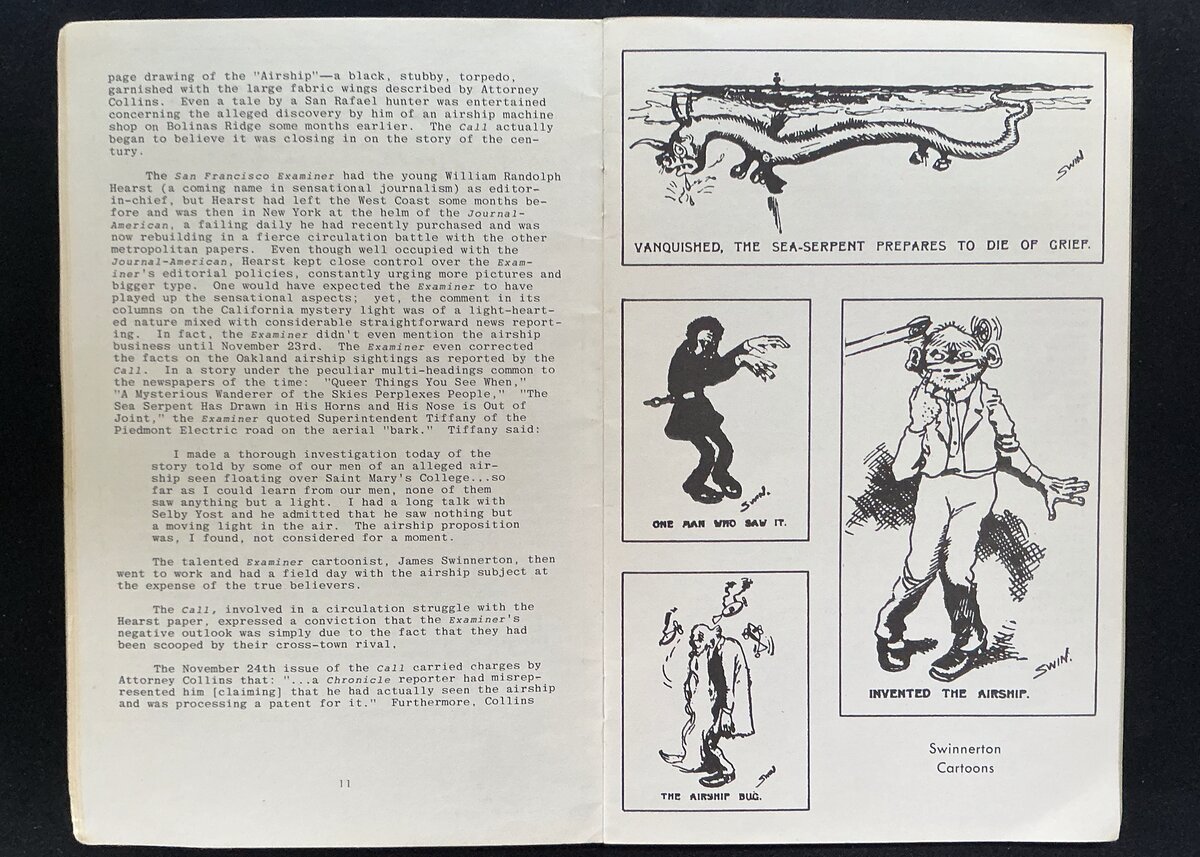
Newspapers with access to Collins — particularly the San Francisco Call — initially treated his claims with guarded interest, while rival papers like the San Francisco Examiner were more skeptical. Collins’s involvement added controversy. When he was unable to produce the inventor or the craft, his credibility collapsed. Dr. Benjamin, who had apparently been hired to lend scientific respectability, eventually withdrew. The Collins episode served to complicate the reports, but the sightings themselves continued independently of his claims.
Spread Across California
The wave did not remain confined to Sacramento. By late November 1896, sightings were reported from cities and towns across California.
In Oakland, witnesses along Broadway near Ninth and Twelfth Streets watched something hovering and moving through the sky. Crowds gathered, and the object was observed from multiple vantage points. It eventually moved toward San Francisco and then out over the dark Bay toward Oakland, with thousands watching.
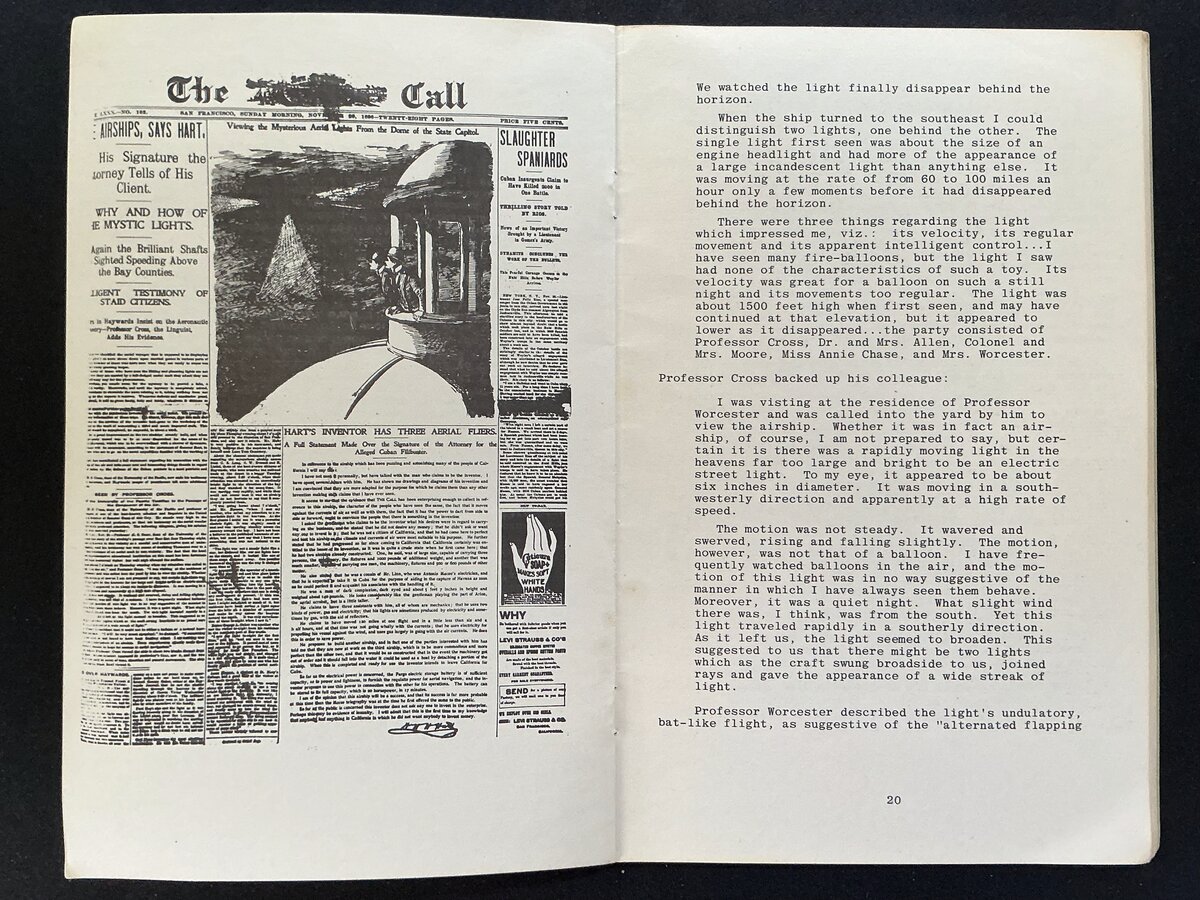
In San Jose, the mystery light appeared over the south end of the city. Professor H.D. Cross of San Jose, a linguistics professor, along with Professor Worcester, provided detailed testimony. Professor Cross described seeing a light that was too large and too bright to be a star, moving in a southwesterly direction at a considerable rate of speed. He gathered a party of witnesses including his wife, a Colonel and Mrs. Allen, and others. Professor Worcester confirmed the object was moving in a southwesterly direction at high speed and that its motion was inconsistent with a balloon.
In San Francisco, the Call newspaper ran extensive coverage. The two major papers engaged in a circulation battle partly fought through their airship reporting. The Call was more sympathetic to witness accounts while the Examiner took a more skeptical approach.
Source: The UFO Wave of 1896 by Loren E. Gross, published 1974. Gross’s monograph was compiled entirely from period newspaper accounts and represents one of the earliest scholarly efforts to document the 1896 California airship wave from primary sources.