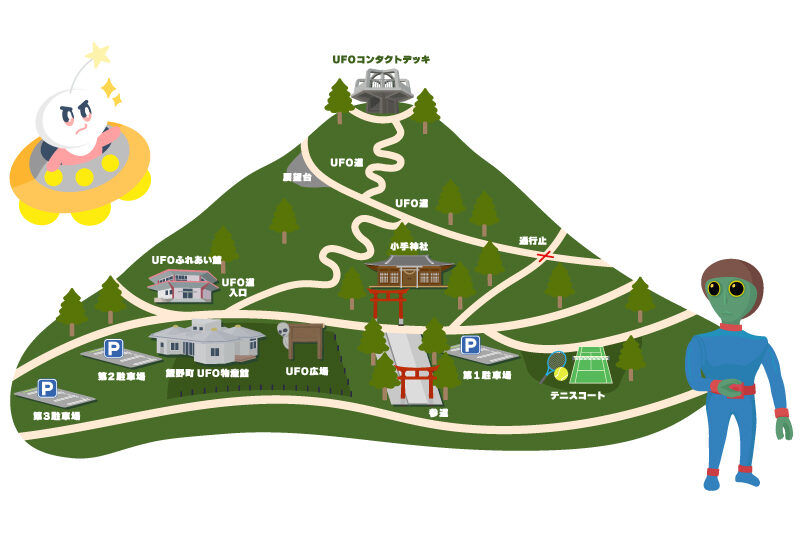
The town of Iino sits in the southern hills of Fukushima City, about twenty kilometres from the prefectural capital. It is a quiet place: rice paddies, forested slopes, a population that has been declining for decades. What makes it unusual is the mountain at its centre.
Mount Senkanmori rises 462 metres in a near-perfect conical shape. Locals have reported luminous objects above and around it for over forty years. The sightings are not occasional. They are frequent enough that in 1992, the municipal government of Fukushima City and the former Iino Town decided to build a museum dedicated to the phenomenon.
The UFO Interactive Hall
The UFO Fureai Kan (UFO Interactive Hall) opened in 1992 at the base of Mount Senkanmori. The facility contains exhibition rooms documenting UFO sighting reports from the region, a 3D virtual theatre, and public bath facilities with views across the valley toward the mountain. The centre also houses a souvenir shop selling UFO-themed goods, from sake to keychains shaped like flying saucers.
The hall was a civic project, funded by the city as part of a broader effort to establish Iino’s identity around its unusual aerial history. In the decades following its opening, the facility became the anchor of what locals now call UFO no Sato: UFO Village.
UFO no Sato is located at 1-299 Aoki Kotegamimori, Iino-machi, Fukushima City, Fukushima Prefecture 960-1303. Open 9:00 AM to 5:00 PM daily (closed Mondays unless a public holiday). Bus service runs from Fukushima Station East Exit, approximately 30 minutes. By car, approximately 30 minutes from Fukushima Station.
Mount Senkanmori and the UFO Way
The mountain itself is the centrepiece of the experience. A walking trail called the UFO Way leads from the Interactive Hall up through forested slopes, passing Kote Shrine (a Shinto shrine predating the UFO association by centuries), to the UFO Contact Deck at the summit.
The Contact Deck is exactly what it sounds like: an observation platform where visitors can scan the skies. During the annual UFO Festival, groups of up to 100 people climb the mountain with Director Mikami for a Mystery Tour, which combines local folklore, UFO history, and a collective attempt to summon a UFO from the summit.
The pyramid shape of the mountain and what locals describe as unusual magnetic field properties are frequently cited as explanations for the concentration of sightings.
The International UFO Laboratory
On June 24, 2021, coinciding with World UFO Day, a new institution was established within the UFO Interactive Hall: the International UFO Laboratory. It is the only specialised UFO research institute in Japan.
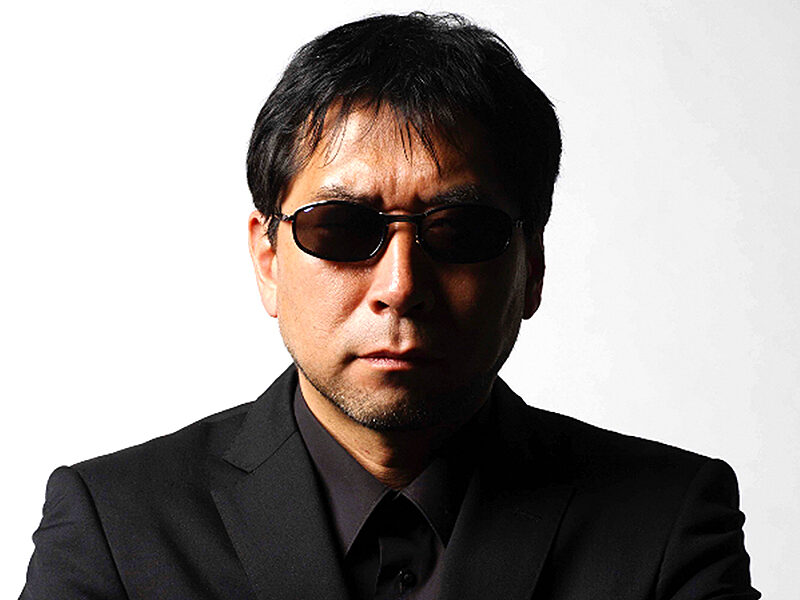
The laboratory’s first director is Takeharu Mikami, editor-in-chief of Monthly Mu, Japan’s longest-running magazine covering paranormal and unexplained phenomena. Mikami has been covering UFO research for decades and brings both a journalistic rigour and a genuine fascination with the subject. Under his direction, the laboratory conducts web-based surveys of UFO sightings, beginning with the Mount Senkanmori area and expanding to cover all of Japan.
The institute recruits researchers from Japan and abroad through online channels, building a network of investigators who analyse sighting reports, photographic evidence, and sensor data. Its establishment reflected a growing institutional willingness in Japan to take UFO research seriously, a trend that accelerated when the Japanese parliament formed a cross-party UAP league in 2024.
The Festival
Every November, Iino transforms. The annual UFO Festival, first held in 2021, draws thousands of visitors to a town with a population of around 5,000. The 2023 festival attracted approximately 4,000 attendees, many in elaborate alien costumes.
The festival features an Alien Costume Parade through the Iino-machi shopping street, with judges awarding prizes in categories including best alien lookalike, most entertaining performance, and (perhaps most ambitiously) most successful UFO summoning act. Comedy performances, food stalls serving local Fukushima specialities, and Mikami’s talk events round out the programme.
The 2023 festival drew an estimated 4,000 attendees.
Japan’s Broader UFO Conversation
Iino’s long-standing embrace of the UFO phenomenon sits within a broader Japanese cultural and political context. Japan has a deep history of aerial anomaly reports, from Edo-period accounts of utsuro-bune (hollow ships) to post-war sightings documented by the Japan Self-Defence Forces.
In June 2024, over 80 Japanese lawmakers formed the Parliamentary League for Unraveling Unidentified Anomalous Phenomena, chaired by Yasukazu Hamada of the Liberal Democratic Party. By March 2026, the league had proposed creating a specialised government body for UAP intelligence under the Deputy Chief Cabinet Secretary for Crisis Management.
The Genkai Nuclear Power Station incident in July 2025, where security guards reported unidentified lights near the facility, prompted closed-door parliamentary hearings and strengthened political momentum.
UFO no Sato is not a novelty. It is one node in a network of institutional, scientific, and political activity that is increasingly treating Japan’s aerial anomalies as a subject worthy of formal investigation.
The NHI Archive holds Japanese sighting data in the sightings database, including historical reports from the Mount Senkanmori area. Japan’s UFO sightings are viewable on the sightings map, and the country is profiled in the Japan country page. See also our coverage of the Japanese Parliamentary League for UAP.