The February 1975 issue opened with the Committee’s announcement of Mrs. Judy Magee’s resignation. Magee had been with the Society since its inception in 1957. She had served as Vice-President and Secretary, had worked on the editorial board of the Society’s former printed magazine, had lectured to charitable and service organisations across Victoria, and had been a frequent contributor to Flying Saucer Review under Charles Bowen’s editorship. Her tribute in the Bulletin was warmer and more specific than the publication’s restrained institutional voice usually allowed: “one of the world’s foremost female UFO investigators.” She would remain a Society member as a special adviser. On the same page, the Society announced a members’ night for Saturday 22 March at Guy’s Coffee Lounge in Mentone, with a slide-illustrated talk by Society lecturers Paul Norman and Judy Magee. It was the first appearance of Paul Norman’s name in the Bulletin’s run as a lecturer. He would go on to become one of Australia’s most prolific UFO investigators.
The centrepiece of the issue, occupying most of page two and running into page three, was the full translated text of Monsieur Robert Galley’s radio interview with Jean-Claude Bourret of France-Inter. The interview had been broadcast on 21 February 1974 at 8.50 p.m. as one of a series of thirty-nine programmes France-Inter devoted to UFO research between 28 January and 22 March 1974. The Australian Bulletin’s editor noted that the interview “was apparently totally ignored by all the British media, (and, of course, by all the Australian media).” The source was Flying Saucer Review Vol. 20 No. 2 (October 1974), translated by Gordon Creighton. The November 1974 issue had carried only a two-sentence reference under the heading No Panic. Now the Bulletin reprinted the full text.
Galley’s substantive statements concerned the institutional architecture France had built around UFO reporting. Since 1970, he confirmed, all gendarmerie reports and pilot sightings of unusual phenomena had been routed to the Group for the Study of Aerial Phenomena, the body that would be formalised three years later as GEPAN within the National Centre for Space Studies. Galley described the Air Force’s 1970 decision that UFOs represented no aerial threat and that scientific study fell outside their remit. He named Monsieur Poher’s research at the CNES into the correlation between variations in magnetic fields and UFO passage as “extremely interesting work” that he was personally following. His most cited remark concerned the gendarmerie’s reliability on humanoid-encounter reports: “When a witness declares that he has seen a saucer land and that he has seen small humanoids near the saucer, very frequently the gendarmes reach the conclusion that the witness is speaking the truth.” Galley’s general position was that an open-minded posture was institutionally necessary, “since it is an irrefutable fact that there are today things that are inexplicable, or poorly explained.”
A short item under the heading Flying Saucer Nest in the Thistles, reprinted from the Sydney Sun-Herald of 15 December 1974, reported brothers Viv and George Huckle discovering a “nest” carved into a patch of saffron thistles while ploughing on a property in the Pullabooka area south of Forbes. The patch was twenty feet in diameter. At the centre the earth had been bared; towards the perimeter, the thistles had been swept down in an anticlockwise direction. Some stems had three or four breaks. Others were pulped. The demarcation line between the nest and the surrounding thistles was, the brothers said, “clearly defined by untouched plants.” They had rejected cattle camp, sheep camp, whirlwind, emu’s nest, and flock of birds. They were waiting for unidentified flying object researchers to determine whether the thistle nest matched the reed-bed nests reported from the Tully area of Queensland in 1966.
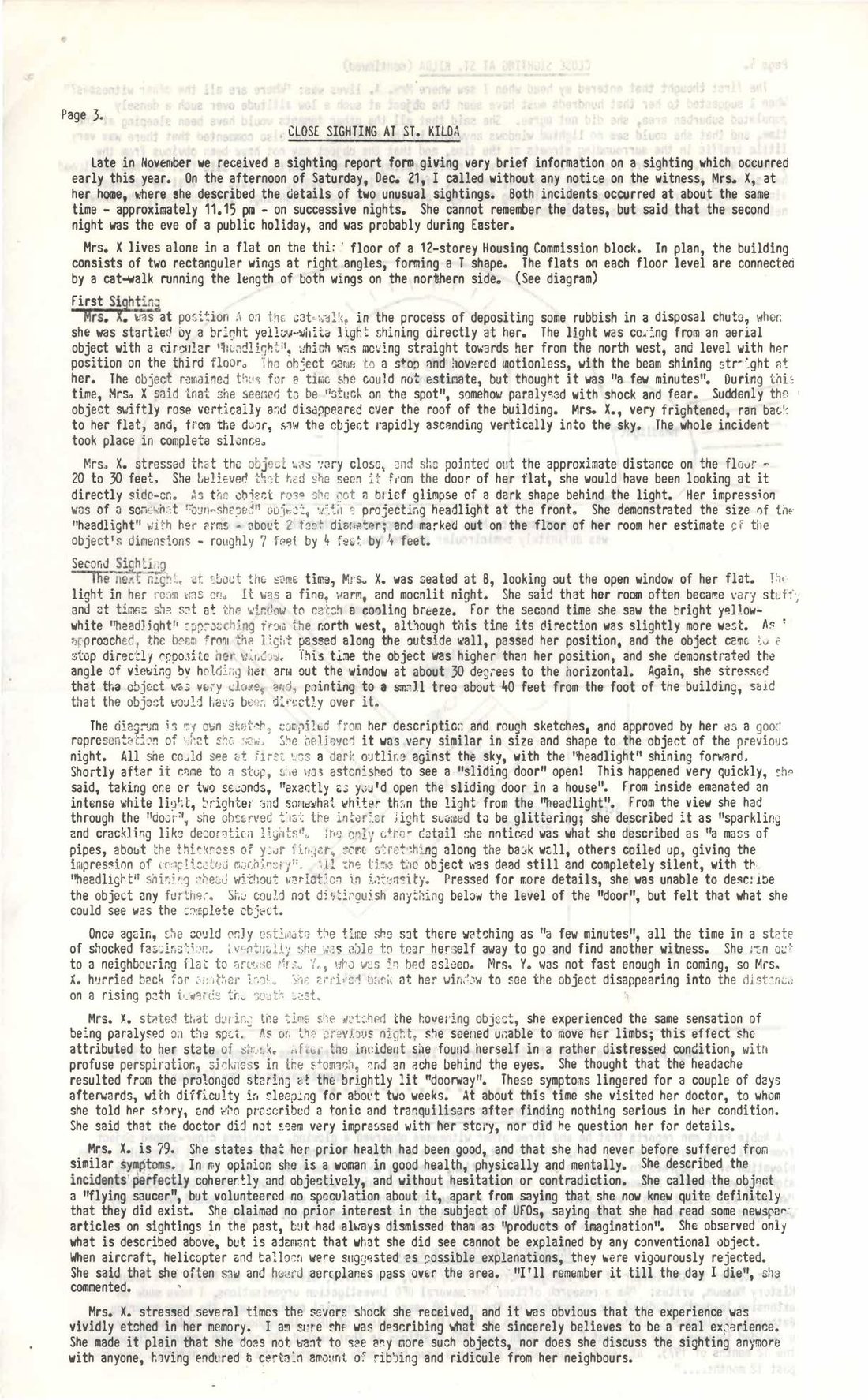
The longest VUFORS field report in the issue, occupying pages three and four with an investigator’s diagram and an object sketch, was Ray Fischer’s investigation of a close-encounter case at a Housing Commission block in St. Kilda. The witness, identified only as Mrs. X, was seventy-nine. The encounter had taken place over two successive nights around Easter 1974, at approximately 11.15 p.m. both nights. On the first night Mrs. X was at a disposal chute on the catwalk of her third-floor flat when she was startled by a bright yellow-white light shining directly at her. The light was carried by a hovering object, position level with hers, beam pointing at her. She found herself “stuck on the spot, somehow paralysed with shock and fear.” After what she estimated as a few minutes the object rose vertically and disappeared over the roof. She put the object’s dimensions at roughly seven feet by four by four, with a circular front “headlight” about two feet in diameter. Distance: twenty to thirty feet.
The next night Mrs. X was at her flat window, room light on. Through the open window she saw the same bright yellow-white headlight approaching from the north-west. The beam passed along the outside wall and the object came to a stop directly opposite her flat, roughly thirty degrees above her horizontal line of sight. She pointed to a small tree about forty feet from the foot of the building and said the object would have been directly over it. Shortly after the object stopped, she saw “a sliding door open, exactly as you’d open the sliding door in a house.” Through the door an intense white light, brighter and somewhat whiter than the headlight, emanated from inside. The interior light “seemed to be glittering, sparkling and crackling like decoration lights.” Through the door she saw “a mass of pipes, about the thickness of your finger, some stretching along the back wall, others coiled up, giving the impression of complicated machinery.” The object was dead still and completely silent. She watched for several minutes, ran to wake her neighbour, was not quick enough, and returned to see the object disappearing into the distance on a rising path towards the south-east. Her physical after-effects on the second night were more severe: profuse perspiration, nausea, ache behind the eyes, and difficulty sleeping for about two weeks. Her doctor found nothing serious and prescribed a tonic and tranquillisers. Fischer’s investigator note recorded that Mrs. X was in good health, described the incidents coherently and without contradiction, had no prior interest in UFOs, and had previously dismissed newspaper UFO articles as “products of imagination.” She told Fischer: “I’ll remember it till the day I die.”
A brief Easter 1974 report from Hall’s Gap in the Grampians described a Noble Park man and three other witnesses watching a glowing, soundless cigar-shaped object hover at thirty degrees elevation for ninety minutes, the colour changing from blue to gold. The witnesses reported “a very warm feeling” and a sense that the object was “drawing attention to itself through some mental thought.”
A statistical contribution came from Rex Gilroy, director of the Mount York Natural History Museum and self-described research officer for several UFO investigation organisations. Writing to the Lithgow Mercury on 9 August 1974, Gilroy reported the results of a ten-year study of the area covering Bathurst, Wallerawang, Lithgow, the Blue Mountains, and Penrith. He estimated more than three hundred sightings across the corridor over the previous five years, with eighty-two in 1973 alone and a further twenty in the Lithgow district over the past twelve months.
The Walkerston report from the Rockhampton Bulletin of 19 August 1974 documented Mrs. Norma Robinson and five children in a car observing a cross-shaped configuration of lights with a bright red revolving light at its centre, moving overhead. The Department of Civil Aviation and airline officials had suggested aircraft lights. The witnesses had pointed out that the object was too low and was entirely soundless.
The Saturday Evening Mercury article by Mac Moult of Hobart, headlined Scamander Sighting is Tasmania’s Best, reported the longest single observation in the issue. Roger Brooks, a senior English master at St. Mary’s District School, and Gary Bensemann, a student at the Northern division of the Tasmanian College of Advanced Education, had been walking a dog on Scamander beach one evening in September 1974, on or shortly before the article’s publication date of 21 September, when they noticed an unusual pale yellow light, dome-shaped, with green and pink lights below it that appeared to move from left to right around a disc-like lower structure. The object was four to five times brighter than Jupiter. The two telephoned Hobart Airport, learned nothing, and then phoned Ken Bennetto, sighting officer of the Tasmanian UFO Investigation Centre. Bennetto talked them through how to plot the object’s course. On the beach they drove two sticks into the sand with a third resting securely across the top, an improvised plumb-line frame they used to track the object’s hover, slow motion, medium-speed runs, and occasional rapid accelerations “like an aircraft on take-off.” Jupiter served as a reference point. After fifteen minutes the object began moving south. The two followed it by car for eight or nine miles to Four Mile Creek. At about 10.50 p.m. it picked up speed. An hour later, Brooks said, “it looked like a star.” They watched until cloud took it at 11.50, saw it reappear briefly at 12.02 a.m., and at 12.15 called it a night: “We were disappointed. We could have kept on watching.” The full observation had lasted one hour and forty-three minutes. Bennetto told Moult that the possibilities of an aircraft, a planet, and a temperature inversion had been ruled out, calling it “a genuine sighting of a UFO, something I’d give my back teeth to have seen myself.” Moult ended his article with a private remark attributed to J. Allen Hynek of Northwestern University: that in Hynek’s private belief, UFOs were “from another dimension.”
A short report from the Kempsey Argus of 1 October 1974 documented Patrick Mowle of the Kempsey Flying Club and three other club members observing a small white light rapidly flashing on and off in the sky midway between Crescent Head and Port Macquarie on the evening of 1 September 1974. The flashing object appeared three times over six minutes, the second and third appearances at noticeably different positions. All four witnesses were experienced pilots and agreed that the light could not have been a normal aircraft.
A Kallista resident, identified only as a Kallista woman, reported a sighting at about 10.30 p.m. on 30 October 1974 from her bedroom window in the Dandenong Ranges. The object was pure gold in colour, soundless, and “boat-shaped with a mast at each end.” She estimated the apparent size as that of a one-cent piece held at arm’s length. The witness sketch reproduced in the Bulletin showed an oblong horizontal body with a vertical protrusion at each end. Her statement was that of a careful observer: she had checked for sound through her fly-wire window, then moved to the sitting room for a clearer view, then watched the object pass behind trees and reappear lower down the hill before disappearing to the north-west. She had no other witnesses.
A long article reprinted from the Saturday Evening Mercury of 19 October 1974, headlined UFO’s of the World Unite, documented the formal establishment of the Centre for UFO Studies’ Australian Coordination Section, abbreviated CUFOS-ACOS, with Harry Griesberg and David Seargent as coordinators at P.O. Box 546, Gosford, NSW. The Centre’s parent body in the United States, founded by J. Allen Hynek and staffed largely by professional scientists, engineers, and university faculty members, operated a twenty-four-hour toll-free line for official agencies, ran computer-based comparisons of sightings, and tested UFO-affected materials including trees, soil, plants, cars, radios, and television sets. Medical studies were made of witnesses reporting temporary blindness, paralysis, nausea, and headaches. In Australia, all UFO groups were being urged to use a standardised report form “which has earned praise from the RAAF.” A proposal under discussion was the adoption of the international Pantone colour system: “Instead of a witness describing a UFO’s colour as ‘yellow-goldy’, one of the 150 colours in the Pantone system can be picked and logged as Pantone 120.” TUFOIC would file reports through the Australian section.
Embedded in the same article was the most precisely observed vehicle-interference case in the issue. A woman, who wished to remain unnamed, had been sitting in her car at St. Helens, Tasmania, waiting for a relative, when the car radio began “playing up, crackling and making piercing noises.” The radio, formerly in good condition, was, the article noted, “now still faulty.” She then noticed the UFO, about thirty metres off the ground, flying in low towards the car. It came to a hover at fence-top height. Alarmed, she reversed to turn the car around. In her panic she bogged it. While she was reversing, the UFO followed slowly and the radio gave out “a piercing noise.” She got out and ran the mile home. She picked up the car the next day. The detail the Bulletin highlighted, attributed to the investigators rather than the witness, concerned the car itself. The front of the car, which had been facing the UFO during the encounter, was “absolutely clean” when the woman picked it up the next day. The rest of the car, the article said, was “filthy.” She had drawn the UFO for the RAAF, who, according to the Mercury, “could not logically account for what was seen.”
A short Central Coast Express report of 14 November 1974 introduced Harry Pinhorn, eighteen, of Wyoming in NSW, who had been working at a factory in Lisarow when a large grey object hovered overhead and then disappeared straight up, “as if there was a hole in the sky.” Pinhorn had told a staff reporter that he had looked up at the trees only because the birds had all suddenly gone quiet. Harry Griesberg of the Central Coast UFO Research Bureau had interviewed Pinhorn for nearly two hours and assessed the report as “quite genuine.” He told the paper that the Bureau had received no UFO reports between April and October and that the lull had been general across Australia.
A Sunraysia Daily report of 2 December 1974 documented a brief sighting at Irymple, near Mildura, by Professor Thomas D. Watkins, an academic from a California college on sabbatical with the CSIRO. Watkins had been working in his garden at about 11 a.m. when he heard “a sharp buzzing noise in the sky.” Looking up, he saw a very bright round object moving rapidly from north to south, away from the earth. His statement to the paper was measured: “I’m a scientist, so I’m not easily fooled. I’ve always been pessimistic about seeing anything like this, but it was very real. I believe that when anything like this occurs it’s the duty of the person concerned to report it so someone, someday, may find out what it’s all about.”
The Hobart Mercury report of 7 December 1974, headlined Boys Say UFOs in Field, named seven schoolboys camping near a bridge over the South Esk River about a mile from Fingal, Tasmania, who had reported two disc-like objects, “a bit bigger than desks,” landing in a paddock about two hundred yards from their camp at about 11.30 p.m. on a Friday night. The senior witness named in the article was Mark Donnellan, thirteen. The others were Barry Gibbons, John Stingle, Ricky Hall, Scott Donnellan, Nigel Vincent, and Peter McGill. Donnellan described “a sort of humming noise and the lights kept shining, all green and orange.” The boys had walked the mile home with the flashes following them. Two hours later, when they returned to the campsite to collect a puppy they had left behind, the lights were still flashing.
The issue closed with a brief membership note across the bottom of page one: “YOUR MEMBERSHIP IS CURRENT, EXPIRES THIS ISSUE”, a reminder that February 1975 was the renewal point. Australian members paid four dollars twenty. Juniors paid two dollars ten. Overseas members paid two dollars fifty US.
Across the seventeen articles, the February 1975 issue made the Bulletin’s editorial posture visible. The Galley interview was reprinted in full because the Australian press had ignored it. The Fischer investigation of Mrs. X ran with an investigator’s diagram and an object sketch because the witness’s coherence and the interior detail merited the space. The Scamander article ran because TUFOIC had assessed it as the best Tasmanian sighting on record, and because Brooks and Bensemann had built a measurement frame on the beach. The CUFOS-ACOS announcement marked Australia’s formal entry into Hynek’s international research network. The Pullabooka thistle nest, twenty feet across with the earth bared at its centre and the stems pulped on an anticlockwise sweep, continued the documentary record of physical-trace cases that had begun at Tully in 1966. Specifics carried the issue: Pantone 120 instead of “yellow-goldy”, Harry Pinhorn looking up because the birds had gone quiet, Mrs. X measuring her object’s headlight against her own arms, the clean front of a car parked at fence-top distance from something the RAAF could not account for.