In December 1957, two months after Sputnik crossed the sky for the first time, a seventeen-page bulletin arrived in the mailboxes of members of the UFO Investigation Centre in Sydney. Its editor was A.P. Tomas. Its president was Dr. W.P. Clifford. Its address was G.P.O. Box 1120, Sydney, and its library occupied Room 1023 on the tenth floor of the Manchester Unity Building at 160 Castlereagh Street, open Fridays from six to nine. This was the third issue of the U.F.O. Bulletin, the publication that would evolve over the following decades into the Australian UFO Bulletin, the longest-running civilian UFO periodical in the country.
The editorial opens with the obvious: “THE SPACE AGE IS HERE.” Sputnik had made the point. But the issue’s centrepiece is not a satellite. It is a correspondence interview with Professor Hermann Oberth, translated from German, in which the man whose research paved the way for the V-2 rocket discusses flying saucers with the same directness he brought to propulsion physics.
Oberth, then working on the U.S. Guided Missile project in Alabama, told the UFOIC he expected manned satellites within five to ten years and a trip to Mars within ten to fifteen years after that. He did not think the moon was used as a UFO operational base. He did not consider all contact claims worthless. “I myself have received letters from such people,” he wrote. “Most of what they give out is rubbish, but among these persons with telepathic powers is a lady whose reports on communications are very remarkable on account of their philosophic and political content.” He planned, upon retirement, to review and publish her reports. “Personally I cannot get rid of the impression that these transmissions do really come from beings who intellectually are at least equal to us and who in culture may be thousands of years ahead of us.”
Oberth believed the UFOs came from other solar systems rather than from planets in our own. He was working on “Photon Drive” and “Ionic Drive” methods of propulsion. “A trip to Mars may then take but a few hours.” In a 1955 article in the Sydney Morning Herald, he had speculated that extraterrestrial inhabitants “may react to rays still unknown to us” and that “their means of communication may be anything from a ray to a para-psychological power revealed to us occasionally in human manifestations of telepathy.”
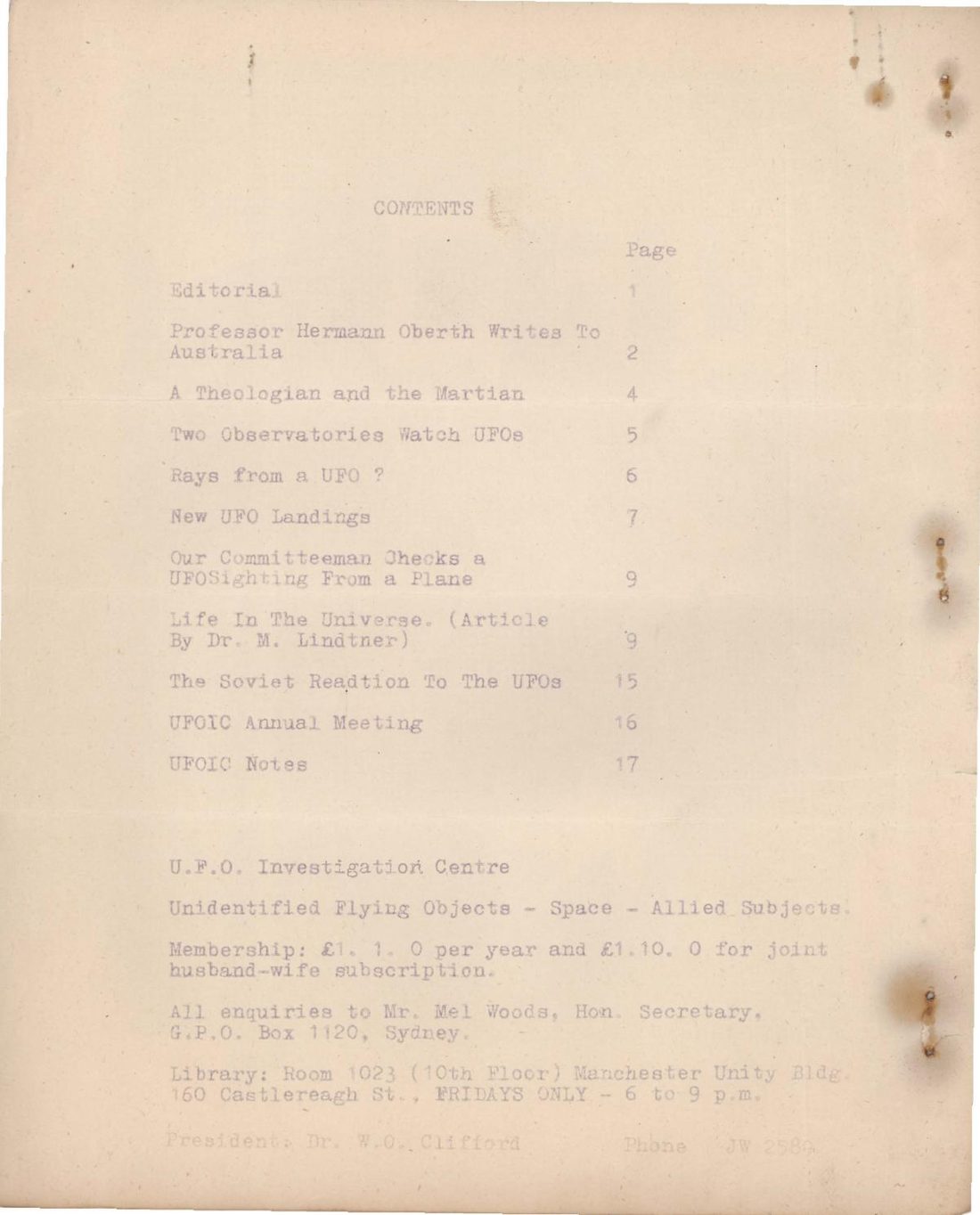
The same issue carried a report of the kind Oberth’s theories sought to explain. On the morning of 8 November 1957, four astronomers at the Commonwealth Observatory on Mount Stromlo, outside Canberra, watched a bright pink object in the sky for eight minutes. They had just finished tracking Sputniks 1 and 2 at 3:03 a.m. when they noticed it. Dr. A. Przybylski described a bright pink luminosity brighter than anything in the sky except the moon. The Assistant Director, Dr. A. R. Hogg, told the press: “What it was remains an open question. It is the first time that the observatory has sighted what might be called an unidentified flying object.” Rough computations placed the object at no more than 1,600 miles above Earth. On the same night, a young astronomer at the National Observatory in Toulouse, France, M. Chapuis, followed a brilliant canary-yellow elliptical object with a telescope for five minutes as it made sweeping turns, disappeared, and descended almost vertically before vanishing in shadow.
Closer to Sydney, the bulletin documented a case from Smithfield, near Fairfield, on 16 September 1957. Les McDonald, seventeen, and Gladys Smith, fourteen, saw a red light in the trees on a dark bush road. The light changed to green, spreading “like a mist” over an area roughly 100 to 120 yards in diameter. Both became “virtually paralysed” but felt a warm glow. The UFOIC Committee investigated. Gladys reported that she had no fear during the experience, was “merely cognizant of things” but unable to react. From an elevated position, a Mrs. Camileri saw a “coloured shower” fall from a clear sky over the district at the exact time reported by the young people. The article connected the case to similar reports from the United States: R.O. Schmidt in Nebraska, whose car stalled near a grounded object that froze him with a beam of light; and James Stokes, an engineer at an Air Force missile base in New Mexico, whose car radio and engine were affected by a passing UFO.
Landing reports arrived from five countries. In Fiji, two middle-aged couples on a boat saw a round white object descend vertically to twenty feet above sea level; a figure standing on the outside shone a bright light on them. “In the isolated district where this UFO was seen there are no comics. The natives have never heard about the ‘flying saucer.’” In Tennessee, a twelve-year-old boy named Everett Clark watched two men and two women step out of a spaceship in a field, “talking ‘like German soldiers in war movies.’” In Nebraska, R.O. Schmidt was invited inside a grounded craft where two women and several men were working on wires and instruments; the pilots, who spoke English and “perfect German,” said they meant no harm and hinted that “THERE MIGHT BE AN ANNOUNCEMENT IN THE NEAR FUTURE.”
Dr. M. Lindtner of the UFOIC contributed a six-page article on “Life in the Universe,” tracing the scientific understanding of life’s origins from Spallanzani and Pasteur through the Miller-Urey experiment of 1952 (demonstrating amino acid formation in a simulated primitive atmosphere) to Professor Stanley’s work at Berkeley creating self-reproducing rod-like organisms from amino acids and nucleic acid. His conclusion: “if matter is universal and life is its inherent quality, then anywhere in the cosmos under conditions similar to ours the generation of similar life patterns must be a logical necessity.” It was the most scientifically literate article the bulletin had published, and it was framed explicitly as groundwork for understanding the UFO phenomenon.
The final feature reported on Soviet reactions to the UFOs. The material was contradictory and, if authentic, remarkable. On one hand, official Soviet sources dismissed saucers as American war-mongering psychosis. On the other, a German publication (Neues Europa, February 1955) reported that the U.S.S.R. Academy of Space Research had concluded that UFOs were “not illusions or mirages but solid objects made of unknown material, hard yet elastic,” that ninety per cent came from Venus, and that landings would begin “in approximately thirty years.” Most striking was a claimed transmission received at Irkutsk, Siberia: an “astrogram” that read, in part, “LANDING ON EARTH IN 15 TERRESTRIAL YEARS… DESTRUCTION NOT INTENDED… DEFENCE USELESS… PEACEFUL COLONISATION… EXCHANGE POSSIBLE.” Soviet nuclear scientists’ reaction, per the German source: “THIS IS THE FIRST AUTHENTIC MESSAGE FROM A U.F.O.”
The bulletin’s editor appended no judgement. “If the German reports are true, this Soviet release of UFO news, particularly of so fantastic a nature, is too amazing to comment.”
At the UFOIC Annual Meeting on 6 November, Dr. Clifford was re-elected President, Tomas re-elected Vice-President, and the organisation gained two new committee members: Dr. J. Greenwell, an amateur astronomer, and Mr. T.W.S. Dutton, a chief engineer. NICAP in Washington was recommended to members at $7.50 per year. Soviet films about space travel were screened. The bulletin closed with a Christmas greeting from the Editor.
This was the UFO Investigation Centre’s third issue, published from Sydney in the first months of the Space Age. Its pages held a correspondence interview with the father of modern rocketry, a sighting by four professional astronomers at Australia’s national observatory, a paralysis case investigated by the organisation’s own committee, a scientific article citing the Miller-Urey experiment, and a purported Soviet intercepted message from an unidentified flying object. The subscription price was two shillings.