Arthur C. Clarke
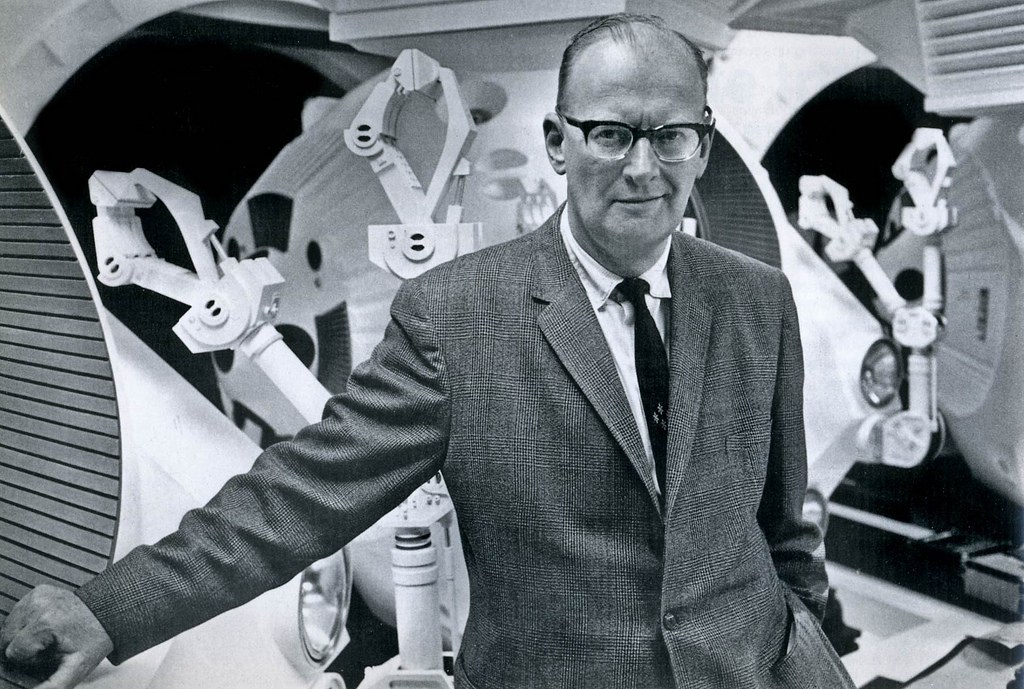
Arthur Charles Clarke, known throughout his publishing life as Arthur C., served in the Royal Air Force as a radar officer through the Second World War, published the 1945 paper that specified the geostationary communications satellite three decades before the technology existed, wrote a series of novels (Childhood's End in 1953, The City and the Stars in 1956, Rendezvous With Rama in 1973) that became the cultural reference points for the postwar speculative-fiction tradition on extraterrestrial intelligence, collaborated with Stanley Kubrick on the screenplay and the parallel novel of 2001: A Space Odyssey across 1964 to 1968, and lived from 1956 until his death in 2008 in Colombo, Sri Lanka, the home he chose for the scuba diving and the climate and the distance from the publishing centres. The visual and narrative grammar of the modern alien-contact film, from Spielberg through Villeneuve, traces its inheritance to the 1968 Clarke-Kubrick collaboration more directly than to any other single source.
A Life
Arthur Charles Clarke was born on 16 December 1917 in Minehead, a Somerset coastal town on the Bristol Channel. His father Charles was a farmer and a former post office signalman who had been gassed in the First World War; his mother Nora had been a post-office clerk. Charles Clarke died in 1931 when Arthur was thirteen, leaving Nora to run the farm and raise four children. Arthur attended Huish's Grammar School in Taunton, read his first issue of Astounding Stories at twelve, and at fifteen was building telescopes and mapping the Moon with his own hand-drawn charts. He could not afford university. He took a Civil Service examination in 1936 and was appointed an Auditor with His Majesty's Exchequer and Audit Department in London.
The London years before the war were the formative years. Clarke joined the British Interplanetary Society in 1934, when the BIS was a small organisation of perhaps thirty members, and rose quickly through it. He met Eric Frank Russell, Olaf Stapledon, William Olaf Cumberland, and the wider circle of British science-fiction writers and theorists. He sold his first science-fiction story (to Astounding, edited by John W. Campbell Jr) in 1937. He was conscripted into the Royal Air Force in 1941, age twenty-three, and served until 1946. The RAF posted him into Ground-Controlled Approach (GCA), the new radar-based blind-landing system being developed by the United States for British airfields. Clarke spent the second half of the war at the Telecommunications Research Establishment at Malvern, training crews on the GCA equipment and writing the operational manuals. His war memoir Glide Path (1963) is the only one of his novels with a substantially autobiographical core.
The 1945 paper that became Clarke's principal scientific legacy was written in his off-duty time at RAF Stradishall in Suffolk and submitted to Wireless World, the British radio-engineering trade journal, where it appeared in the October 1945 issue under the title "Extra-Terrestrial Relays." The paper specified the geostationary orbital altitude (approximately 35,786 kilometres above the equator), the three-satellite global communications configuration, the power-budget calculations, and the hand-over geometry for continuous coverage. It was published eighteen years before the first geosynchronous communications satellite (Syncom 2, 1963) and twenty-one years before the first continuous geostationary commercial service (Intelsat I, 1965). The geostationary belt is named the Clarke Orbit in International Astronomical Union usage.
After demobilisation Clarke read mathematics and physics at King's College London on a Civil Service grant, took a first-class degree in 1948, and went to work as the assistant editor of Science Abstracts. He chaired the British Interplanetary Society twice (1946 to 1947, 1951 to 1953). His first novel, Prelude to Space, was completed in 1947 and published in 1951. The Sands of Mars followed the same year. Childhood's End in 1953 was the breakthrough, the novel that the postwar generation of science-fiction readers in the United States and the United Kingdom carried with them into the 1960s.
Clarke moved to Ceylon, later Sri Lanka, in 1956. He had been diving since 1954 and Ceylon offered him reef diving, a warm climate, and a tax position the British Inland Revenue was willing to accept. He took Sri Lankan permanent residency in 1975 and stayed for the remaining five decades of his life. He hosted three British television series on anomalous phenomena (Arthur C. Clarke's Mysterious World, 1980; Arthur C. Clarke's World of Strange Powers, 1985; Arthur C. Clarke's Mysterious Universe, 1994), wrote prolifically through the 1970s and 1980s including the Rama sequence and the 2010, 2061 and 3001 sequels to 2001, was knighted in 1998 (the ceremony delayed pending the clearance of allegations subsequently shown to be unfounded), and died at Apollo Hospital in Colombo on 19 March 2008 of post-polio syndrome, age ninety.
Any sufficiently advanced technology is indistinguishable from magic.Clarke's Third Law, from "Hazards of Prophecy" (1962, revised edition of Profiles of the Future)
Photographs
Clarke was photographed across his career by the BBC, by Sri Lankan newspapers, by the British science-fiction press, and by the Sri Lanka Underwater Federation. Wikimedia Commons holds Creative Commons-licensed photographs of Clarke from the 1960s onwards, including portraits with Stanley Kubrick during the 2001 production, with Sri Lankan diving companions, and at his Colombo home. Most photographs of Clarke in the archive's possession remain at the sourcing-verification stage and are not yet EXIF-confirmed for display.
The 1945 Geostationary Paper
"Extra-Terrestrial Relays: Can Rocket Stations Give Worldwide Radio Coverage?" appeared in Wireless World on pages 305 to 308 of the October 1945 issue. The paper opened with the observation that the only way to obtain continuous global high-frequency radio coverage was to place repeating stations in space at orbital altitudes that allowed continuous line-of-sight contact between sender and receiver. Clarke specified the geostationary altitude (the orbital radius at which a satellite's period matches the Earth's rotation), gave the calculation for the altitude (the figure of approximately 22,300 statute miles), and showed by orbital geometry that three satellites equally spaced above the equator would provide effectively complete coverage of the inhabited world. He calculated the power budgets, the antenna gain requirements, the bandwidth implications, and the manning requirements for the early manned stations he envisaged.
The paper was an engineering specification, not a science-fiction story. Clarke had been thinking about the geostationary configuration since reading the German rocketry literature of the early 1940s and discussing the question with the BIS membership during the war. He sold the manuscript to Wireless World for forty pounds and did not patent the idea, partly because he was a serving officer at the time of submission, partly because he considered the orbital configuration to be a natural fact that no individual could properly claim.
The first geosynchronous communications satellite (Syncom 2) was launched on 26 July 1963, eighteen years after the paper. The first geostationary commercial service (Intelsat I, "Early Bird") followed on 6 April 1965. By the early 1970s the Clarke-orbit communications constellation was the principal global telephony and television relay infrastructure. The International Astronomical Union formally named the geostationary belt the Clarke Orbit in 2001 in recognition of the 1945 paper. Clarke received the Marconi Prize for the work in 1982 and was a regular subject of the satellite-communications industry's institutional memory for the remainder of his life.
The original four-page article is held by the IEEE History Center, the Smithsonian National Air and Space Museum (which has a framed copy in its satellite-communications exhibit), and the Clarke estate. The text has been republished in the IEEE Aerospace and Electronic Systems Magazine of October 1990 (volume 5, issue 10) with a contemporary engineering commentary, and in Clarke's own essay collection Voices from the Sky (1965). The 1945 manuscript copy retained by the editorial staff of Wireless World bears Clarke's handwritten power-budget calculations in the margin.
The Kubrick Collaboration, 1964 to 1968
Stanley Kubrick contacted Clarke through the New York literary agent Scott Meredith in April 1964 with the proposition of a collaboration on what Kubrick called "the proverbial good science fiction movie." Clarke flew to New York the following month, took up residence at the Chelsea Hotel, and the two men began a four-year working partnership that produced the screenplay of 2001: A Space Odyssey, the parallel novel of the same title, and the visual and conceptual grammar that has shaped every serious film treatment of the extraterrestrial-contact question since.
The working method was unusual. Clarke wrote the novel as the screenplay developed, with the two texts evolving in parallel through 1964 and 1965, the screenplay handed to the film production at MGM Borehamwood in 1965, and the novel held back for publication until 1968 to coincide with the film. The film premiered at the Uptown Theater in Washington, DC, on 2 April 1968. Clarke flew back from Sri Lanka for the premiere. The reception was mixed at first; the long, dialogue-light sequences and the deliberately ambiguous final movement (the Star Child) were controversial. The film became, across the next two decades, the work to which every subsequent serious treatment of human encounter with non-human intelligence has been compared.
The novel is the more direct of the two works. Where the film holds the encounter as visual ambiguity (the monolith, the Star Gate, the Star Child), the novel narrates the same events in straightforward science-fiction prose: the monolith is a deliberate signalling device left by a non-human intelligence to monitor and accelerate the development of intelligent species in this solar system; the Star Gate is a transport mechanism between widely separated regions of the universe; the Star Child is Bowman returned in a new physical form. Clarke considered the novel and the film to be parallel works of equal weight. The 2010, 2061 and 3001 sequels Clarke wrote between 1982 and 1997 develop the novel's framework. The Kubrick estate has not been associated with the sequels.
The Contactee Question
Clarke was a public sceptic on the contemporary contactee literature throughout his career and was, at the same time, the figure who did more than any single twentieth-century writer to shape how the general reading and viewing public imagined the question of non-human intelligence. The distinction is the substantive one. He distinguished consistently between (a) the engineering and astronomical questions of whether and how non-human intelligences might exist and might be contacted, which he treated as serious and open, and (b) the contemporary witness-testimony, abduction-experience and contactee-tradition register, which he treated with considerable scepticism on epistemic grounds.
His three British television series across 1980 to 1994 were the visible public face of this distinction. Mysterious World, Strange Powers and Mysterious Universe investigated reported paranormal and ufological phenomena (cattle mutilation, ball lightning, alleged psychic phenomena, ancient archaeology controversies) with an editorial framing of measured engineering scepticism. Clarke himself appeared in the framing segments, generally restrained, generally noting both the engineering implausibility of most of the witness accounts and the residual question of whether the phenomena reported across so many cultures and so many centuries could really be exhaustively explained in conventional terms. The framing was honest. The viewing audience went away with the question more open than they had arrived with it.
The fiction has done more shaping than the television. Childhood's End introduced the visual image of large hovering craft above the world's capitals that V (1983) and Independence Day (1996) inherited; the Overlords' physical form anticipated by half a century the standard visual grammar of the postwar abduction-account "grey." The monolith in 2001 became the cultural shorthand for the artefact-as-evidence-of-intelligence proposition. Rendezvous With Rama set the visual and narrative grammar of the artefact-encounter genre that Arrival (2016) and Annihilation (2018) inherit. The substantive influence on the cultural imagination of contact, separately from any specific claim about specific incidents, runs through Clarke's work more directly than through any other twentieth-century source.
The fact that Clarke was a public sceptic on the specific contemporary contactee literature does not diminish the substantive influence of his fiction on how the general public imagines the contact question. The two registers operate on different evidentiary standards. Clarke held the witness-testimony register to engineering and epistemic standards he considered most contemporary contactee accounts to fail; he held the speculative-fiction register to dramatic and narrative standards he considered worth pursuing seriously. The archive holds his fiction as cultural-grammar primary source for the postwar contact-imagination tradition, and holds his television scepticism as one of the strongest mainstream contemporary critiques of the contactee witness register.
Connected People
American film director (1928 to 1999) who proposed the 2001 collaboration in 1964 and directed the film through to release in April 1968. The Kubrick-Clarke working partnership produced both the film and the parallel novel. The visual ambiguity of the film and the narrative directness of the novel are the two complementary halves of the project as the two men conceived it.
The senior American figure in the Campbell-era Astounding generation alongside whom Clarke published from 1937 onwards. The Heinlein-Clarke correspondence runs through the 1940s, 1950s and 1960s. The two men were the public scientific-rationalist face of the postwar speculative-fiction tradition in their respective countries, though their political positions diverged sharply.
Campbell-era contemporary of Clarke. The Asimov-Clarke pact (negotiated in a New York taxi cab in the 1960s) had Clarke acknowledging Asimov as the second-best science-fiction writer in the world if Asimov acknowledged Clarke as the second-best science writer in the world. The two men corresponded across forty years and shared editorial relationships with the principal American science-fiction magazines of the period.
The senior German-American rocketry figure of the postwar period and the principal interlocutor for Clarke's interplanetary-rocketry writing of the 1940s and 1950s. The Clarke-von Braun correspondence runs through to von Braun's 1977 death. Clarke's engineering rocketry essays (collected in The Exploration of Space, 1951, and The Promise of Space, 1968) draw heavily on the von Braun design tradition.
American planetary scientist (1934 to 1996) whose Cosmos (1980) television series ran in the same general public-facing-science register as Clarke's Mysterious World. The Clarke-Sagan correspondence runs through the 1960s, 1970s and 1980s. Sagan and Clarke shared the editorial position of public scepticism on contemporary contactee claims combined with sustained scientific seriousness about the long-term question of extraterrestrial intelligence.
British radio astronomer (1913 to 2012), founding director of the Jodrell Bank Observatory, with whom Clarke corresponded across the geostationary-orbit deployment years and into the SETI period. Lovell's Out of the Zenith (1973) cites Clarke's 1945 paper as having anticipated the engineering requirements for the deep-space tracking facilities Jodrell Bank built across the 1960s.
English Campbell-era science-fiction writer (1905 to 1978), Charles Fort enthusiast, author of Sinister Barrier (1939) and other novels engaging the contactee and anomalous-phenomena register from the science-fiction direction. Long-standing British Interplanetary Society colleague of Clarke. The Clarke-Russell correspondence is one of the substantial sources for the British speculative-fiction tradition's engagement with the contactee register.
English philosopher and novelist (1886 to 1950) whose Last and First Men (1930) and Star Maker (1937) were the formative influences on Clarke's cosmic-scale fiction. Clarke met Stapledon through the British Interplanetary Society in the 1940s. Childhood's End and the 2001 sequence are direct inheritances of the Stapledonian cosmic perspective.
In the Archive
Clarke appears across three sections of the archive. The engineering and satellite-communications history holds the 1945 paper and the Marconi Prize material. The British Interplanetary Society newsletter run (held in the archive's Journal of the BIS collection) carries Clarke's editorial work and his BIS chairmanship years. The cultural-grammar tradition of postwar contact imagination runs through the Childhood's End and 2001 inheritances and is referenced across the Books and Films section. Neil McAleer's Visionary: The Odyssey of Sir Arthur C. Clarke (2013, the updated edition of the 1992 authorised biography) is the standard scholarly biography. The Arthur C. Clarke Center for Human Imagination at the University of California, San Diego, is the principal scholarly repository.
The cultural-grammar inheritance of 2001: A Space Odyssey is documented through the Books and Films page. The British Interplanetary Society editorial work is documented through the Journal of the BIS collection. The wider postwar British speculative-fiction tradition's engagement with the contactee register runs through the Biographies hub (including the Olaf Stapledon entry when built) and through the BIS / New Worlds editorial correspondence the archive holds.
Sources
Clarke, Arthur C. "Extra-Terrestrial Relays: Can Rocket Stations Give Worldwide Radio Coverage?" Wireless World, October 1945. Clarke, Arthur C. Childhood's End, Ballantine Books, 1953. Clarke, Arthur C. 2001: A Space Odyssey, New American Library, 1968. Clarke, Arthur C. The Lost Worlds of 2001, New American Library, 1972. Clarke, Arthur C. Rendezvous With Rama, Harcourt Brace Jovanovich, 1973. Clarke, Arthur C. The Fountains of Paradise, Harcourt Brace Jovanovich, 1979. Clarke, Arthur C. Astounding Days: A Science Fictional Autobiography, Gollancz, 1989. McAleer, Neil. Visionary: The Odyssey of Sir Arthur C. Clarke, Clarke Project, 2013 (updated edition of the 1992 authorised biography). Clarke obituaries: BBC, 19 March 2008; New York Times, 19 March 2008; The Times (London), 20 March 2008. Sri Lanka government press release on Clarke's death, 19 March 2008. International Astronomical Union resolution on the naming of the Clarke Orbit, 2001.