Credo Mutwa
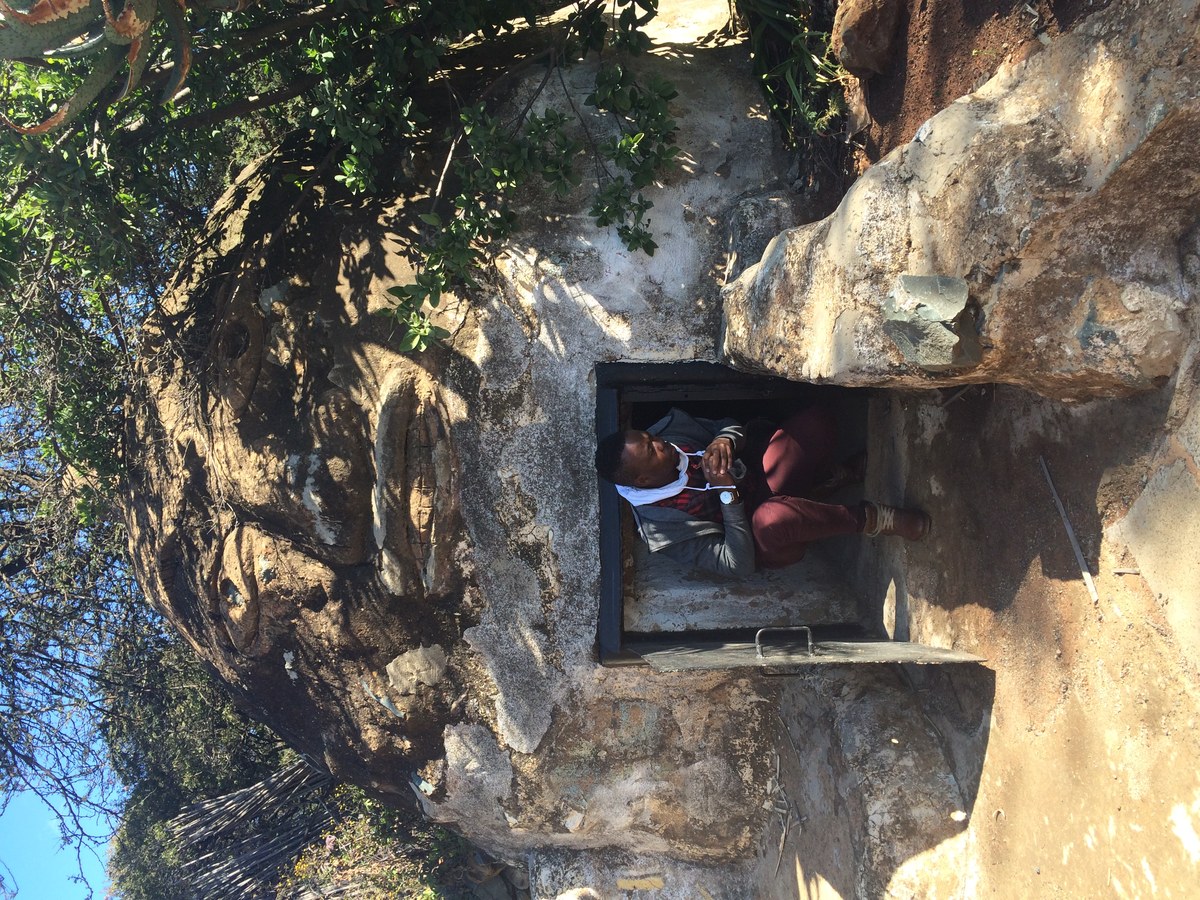
Vusamazulu Credo Mutwa, known throughout his long public life as Credo or as Baba (father), was a Zulu sangoma and sanusi (a senior diviner-healer) who spent seven decades transmitting southern African oral cosmology into print, into cultural-museum installation, and into a global audience he had not initially sought. Indaba My Children (1964) is the principal published source for the Zulu creation narratives, mythology, and the sangoma initiatory tradition in twentieth-century English. The cultural villages he built at Witwatersrand and at Kuruman were the museum-scale projects of his middle years. The 1999 conversations with the English broadcaster David Icke carried the Zulu cosmological figures (the Chitauri, the Mantindane, the wider sanusi-tradition cosmography) into the postwar contactee-tradition register the archive holds. He died at Kuruman in March 2020, age ninety-eight, having outlived most of his interlocutors.
A Life
Vusamazulu Credo Mutwa was born on 21 July 1921 near the Mhlathuze River in Zululand, the eastern coastal region of what was then the Union of South Africa. His father Numazwana was a Catholic catechist working for the Catholic mission in the area; his mother Numabunu was the daughter of a Zulu sangoma named Ziko Shezi who had refused conversion. The parents separated before the boy's birth over the religious divide and the boy was raised by his Catholic father's family in successive missions. He spoke isiZulu, learned English and Afrikaans through the mission schools, and was baptised Credo (the Catholic Latin word for "I believe").
He left the mission system as a teenager and worked as a labourer in Johannesburg through the late 1930s. In 1937, on a Johannesburg street, he was beaten and sexually assaulted by a group of mine workers in a racially compounded street attack. The assault produced a long physical recovery and a deeper crisis of religious confidence. Mutwa wrote in Indaba My Children and in interviews across the rest of his life that the experience broke his confidence in the Catholic framework he had been raised inside. He returned to Zululand and to his maternal grandfather Ziko Shezi, who initiated him into the sangoma tradition. The initiation training, conducted across more than twenty years in the Zulu countryside and at sites across southern Africa, was the foundation of everything Mutwa subsequently wrote and built.
The published work began with Indaba My Children, completed in 1959 and published by Blue Crane Books in Johannesburg in 1964. The book is a six-hundred-page synthesis of Zulu creation narratives, mythology, oral history and sangoma cosmology, organised around the figure of an old initiate transmitting the tradition to younger listeners. It went through multiple editions in South Africa and was reissued by Canongate in the United Kingdom in 1998 and by Grove Atlantic in the United States in 1999. Africa is My Witness followed in 1966 and My People in 1969. Mutwa's printed work in the 1960s and 1970s was the largest single contribution by a southern African writer to the international literature on the regional oral-cosmological tradition.
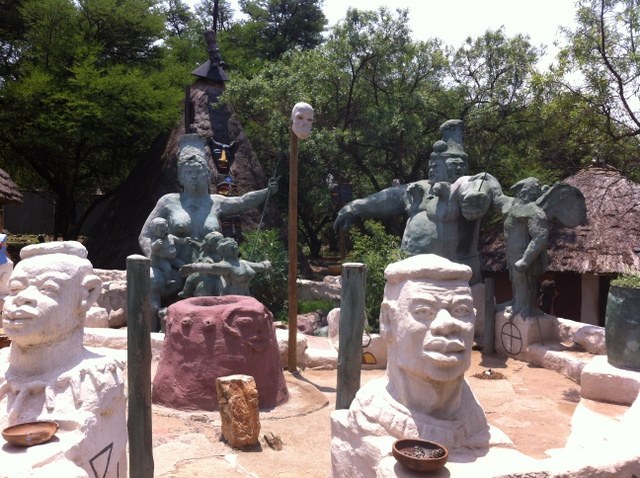
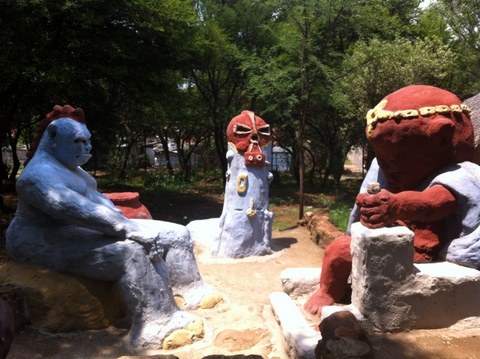
The cultural-village work occupied the middle decades. Mutwa worked as curator at the Witwatersrand Show in the 1970s and subsequently built KwaKhaya LeNdaba ("the home of the stories") at the Soweto edge in 1975, a working cultural village with traditional architecture, ceremonial spaces and exhibition material. The village was destroyed in the Soweto uprising of 1976 and Mutwa was attacked twice during the political violence of the late 1970s. He rebuilt at Mafikeng in the 1980s and continued the project at successive sites until age and the changing security situation closed the operations down in the 2000s. He moved to the small town of Kuruman in the Northern Cape, lived through the last fifteen years of his life there with his wife Cecilia Mutwa, and died on 25 March 2020 at the age of ninety-eight.
I am a man with one foot in the world of waking and one in the world of dreaming, and I have come to tell you that the two worlds have always been one.Mutwa, opening passage of Indaba My Children, 1964
Photographs
Mutwa was photographed extensively in South Africa from the 1960s onwards by the South African press, by ethnographic researchers, and by the cultural-village visitors and journalists who came through KwaKhaya LeNdaba across the 1970s, 1980s and 1990s. The David Icke 1999 production team produced video and stills of Mutwa in his Mafikeng setting during the interview sessions. The South African History Online (SAHO) photographic archive holds some institutional material. The principal visual record of Mutwa's working life is the cultural-village photography held below.
Indaba My Children
The 1964 book is the founding text of Mutwa's published career. The narrative frame is an old initiate (the Mlozwana, the "small one") transmitting the tradition to a circle of listeners across a series of nights. The content spans the Zulu creation narratives (the High God Mvelinqangi, the first ancestors, the wars between the first generations), the cosmological geography (the layers of the cosmos, the underworld, the afterlife), the sangoma initiation tradition, herbal and ceremonial practice, the political history of the Zulu nation from the Mthethwa confederacy through Shaka and into the colonial period, and the prophetic tradition.
The book's reception inside South Africa was complicated. Some senior figures in the Zulu cultural establishment criticised Mutwa for publishing initiatory material that they considered ought to have remained oral; others welcomed the printed record at a moment (the apartheid 1960s) when the traditional cosmological inheritance was under multiple kinds of pressure. The international reception across the 1960s and 1970s was substantial. The Carl Jung circle and the Joseph Campbell circle both engaged with the book; Stephen Larsen drew on it for The Shaman's Doorway (1976). The 1998 and 1999 Western reissues placed it inside the wider postwar oral-cosmology publication tradition the archive holds in its global-cosmology section.
The first edition was 595 pages with line illustrations by Mutwa himself. The original print run was small (estimates of around two thousand copies) and first editions are now scarce. The 1998 Canongate UK edition is the standard modern text in English. The 1999 Grove Atlantic US edition added a translator's note on the orthography of the isiZulu terms and is the edition most often cited in subsequent academic work. The book has not been translated into isiZulu itself, an omission Mutwa noted with regret in interviews from the 1990s onwards.
The Chitauri Material
The Chitauri tradition is one of the strands of Zulu cosmology Mutwa transmitted across his published and recorded work. As Mutwa described it, in Indaba My Children and in greater detail in his later interviews and in Zulu Shaman: Dreams, Prophecies, and Mysteries (1996, expanded edition 2003), the Chitauri were a category of non-human beings, sometimes rendered as "the children of the serpent" or "the dictators," who according to the sangoma tradition had played a substantial role in the formation of human civilisation and in the institutional histories of the kingdoms and empires of the long human past. The Zulu name itself, Mutwa stated, was the term used in the initiatory tradition to denote these beings; the Chitauri figured both in creation narratives and in the prophetic-tradition material concerning the contemporary period.
The Chitauri material drew comparative attention from the late 1980s onwards as the Western postwar contactee tradition reached for non-Western cosmological sources to ground its own claims about non-human presence in human history. Mutwa's printed and recorded testimony became one of the principal southern African sources cited in this wider literature. The published academic engagement was thinner than the popular reception. The ethnographic record of the Chitauri category outside Mutwa's own corpus is limited, and the scholarly question of whether the Chitauri tradition as Mutwa presented it represents an extant pre-colonial Zulu cosmological inheritance, a Mutwa synthesis drawing on multiple southern African sources, or a contact-zone tradition that incorporates colonial-era theological elements is unresolved.
The 1999 David Icke Interviews
The English broadcaster and author David Icke interviewed Mutwa at length in South Africa in 1999. The interviews produced two principal video releases: The Reptilian Agenda Part 1 (approximately three hours) and The Reptilian Agenda Part 2 (approximately five hours), both released by Icke through Bridge of Love Publications in 1999 and 2000. The video material has since been distributed through successive formats and remains in continuous circulation.
The Icke interviews are the most extensive recorded conversation Mutwa gave on the Chitauri material, on his own claimed 1959 abduction experience, and on the wider sangoma-tradition cosmography of non-human presence in human history. The interviews carry substantial value as a recorded primary source for Mutwa's sustained explication of the material, conducted in English with Mutwa speaking from his cultural-village setting in the South African Northwest. The interviews also carry the Icke editorial framing, which placed the Chitauri material inside Icke's wider reptilian-elite thesis, a framework Mutwa engaged with but did not necessarily originate.
The archive distinguishes between (a) Mutwa's transmission of the Zulu cosmological tradition as he understood it, which is the documentary record of substantial value for the global-cosmology section, and (b) the Icke editorial framework, which is a separate Western-author thesis that drew on Mutwa's material as one of several non-Western sources. The two registers operate on different evidentiary grounds and should be cited separately. The Icke material from the late 1990s onwards has subsequently developed in directions that have included content the archive does not endorse and that Mutwa himself, on the available record, did not endorse either. The 1999 Mutwa-Icke recordings are held as a primary source for what Mutwa said; the wider Icke corpus is not held as a source for the Chitauri tradition.
Mutwa's published and recorded transmission of the Zulu cosmological tradition is documentary record of the tradition as Mutwa received and presented it. The wider David Icke editorial framework into which the Chitauri material was incorporated from 1999 onwards is a separate Western-author thesis, developed across more than thirty subsequent books and recordings, that draws on Mutwa as one of multiple non-Western sources and combines the Mutwa material with a wide range of other strands including conspiracy-tradition material the archive treats with substantial caution. The two should be cited separately. Mutwa's recorded testimony is the primary source for the Chitauri category; the Icke framework is not.
The Mantindane Account
Mutwa recounted, in interviews from the 1990s onwards and in the expanded edition of Zulu Shaman (2003), an experience he placed in 1959 in which he was, by his account, taken from his home in Zululand by small humanoid beings he identified as the Mantindane, transported to an underground or otherwise-located facility, subjected to procedures he later described as medical or instrumental, and returned. The account he gave is consistent across multiple recorded tellings between 1996 and his death in 2020. The cultural-cosmological framework Mutwa placed the experience inside is the Zulu sanusi-tradition cosmography of non-human encounter, the category of "small ones" within that tradition, and the wider prophetic literature his initiatory teachers had passed to him.
The Mantindane account has been cited as a significant non-Western parallel to the postwar Western abduction-experience register the archive documents through the contactee-era material and the wider abduction-research literature. The substantive parallels (small humanoid beings, instrumental procedures, lost time, subsequent insight or initiation) are notable. The cultural-cosmological frame Mutwa placed the experience inside is, however, distinct from the Western contactee tradition's framing, and the archive holds the Mutwa material as documentary record of his own account and of the Zulu cosmological frame he placed it inside, rather than as straightforwardly equivalent to the Western abduction register.
Connected People
Zulu sangoma who took Mutwa as an apprentice on his return to Zululand after the 1937 Johannesburg assault. Shezi conducted the initiatory training that became the substantial foundation of Mutwa's lifelong work. The figure inside the family Mutwa most often cited in interviews as the source of the material he subsequently transmitted to print.
English former footballer and broadcaster who from the early 1990s onwards developed a body of writing on what he termed the reptilian-elite thesis. Conducted the 1999 interviews with Mutwa that produced The Reptilian Agenda video material. The Icke corpus from the late 1990s onwards has subsequently included content the archive does not endorse. The 1999 Mutwa recordings are held as a primary source for Mutwa's testimony; the wider Icke editorial framework is treated separately.
American writer and Joseph Campbell associate whose The Shaman's Doorway (1976) drew on Indaba My Children as one of the principal twentieth-century printed sources for the sangoma tradition's engagement with cosmological and trance-state material. The Larsen citation is among the earliest substantial Western academic engagements with the Mutwa corpus.
American comparative-mythology scholar (1904 to 1987) whose Masks of God sequence and subsequent essays cited Mutwa's work as one of the substantial twentieth-century African sources for the comparative cosmology project. The Campbell engagement was indirect (through correspondence and through Larsen) rather than personal.
The creator-figure of Zulu cosmology as transmitted through Mutwa's published work and the wider isiZulu oral tradition. Mvelinqangi (the "originator" or "the first to appear") is the apex figure of the Zulu cosmography Mutwa transmitted. The Mvelinqangi tradition runs parallel to but is distinct from the Khoekhoe Tsui-Goab and the Xhosa Qamata, the corresponding apex-deity figures in the related southern African cosmologies.
Mutwa's second wife and long-standing partner in the cultural-village work. Sustained the operation through the post-1976 rebuilding years and the moves to Mafikeng and Kuruman. The principal witness inside the household for the late-period work and the figure who managed Mutwa's affairs through the final decade of his life.
South African ethnographer who worked with Mutwa across the 1990s and 2000s on the transcription and editorial preparation of the late-period material. The bridge figure between Mutwa's oral practice and the printed and recorded record of the last fifteen years of his life.
In the Archive
Mutwa appears across three sections of the archive. The published printed record (Indaba My Children through Zulu Shaman) is held in the global-cosmology and comparative-religion holdings as the principal twentieth-century English-language source for the southern African sangoma cosmological tradition. The 1999 David Icke recordings are held as a primary recorded source for Mutwa's late-period transmission of the Chitauri and Mantindane material, with the editorial caveats noted above. The Mutwa material's placement inside the postwar contactee-tradition reception is documented through the archive's contactee-era material and through the wider non-Western cosmological-source coverage. The archive's South Africa country page holds the regional context for the Mutwa corpus.
The wider postwar contactee tradition into which the Mutwa material was received from the 1990s onwards is documented through the Contactee Era 1950 to 1965 page. The South African regional context is documented through the South Africa country page. The comparative-cosmology and global-cosmology coverage holds the Larsen, Campbell and parallel non-Western source material alongside Indaba My Children as one of its principal twentieth-century English-language sources.
Sources
Mutwa, Vusamazulu Credo. Indaba, My Children, Blue Crane Books, Johannesburg, 1964. Mutwa, Vusamazulu Credo. Africa is My Witness, Blue Crane Books, 1966. Mutwa, Vusamazulu Credo. My People, Anthony Blond, London, 1969. Mutwa, Vusamazulu Credo. Isilwane, the Animal, Struik, Cape Town, 1996. Mutwa, Vusamazulu Credo. Zulu Shaman: Dreams, Prophecies, and Mysteries, Destiny Books, Rochester, Vermont, 1996; expanded edition 2003. Larsen, Stephen. The Shaman's Doorway, Harper and Row, 1976. Campbell, Joseph. The Masks of God: Primitive Mythology, Viking, 1959 (and the subsequent volumes). Icke, David. The Reptilian Agenda (video, two parts), Bridge of Love Publications, 1999 and 2000 (held as primary recorded source for Mutwa's testimony; the Icke editorial framework is treated separately). South African press obituaries: Sunday Times (Johannesburg), 29 March 2020; Mail and Guardian, 26 March 2020; New York Times, 6 April 2020.