Rear Admiral Richard E. Byrd
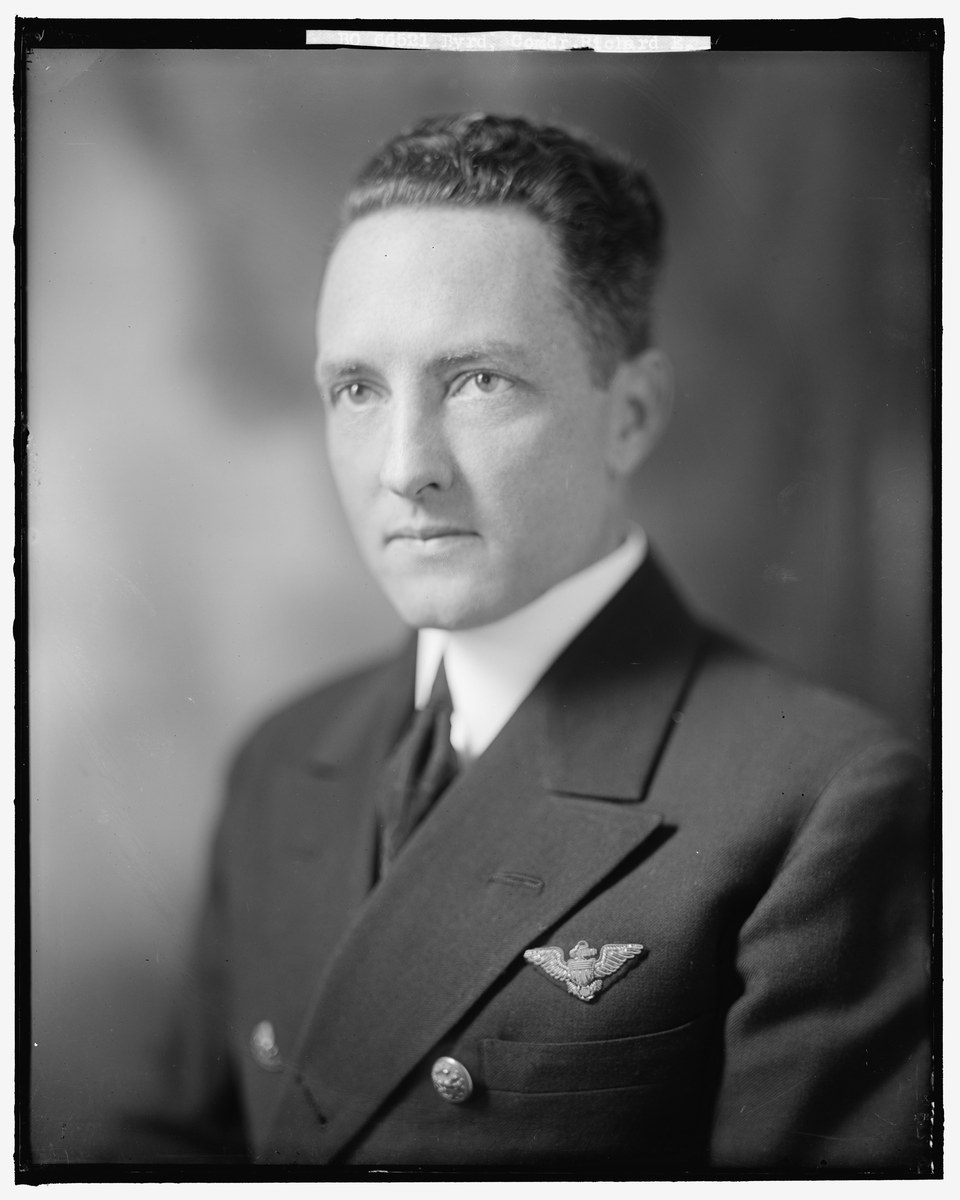
Richard Evelyn Byrd Jr., known throughout his public life as Admiral Byrd, commanded the United States Navy's polar aviation programmes through their formative decades. He claimed the first overflight of the North Pole in 1926, made the first verified flight over the South Pole in 1929, wintered alone at the Advance Base on the Ross Ice Shelf in 1934 and nearly died there, commanded Operation Highjump across the 1946 to 1947 Antarctic summer with thirteen ships and four thousand seven hundred men, and remained the United States' senior Antarctic authority through the International Geophysical Year preparations until his death in 1957. He is also the figure around whom the postwar hollow-Earth tradition assembled itself, an assemblage he did not invite and did not live long enough to refute.
A Life
Byrd was born on 25 October 1888 in Winchester, Virginia, into one of the state's old families. His mother Eleanor was a Bolling and traced descent from Pocahontas; his father Richard Sr. was a state legislator and federal attorney. The two surviving brothers, Tom and Harry, both became significant figures themselves, Harry as Governor of Virginia and a thirty-two-year United States Senator. Dick, as the family called him, was sent on a solo voyage to the Philippines at the age of twelve to visit his godfather, a federal judge in Manila, and returned having circled the globe by steamer and railway alone. The voyage became the seed of every story he wrote about himself for the rest of his life.
He took his commission at the Naval Academy at Annapolis in 1912. A football injury and a fall down a hatch left him with an ankle that would never properly support sea duty. Byrd was placed on the retired list in 1916 at the age of twenty-eight, recalled for the First World War, and assigned to aviation training at Pensacola in 1917. The Navy he could not walk on a pitching deck for, he could fly above. He earned his wings in 1918 and spent the war commanding the United States naval air station at Halifax, Nova Scotia, planning what would have been the first transatlantic flight had the Armistice not come first. The transatlantic flight was made the following year by the NC-4, a project Byrd had helped to design.
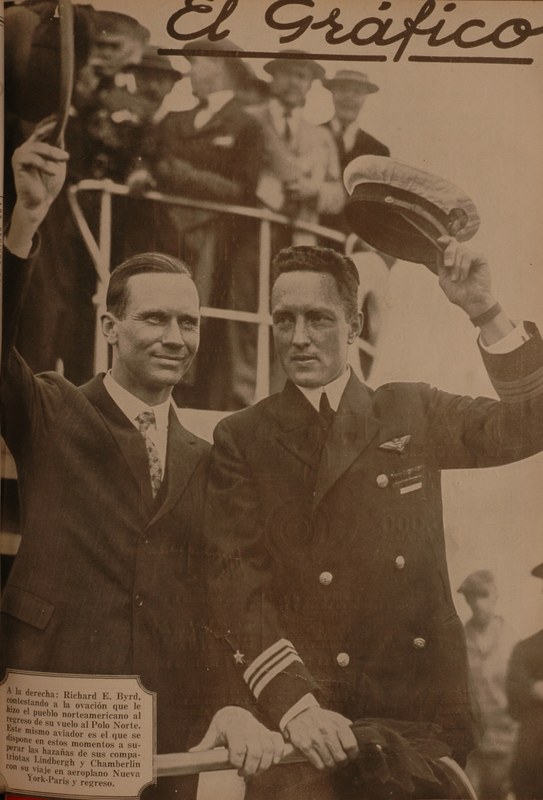
The 1920s were the polar years. Byrd attached himself to the 1925 MacMillan Expedition to Greenland and flew Loening amphibian biplanes from a base on Etah, mapping the Greenland coast for the National Geographic Society. The MacMillan voyage taught him two lessons: that polar flying was about to become a serious branch of aviation, and that whoever planted the United States flag at a pole first would carry it for life. On 9 May 1926 Byrd and his pilot Floyd Bennett took off from Spitsbergen in a Fokker trimotor named the Josephine Ford and returned to the same airfield fifteen hours and fifty-seven minutes later with a claim that they had overflown the North Pole. The claim made Byrd a national celebrity. It has been contested ever since.
The South Pole flight, by contrast, was not contested. Byrd's first Antarctic expedition wintered at Little America on the Ross Ice Shelf through 1929. On 28 and 29 November 1929 he flew a Ford trimotor with Bernt Balchen, Harold June and Ashley McKinley over the South Pole and returned without incident. Congress promoted him to Rear Admiral, jumping him over more senior officers. He was forty-one years old, and the most decorated polar aviator alive.
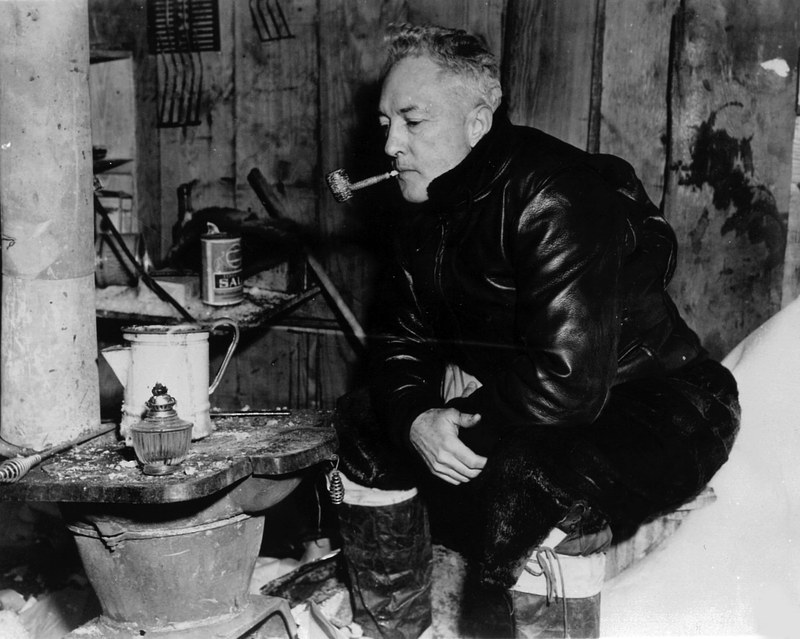
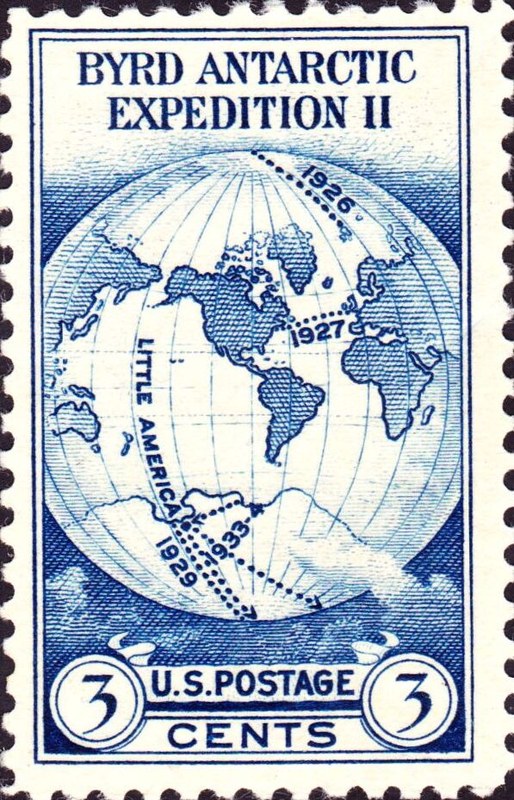
The Second Antarctic Expedition followed in 1933 to 1935. Byrd took 153 men, two aircraft, dog teams, and the expedition ship Bear of Oakland to Little America II. He spent the winter of 1934 alone at the Advance Base, a one-room hut buried in the ice 123 miles south of Little America, manning meteorological instruments and recording the long Antarctic night. The hut's stovepipe and ventilation were defective. Byrd was poisoned by carbon monoxide for weeks and concealed the fact in his radio reports to keep his men from a winter rescue mission across the unsurveyed shelf. He nearly died. He wrote about the experience in Alone (1938), which is the polar-exploration book that everyone who has ever written a polar-exploration book afterwards has read.
The Third Antarctic Expedition (1939 to 1940) was the United States Antarctic Service Expedition, the first federally funded American Antarctic operation. The Second World War interrupted everything. Byrd served as a senior naval planner through the war and undertook diplomatic missions to the Pacific theatre. He commanded Operation Highjump in the Antarctic summer of 1946 to 1947, the largest Antarctic expedition then mounted by any nation. He commanded Operation Deep Freeze, the United States Navy contribution to the 1957 to 1958 International Geophysical Year, until his death on 11 March 1957 at his home in Boston. He was sixty-eight.
I am hopeful that this archive of the polar regions will be a useful witness when men have at last learned to live together as the explorers do.Byrd, dedication to Discovery, 1935
Photographs
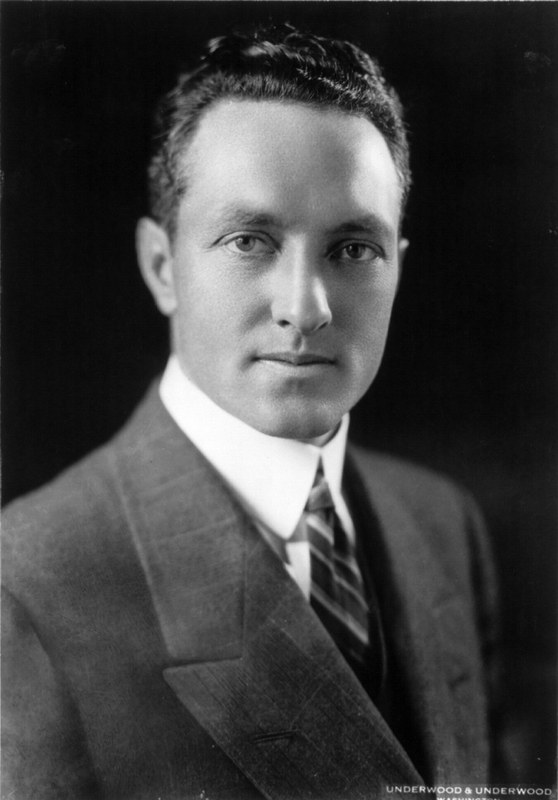
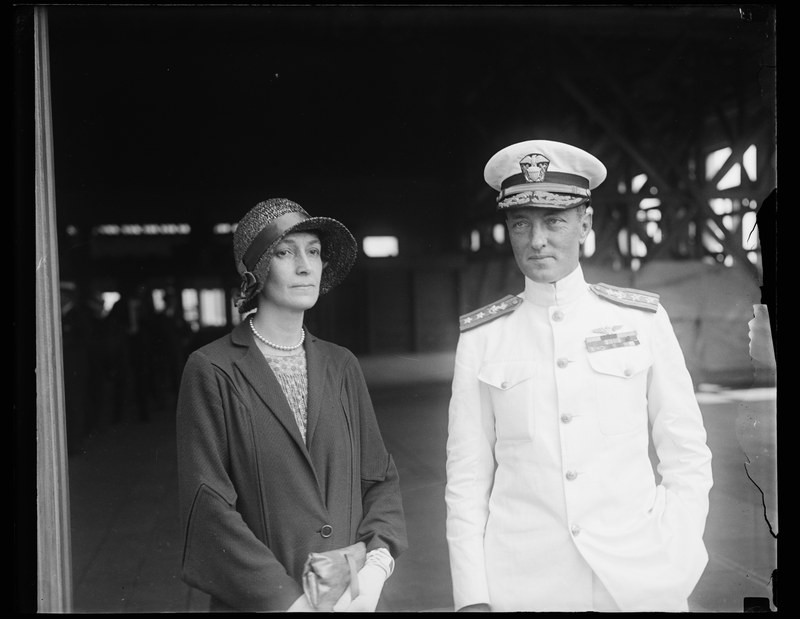
Byrd was photographed institutionally throughout his career. The National Geographic Society documented the 1925 MacMillan Expedition, the 1926 North Pole flight, the 1929 South Pole expedition, and the second Antarctic expedition. The United States Navy photographed Operation Highjump exhaustively. The Library of Congress holds substantial Byrd material, including the press photography of his returns from the poles. Most photographs of Byrd in the archive's possession are at sourcing-verification stage and are not yet EXIF-confirmed for display.
The North Pole Question, 9 May 1926
Byrd's North Pole claim rests on the navigation log he and Floyd Bennett produced from the Josephine Ford on 9 May 1926. The log records a flight from Spitsbergen to the Pole and back inside fifteen hours and fifty-seven minutes. The National Geographic Society reviewed the navigation in 1926 and certified the flight as having reached the Pole. Roald Amundsen, who flew the airship Norge over the Pole three days later with Lincoln Ellsworth and Umberto Nobile, publicly supported Byrd at the time. Bennett told the journalist Bernt Balchen privately in 1927 that the flight had turned back short of the Pole because of an oil leak. Balchen kept the conversation to himself until after both Byrd and Bennett were dead.
In 1996, Dennis Rawlins published an analysis of Byrd's original navigation diary, which had been donated to the Ohio State University after Byrd's death. The diary contains erased sextant entries that, when recovered photographically, are inconsistent with the published flight log. Rawlins concluded that the Josephine Ford had turned back roughly 150 miles short of the Pole. Other navigation historians have produced reconstructions that put the aircraft within margin of the Pole. The historical consensus as of the early twenty-first century is that the question is unresolved and that Byrd probably believed he had reached the Pole at the time he claimed it.
The 1926 flight diary is accession 56.1, Papers of Richard E. Byrd, Byrd Polar and Climate Research Center, Ohio State University. The sextant entries that Rawlins recovered photographically are at folio 36. The diary was kept in family possession from 1957 until donated to Ohio State in 1985. It had not been available to historians during Byrd's lifetime.
Operation Highjump, 1946 to 1947
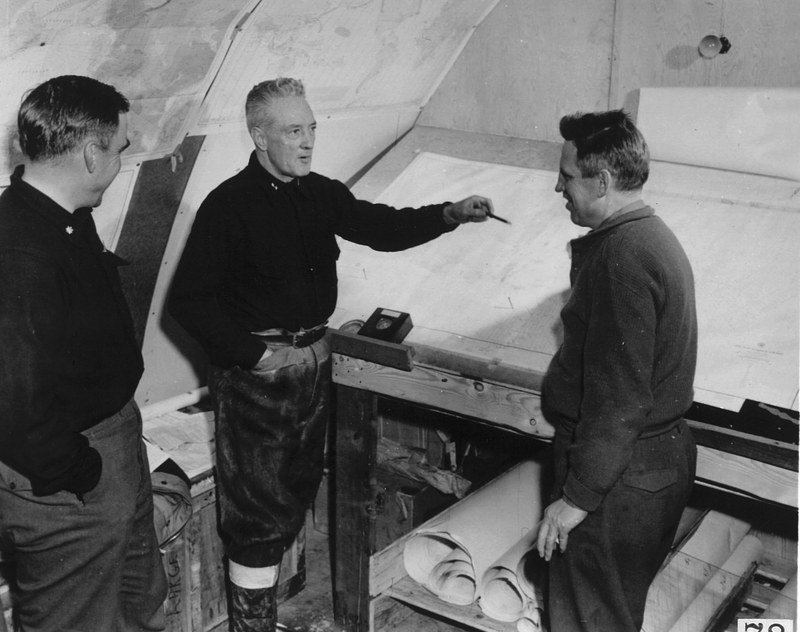
Operation Highjump was the largest Antarctic expedition mounted by any nation up to that time. It was a United States Navy operation, not a Byrd personal expedition, and Byrd held the title of Officer in Charge under the formal command of Rear Admiral Richard H. Cruzen. The task force comprised thirteen ships including the aircraft carrier USS Philippine Sea, the submarine USS Sennet, two seaplane tenders, supply ships, and the icebreakers USS Northwind and USS Burton Island. Four thousand seven hundred men sailed south. The operation ran from August 1946 through to the end of February 1947.
The official stated objectives were the training of personnel and equipment in Antarctic conditions, the consolidation of United States sovereignty over the Antarctic region, the testing of aircraft for polar operations, and the gathering of meteorological, geographical and magnetic data. The operation accomplished most of these objectives. Six naval aircraft were lost. Three sailors died, one in an aircraft accident on Thurston Island and two from operational hazards on the Ross Ice Shelf. The expedition mapped roughly 700,000 square miles of Antarctic coastline by photographic reconnaissance, including the Rockefeller Plateau and the Walgreen Coast.
Highjump was withdrawn earlier than originally planned, in late February 1947. The reason given in the operational record was the weather, which was deteriorating earlier than expected and was complicating ship handling around the ice edge. Byrd's published statement on return to the United States, in a press conference at the Naval Operating Base, Norfolk, on 5 March 1947, was that the expedition had been "a tremendous success" and that his recommendation was that the United States establish a permanent Antarctic research presence. That recommendation was implemented over the following decade as Operation Deep Freeze and the IGY Antarctic stations.
The early withdrawal of Highjump, the operation's military scale, and the timing relative to the postwar emergence of UFO reporting (Roswell occurred four months later, in July 1947) gave rise to a sustained postwar tradition that the expedition had encountered something extraordinary in the Antarctic that had forced its premature retreat. The contemporary documentary record does not support the claim. The Highjump operational reports are declassified and held at the National Archives Record Group 313.
A statement frequently attributed to Byrd in the contactee-tradition and hollow-Earth literature, that the United States must "take defensive action against polar invaders" or that "flying objects can fly from pole to pole at incredible speeds," is sometimes claimed to have appeared in El Mercurio of Santiago, Chile, in March 1947. The Chilean newspaper's actual coverage from that period addresses Soviet polar aviation capability and the question of whether the Soviet Union could route bombers across the Arctic into the Western Hemisphere. The statement as commonly quoted in the contactee literature is a paraphrase whose Antarctic-saucer reading is not present in the original Spanish. The transformation of the quotation into its now-familiar form is traceable to the 1960s American hollow-Earth literature, principally Raymond Bernard's 1964 The Hollow Earth.
Advance Base, 1934
Byrd spent four and a half months alone at the Advance Base hut on the Ross Ice Shelf, 123 miles south of Little America II, from March to August 1934. The Advance Base was intended as the southernmost meteorological station ever manned, recording temperatures, barometric pressure and aurora through the polar night. The hut was a single nine-by-thirteen-foot room buried in the ice with the entry trapdoor reached by a vertical ladder from a snow tunnel. Byrd took a four-month supply of food, a stove, a kerosene lantern, a radio set and his writing paper.
The stovepipe and the petrol generator vented carbon monoxide into the hut. By the end of May Byrd was severely ill and unable to keep his radio schedule reliably. He concealed the condition from Little America to prevent the men from attempting a tractor rescue across unsurveyed ice in the dark. The base radio operator at Little America, Dyer, noticed the irregular schedules but could not extract any specific complaint from Byrd. In August, with Byrd's condition continuing to deteriorate, Thomas Poulter and two others made the tractor journey south, found Byrd alive but severely weakened, and stayed with him until the spring relief operation in October.
Byrd's account of the experience, Alone, was published in 1938. The book is the founding text of the polar-solitude literature. It is read against the wider question of whether Byrd's writing across his career romanticised hardship in ways that obscured operational error: the Advance Base failure was, by Byrd's own later acknowledgement, a failure to inspect his stove and generator installations adequately before being left at the hut.
The Hollow-Earth Tradition
The hollow-Earth tradition as it attaches to Byrd is an entirely posthumous assemblage. Byrd died in March 1957. The "Inner Earth Diary" purportedly recording his entry into a subterranean civilisation through a polar opening did not appear in print until the 1960s. The text most often cited is a typescript that began circulating through American occult and contactee networks around 1964, the same year Raymond Bernard's The Hollow Earth was published. Bernard's book brought the Byrd-Inner-Earth material into mass circulation. The provenance of the "diary" itself has never been substantiated. The Byrd Polar and Climate Research Center, which holds Byrd's actual papers, has stated repeatedly that no such diary exists in the Byrd archives and that the typescript is not Byrd's writing.
The tradition's roots run back through the 1947 Antarctic operation. Wilhelm Landig, an Austrian SS veteran working in postwar Vienna, developed through the late 1940s and 1950s the mythology of a Nazi redoubt in Antarctica (the "Neuschwabenland" thesis), which by the 1960s had absorbed the hollow-Earth strand. American writers of the 1950s and 1960s, principally Ray Palmer at Amazing Stories and Bender at Space Review, carried the hollow-Earth material into the United States contactee press. Bernard's 1964 book consolidated the assemblage. The Byrd material was a relatively late addition to a tradition that had been assembling for two decades around different anchor points.
The tradition has continued to develop in successive waves, gaining momentum through internet publishing in the 1990s and 2000s, and is one of the longest-running postwar conspiracies attached to a real historical expedition. The archive holds the material as documentary record of the tradition rather than as adjudicated history of Byrd's expeditions. Byrd's own writings (the books, the press conferences, the operational reports) and the Byrd Polar and Climate Research Center accession at Ohio State are the documented record. The Bernard book and the inheritor literature are the inherited record.
The hollow-Earth tradition is documented in the archive's hollow-Earth movement page and runs through the Space Review collection (Bender's bulletin), the Amazing Stories material (Ray Palmer's Shaver-era issues), and various 1960s contactee bulletins. The actual operational record of Highjump is documented through the archive's United States government records hub, with National Archives Record Group 313 holding the Navy operational reports.
Connected People
United States Navy chief warrant officer who piloted the Josephine Ford on the 1926 North Pole flight with Byrd. Awarded the Medal of Honor jointly with Byrd. Died of pneumonia in 1928 on the way to a relief flight for the Bremen transatlantic crew. The 1927 private remark to Bernt Balchen that the flight had turned back short of the Pole is the principal evidence cited in the modern revisionist accounts.
Pilot of the Ford trimotor on Byrd's 1929 South Pole flight. Later commanded United States Army Air Force operations in Greenland during the Second World War. Carried Bennett's 1927 private remark about the North Pole flight for thirty years before disclosing it in his 1958 autobiography Come North With Me.
First to reach the geographic South Pole, 1911. Overflew the North Pole in the airship Norge on 12 May 1926 with Lincoln Ellsworth and Umberto Nobile, three days after Byrd's claim. Publicly endorsed Byrd's claim at the time and never revisited the question. Died on a 1928 Arctic rescue flight searching for Nobile, whose airship Italia had crashed on the ice.
Independently wealthy American who flew with Amundsen on the 1926 Norge flight, made the first transantarctic flight in 1935, and ran his own Antarctic expeditions in the late 1930s. The Byrd-Ellsworth relationship was correct rather than warm; they competed for the National Geographic Society's polar-exploration patronage through the interwar period.
The actual operational commander of Operation Highjump under whom Byrd served as Officer in Charge. Cruzen handled the day-to-day naval operation; Byrd handled the public face and the scientific direction. The distinction is consistently elided in the postwar hollow-Earth literature, which presents Highjump as a Byrd personal expedition.
Pen name of Walter Siegmeister, an American writer whose 1964 book The Hollow Earth brought the Byrd-Inner-Earth-diary tradition into mass circulation. Siegmeister had been publishing occult and contactee material since the 1930s and died in 1965, a year after the book's appearance, in South America. The book is the principal modern source of the hollow-Earth-Byrd tradition.
American science-fiction and contactee-era editor whose magazines (Amazing Stories from 1938 to 1949, then Fate from 1948) circulated the early hollow-Earth and Antarctic-redoubt material in the United States. The Shaver Mystery years at Amazing Stories seeded the wider hollow-Earth tradition that The Hollow Earth would consolidate fifteen years later.
Dick Byrd's elder brother. Governor of Virginia 1926 to 1930, United States Senator from Virginia 1933 to 1965, a dominant figure in southern Democratic politics. The Byrd political machine in Virginia provided the institutional backing for Byrd's expedition fundraising and for his promotion to Rear Admiral in 1929.
In the Archive
Byrd appears across four sections of the archive. The aviation-history and polar-exploration material treats him as a major figure of twentieth-century American expedition. The United States Navy operational record of Operation Highjump is held at the National Archives Record Group 313. The postwar hollow-Earth and Nazi-Antarctic-redoubt traditions, including the spurious "Inner Earth Diary," are documented through the contactee-era newsletter holdings and the Amazing Stories / Fate / Space Review editorial chains. The 1996 Dennis Rawlins navigation analysis and the wider polar-history revisionist literature are held in the archive's secondary-source library.
Lisle A. Rose's Explorer: The Life of Richard E. Byrd (2008) is the standard modern scholarly biography. Eugene Rodgers' Beyond the Barrier: The Story of Byrd's First Expedition to Antarctica (1990) covers the 1928 to 1930 expedition. The Byrd Polar and Climate Research Center at Ohio State University holds the Byrd papers and is the primary archival repository.
Sources
Byrd, Richard E. Skyward, 1928. Byrd, Richard E. Little America, 1930. Byrd, Richard E. Discovery: The Story of the Second Byrd Antarctic Expedition, 1935. Byrd, Richard E. Alone, 1938. Rose, Lisle A. Explorer: The Life of Richard E. Byrd, University of Missouri Press, 2008. Rodgers, Eugene. Beyond the Barrier: The Story of Byrd's First Expedition to Antarctica, Naval Institute Press, 1990. Balchen, Bernt. Come North With Me: An Autobiography, 1958. Rawlins, Dennis. "Byrd's Heroic 1926 North Pole Failure," DIO: The International Journal of Scientific History, vol. 10, 2000. Operation Highjump operational reports, National Archives Record Group 313, declassified. Byrd Polar and Climate Research Center, Ohio State University, accession 56.1 (Papers of Richard E. Byrd). Bernard, Raymond. The Hollow Earth, Fieldcrest Publishing, 1964 (documentary record of the inherited tradition, not the documented expedition record).