Historical Archive
Encyclopædia Britannica Confidential Report: Flying Saucers (1953)
A confidential briefing prepared by the Library Research Service for client L.J. Monk Esq.
Encyclopædia Britannica Ltd., London • Confidential Report for L.J. Monk Esq. • From the NHI Held Archive
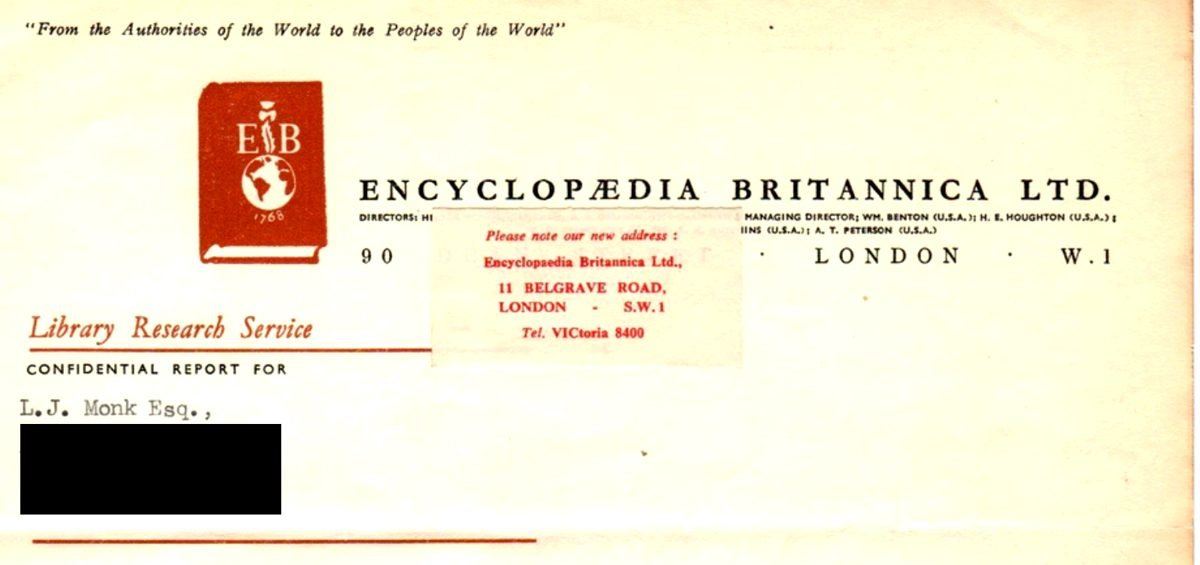
In the early 1950s, Encyclopædia Britannica Ltd. ran a separate Library Research Service that prepared confidential reports for private clients. Staffed by trained library researchers (distinct from the main editorial team), the service pulled from published sources believed to be reliable and compiled neutral overviews on request.
This seven-page report, titled simply Flying Saucers, was produced for a British client identified only as “L.J. Monk Esq.” Internal references to a July 20, 1953 Aviation Week article date it to mid-1953 or shortly after, right at the height of the early flying-saucer wave. The physical copy reproduced here belongs to the archive and is digitised here from the NHI Held Archive.
Pre-1947 Sightings: “Flying Saucers Are Old Stuff”
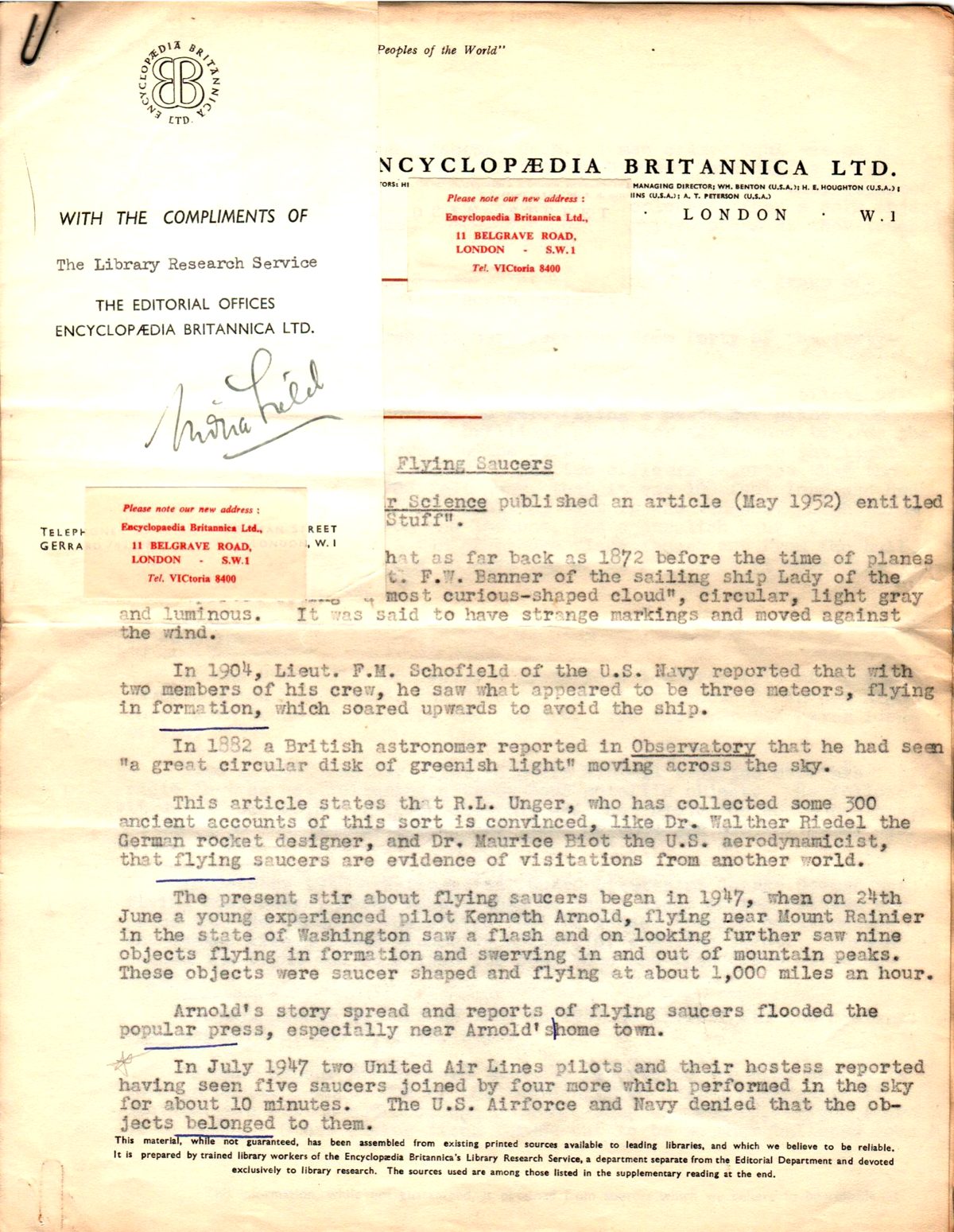
Rather than beginning with Kenneth Arnold, the report starts by showing the phenomenon has a much longer history. Citing a May 1952 Popular Science article, it recounts Capt. F.W. Banner’s 1872 sighting from the sailing ship Lady of the Lake: a circular, luminous, light-grey object with strange markings that moved against the wind. It also notes an 1882 British astronomer’s observation of a “great circular disk of greenish light” published in Observatory, and a 1904 U.S. Navy report by Lt. F.M. Schofield of three meteor-like objects flying in formation that climbed to avoid his ship.
The researchers mention R.L. Unger, who had collected around 300 historical accounts, and note that he, along with German rocket designer Dr. Walther Riedel and U.S. aerodynamicist Dr. Maurice Biot, believed these objects indicated visitations from another world. The tone remains neutral, one viewpoint among many.
The 1947-1948 Wave
The modern flap begins with pilot Kenneth Arnold’s sighting on June 24, 1947, near Mount Rainier, Washington. Arnold reported nine bright, saucer-shaped objects flying in formation at an estimated 1,000 mph. His story triggered a flood of similar reports.
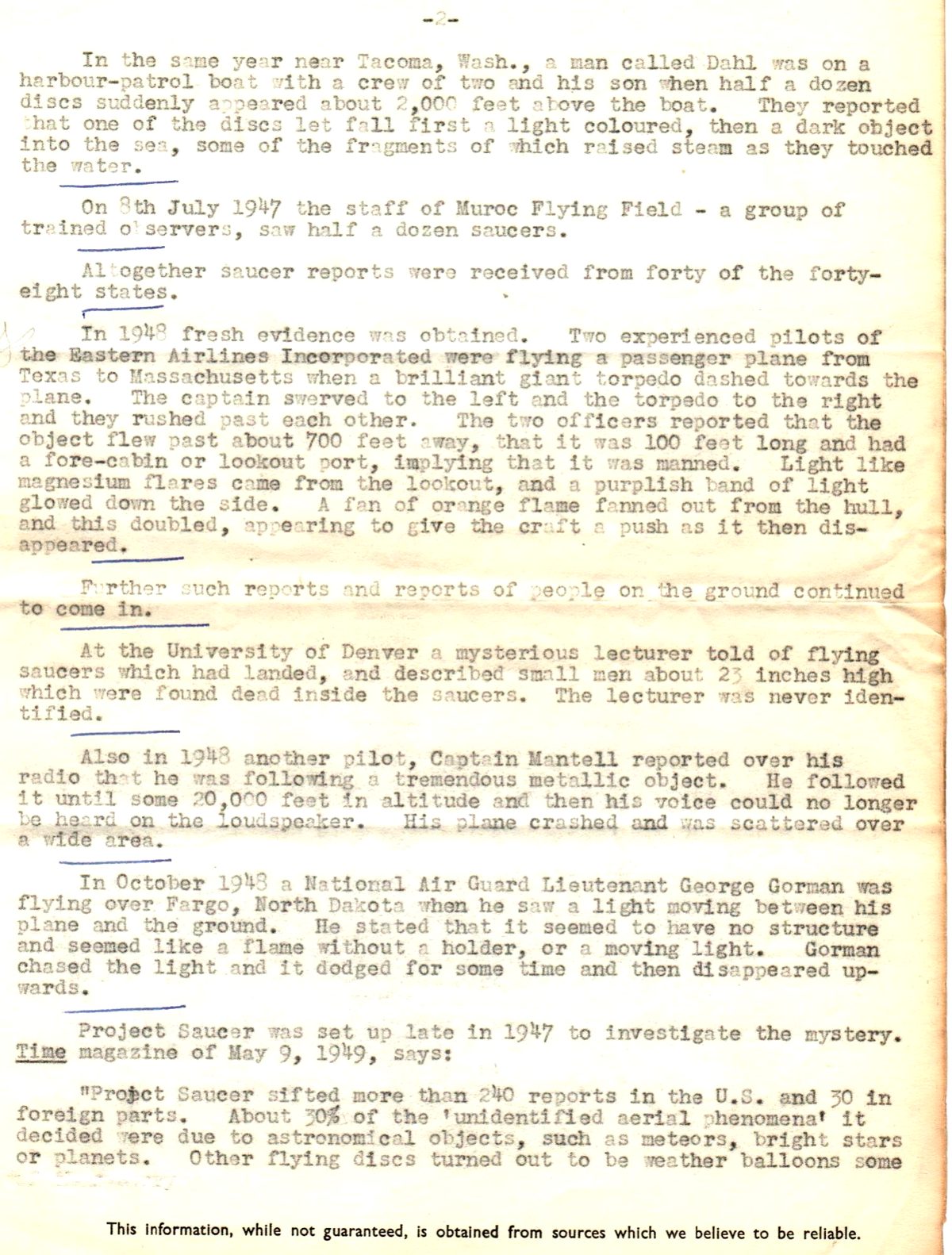
The document records several high-profile cases in quick succession. In July 1947, two United Air Lines pilots and their hostess watched five discs joined by four more, performing manoeuvres for about ten minutes. In the same period near Tacoma, Washington, harbour patrol boat operator Harold Dahl reported six discs overhead; one dropped light and dark debris into the water that produced steam on impact. On July 8, 1947, trained observers at Muroc Flying Field saw half a dozen saucers.
In 1948 the reports grew more dramatic. Two Eastern Airlines pilots described a 100-foot “giant torpedo” with a lighted fore-cabin that passed within 700 feet of their passenger plane. Captain Thomas Mantell chased a “tremendous metallic object” to 20,000 feet before losing radio contact; his plane crashed and scattered across a wide area. National Air Guard Lt. George Gorman engaged in a prolonged chase with a glowing, structureless light over Fargo, North Dakota.
Project Saucer and the Official View
Late in 1947 the U.S. Air Force launched Project Saucer (later Project Sign) to investigate. According to Time magazine (May 9, 1949), analysts reviewed more than 240 U.S. reports and 30 foreign ones. Roughly 30% were explained as astronomical objects, meteors, stars, planets. Many others were weather balloons, cosmic-ray research balloons, reflections, or hoaxes.
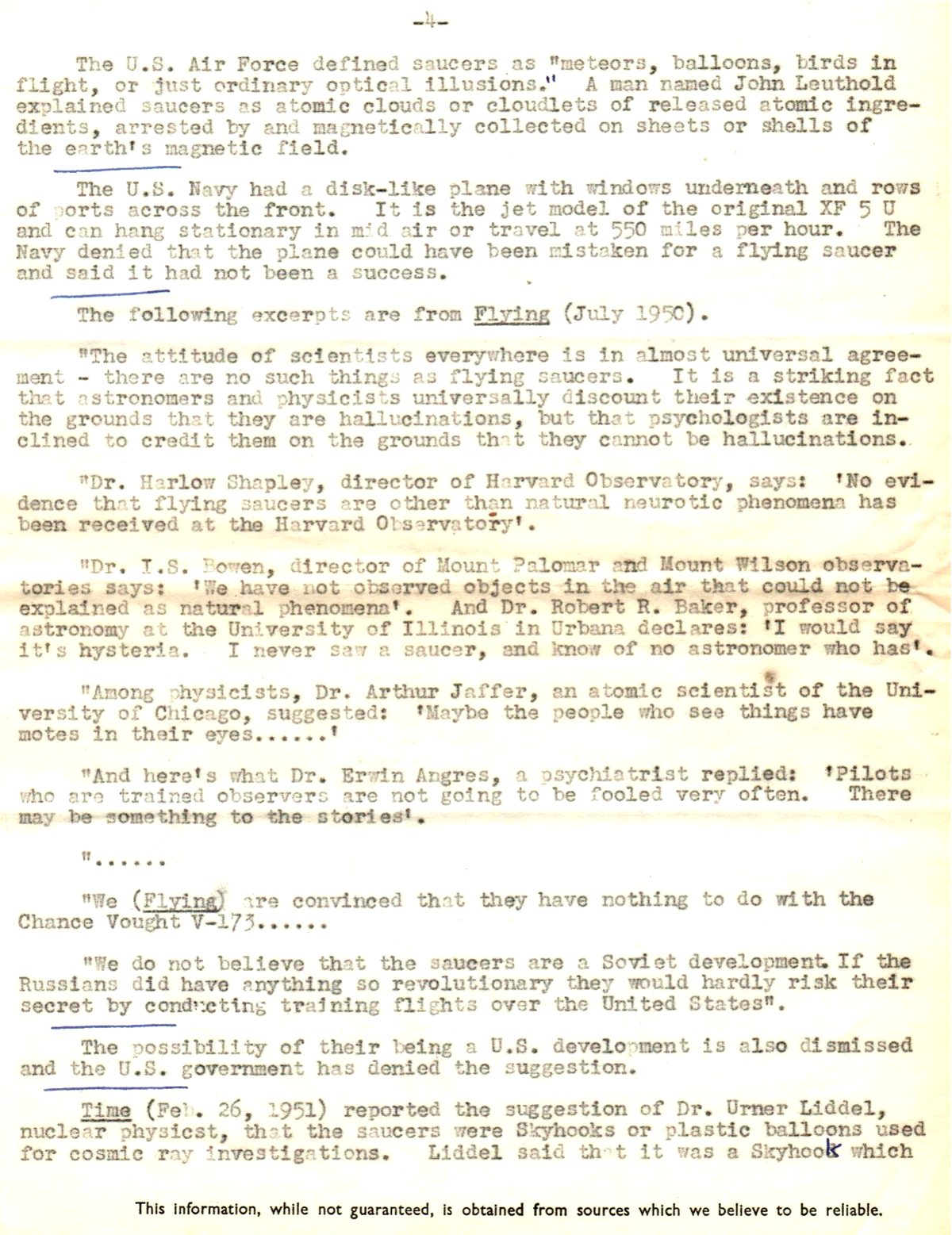
The Air Force’s public position was straightforward: saucers were “meteors, balloons, birds in flight, or just ordinary optical illusions.” On the hardware side, the U.S. Navy had its own experimental disk-shaped aircraft, the jet model of the original XF 5 U, capable of hanging stationary in mid-air or travelling at 550 mph. The Chance-Vought V-173, a saucer-shaped fighter plane, is also noted, along with the 1910 “Secret Circle Aeroplane” and various diamond-shaped prototypes. The Navy denied any of these could have been mistaken for flying saucers.
What the Scientists Said
Drawing from Flying magazine (July 1950), the report shows near-universal scientific scepticism. Astronomers including Dr. Harlow Shapley (Harvard), Dr. I.S. Bowen (Palomar/Wilson), and Dr. Robert R. Baker (Illinois) dismissed the sightings as hallucinations, hysteria, or natural phenomena. Physicist Dr. Arthur Jaffer suggested observers might simply have “motes in their eyes.”
A rare counterpoint came from psychiatrist Dr. Erwin Angres, who noted that trained pilots were unlikely to be fooled repeatedly and that “there may be something to the stories.” Flying magazine itself ruled out the Chance-Vought V-173, and judged a Soviet origin unlikely, the Russians would hardly risk their secret by conducting training flights over the United States.
Dr. Donald Menzel’s Mirage Explanation
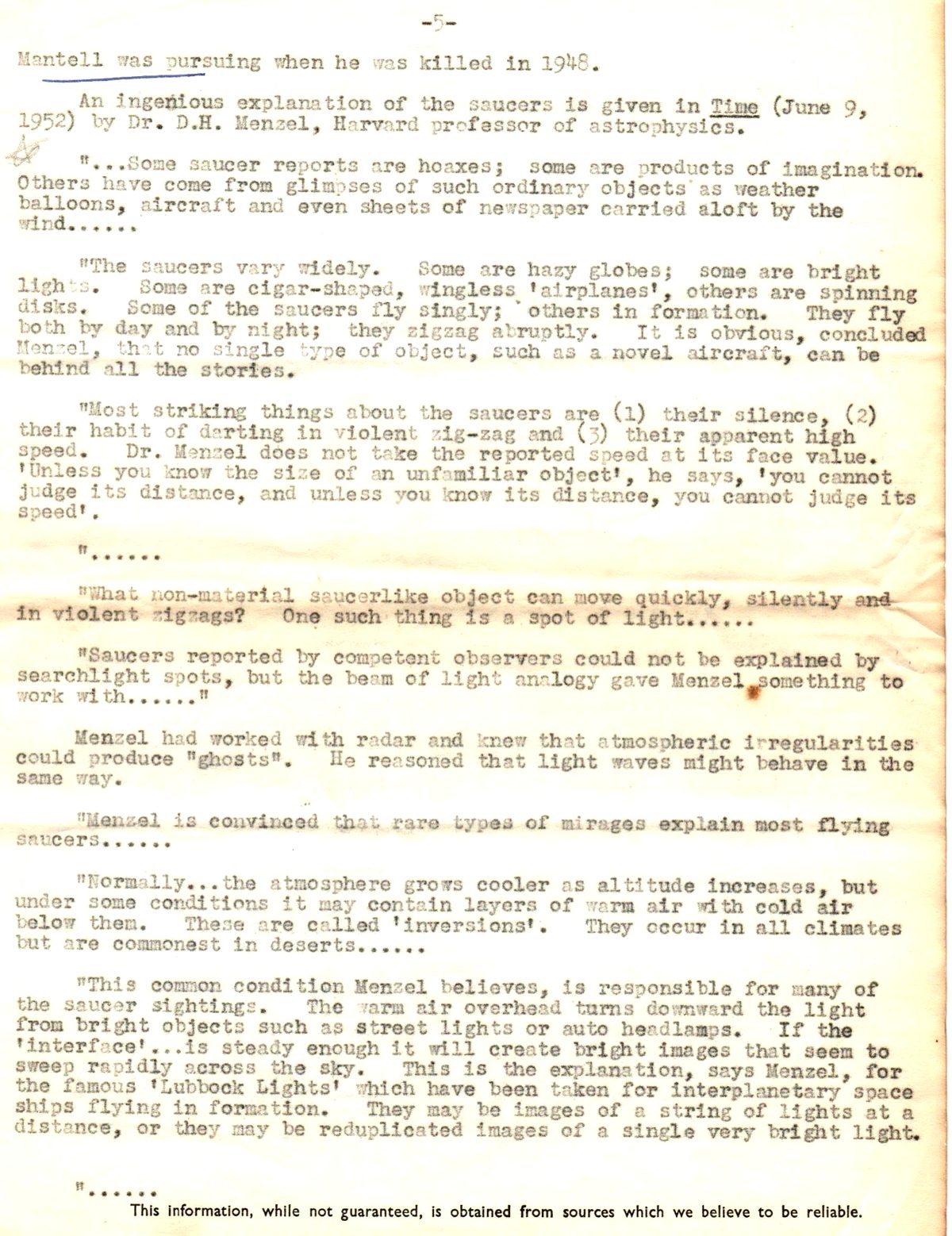
Considerable space is given to Harvard astrophysicist Dr. Donald H. Menzel’s theory, published in Time (June 9, 1952). Menzel argued that most sightings resulted from rare atmospheric mirages caused by temperature inversions, layers of warm air over cold air that bend light and create moving, silent, zigzagging “objects.”
He pointed out the wide variety of descriptions, hazy globes, bright lights, cigar shapes, spinning disks, objects flying singly or in formation, made a single secret aircraft unlikely. Three characteristics stood out: the silence, the violent zigzag manoeuvres, and the apparent high speed, though Menzel cautioned that without knowing an object’s size, you cannot judge its distance, and without knowing its distance, you cannot judge its speed.
Menzel proposed atmospheric inversions as the explanation for the Lubbock Lights, which had been interpreted as interplanetary spacecraft flying in formation. He was confident enough in his theory that, after satisfying himself by mathematical analysis, he set about generating small-scale flying saucers in his basement laboratory.
Washington, D.C., The 1952 Radar Incident
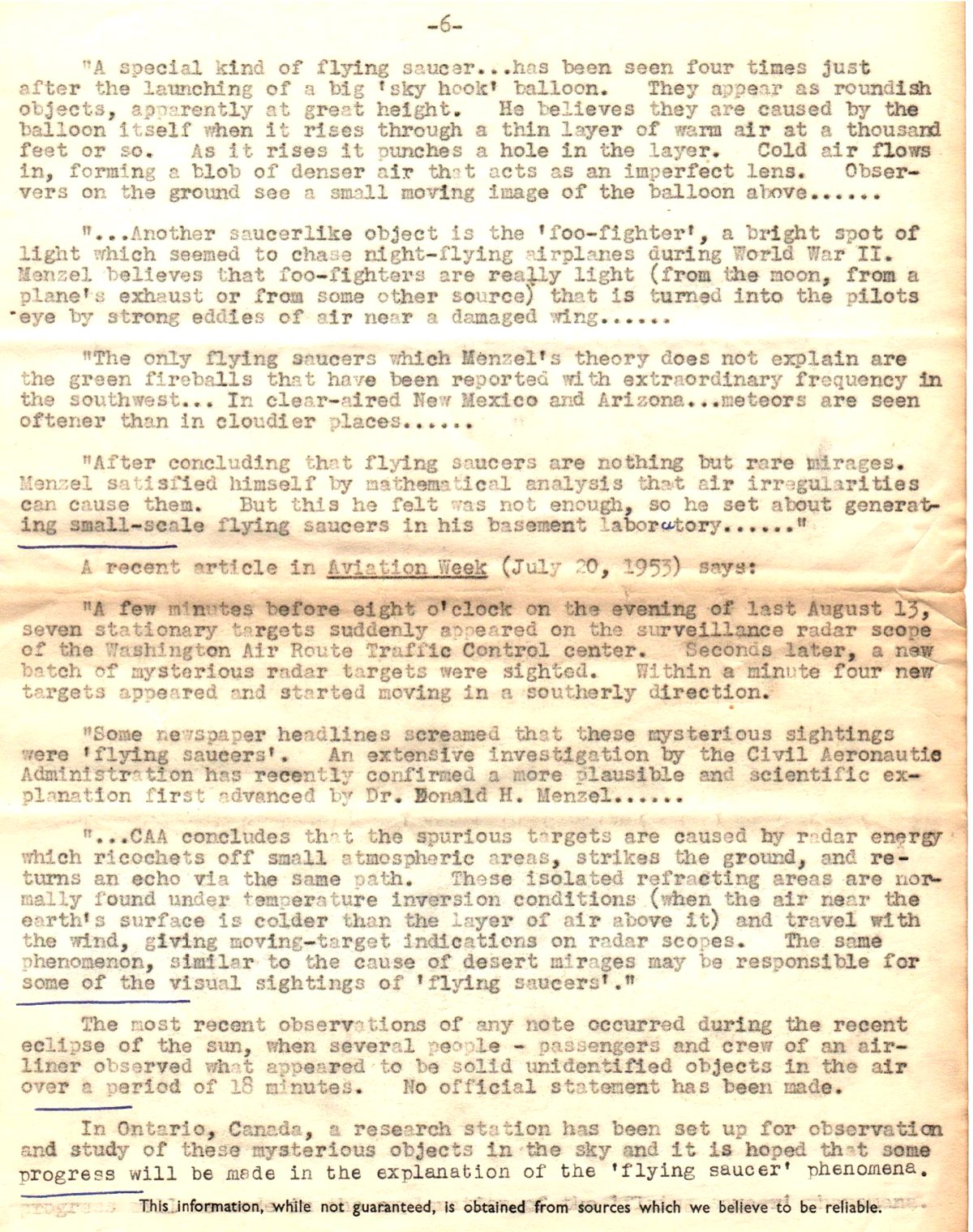
The final major episode comes from Aviation Week (July 20, 1953). On the evening of August 13, seven stationary targets suddenly appeared on the surveillance radar scope of the Washington Air Route Traffic Control centre. Seconds later, a new batch of mysterious targets appeared. Within a minute, four more showed up and began moving south.
Newspaper headlines screamed “flying saucers,” but the Civil Aeronautic Administration confirmed a more prosaic explanation: radar energy ricocheting off small atmospheric areas under temperature-inversion conditions, striking the ground and returning an echo. These refracting areas travelled with the wind, producing moving-target indications on the scopes, the same phenomenon, at a different scale, that Menzel had proposed for visual sightings.
The Final Entries
Two brief items close out the report. During a recent solar eclipse, passengers and crew of an airliner observed what appeared to be solid unidentified objects in the air over a period of 18 minutes; no official statement was issued. And in Ontario, Canada, a research station had been established to observe and study these mysterious objects, with the hope that some progress would be made.
No conclusion is drawn. No verdict is offered. The Library Research Service had done its job: compile the evidence, present the competing explanations, and let the client decide.
See also: Flying Saucer Review Issue #8 (Feb 1953)
About the Source
Title: Flying Saucers
Publisher: Library Research Service, Encyclopædia Britannica Ltd., 11 Belgrave Road, London S.W.1
Prepared for: L.J. Monk Esq. (Confidential Report)
Date: c. 1953 (internal evidence: references Aviation Week, July 20, 1953)
Pages: 7 typed pages + compliments slip
Sources cited: Popular Science, Time, Flying, Aviation Week, The Book of Flying (ed. C. Wallace), Observatory
Archive: NHI Held Archive
This material was compiled by trained library workers of the Encyclopædia Britannica’s Library Research Service, a department separate from the Editorial Department and devoted exclusively to library research.