Historical Archive
Flying Saucer Review, Issue #8, February 1953
America’s first civilian UFO research magazine, published from a Brooklyn post office box
Published by Elliot Rockmore • G.P.O. Box 853, Brooklyn 1, N.Y. • Printed January 22, 1953 • From the NHI Held Archive
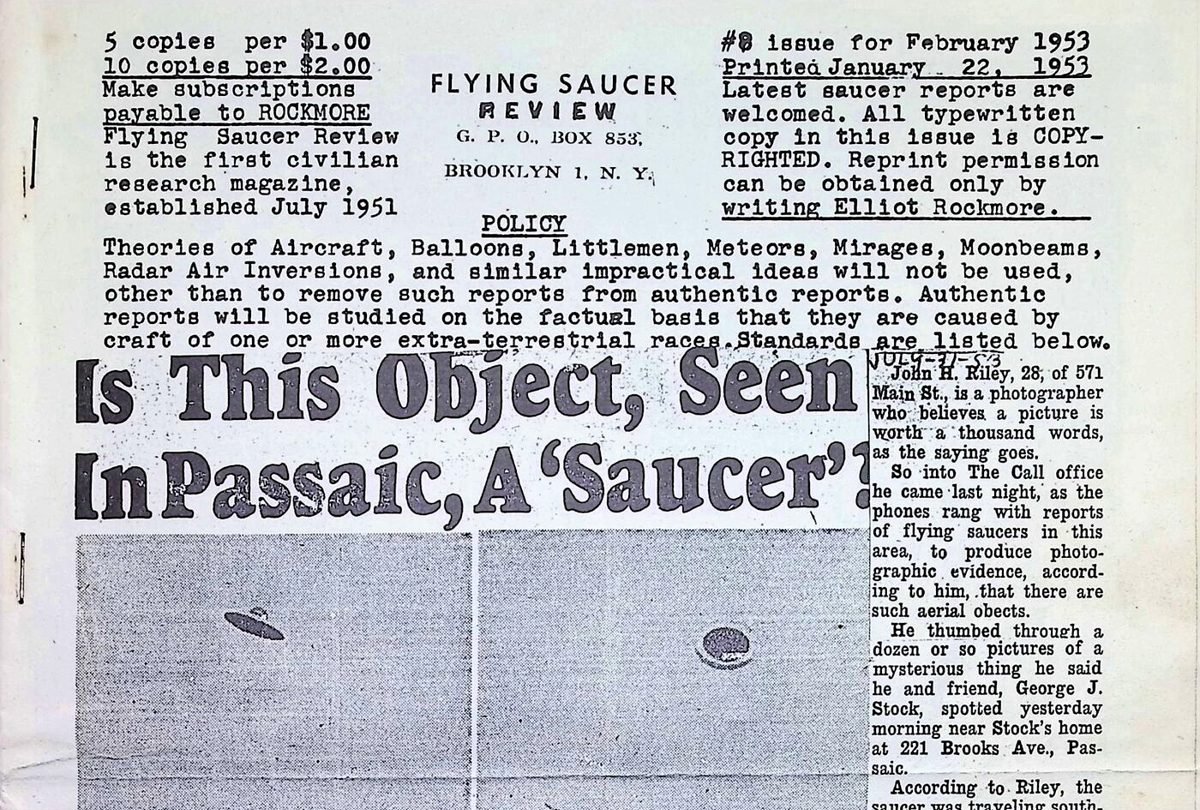
In July 1951, Elliot Rockmore began publishing what he called America’s first independent civilian magazine devoted entirely to flying saucers. Operating out of G.P.O. Box 853, Brooklyn 1, N.Y., the Flying Saucer Review was a typewritten, mimeographed newsletter sold five copies for a dollar. It had no government, military, or institutional backing, just one man compiling and analysing sighting reports at his own expense.
This is Issue #8, cover-dated February 1953 and printed on January 22, 1953. The fourteen-page issue is packed with 48 numbered sighting reports, analytical commentary, statistical breakdowns, newspaper clippings, and reproduced photographs. The physical copy reproduced here is from the NHI Held Archive.
The Editorial Policy
The front page carries a policy statement declaring that “impractical ideas”, aircraft, balloons, little men, meteors, mirages, moonbeams, radar inversions, and similar explanations, would only be used to screen out false reports. All authentic sightings, Rockmore stated, would be studied on the factual basis that they were caused by craft belonging to one or more extraterrestrial races. He offered no competing hypotheses, genuine saucer reports were treated as extraterrestrial by editorial fiat.
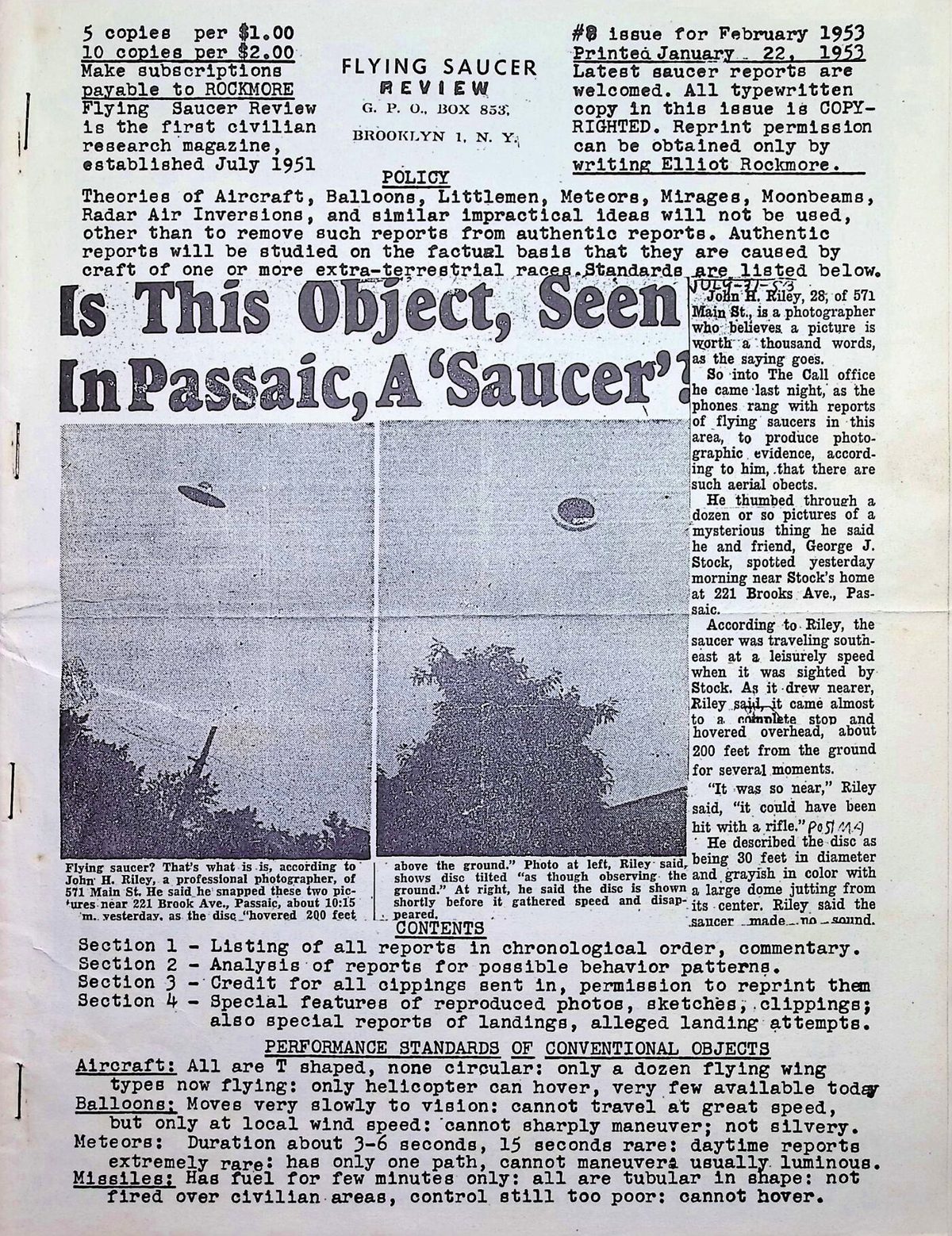
“Is This Object, Seen in Passaic, A ‘Saucer’?”
The cover is dominated by two photographs taken in July 1952 by professional photographer John H. Riley of Passaic, New Jersey. Riley and his friend George J. Stock spotted a grayish, dome-shaped object about 30 feet across hovering at roughly 200 feet. Riley described it moving southeast at a leisurely pace before stopping almost completely overhead. The photos show a clear disc with a central dome, one image tilted as if observing the ground, the other just before it accelerated and vanished. No sound was reported.
Performance Standards of Conventional Objects
Rockmore included a handy reference chart listing the known limits of aircraft, balloons, meteors, and missiles of the era. Aircraft were T-shaped (only a handful of flying-wing types existed), balloons drifted only with the wind, meteors lasted seconds, and missiles were tubular and not flown over populated areas. Any object that broke all these rules was, by his standards, a genuine saucer.
The Sighting Log, 48 Reports in 23 Days
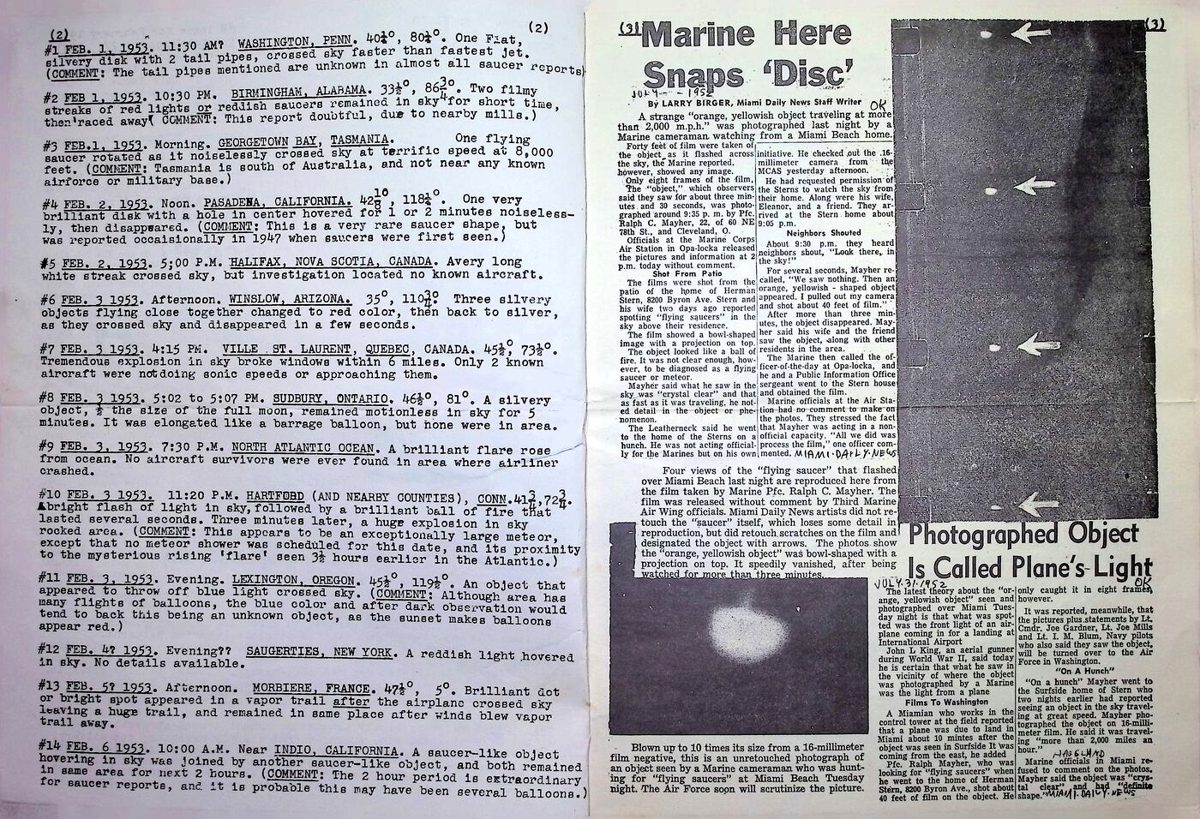
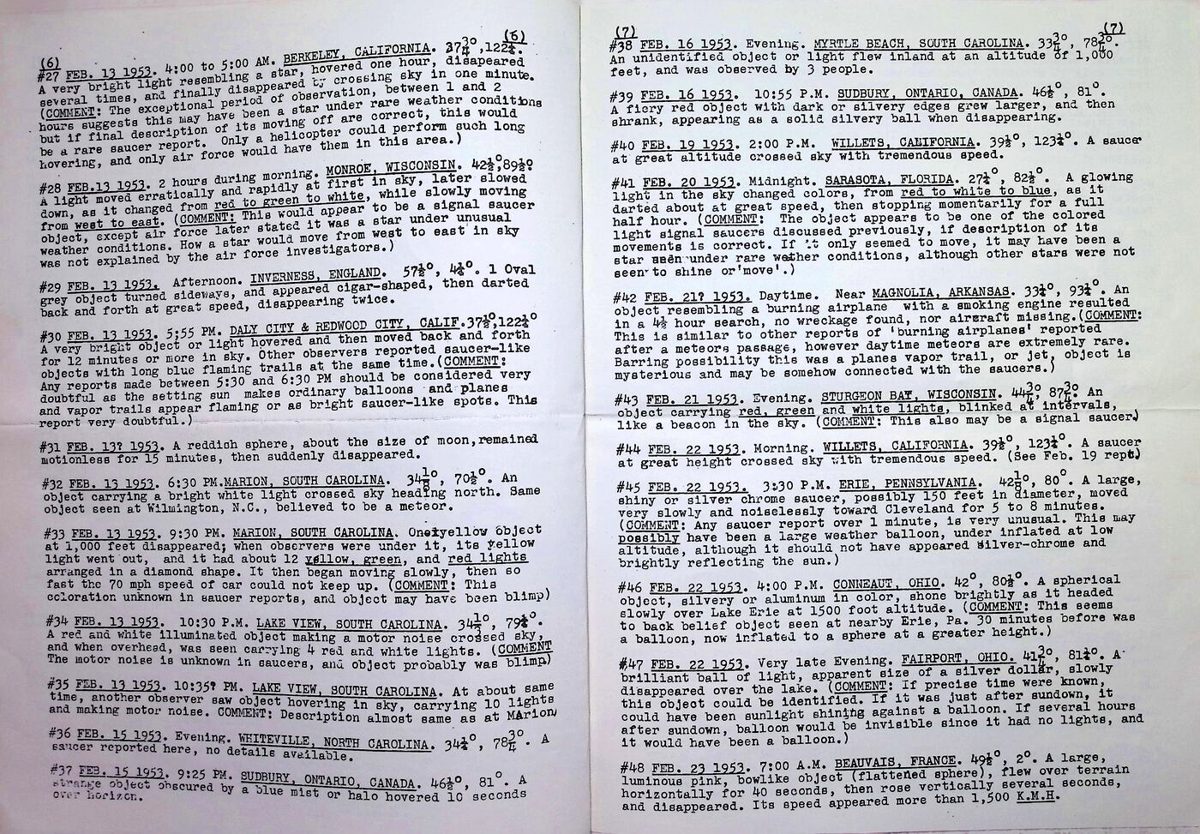
The core of the issue is a detailed chronological log of every report received between February 1 and February 23, 1953. Each entry includes date, time, precise location with latitude and longitude, a description, and Rockmore’s own sharp “COMMENT” notes.
The sightings span the United States, Canada, France, England, Tasmania, and Southern Rhodesia. Some are quickly dismissed (e.g., near industrial mills or likely balloons), while others are flagged as strong unknowns. Highlights include:
- A rotating saucer at 8,000 feet over Georgetown Bay, Tasmania.
- A tremendous explosion in Ville St. Laurent, Quebec that shattered windows six miles away.
- A marine pilot near Cherry Point, North Carolina who watched a saucer with red side lights for 30 minutes before it raced off at 500 mph and vanished in a flash.
- A cigar-shaped object over Inverness, England.
- Multiple reports of lighted, manoeuvring discs that far exceeded the performance of any known aircraft.
Newspaper Clippings
Rockmore scattered contemporary press reports throughout the issue for corroboration. Standouts include the Miami Daily News story of Marine Pfc. Ralph C. Mayher photographing an orange, bowl-shaped object travelling at over 2,000 mph, and various accounts of objects changing colours, hovering for hours, or being chased by jets.
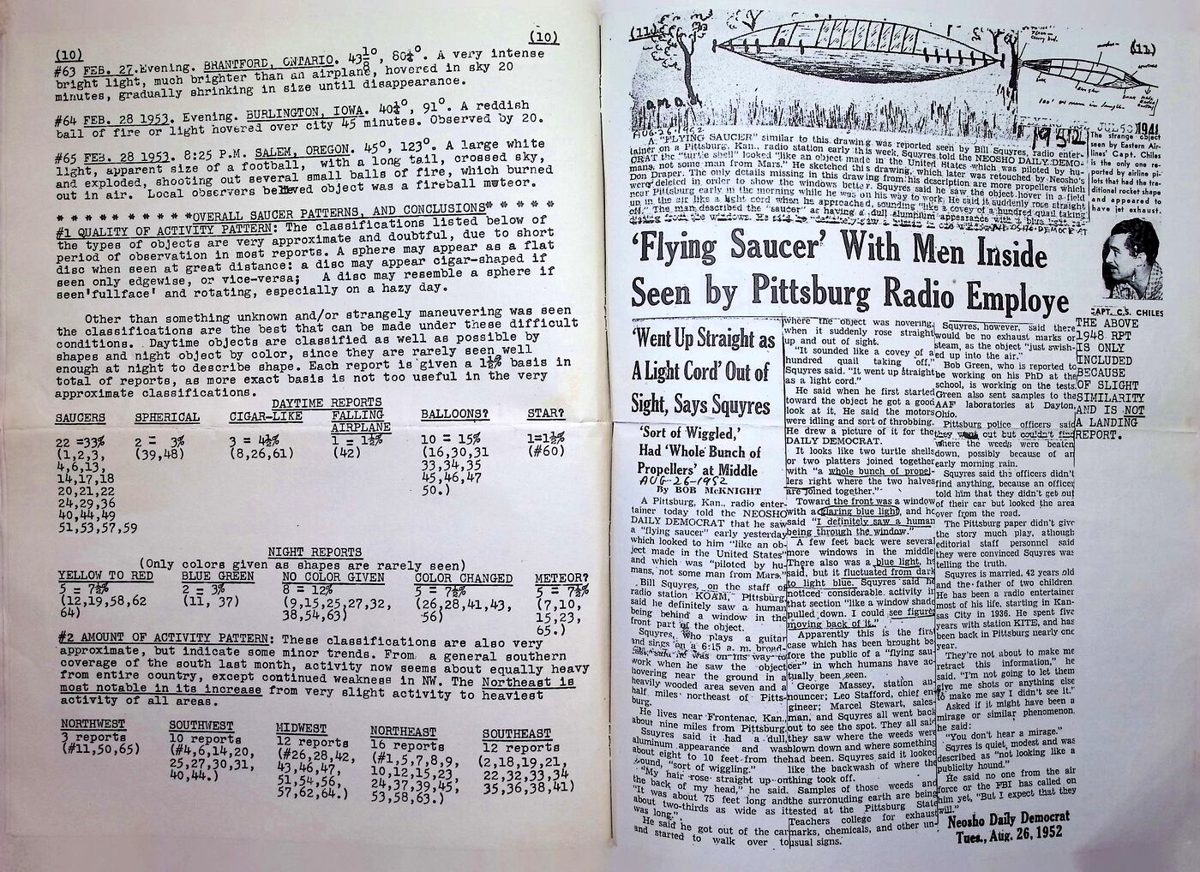
Perhaps the most dramatic clipping is from the Pittsburgh Sun-Telegraph (October 28, 1952), headlined “‘Flying Saucer’ With Men Inside Seen by Pittsburg Radio Employe.” It includes a hand-drawn illustration of a cigar-shaped craft with a red band, a light cord extending from it, and what the witness described as figures visible inside. The witness reported the object went straight up and out of sight.
Statistical Analysis and Shape Classification
Rockmore didn’t simply compile reports, he analysed them. The issue includes a statistical breakdown of object shapes observed across all reports, categorising sightings by form: saucer, ball, light, cigar, fireball, and other variants. He also maintained separate tallies for reports identified as probable balloons and probable stars, systematically filtering out conventional explanations before drawing conclusions about the remainder.
This analytical rigour, rudimentary by modern standards but remarkable for a one-person operation in 1953, anticipated the kind of systematic cataloguing that later organisations like NICAP and MUFON would adopt. Rockmore was, in effect, building a database by hand, one issue at a time.
Special Features, Pattern Analysis
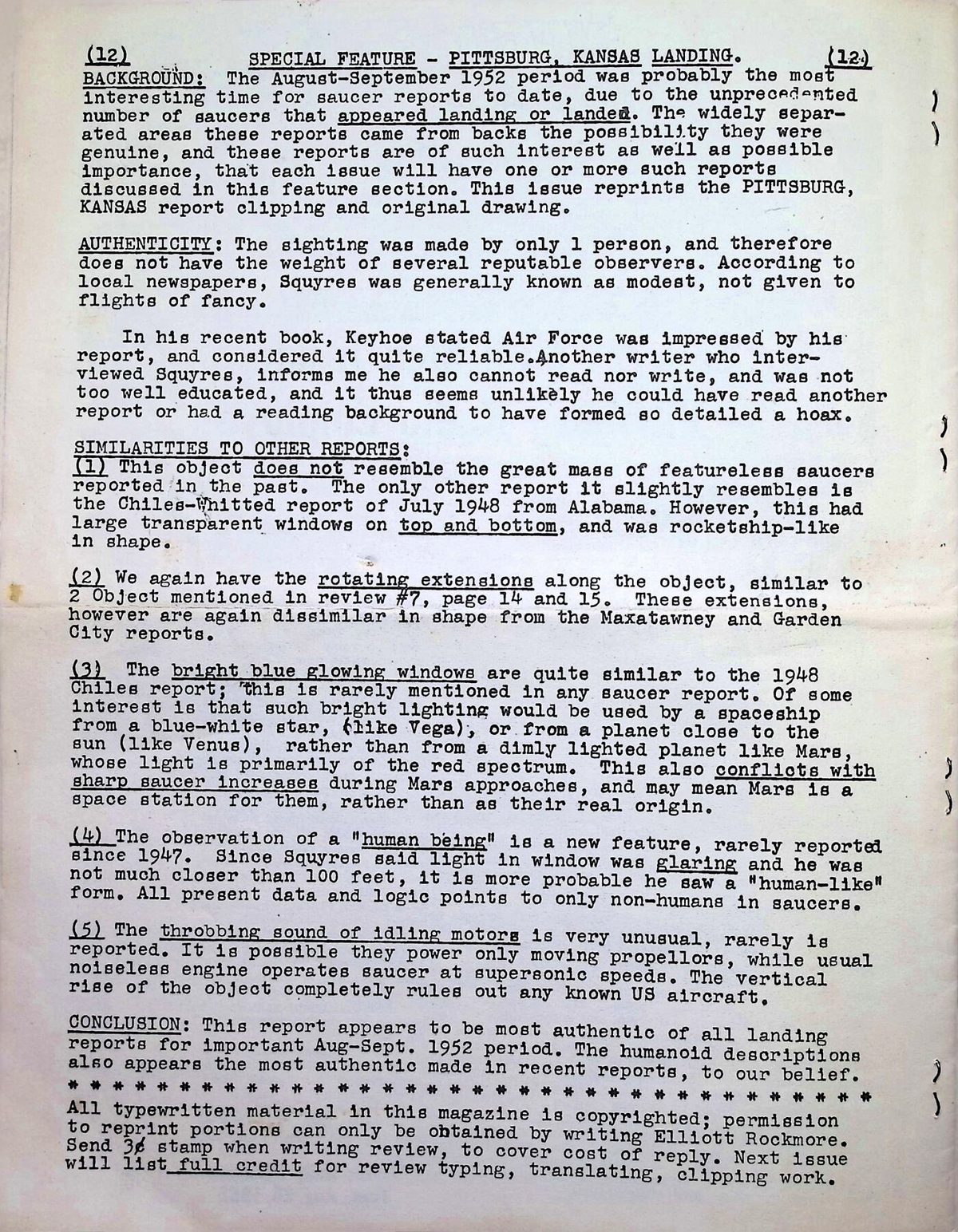
The final pages step back from individual reports to identify emerging patterns. Rockmore notes that the August-September 1952 period produced the greatest concentration of saucer reports to date. He discusses the Passaic photographs and the Mayher film in greater analytical detail, and observes that the Pittsburgh “men inside” report closely resembles the Chiles-Whitted Eastern Airlines encounter of 1948.
His pattern observations are sharp. The great mass of featureless saucers reported in earlier years had begun giving way to reports with more structural detail. He flags what he calls the “funny tunnel”, a feature described in multiple 1952-53 reports where a tube or cord-like projection extended from the craft. Landing attempts and near-ground sightings were becoming more frequent. Objects observed closer than 100 feet were more likely to be described as having a “Frisonne-like” rim. Reported sounds and visible exhaust remained very unusual across all reports.
See also: Encyclopædia Britannica Confidential Report on Flying Saucers (1953)
About the Source
Title: Flying Saucer Review, Issue #8
Period: February 1953 (Printed January 22, 1953)
Publisher: Elliot Rockmore, G.P.O. Box 853, Brooklyn 1, N.Y.
Established: July 1951, described as “the first civilian research magazine”
Price: 5 copies for $1.00 / 10 copies for $2.00
Contents: 48 sighting reports (Feb 1-23, 1953), photographic evidence, newspaper clippings, statistical analysis, pattern observations
Archive: NHI Held Archive
Note: This is not the British Flying Saucer Review (est. 1955), which was a separate and unrelated publication. Rockmore’s Brooklyn-based magazine predates it by four years.