Civilian Information Brief for Flying Saucer Researchers
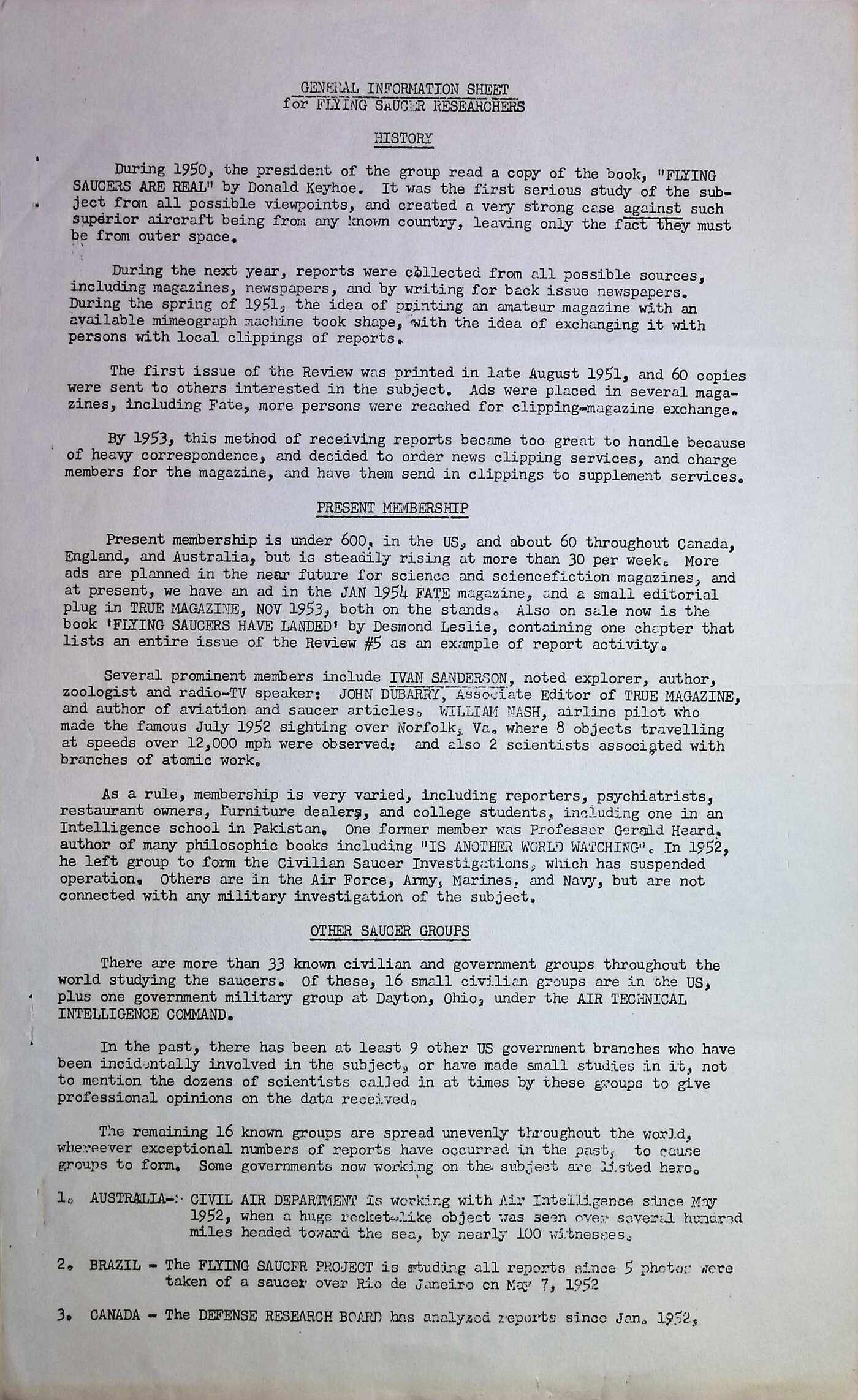
The Flying Saucer Researchers was an American civilian-research group formed in 1950 by Donald Keyhoe, the same Keyhoe whose 1950 book Flying Saucers Are Real had given the post-Roswell American civilian-research movement its principal text. The group's first Review was printed in approximately sixty copies in August 1951. By 1953 the membership was approaching 600 in the United States and 60 internationally, with growth of approximately thirty new members per week and advertising in Fate Magazine (January 1954) and True Magazine (November 1953). The General Information Sheet held by the archive is the documented 1952 to 1953 working methodology statement, distributed to prospective members. It is the English-language documentary record of the early-1950s American civilian-research methodology before the NICAP founding of January 1956 and the APRO founding at Tucson Arizona in 1952.
About the Item
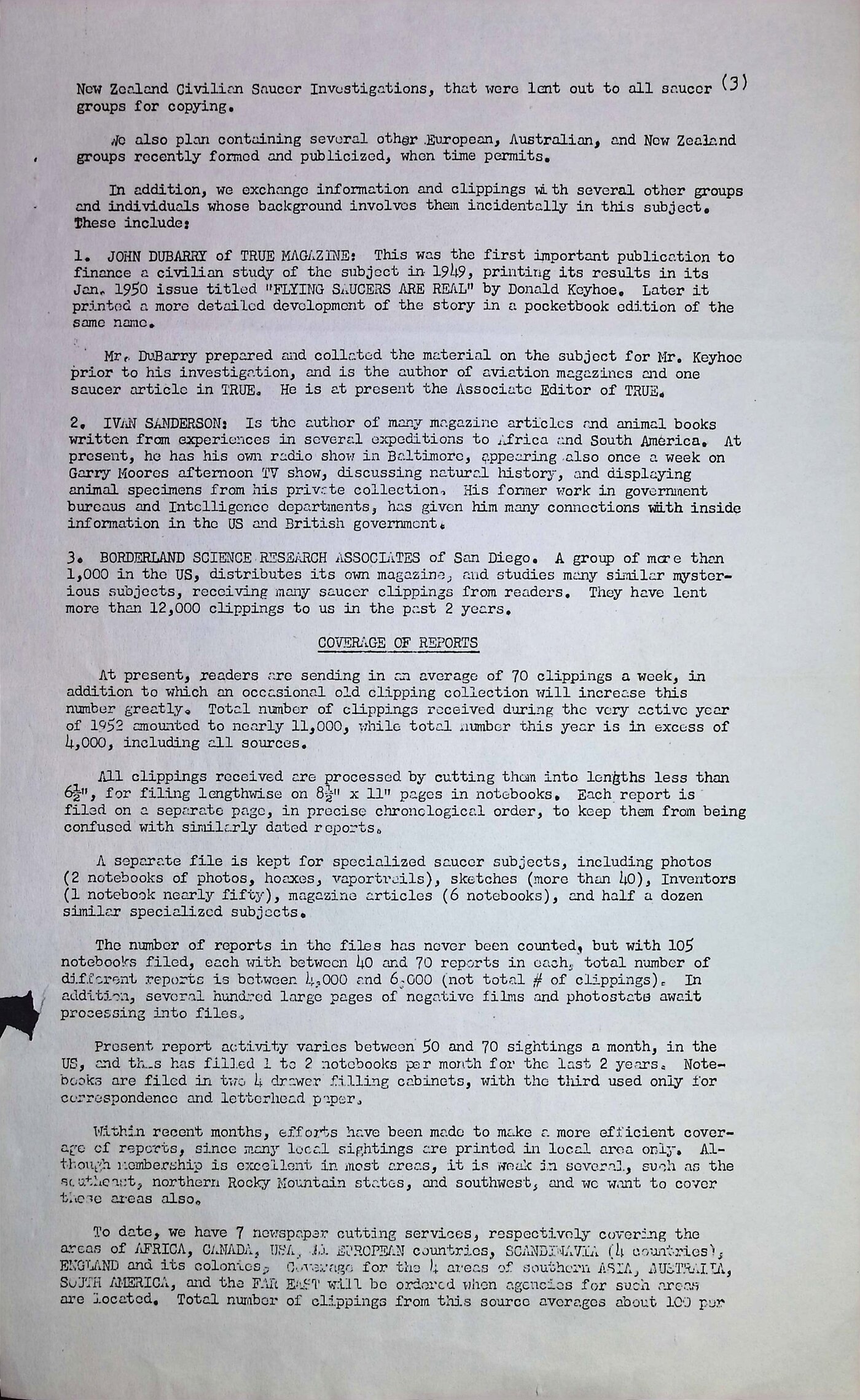
The Civilian Information Brief is an eight-page typewritten document distributed by the Flying Saucer Researchers to prospective members across the 1952 to 1953 period. The opening page identifies the group's working framework: the President is Donald Keyhoe, the group was formed in 1950 after the publication of Keyhoe's The Flying Saucers Are Real, the first Review was printed in August 1951 in sixty copies, and the present (1953) membership runs at approximately 600 in the United States with 60 international members growing at approximately thirty new members per week. The group runs the American civilian-research clipping exchange of the period: approximately seventy clippings per week received, exchanged with thirty-three known groups worldwide, with 105 notebooks on file by 1952 holding between 4,000 and 6,000 sighting reports.
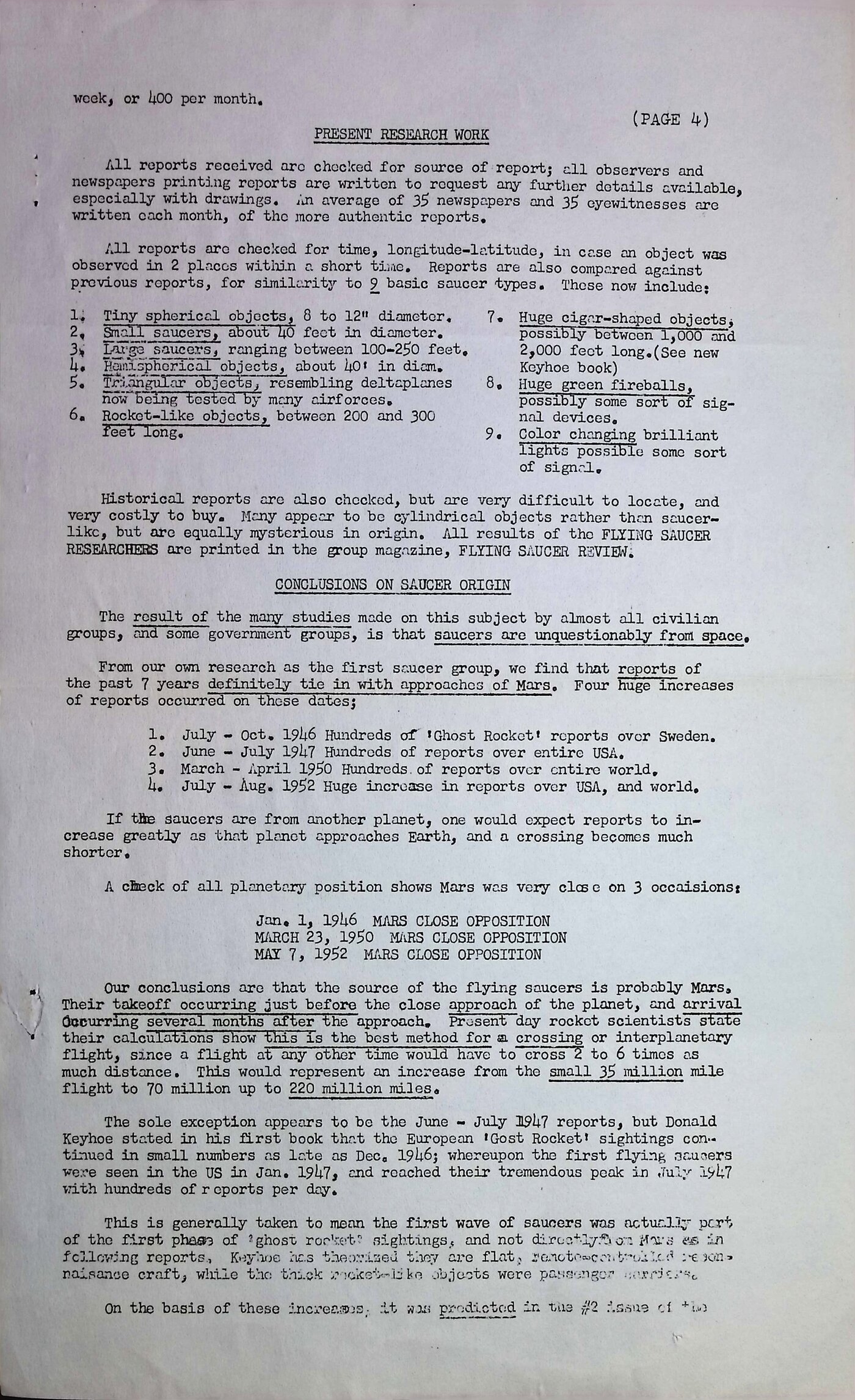
The Present Research Work section sets out the group's nine-category morphological classification of saucer phenomena: tiny spherical objects 8 to 12 inches; small saucers approximately 40 feet; large saucers between 100 and 250 feet; hemispherical objects approximately 40 feet; triangular and delta-shaped objects; rocket-like objects 200 to 300 feet; cigar-shaped objects 1,000 to 2,000 feet (the Mother Ships of the contactee literature would absorb this category in the mid-1950s); green fireballs; and colour-changing brilliant lights. The category list is the documented early-1950s American working classification of the phenomenon's reported morphology, predating the later Hynek Close Encounters classification of 1972.
The Conclusions on Saucer Origin section sets out the group's working assessment that the saucer source is probably Mars, on the documented correlation between sighting peaks and Mars-Earth oppositions: the June 1948 Mars Close Opposition; the March 23, 1950 Mars Close Opposition; and the May 7, 1952 Mars Opposition. The five-year monitored sighting record showed concentration around each Mars opposition, with the July 1947 Kenneth Arnold sighting falling outside that pattern (the 1947 sighting fell at a Mars distance of approximately 200 million miles). The Mars hypothesis would be the working civilian-research framework across the 1952 to 1957 period before the Adamski contactee Venusian-source material and the wider 1957 to 1965 contactee literature shifted the working source to Venus and to the broader Solar System.
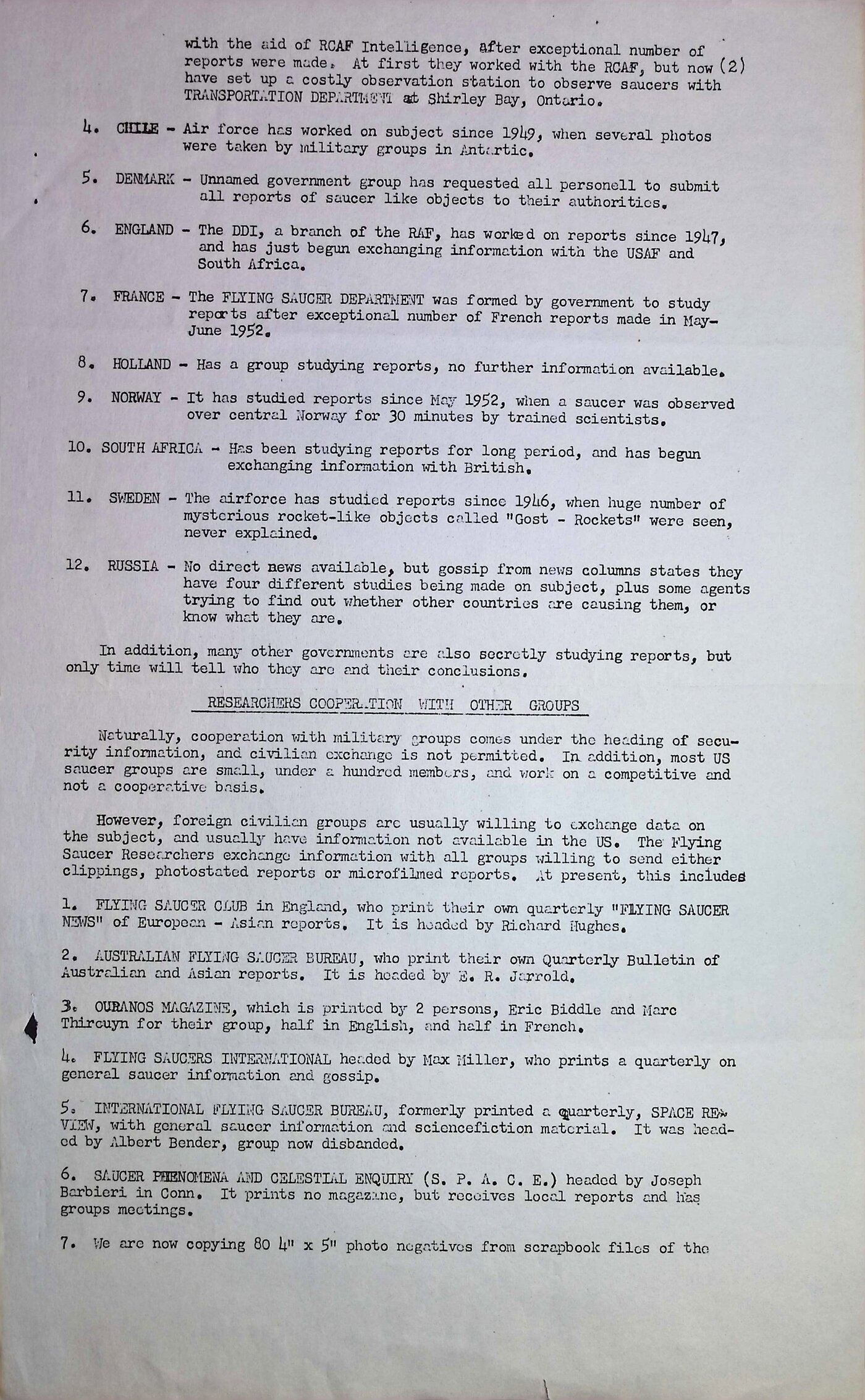
The Other Saucer Groups section identifies the group's working international exchange partners: thirty-three known civilian-research groups worldwide as of 1952, with sixteen American civilian branches and the remainder distributed across twelve countries with government programs. The international list named in the document includes the Flying Saucer Club of England under Richard Hughes; the Australian Flying Saucer Bureau under E. R. Jarrold; Ouranos Magazine of Paris under Eric Biddle and Marc Thircuyn; Flying Saucers International of Pasadena under Max Miller; the International Flying Saucer Bureau of Connecticut under Albert Bender; and SPACE of Connecticut under Joseph Barbieri. The named British, Australian, French, and American partners are the documented international civilian-research community of the immediate pre-NICAP period.
Why It Matters
The Civilian Intel Brief matters for two specific reasons. First, the document is the English-language working-methodology statement of the early-1950s American civilian-research community, four years before the NICAP founding of January 1956 and contemporary with the Aerial Phenomena Research Organization founding at Tucson in 1952. The Brief identifies Donald Keyhoe as the group's President in 1952 to 1953, which places Keyhoe (later the principal NICAP figure from 1956 to 1969) at the working centre of the immediately pre-NICAP American civilian community. The documented methodology (clipping exchange, sighting classification, statistical Mars-correlation analysis) is the same methodology NICAP would inherit and elaborate from 1956 onwards.
Second, the document identifies the working international exchange partners of the period: Richard Hughes's Flying Saucer Club of England, E. R. Jarrold's Australian Flying Saucer Bureau, Eric Biddle and Marc Thircuyn's Ouranos Magazine of Paris, Max Miller's Flying Saucers International of Pasadena, Albert Bender's International Flying Saucer Bureau of Connecticut (which would close in October 1953 after the documented Three Men in Black visit Bender reported in his subsequent Flying Saucers and the Three Men of 1962), and Joseph Barbieri's SPACE of Connecticut. The list is the documented working English-language international civilian-research network at the moment immediately before the 1953 to 1957 contactee period reorganised the American civilian community around Adamski, King, and the Aetherius Society publishing programme.
The Civilian Intel Brief sits alongside the wider American post-1947 civilian-research documentary record the archive holds across its mid-twentieth-century collections, including the Round Robin Borderland Sciences Research Associates publication that the brief identifies as the American civilian counterpart of the Flying Saucer Researchers, the APRO Bulletin record of the period, and the working pre-NICAP English-language civilian-research community the archive's newsletter archive documents at collection level. The thirty-three named international groups listed in the brief constitute one of the documented early-1950s English-language working international civilian-research community memberships.
Page-by-Page Scans
The full 8-page digitisation. Click any page to enlarge.