Australian Flying Saucer Review
Victorian UFO Research Society (VUFORS)
History
The Victorian UFO Research Society (VUFORS) was founded in Melbourne in the late 1950s by a group of investigators who recognised that Australia was producing UFO cases as compelling as anything being reported in the United States, but without any local organisation to document them. The group became the principal hub for UFO investigation in Victoria, and its journal, the Australian Flying Saucer Review, became the publication of record for Australian ufology.
Australia's geography shaped the character of the reports VUFORS collected. Cases occurred across vast, sparsely populated landscapes: the outback of central Australia, the Bass Strait between Victoria and Tasmania, the tropical north of Queensland, and the remote coastline of Western Australia. Witnesses were often isolated, sometimes hundreds of kilometres from the nearest town. This meant that Australian sightings rarely benefited from multiple independent witnesses in urban settings, but when they did occur in populated areas, the cases were extraordinary.
The Australian Flying Saucer Review documented cases that would become central to the international research literature. The Westall school encounter of April 1966, where more than 200 witnesses at a Melbourne high school watched an object descend, land briefly, then depart at extraordinary speed, was investigated by VUFORS members within hours. The Frederick Valentich disappearance of October 1978, in which a young pilot vanished over Bass Strait after radioing Melbourne air traffic control about an unidentified object above his Cessna, remains one of the most disturbing cases in aviation history. VUFORS had investigators on both cases immediately.
The publication covered the full range of UFO phenomena reported across the continent, from nocturnal lights over the outback to close encounters in suburban Melbourne, from radar-visual cases tracked by RAAF controllers to physical trace cases in remote paddocks. VUFORS investigators were trained in interview technique and evidence preservation, and their reports reflect a consistently professional standard.
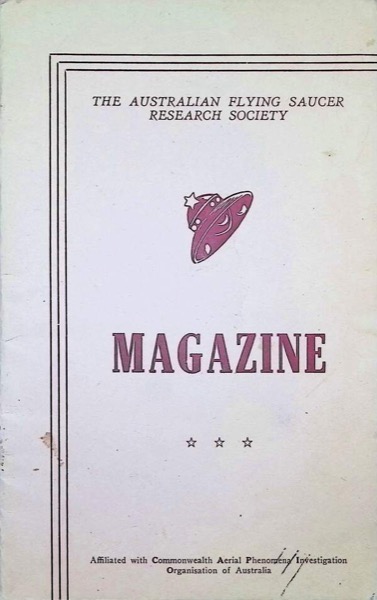
Browse the Collection
Two ways to explore: by issue (covers, decade-grouped) or by article (search across the run).
233 articles catalogued, grouped by issue