Country File AU · Rank 3 of 261
Australia
1947 to present · 4,564 documented sightings
Australia holds one of the most documented civilian UFO records in the southern hemisphere. The Royal Australian Air Force investigated sightings under Department of Air authority from 1953 until the formal transfer of civilian reporting to private organisations in 1996. The Joint Intelligence Organisation produced classified assessments. The Australian Newspaper Clippings collection on the archive runs to 1,027 catalogued items drawn from the Trove digitised press archive, with the Sydney Morning Herald, the Argus and the Brisbane Telegraph among the most heavily represented mastheads. Three case exhibitions cover the Cruttwell Papua collection from 1959 to 1960, the Westall school encounter of April 1966, and the Frederick Valentich disappearance of October 1978.
I have been able to see a craft above me, hovering with sort of a green light and four bright lights. It is approaching from due east towards me. It is hovering, and it is not an aircraft.Frederick Valentich, final radio transmission to Melbourne flight service, 7:06 pm, 21 October 1978
1947 to 1960: Postwar Sightings and the Drury Film
The Kenneth Arnold echo reached Australia and produced its first civilian-research organisation.
Australian press coverage of the postwar UFO phenomenon began within weeks of the Kenneth Arnold sighting of 24 June 1947. The Sydney Morning Herald, the Brisbane Telegraph, the Adelaide Advertiser and the Hobart Mercury all carried coverage through July 1947. The Trove-digitised Australian press archive on file holds more than 1,000 catalogued clippings from this period, spanning all six states and the two mainland territories.
The Drury film was shot at 11 am on 23 August 1953 from a vacant lot at Tingalpa, Brisbane. T.C. Drury, a former Department of Civil Aviation officer, recorded approximately twenty-two seconds of 16mm footage of an object that he described as silver, cylindrical, and travelling at speed across a clear morning sky. The film was lent to the RAAF for analysis. When it was returned to Drury several months later, twenty seconds had been removed. Only two seconds of footage survive in the public record. The Drury case is among the earliest documented instances of an Australian government chain-of-custody dispute over civilian UFO imagery.
Edgar Jarrold founded the Australian Flying Saucer Bureau in Sydney in late 1953, the first civilian UFO research organisation in Australia. Jarrold's Australian Flying Saucer Magazine, published in mimeographed form between 1954 and 1956, is among the earliest English-language UFO periodicals from outside the United States. The archive holds the Australian Flying Saucer Review (AFSRS) successor publication and the broader Australian periodical tradition that grew out of Jarrold's founding work.
1959 to 1968: Cruttwell, Westall, Tully
Anglican missionary, Melbourne schoolchildren, and Queensland sugar cane.
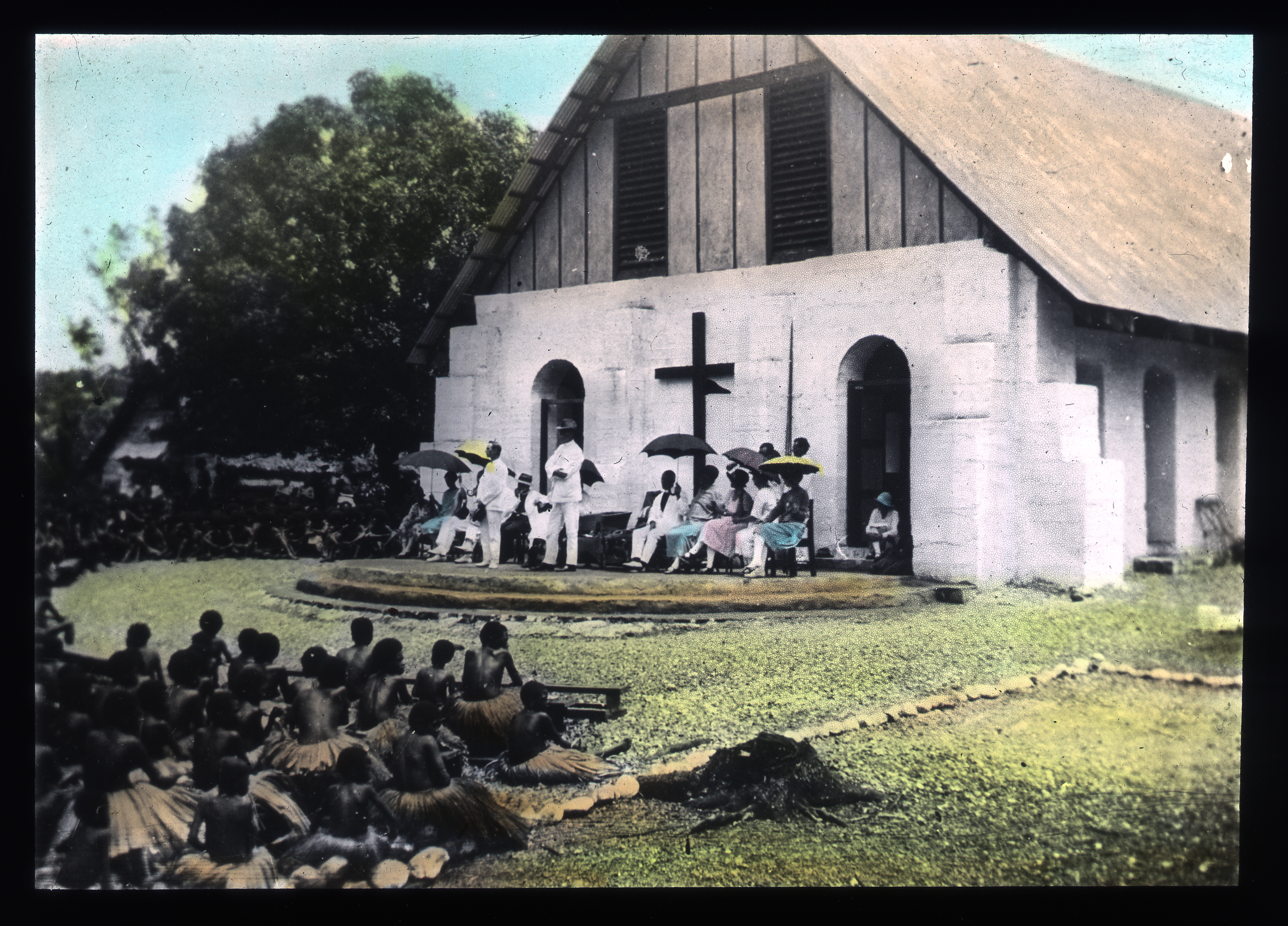
The Reverend Norman Cruttwell, an Anglican missionary serving in the highlands of Papua New Guinea (then under Australian Trust Territory administration), began systematically recording UFO sightings reported by his parishioners in late 1958. The Cruttwell archive comprises handwritten field reports from across the Papua New Guinea highland diocese, including the Boianai sightings of 26 to 28 June 1959 witnessed by 38 named individuals including Father William Booth Gill, the case that became the foundational documentation of organised Anglican-mission UFO recording. The 49-scan Cruttwell Papua collection is among the most significant single-source field investigation records from the southern hemisphere.
The Westall school encounter of 6 April 1966 in Clayton South, Melbourne is the largest multi-witness daytime UFO case in the Australian record. More than 200 students and staff at Westall High School and the adjacent Westall State Primary School observed a low-flying disc-shaped object descend behind a stand of pine trees in the Grange paddock adjoining the school grounds. The object ascended approximately twenty minutes later. The witnesses included Andrew Greenwood, science teacher; Marilyn Eastwood, senior student; and Joy Clarke, deputy head. The case has been investigated continuously since 1966, most extensively by Shane Ryan and the Victorian UFO Research Society. The Westall 50-year reunion of 2016 confirmed the continued first-hand testimony of multiple witnesses.
The Tully saucer nest of 19 January 1966 occurred on the Horseshoe Lagoon, north of Tully, Queensland. Banana farmer George Pedley reported observing a rotating disc-shaped object rise from a swamp and depart at speed. A circular swirled pattern in the reeds, approximately ten metres in diameter, remained on the water after the object's departure. The Royal Australian Air Force investigated under the Department of Air UFO programme. The Pedley case attracted national and international attention, with Flying Saucer Review coverage under Charles Bowen's editorship.
The children are upset. The teachers saw it. I saw it. It was not a weather balloon and it was not a light plane. Somebody at the air force base in Laverton knows what it was.Andrew Greenwood, science teacher, Westall High School, 6 April 1966
October 1978: The Valentich Disappearance
Six minutes of radio transmission over Bass Strait. The Cessna and the pilot never recovered.
Frederick Valentich, twenty years old, departed Moorabbin Airport in Melbourne at 6:19 pm on Saturday 21 October 1978 in a Cessna 182L bound for King Island on a training flight. At 7:06 pm, over Bass Strait approximately twenty kilometres north of King Island, Valentich radioed Melbourne flight service to report an unknown aircraft hovering above his Cessna. Over the six minutes that followed, he described a large metallic object with four bright lights orbiting his plane. His final words were cut off by a metallic scraping sound. Neither Valentich nor his aircraft were ever found despite a four-day search by RAAF and civilian aviation resources.
The Department of Transport investigation file ran to 217 pages and was released in stages between 1982 and 2012. The final official position is that the cause of the disappearance is unknown. The Bureau of Air Safety Investigation report of 1982 is the most extensive single-incident Australian aviation investigation file on the public record. Corroborating sightings on the evening of 21 October were reported by twenty-one independent witnesses across coastal Victoria and Tasmania, including the Cape Otway lighthouse keeper Vladimir Krsteski and the Bass Strait fishing vessel Lucky Strike crew.
The Valentich case is the foundational Australian aviation UFO incident. It has been investigated continuously by Bill Chalker, Keith Basterfield, and the Australian Centre for UFO Studies. Multiple book-length treatments have appeared, including Kevin Killey and Gary Lester's The Devil's Meridian (1980) and Paul Norman's The Valentich Disappearance (1991). The case remains one of the most thoroughly documented aviation UFO events on the global record.
1980s to 1996: Mundrabilla, Chalker, and the End of RAAF Investigation
The Nullarbor incident, the civilian-research transition, and the closure of the Department of Air programme.
The Mundrabilla incident of 20 January 1988 occurred on the Eyre Highway across the Nullarbor Plain in Western Australia at approximately 4:30 am. Faye Knowles and her three sons reported that an unknown light-source descended onto the roof of their family car, apparently lifted the vehicle briefly off the road surface, and deposited a fine ash-like residue across the bodywork. The Knowles family stopped at the Mundrabilla roadhouse to report the incident; the residue was collected by police and forwarded to the South Australian Police Department's forensic laboratory. The RAAF subsequently received the laboratory analysis. The Mundrabilla case remains in dispute; the most extensively published civilian investigation has been Keith Basterfield's.
Bill Chalker, the Sydney-based chemist and former Department of Defense consultant, began his sustained engagement with the Australian UFO question in the mid-1970s and has continued for five decades. Chalker negotiated formal access to the RAAF UFO file series in 1982 and produced the only systematic civilian summary of the Department of Air investigation period. His The OZ Files (1996) is the standard reference work for Australian civilian-research-tradition UFO history. His subsequent Hair of the Alien (2005) extended the work into biomedical-trace investigation. Chalker continues to publish through The OZ Files research blog and through cross-Atlantic reporting partnerships with the post-2017 Disclosure Network.
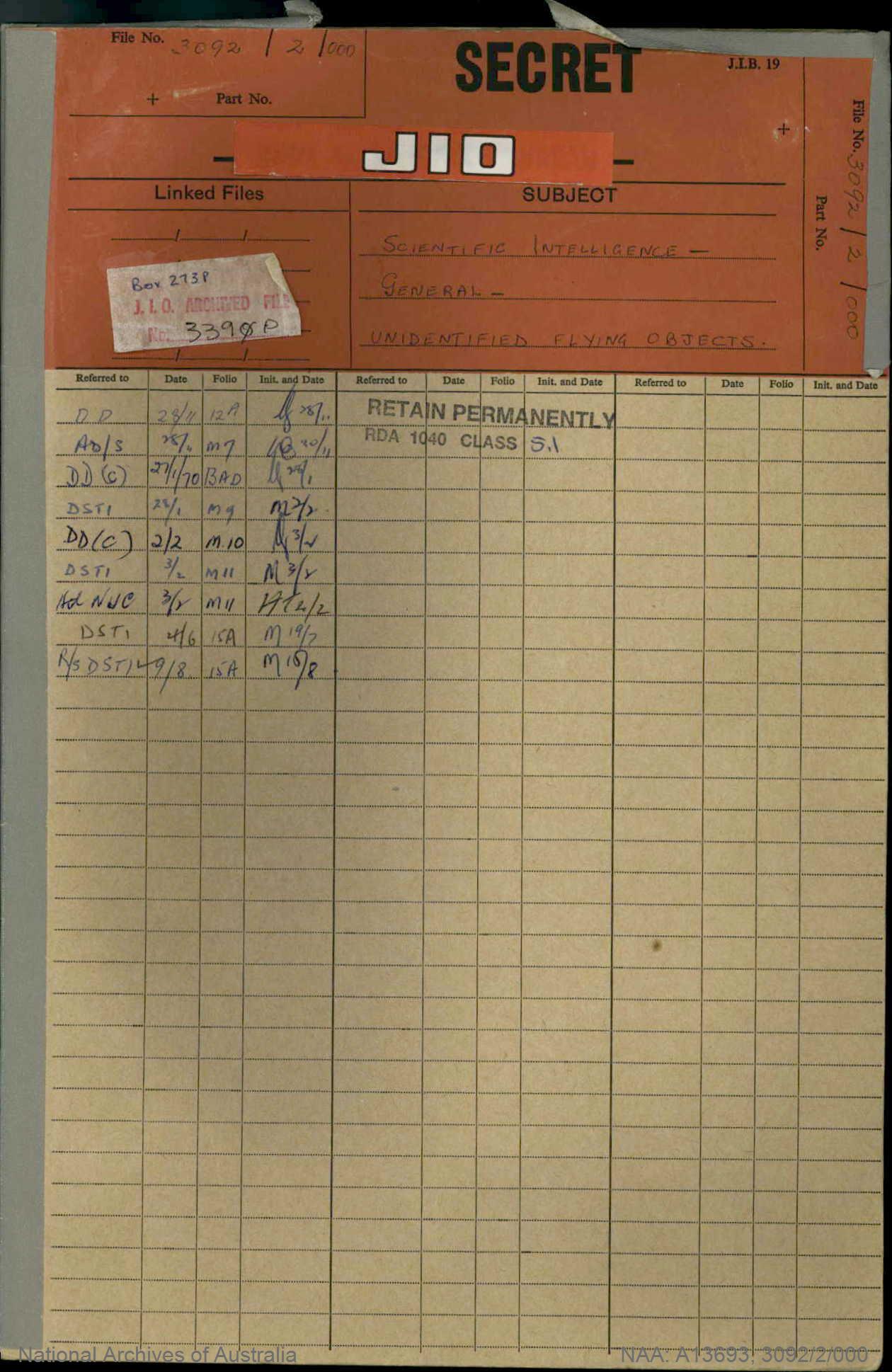
The Royal Australian Air Force formally ended its UFO investigation programme on 14 February 1996 with the issuance of Department of Defense directive AAP 1004 superseding the previous RAAF UFO reporting structure. The Department of Defense position from 1996 onwards has been that UFO investigation is not a defence matter and that civilian reports should be referred to private research organisations. The RAAF investigation files from 1953 to 1996 were transferred to the National Archives of Australia.
The archive's Australia Reading Room holds three viewers: the RAAF Department of Air investigation files, the additional National Archives of Australia holdings, and the broader Australia government records hub. The records cover the 1953 to 1996 Department of Air UFO investigation period plus the post-1996 NAA-administered file release programme.
The Civilian Research Tradition
Edgar Jarrold's mimeographed Sydney bulletin opened a civilian-research tradition older than the RAAF programme it sometimes worked alongside.
Edgar Jarrold's Australian Flying Saucer Bureau, founded in Sydney in late 1953, is the first body. Australian Flying Saucer Magazine ran for two years on a mimeographed circular distribution out of Jarrold's Mosman address. The Australian Flying Saucer Research Society (AFSRS) succeeded it through 1955 to the late 1960s with the Australian U.F.O. Bulletin, a quarterly that drew on the international Donald Keyhoe / NICAP correspondence network plus Australian field-investigator submissions. The archive's holdings of the AUFOB cover the formative 1957 to 1968 run.
The Victorian UFO Research Society (VUFORS) emerged from the AFSRS in 1957 and remains the longest-running Australian civilian-research body. VUFORS investigated the Westall 1966 case from initial response through to the 50-year reunion. The Australian Centre for UFO Studies (ACUFOS), founded 1974 in Sydney by Bill Chalker and others, modelled itself on the J. Allen Hynek Center for UFO Studies in the United States. ACUFOS produced the Australian and New Zealand UFO Research Journal through the late 1970s and early 1980s with serious case-investigation discipline and a sceptical-but-not-debunking editorial position.
The Tasmanian UFO Investigation Centre (TUFOIC) under Keith Roberts opened the southern Tasmanian field-investigation record. The UFO Research (NSW) and UFO Research Queensland chapters under Bryan Dickeson and Stan Seers ran state-level case files through the 1970s and 1980s. The Mutual UFO Network Australia chapter under Robert Frola operated in parallel from the late 1970s, providing the cross-Pacific reporting link to MUFON Texas. The independent Independent Network of UFO Researchers (UFOR(SA)) under Keith Basterfield covered the South Australian record from the early 1980s.
The contemporary network is led by Bill Chalker's The OZ Files research blog, the Disclosure Australia project under Paul Dean, the Australian UFO Database under Keith Basterfield, and the Twitter-and-podcast disclosure-era reporting network led from outside Australia by Ross Coulthart at NewsNation. The 1996 RAAF programme closure removed the institutional reference point for civilian-research; the civilian network has carried the documentation discipline forward without it.
Case Exhibitions
Three case exhibitions covering the foundational Australian and Australian-Trust-Territory cases.
 1959 to 1960
Flying Saucers Over Papua
Anglican-mission field reports, multi-witness
1966
The Westall School Encounter
Mass sighting, daytime, 200+ witnesses
1959 to 1960
Flying Saucers Over Papua
Anglican-mission field reports, multi-witness
1966
The Westall School Encounter
Mass sighting, daytime, 200+ witnesses
 1978
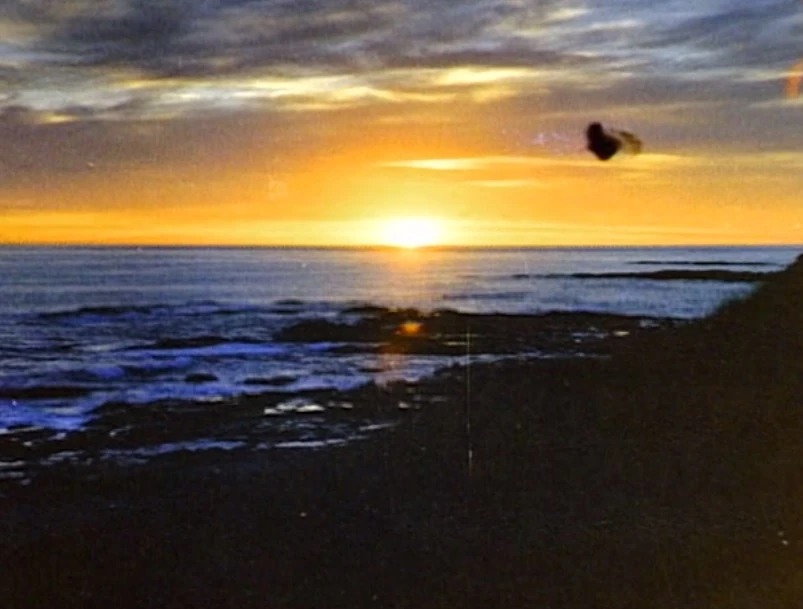
The Valentich Disappearance
Aviation, multi-witness, unrecovered
1978
The Valentich Disappearance
Aviation, multi-witness, unrecovered
Government Reading Room
The declassified RAAF and NAA holdings.
Newsletter Coverage
The Australian civilian-research periodical record. The archive's holdings cover the AFSRS founding period through the contemporary research network.
The Australian U.F.O. Bulletin (AUFOB) under the AFSRS and the later Victorian UFO Research Society is the longest-running Australian civilian-research periodical on the archive's record. The 1957 to 1968 run carried Edgar Jarrold's editorial line, the first organised Australian field-investigation reports, the 1959 Father William Booth Gill Boianai case as it broke, the early Westall 1966 coverage, and a sustained international correspondence with Donald Keyhoe at NICAP. The Tasmanian UFO Investigation Centre TUFOIC Newsletter, the ACUFOS Australian and New Zealand UFO Research Journal and the UFOR(NSW) UFO Tasmania series fill out the regional record.
The Folio deep-read of the AUFOB run is in progress at the time of writing. The completed extractions cover the December 1957, April 1959, July 1959 and February 1968 issues. Per-issue deep-read posts for November 1974 (the Camden teenagers encounter, the Jandowae mystery holes, Stanton Friedman's Watergate comparison) and February 1975 (the full text of Robert Galley's France-Inter interview, Ray Fischer's St. Kilda close-encounter investigation, the Scamander one-hour-forty-three-minute observation) are published. The remaining May 1975 through May 1976 sequence is in editorial preparation. Bookmarks below jump into the archive's existing landing pages.
The Australian collection sits inside a broader civilian-research periodical catalogue spanning twenty countries. Browse the full record at Newsletter Archive, or filter to the Australian section directly.
Witnesses, Officials, and Researchers
The Australian figures whose work shaped the documentary record.
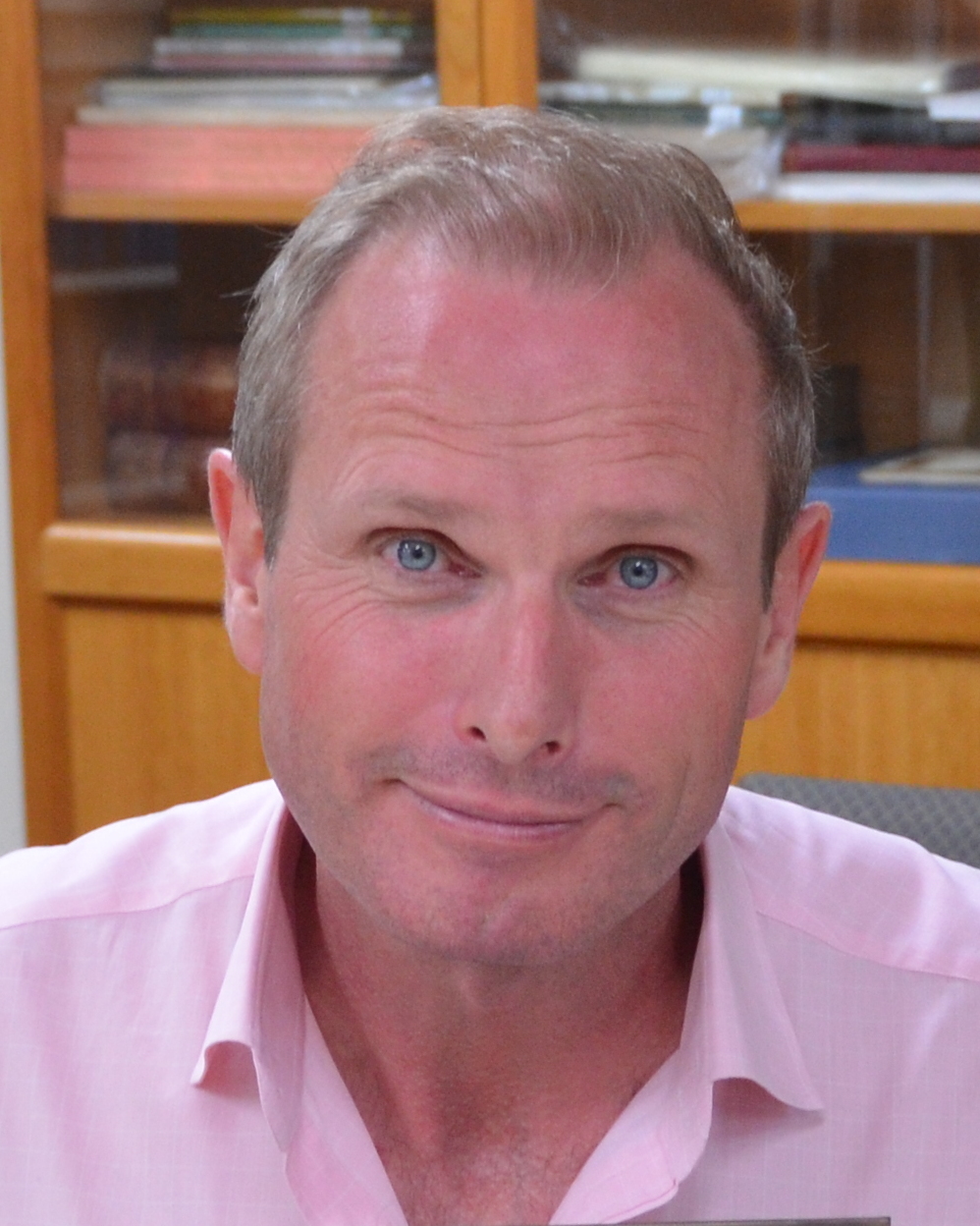 Ross Coulthart
Journalist
Australian investigative journalist with thirty-five years of mainstream reporting experience. Author of In Plain Sight (2021). Senior national security correspondent at NewsNation in the United States. Conducted the world-exclusive 5 June 2023 interview with David Grusch.
Ross Coulthart
Journalist
Australian investigative journalist with thirty-five years of mainstream reporting experience. Author of In Plain Sight (2021). Senior national security correspondent at NewsNation in the United States. Conducted the world-exclusive 5 June 2023 interview with David Grusch.
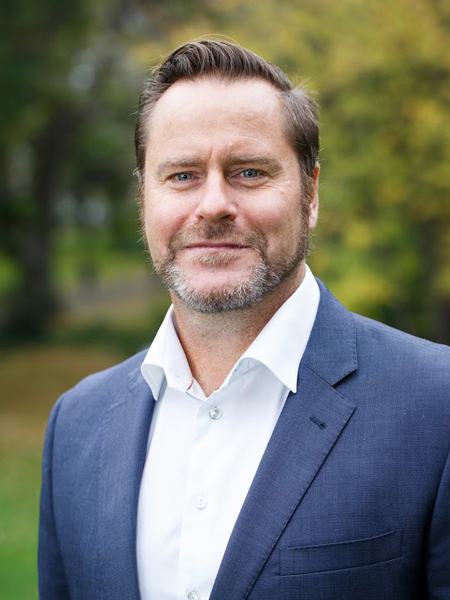 Senator Peter Whish-Wilson
Australian Greens, Tasmania
Australian Greens Senator for Tasmania. Has raised UAP questions in the Australian Parliament across multiple parliaments. Has corresponded publicly with the Department of Defense on RAAF UFO investigation closure.
Rev. Norman Cruttwell
Anglican Missionary, Papua New Guinea
Compiled the Boianai sightings field reports of June 1959 under Australian Trust Territory administration. The Cruttwell archive is one of the most significant single-source field investigation records from the southern hemisphere.
Frederick Valentich
Pilot, 1958 to 1978
Twenty-year-old Class Four instrument-rated pilot. Final radio transmission at 7:11 pm, 21 October 1978 over Bass Strait. The aircraft and the pilot were never recovered.
Edgar Jarrold
Australian Flying Saucer Bureau Founder, 1953
Founded the first civilian UFO research organisation in Australia in late 1953. Australian Flying Saucer Magazine 1954 to 1956 is among the earliest English-language UFO periodicals outside the United States.
Keith Basterfield
Researcher
South Australian researcher whose Project 1947-affiliated work on the Mundrabilla incident and the Valentich corroborating-witness pattern is the most extensively published civilian investigation of those cases.
Rev. Father William Booth Gill
Anglican Missionary, Papua New Guinea
Mission priest at the Boianai Anglican mission. Principal named witness to the 26 to 28 June 1959 Boianai sightings. His written report of the encounter, signed by 38 mission staff and parishioners, is the case's foundational document.
Andrew Greenwood
Science Teacher, Westall High School
Science teacher present at the 6 April 1966 Westall encounter. His first-person account at the school grounds and his sustained public testimony over five decades is the case's most-cited adult professional witness statement.
Keith Roberts
TUFOIC Founder, Tasmania
Founded the Tasmanian UFO Investigation Centre in the 1970s. Carried the field-investigation discipline through southern Tasmania for four decades. The TUFOIC newsletter is on file in the archive's Australian collection.
Paul Dean
Disclosure Australia, Melbourne
Melbourne-based researcher running the Disclosure Australia FOIA programme. Has obtained material releases from the Royal Australian Air Force and the Department of Defense on the post-1996 Australian institutional position on UAP reporting.
T.C. Drury
Aviation Officer, Brisbane, 1953
Former Department of Civil Aviation officer. Recorded twenty-two seconds of 16mm cine footage from Tingalpa, Brisbane on 23 August 1953. Twenty seconds were removed during RAAF analysis. The Drury case is the earliest documented Australian government chain-of-custody dispute over civilian UFO imagery.
Senator Peter Whish-Wilson
Australian Greens, Tasmania
Australian Greens Senator for Tasmania. Has raised UAP questions in the Australian Parliament across multiple parliaments. Has corresponded publicly with the Department of Defense on RAAF UFO investigation closure.
Rev. Norman Cruttwell
Anglican Missionary, Papua New Guinea
Compiled the Boianai sightings field reports of June 1959 under Australian Trust Territory administration. The Cruttwell archive is one of the most significant single-source field investigation records from the southern hemisphere.
Frederick Valentich
Pilot, 1958 to 1978
Twenty-year-old Class Four instrument-rated pilot. Final radio transmission at 7:11 pm, 21 October 1978 over Bass Strait. The aircraft and the pilot were never recovered.
Edgar Jarrold
Australian Flying Saucer Bureau Founder, 1953
Founded the first civilian UFO research organisation in Australia in late 1953. Australian Flying Saucer Magazine 1954 to 1956 is among the earliest English-language UFO periodicals outside the United States.
Keith Basterfield
Researcher
South Australian researcher whose Project 1947-affiliated work on the Mundrabilla incident and the Valentich corroborating-witness pattern is the most extensively published civilian investigation of those cases.
Rev. Father William Booth Gill
Anglican Missionary, Papua New Guinea
Mission priest at the Boianai Anglican mission. Principal named witness to the 26 to 28 June 1959 Boianai sightings. His written report of the encounter, signed by 38 mission staff and parishioners, is the case's foundational document.
Andrew Greenwood
Science Teacher, Westall High School
Science teacher present at the 6 April 1966 Westall encounter. His first-person account at the school grounds and his sustained public testimony over five decades is the case's most-cited adult professional witness statement.
Keith Roberts
TUFOIC Founder, Tasmania
Founded the Tasmanian UFO Investigation Centre in the 1970s. Carried the field-investigation discipline through southern Tasmania for four decades. The TUFOIC newsletter is on file in the archive's Australian collection.
Paul Dean
Disclosure Australia, Melbourne
Melbourne-based researcher running the Disclosure Australia FOIA programme. Has obtained material releases from the Royal Australian Air Force and the Department of Defense on the post-1996 Australian institutional position on UAP reporting.
T.C. Drury
Aviation Officer, Brisbane, 1953
Former Department of Civil Aviation officer. Recorded twenty-two seconds of 16mm cine footage from Tingalpa, Brisbane on 23 August 1953. Twenty seconds were removed during RAAF analysis. The Drury case is the earliest documented Australian government chain-of-custody dispute over civilian UFO imagery.
The Disclosure Era, 2017 to Present
Australia in the post-AATIP cycle.
Australia's institutional engagement with the post-2017 disclosure cycle has been less visible than its US, UK, and Japanese counterparts. The Australian Department of Defense position has remained that UAP are not a defence matter under the 1996 directive. No equivalent of the US AARO, the UK CONDIGN study, or the Japanese parliamentary cross-party UAP league has emerged from the Australian institutional structure.
The Australian journalism on the post-2017 cycle has been led from outside the Australian press by Ross Coulthart at NewsNation in the United States. Coulthart's January 2026 reporting on observations of UAP over RAAF Base Tindal in the Northern Territory was the first significant return of Australian-domestic UAP coverage to a major broadcast platform since the 1996 RAAF programme closure. The Department of Defense has declined to confirm or deny the underlying observations. The Australian mainstream press has reported the Tindal claims at modest scale relative to the original NewsNation broadcast.
The parliamentary record is sparse. Senator Peter Whish-Wilson of the Australian Greens has tabled written questions on the Department of Defense position on UAP across multiple parliaments. The Senate Foreign Affairs, Defence and Trade Committee has not held a UAP-specific inquiry. The All-Party Parliamentary Group on UAP that exists in the United Kingdom has no Australian equivalent.
Track the unfolding record at Latest. Browse the related newsletter coverage at Australian Flying Saucer Review and TUFOIC Newsletter. See the related country profiles at United States and United Kingdom for the broader Anglosphere disclosure record.
From the Archive
The full Australian documentary record on this site.
Australia holds 4,564 sightings in the archive's sighting database, ranked third globally. The decade with the largest Australian sighting volume on record is the 1950s with 969 entries, followed by the 1970s (730), the 1960s (628), the 1990s (524), the 2000s (479) and the 1980s (382). The most common reported shape is Disc, with 1,007 reports, representing 22 per cent of the total Australian record. The disc-dominant distribution distinguishes the Australian record from the light-dominant US record and the disc-and-light British record.
The Australian Newspaper Clippings collection on the archive runs to 1,027 catalogued items from the Trove digitised press archive, the Sydney Morning Herald, the Brisbane Telegraph, the Adelaide Advertiser and the Argus among the most heavily represented mastheads. The full shape and decade catalogue and the linked encyclopedia entries are browsable from the Countries hub.