The Valentich Disappearance
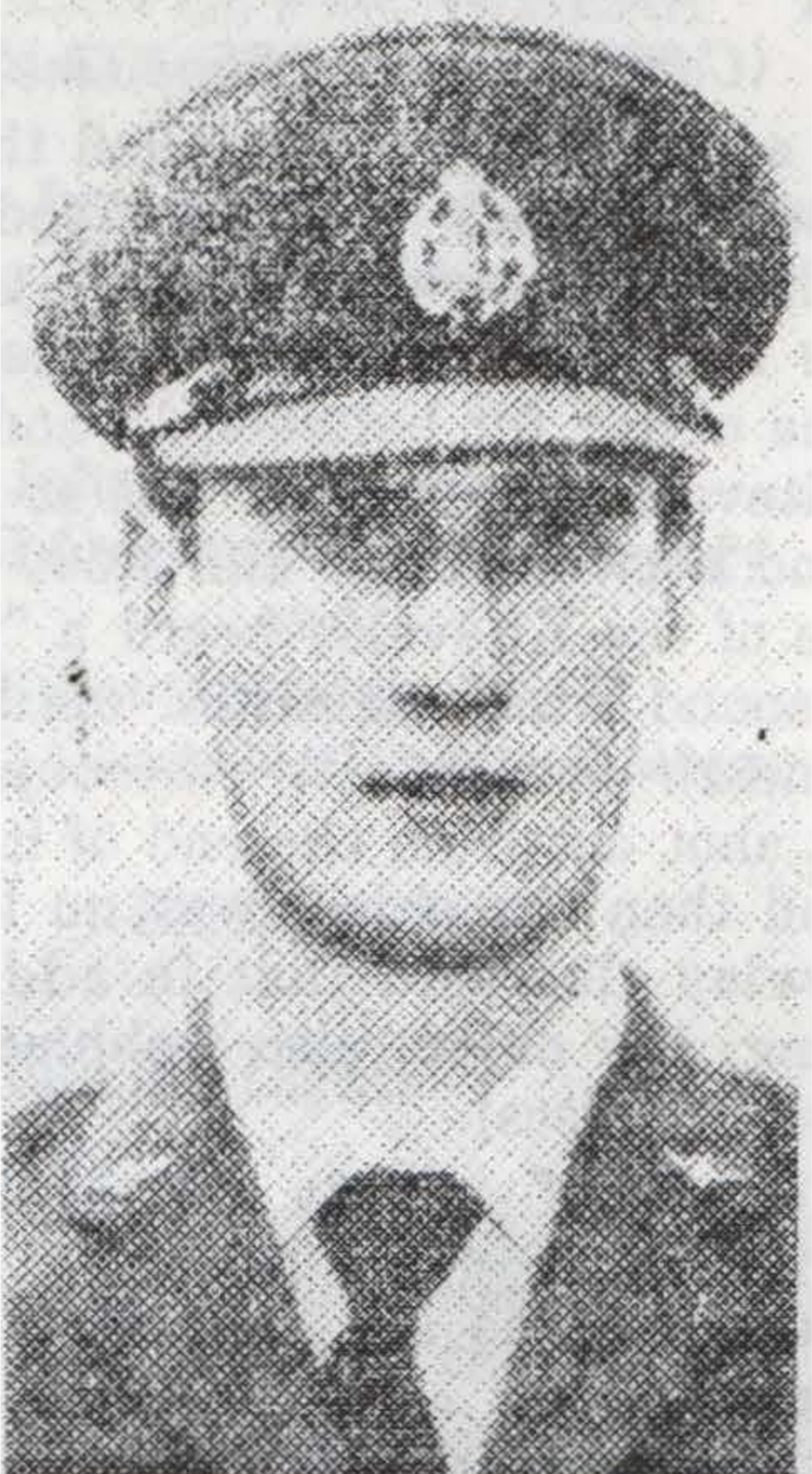
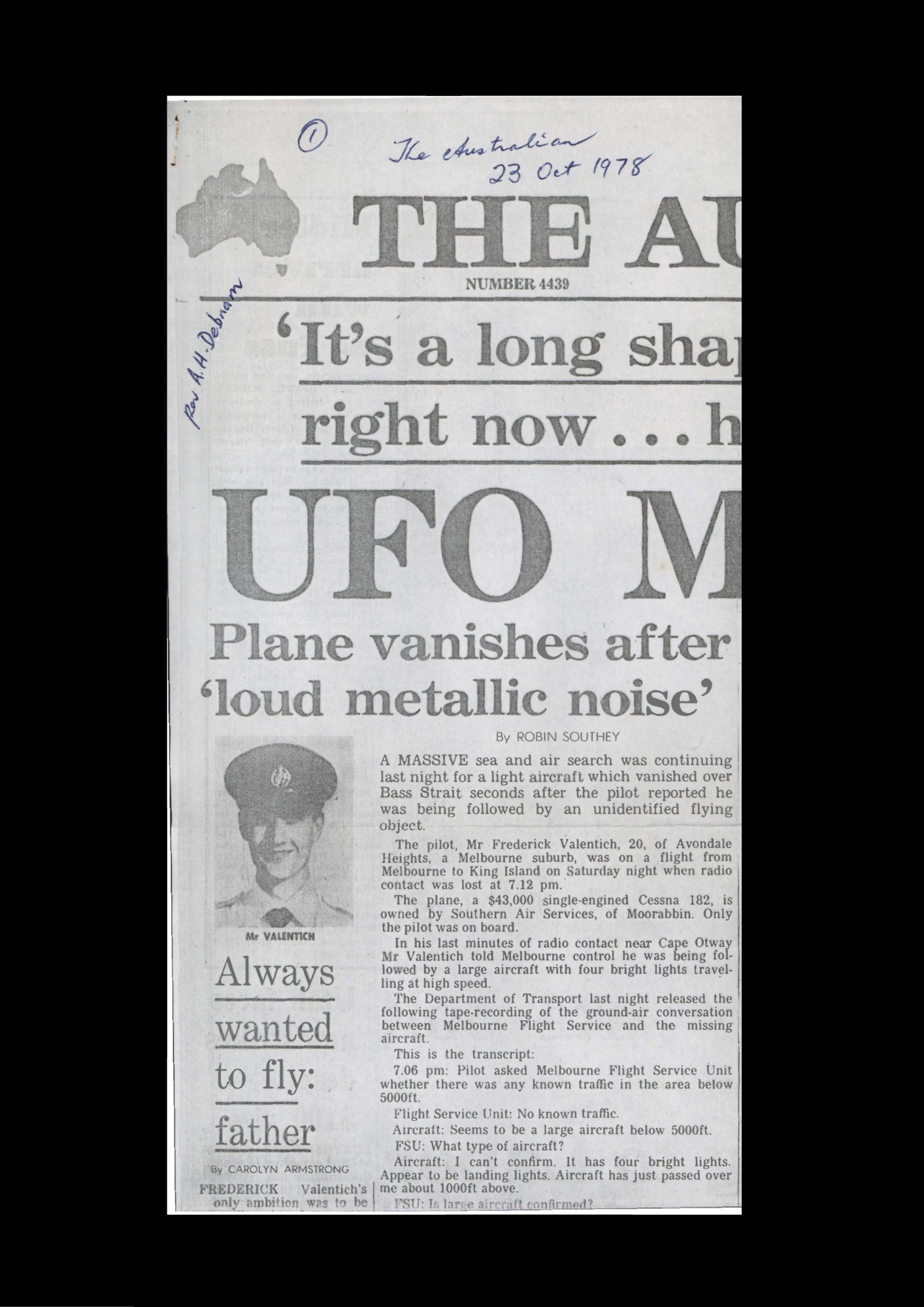
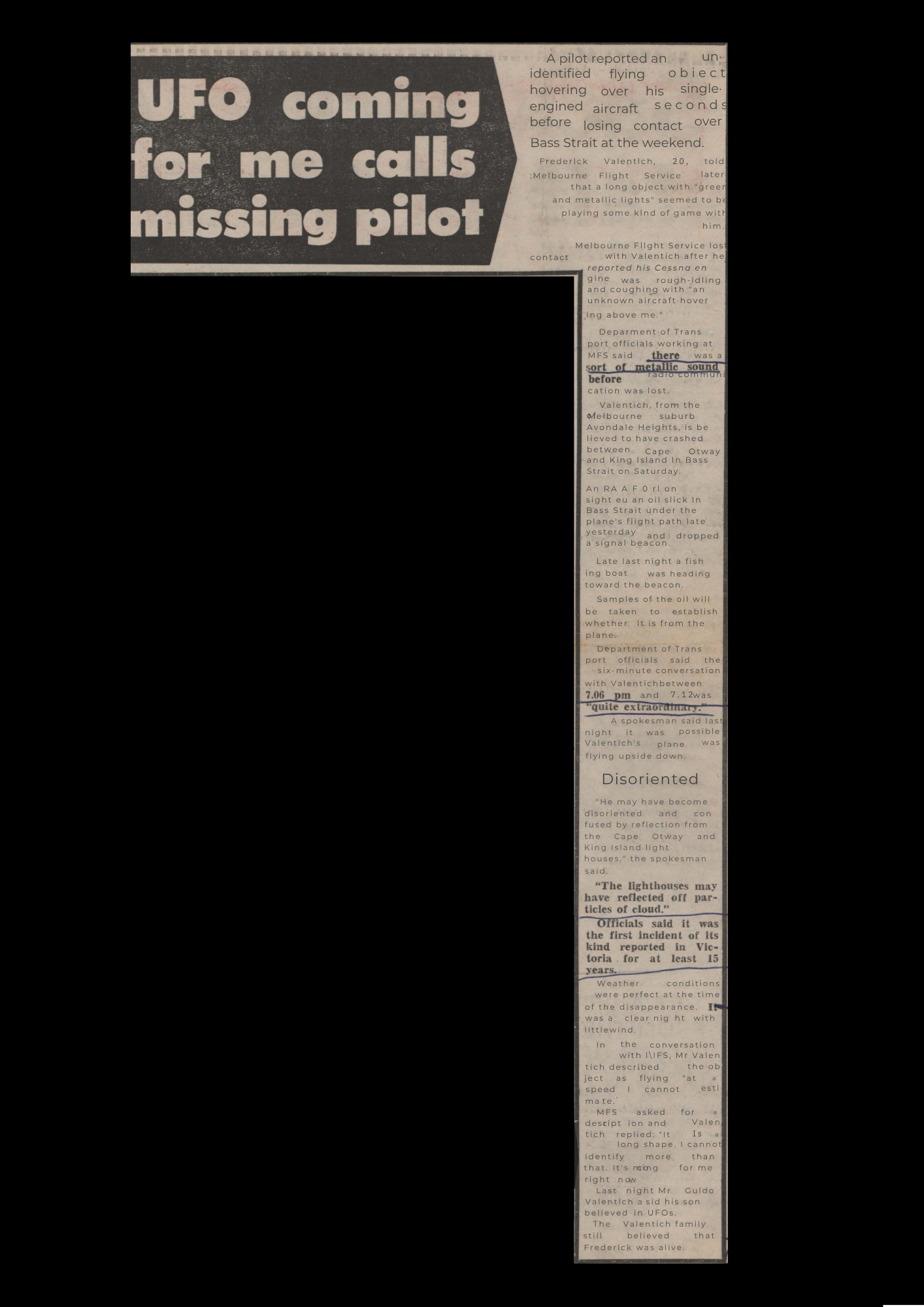
At 7:06 pm on a calm Saturday evening, twenty-year-old pilot Frederick Valentich radioed Melbourne air traffic control to report an unknown aircraft hovering above his Cessna 182. Over six minutes of increasingly urgent transmissions, he described a large metallic object with four bright lights orbiting his plane. His final words were cut off by a metallic scraping sound. Neither Valentich nor his aircraft were ever found.
It is not an aircraft.Frederick Valentich, final transmission to Melbourne ATC, 21 October 1978
The Flight
What happened between Moorabin Airport and the waters of Bass Strait.
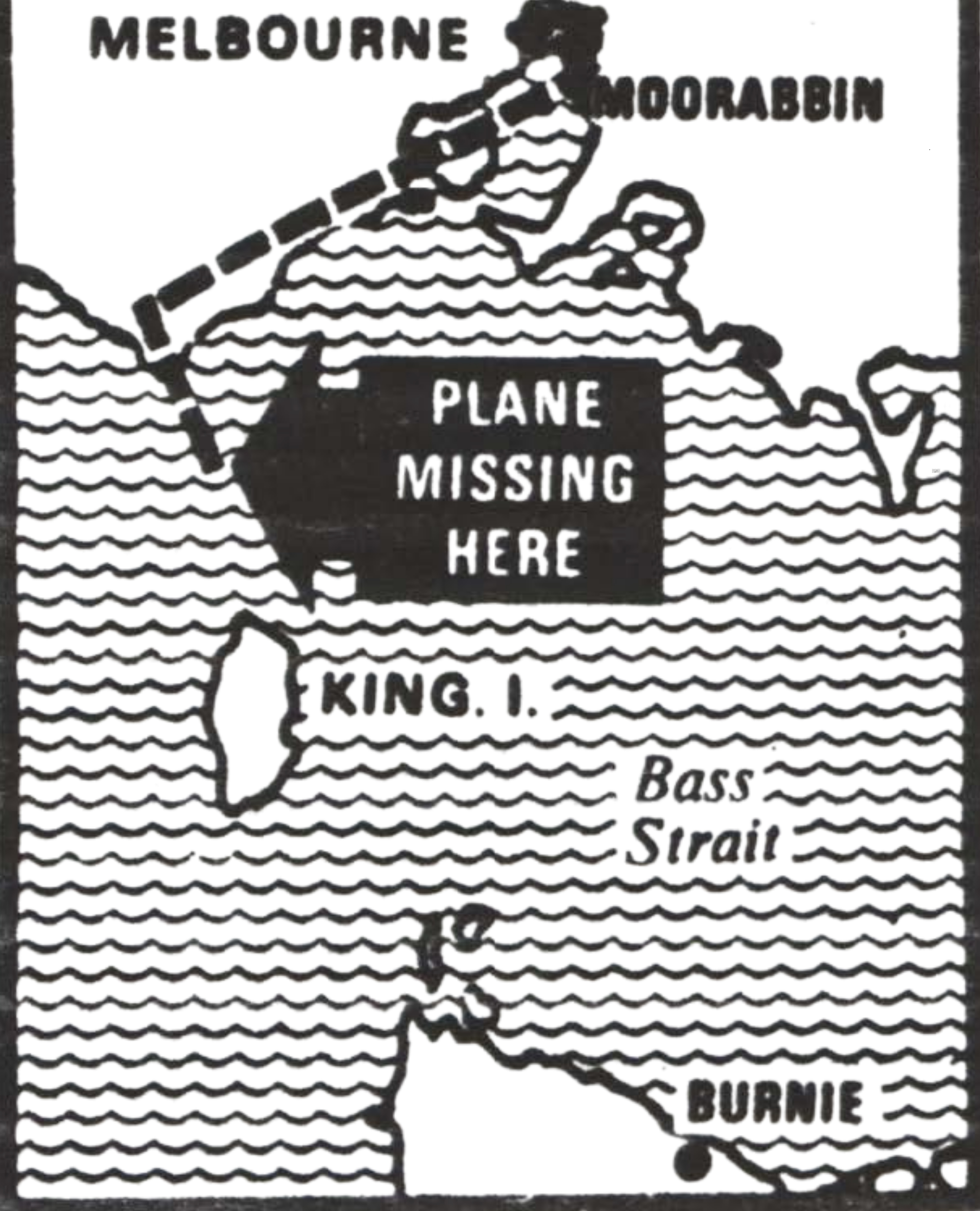
Frederick Valentich filed his flight plan at Moorabin Airport in Melbourne's southeastern suburbs on the afternoon of Saturday, 21 October 1978. He intended to fly his Cessna 182L, registration VH-DSJ, across Bass Strait to King Island, collect a load of crayfish for the officers' mess at the Air Training Corps, and return. It was a routine flight. The weather was clear with a trace of cloud. Sunset was at 7:12 pm.
He departed at 6:19 pm and climbed to his planned cruising altitude of 4,500 feet. At 7:06 pm, roughly halfway across Bass Strait, Valentich contacted Melbourne Flight Service. He asked if there was any known traffic below five thousand feet. There was not.
What followed was six minutes and twelve seconds of radio exchange that has become one of the most studied pilot-UAP transcripts in aviation history. Valentich described a large aircraft below him, then above him. Four bright lights. Metallic surface, shiny, with a green light. Moving at high speed, then hovering. He reported his engine running rough. The object, he said, was orbiting on top of him.
Steve Robey, the air traffic controller handling the frequency, kept his composure. He asked standard questions: type of aircraft, altitude, heading. Valentich's answers grew more alarmed. At 7:09 pm he told Melbourne the object was "not an aircraft." At 7:10 pm he said it was hovering on top of him again. His final identifiable words, at approximately 7:12 pm, were followed by seventeen seconds of open microphone. The sound recorded was described in official reports as metallic, scraping. Then silence.
An extensive air and sea search found nothing. No wreckage, no emergency beacon signal, no body. The Department of Transport investigation concluded that the reason for the disappearance was unknown. That remains the official finding.
The Australian Coastal Surveillance Centre initiated a distress phase within hours. Three fishing vessels, the Helen D, Balamara, and Nautilus 1, were chartered from King Island to begin a surface search. The ACSC broadcast XXY urgency messages requesting all vessels in Bass Strait to report any sightings or hearing reports. Nancy Heath, a ship in the vicinity, tracked the aircraft's intended flight path to within five nautical miles of Cape Wickham Light and found nothing.
By the morning of 22 October, a RAAF P-3 Orion joined the search alongside civil aircraft. Seven aircraft eventually searched an area of 5,000 square nautical miles. An oil slick was spotted in the search area and a sample collected for analysis. Debris was found near the Victorian coastline but confirmed not from an aircraft. Total search hours exceeded 62 hours and 35 minutes of flying time. The search was terminated on 25 October with no trace of VH-DSJ.
Ministerial situation reports (SITREPs) were issued daily to the Secretary of the Department of Transport, the Minister, and the RAAF. The total cost of the vessel charter alone was $1,838.45, paid through the Tasmanian Police Commissioner's office. In a telex exchange between the ACSC and Melbourne SAR during the search, an operator remarked about the UFO connection. His counterpart replied that the situation was far from funny, particularly for the pilot's family.
The ATC Transcript
Melbourne Flight Service Unit recording, 21 October 1978. Times in local (AEST).
The Investigation
Two researchers, working independently, built the case record that endures.
Bill Chalker was in the field within days. An industrial chemist with a B.Sc. Honours from the University of Newcastle, Chalker served as APRO's field investigator for the Bass Strait region. He interviewed witnesses, gathered the ATC transcript from official sources, and wrote the first detailed account for the October 1978 issue of the APRO Bulletin. Seven separate articles in that single issue covered the disappearance, the theories, the witness statements, and the search. Chalker's reporting was methodical and restrained, offering no speculation beyond what the evidence supported.
The second major investigation came from the other side of the Pacific. Dr. Richard F. Haines, a physiological psychologist at NASA's Ames Research Center in California, had spent years studying pilot-UFO encounters as an aviation safety question. The Valentich case was, for Haines, the case: a trained pilot, a recorded transcript, corroborating ground witnesses, and a documented government investigation, all converging on a single event. He spent years on the analysis. The Fund for UFO Research published his study in the mid-1980s, and it later became the book Melbourne Episode.
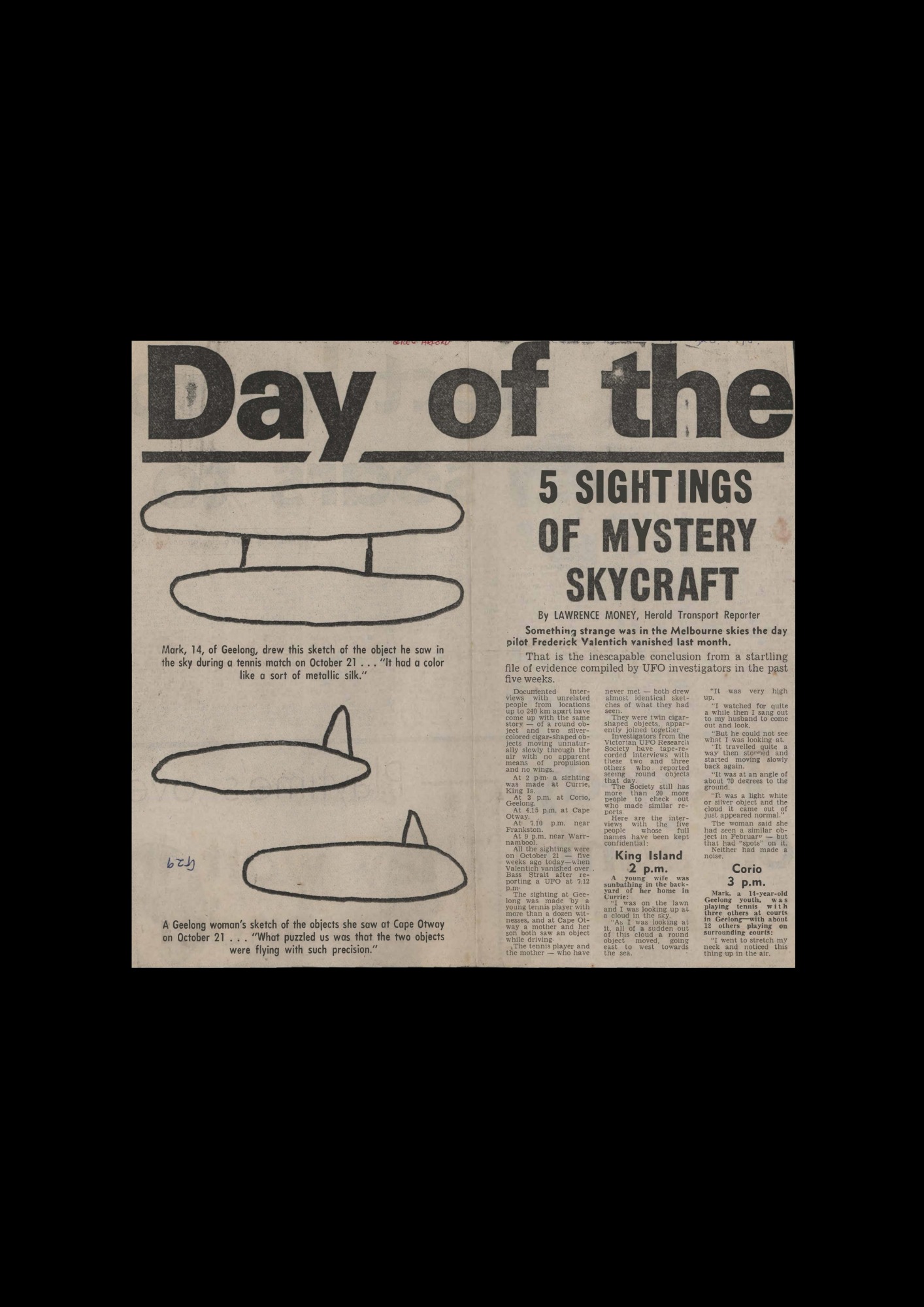
What set these two investigations apart from the tabloid coverage was their focus on corroboration. The evening of 21 October 1978 produced multiple independent UFO sighting reports around Bass Strait. VUFORS, the Victorian UFO Research Society, received at least fifty reports. Witnesses on the ground and at sea described lights and objects consistent with what Valentich reported from the cockpit. These were ordinary people: a family near Cape Otway, fishermen in the strait, a woman driving near the coast. They had no reason to fabricate.
The ACOS Bulletin later placed the disappearance in a broader pattern: 22 aircraft had gone missing over Bass Strait without trace. Most of those were wartime losses, but the pattern caught attention. The strait, shallow and cold, does not easily yield wreckage, and several of those older disappearances also lacked satisfactory explanations.
The most thorough analysis ever published of the case involving a pilot in Australia who disappeared after a series of unusual events.Fund for UFO Research, on Haines' study, Quarterly Report Q4 1985
Melbourne Episode by Dr. Richard F. Haines (FUFOR, mid-1980s) remains the definitive technical analysis. Haines later served as Chief Scientist of NARCAP, the National Aviation Reporting Center on Anomalous Phenomena. Bill Chalker's field investigation reports appeared in the October 1978 APRO Bulletin (Vol. 27, No. 4), which devoted seven articles to the case.
Official Records
The RAAF investigation file A4703 1978-1205, released by the National Archives of Australia. 217 pages of search and rescue logs, ministerial briefings, telex traffic, and police correspondence.
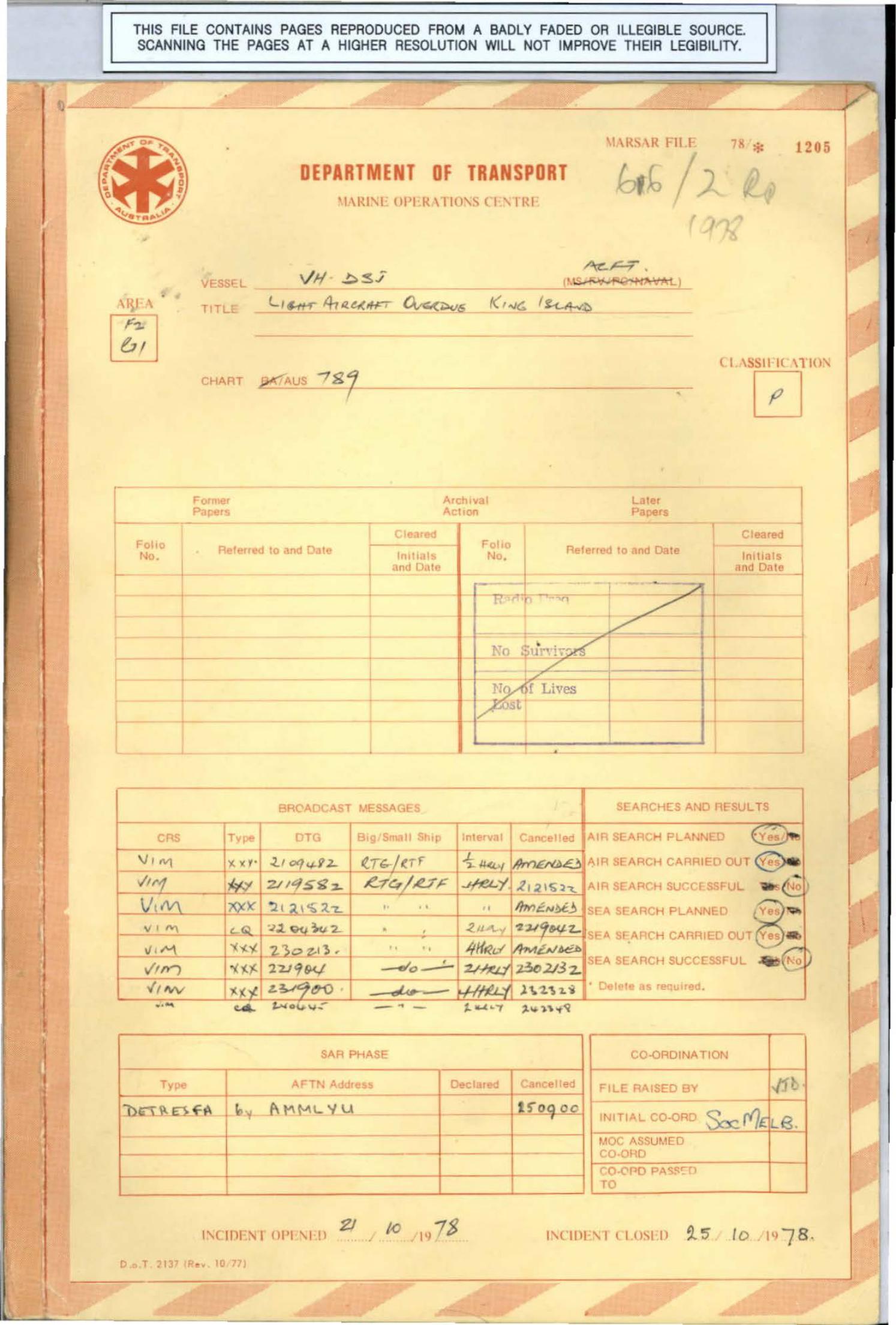
This file includes the MARSAR (Maritime Search and Rescue) narrative, daily ministerial SITREPs, search vessel charter invoices, police correspondence from the Tasmanian Commissioner's Office, and operational telex traffic between ACSC Canberra and Melbourne SAR. Also included: a separate UFO report from Darwin dated 22 October 1978, where two aircraft on the Tennant Creek to Darwin route reported a brilliant white iridescent light falling at speed, with nothing visible on radar. At least 79 additional documents were referred to other agencies and not all have been released under Freedom of Information.
The Australian government's UFO investigation history is documented in the Australia Reading Room, which includes the JIO document viewer and RAAF collection catalogue. See the Victoria sightings page for all Victorian sighting reports, and the Australia country page for the full national record. Bill Chalker's broader research is covered in the Bill Chalker profile.
Newsletter Coverage
How the UFO research community documented, analysed, and debated the case across seven publications.
The Victorian UFO Research Society investigated this case across more than a decade of the Australian UFO Bulletin. Paul Norman's findings, the six-week Bass Strait buildup, the corroborating witnesses around the strait, the Cape Otway rabbit hunters, and the Ground Saucer Watch analysis of the Manifold photograph, are collected in Eighteen Years of Investigating the Valentich Disappearance.
Newspaper Coverage
Thirteen press clippings from Australian and regional newspapers, October to November 1978. Scanned from originals held in the AFU/CFI Archive, Sweden and the National Library of Australia's Trove digital archive.