United States
Newspaper Clippings Collection
The United States generated more newspaper coverage of unidentified aerial phenomena than any other country in the twentieth century. It was the nation where the modern UFO era began, where the largest government investigation programmes operated, and where the press had the deepest infrastructure for covering strange events in the sky. This exhibition draws on a single, remarkable source: the UFO Newsclipping Service (NCS), compiled by Lucius Farish from Plumerville, Arkansas, from 1969 until his death in 2011.
Farish was a quiet, meticulous archivist who subscribed to newspaper clipping services, maintained contacts with editors across the country, and assembled monthly compilations of every UFO-related press report he could find. His operation was small (a post office box, a photocopier, a mailing list of subscribers) but the output was staggering. The NCS captured American newspaper coverage of UFO sightings at a level of granularity that no government programme, academic study, or media organisation matched. The 3,595 US sighting reports in this collection represent the backbone of that effort.
Curated Exhibits
Close-read exhibitions built from individual clipping collections in the archive, presented with the original scans.
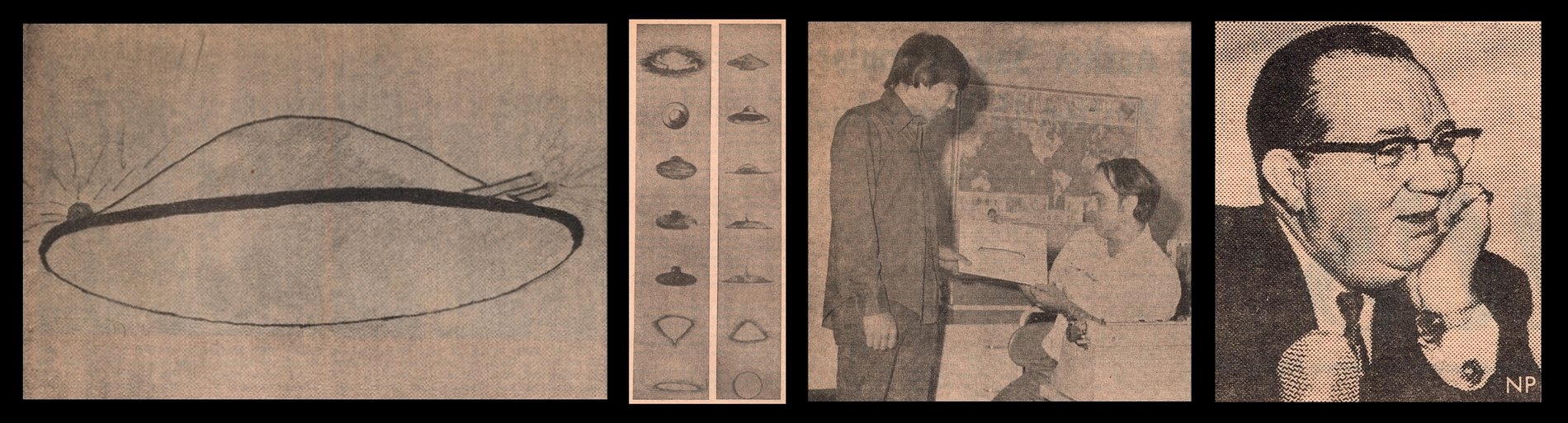
The 1974 New Hampshire Wave
The Lakes Region wave in the Laconia Evening Citizen, with earlier press and a 1978 tail.
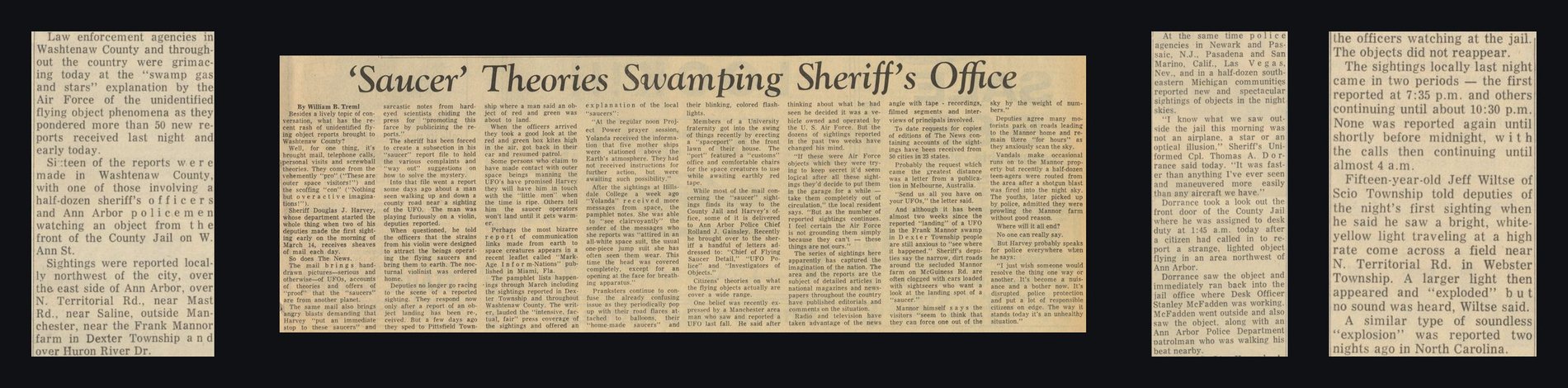
The 1966 Michigan Swamp Gas Wave
The Washtenaw County wave and the Air Force "swamp gas" explanation.
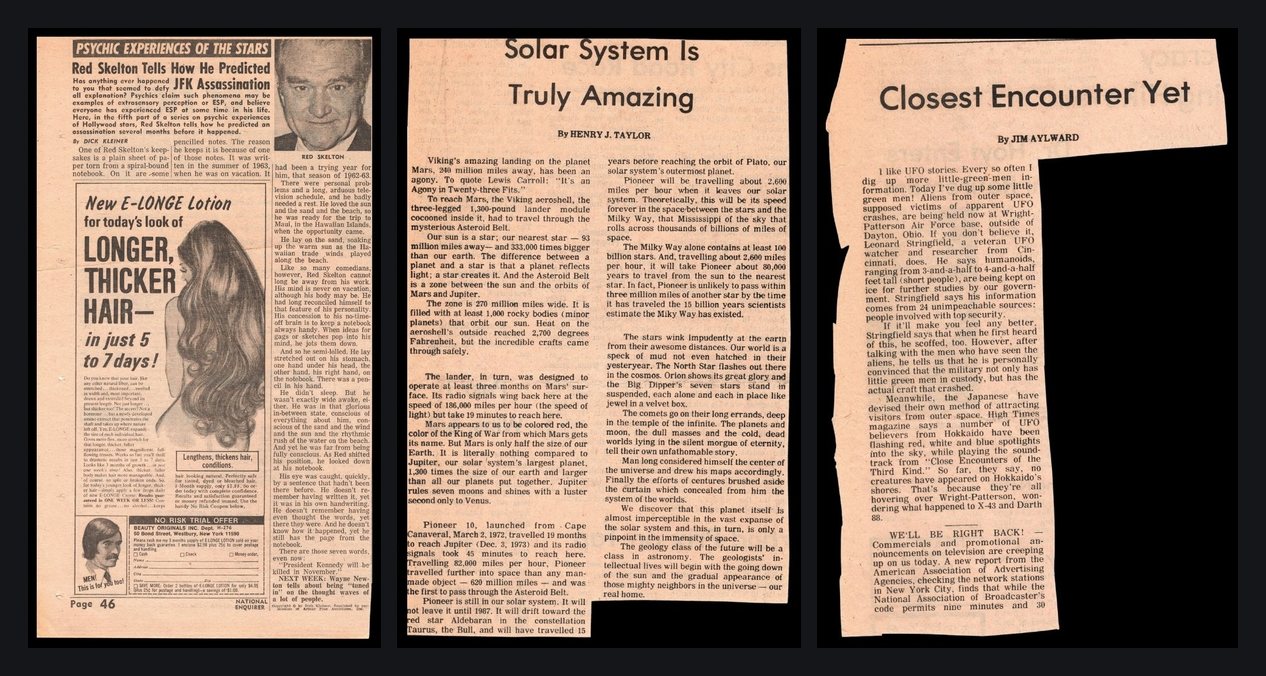
Beyond the Sightings
The psychic, the strange, and the space age, kept beside the sightings.
1940s to 1960s
The Wire Service Era
Before Farish launched the NCS in 1969, American UFO press coverage followed the rhythms of the wire services. When the Associated Press or United Press International moved a sighting story, papers from Portland, Maine to Portland, Oregon ran it. When the wires went quiet, so did the local desks. The result was coverage that arrived in waves: the Kenneth Arnold sighting and Roswell in 1947, the Washington, D.C. radar incidents of 1952, the Michigan "swamp gas" flap of 1966. Between waves, editors treated UFO reports as filler material, tucked between classified advertisements and weather forecasts.
The Air Force shaped this coverage more than any other institution. Project Sign (1948), Project Grudge (1949), and Project Blue Book (1952 to 1969) gave reporters an official source to call, and most of them did. A sighting story without an Air Force comment felt incomplete. The result was a feedback loop: witnesses reported sightings, reporters called Wright-Patterson Air Force Base, a spokesman offered an explanation (weather balloon, planet Venus, temperature inversion), and the story ran with the official line in the final paragraph. Blue Book processed 12,618 reports across its lifetime. The press covered only a fraction, but the ones it did cover followed this template almost without exception.
The Condon Committee report of 1969, commissioned by the Air Force and conducted at the University of Colorado, declared that further study of UFOs was unlikely to yield scientific results. The Air Force closed Blue Book the same year. For many editors, the Condon report was permission to stop covering UFO sightings altogether. For Lucius Farish, it was the reason to start the NCS: someone needed to keep tracking what the papers were printing, because the government had just announced it would stop.
1970s
The Post-Condon Resurgence
The closure of Project Blue Book was supposed to end the story. It did the opposite. With no Air Force spokesman to call for a dismissive quote, editors had to decide for themselves whether a sighting report was newsworthy. Many decided it was. The NCS began capturing this shift in real time from its first issue in 1969, and the 1970s produced 643 US press reports, a sharp increase over the rate of coverage in the late 1960s.
The 1973 wave drove much of this coverage. Beginning in September and peaking in October, sightings poured in from across the southern and midwestern United States. Mississippi, Ohio, Alabama, and Pennsylvania produced clusters of reports dense enough to dominate local front pages for weeks. The Pascagoula, Mississippi case of 11 October 1973, in which two shipyard workers reported being taken aboard a craft by robotic beings, generated international wire coverage and became one of the decade's most investigated cases. Local papers from Biloxi to Jackson ran follow-up stories for months.
The 1970s also saw the press begin to treat UFO witnesses with more sympathy. The cultural shift of the post-Watergate years, when Americans learned to distrust official explanations, extended to UFO reporting. Without a government programme to provide pat answers, reporters spent more time with witnesses and less time seeking debunking quotes. The NCS captured this change in editorial tone across hundreds of small-town papers that would never have made it into any national archive.
1980s
Peak Coverage
The 1980s produced 1,658 US press reports in the NCS collection, more than any other decade and nearly half the entire American total. Three factors converged to create this peak. First, the Hudson Valley wave of 1982 to 1986 generated sustained regional coverage across New York, Connecticut, and New Jersey as thousands of witnesses reported enormous boomerang-shaped craft. The Westchester County papers ran sighting stories so frequently that editors eventually created standing columns to handle the volume.
Second, two cases broke through into national and international coverage. The Cash-Landrum incident of December 1980, in which Betty Cash, Vickie Landrum, and Colby Landrum suffered severe radiation-like injuries after encountering a diamond-shaped craft escorted by military helicopters near Huffman, Texas, produced years of press coverage as the family pursued a lawsuit against the US government. Gulf Breeze, Florida, where builder Ed Walters photographed a series of UFO encounters beginning in 1987, divided the research community but kept papers across the Gulf Coast running stories well into the 1990s.
Third, the Reagan era's Strategic Defence Initiative (SDI) put advanced aerospace technology on the front page, and reporters covering SDI sometimes found themselves fielding calls from readers who had seen something they could not explain. The Cold War context meant that any unidentified object in American airspace carried implicit national security weight. Small-town editors who might otherwise have spiked a UFO story ran it because their readers were already anxious about what might be flying overhead.
1990s
The Phoenix Lights Era
The 1990s produced 1,527 US press reports, nearly matching the 1980s peak. The decade opened with the Belgian triangle wave of 1989 to 1990 generating American wire coverage, and it closed with the Phoenix Lights having permanently altered public expectations of what a mass sighting looked like. In between, the cultural landscape shifted around UFOs in ways that both helped and hindered serious press coverage.
The Phoenix Lights of 13 March 1997 remains the single most widely witnessed UFO event in American history. Thousands of residents across a 300-mile corridor from Henderson, Nevada to Tucson, Arizona reported an enormous V-shaped formation of lights passing silently overhead. Arizona Governor Fife Symington held a press conference in which an aide appeared in an alien costume, drawing national ridicule. Years later, Symington admitted publicly that he had witnessed the formation himself and had staged the joke to reduce panic. The Arizona Republic, the Phoenix New Times, and papers across the state produced hundreds of articles. The NCS captured coverage from local papers that national databases missed entirely.
Area 51 entered mainstream American culture in the 1990s, driven by Bob Lazar's 1989 television interviews, the 1994 designation of the Groom Lake restricted area, and Tim Burton's 1996 film Mars Attacks!. The X-Files, which ran from 1993 to 2002, normalised UFO language in American households. These cultural shifts had a measurable effect on press coverage: editors were more willing to run sighting stories when their readers were already primed by entertainment media to take the subject half-seriously.
2000s to 2010s
Decline of Print, Rise of Everything Else
The final decade of the NCS captured a newspaper industry in free fall. Between 2000 and 2011, American newspaper advertising revenue dropped by more than 60 percent. Newsrooms shed reporters by the thousands. The kind of beat reporter who once covered a local sighting by driving out to interview the witness was increasingly a luxury that shrinking papers could not afford. The NCS collection shows this directly: 1,290 reports in the 2000s, dropping to 116 in the 2010s before Farish's death ended the service in 2011.
The reports that did make print in this era tended to cluster around events too large to ignore. The Stephenville, Texas sightings of January 2008, in which dozens of witnesses (including a constable and a pilot) reported a massive silent object near the Crawford Ranch, generated national coverage and forced the Air Force to reverse an initial denial that F-16s had been in the area. The Stephenville Empire-Tribune ran the story on its front page and was rewarded with the most traffic its website had ever received. It was one of the last great newspaper UFO stories, a case that played out in newsprint before migrating to the internet.
The attacks of 11 September 2001 also reshaped the context for UFO reporting. Unidentified objects in American airspace became a security matter rather than a curiosity. NORAD and the FAA tightened tracking procedures. When sightings did make the news after 2001, editors were more likely to frame them in terms of airspace safety than scientific mystery. This shift in framing anticipated the language that would later dominate the 2017 New York Times revelations about the Pentagon's Advanced Aerospace Threat Identification Programme, which cast UAP as a defence concern rather than a fringe interest.
About the UFO Newsclipping Service
Lucius Farish operated the UFO Newsclipping Service from his home in Plumerville, Arkansas (population 800) for over four decades. He began as a subscriber to commercial newspaper clipping bureaus, which would scan papers nationwide and mail him every article matching his search terms. As those services declined, he built his own network of correspondents: researchers, librarians, and local UFO group members who mailed him clippings from their regions. Each month, Farish photocopied the best material, stapled it together, and mailed it to a subscriber list that never exceeded a few hundred people.
The NCS was never a commercial success. Farish ran it as a labour of dedication to the historical record. When he died in February 2011, the service ended with him. No one picked it up. The archive he left behind, now preserved in this collection, represents the most comprehensive single-source record of American newspaper UFO coverage ever assembled. The 3,595 US sighting reports are supplemented by international coverage, editorials, letters to the editor, and feature articles that bring the total NCS collection to tens of thousands of items.