Al Worden
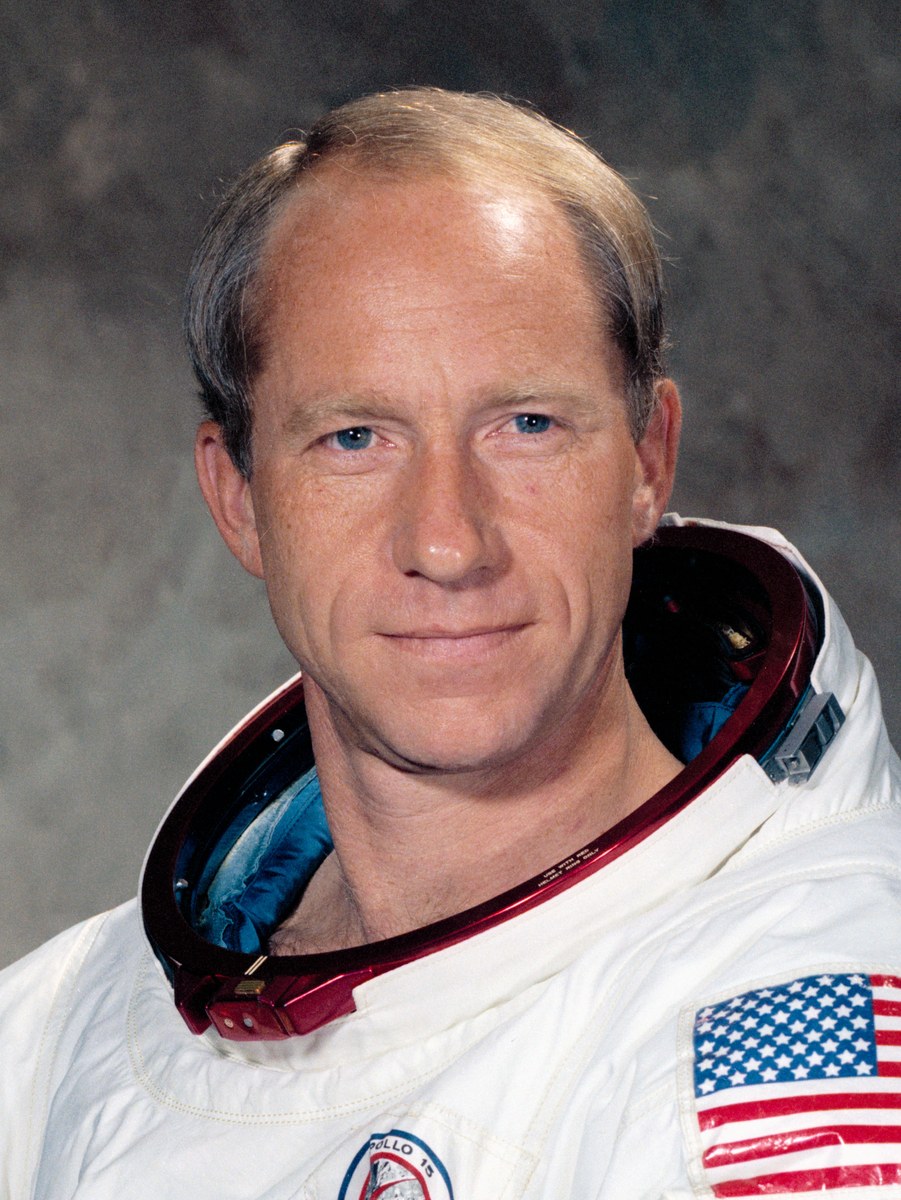
Alfred Merrill Worden, known throughout his Air Force and NASA career as Al, was the Command Module Pilot of Apollo 15, the fourth crewed lunar landing mission, in the summer of 1971. He spent three days alone in lunar orbit while Dave Scott and James Irwin worked the surface at Hadley-Apennine; conducted the first deep-space extravehicular activity in human history on the return leg home; was decorated by the United States and a series of foreign governments; and was reassigned out of active astronaut status within months of return after the Apollo 15 commemorative covers scandal. The covers scandal was an internal NASA disciplinary action; the late-life public statements about human origins were one of the more surprising contributions to the astronaut-disclosure register made by anyone who had been to the Moon.
A Life
Alfred Merrill Worden was born on 7 February 1932 in Jackson, Michigan, the eldest of five children of Merrill and Helen Worden. The family farmed. He went through Jackson High School, worked his summers building roads and stacking hay, and won an appointment to the United States Military Academy at West Point. He graduated from West Point with the class of 1955, took his commission in the United States Air Force, and entered pilot training the same year. The first decade of his Air Force career was the standard fighter-pilot track: F-86 Sabre, F-94 Starfire, F-102 Delta Dagger, transition to F-100 Super Sabre, and a posting at Randolph and at Bitburg in West Germany.
The route to the astronaut corps went through test pilot school. Worden completed the Empire Test Pilots' School at Farnborough, England, on exchange in 1964, then was assigned to the Aerospace Research Pilot School (ARPS) at Edwards Air Force Base in California in 1965. ARPS under Chuck Yeager's command was the institutional pipeline through which NASA recruited the Group 5 (1966) and Group 7 (1969) astronaut intakes. Worden applied for selection in 1965 and was named to Astronaut Group 5 in April 1966 along with eighteen others including Edgar Mitchell, Stuart Roosa, John Bull and Jack Lousma.
He spent the years 1966 to 1970 on the standard astronaut career arc: technical assignments inside the astronaut office, support-crew positions on Apollo 9 and Apollo 12, and progression up the rotation. His prime-crew assignment to Apollo 15 came in March 1970 with David R. Scott as Commander and James B. Irwin as Lunar Module Pilot. The mission launched from Pad 39A at the Kennedy Space Center on 26 July 1971 and returned to splashdown in the Pacific on 7 August 1971.
The post-flight disciplinary action that ended Worden's active astronaut career arrived in early 1972. He was reassigned out of the prime crew of any further mission, kept on the NASA roster through to 1975 in a research role at the Ames Research Center, and retired from both NASA and the United States Air Force in September 1975 with the rank of Colonel. He moved into the private sector, ran for the United States House of Representatives unsuccessfully in 1982 from Florida's 12th district, worked in the aerospace industry, and from the late 1970s onwards became one of the most active public-speaking veterans of the Apollo programme. He published his autobiography Falling to Earth (Smithsonian Books, 2011) with the journalist Francis French. He died of natural causes at his home in Sugar Land, Texas, on 18 March 2020, at the age of eighty-eight.
I think we may be a combination of creatures that were living here on this planet and creatures that were brought here from somewhere else.Worden, in interviews on the Apollo legacy, late period
Photographs
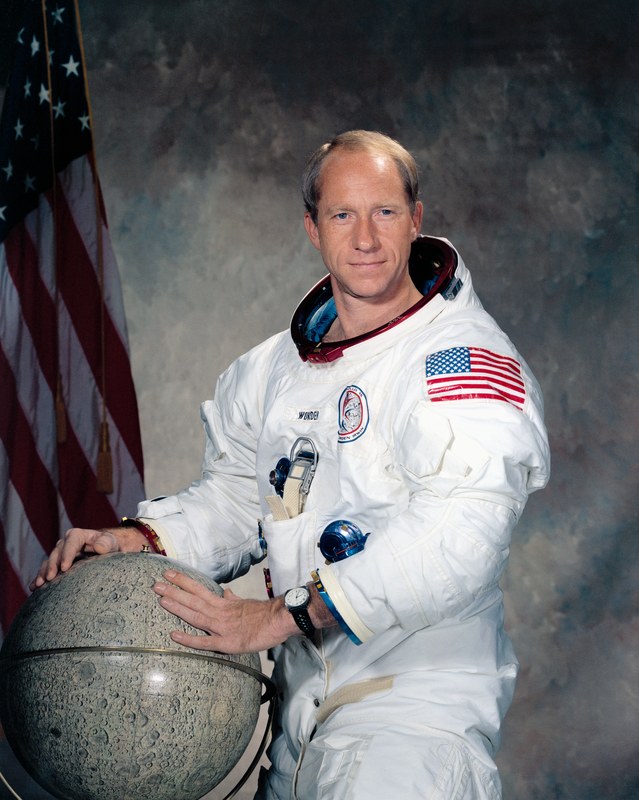
Worden was photographed extensively by NASA throughout the Apollo 15 training and mission cycle. The NASA Johnson Space Center photographic archive holds the official portraits, the training photography, the Apollo 15 in-flight imagery from the Command Module, and the post-mission press coverage. The 1971 flight was the first Apollo mission to carry the Mapping Camera and the Panoramic Camera, both of which Worden operated, generating the most extensive single-mission photographic record of the lunar surface produced in the Apollo programme.
Apollo 15
Apollo 15 launched at 09:34 Eastern Daylight Time on 26 July 1971 with Worden, Scott and Irwin aboard the Command and Service Module Endeavour and the Lunar Module Falcon. The mission was the first of the J-series Apollo flights, with extended surface stay, the first Lunar Roving Vehicle, the Scientific Instrument Module (SIM) bay in the service module for orbital lunar science, and the first deep-space extravehicular activity planned for the return leg home.
Worden spent the surface phase of the mission alone in lunar orbit aboard Endeavour, operating the SIM bay instruments through approximately seventy-five hours of lunar revolution. The SIM bay carried the Panoramic Camera (high-resolution stereo imaging of the lunar surface from orbit), the Mapping Camera, the Laser Altimeter, the Gamma-Ray Spectrometer, the X-Ray Spectrometer, and a subsatellite released into lunar orbit at the end of the mission. The orbital-science yield from Apollo 15 was the largest of any single Apollo flight. The mapping coverage of the lunar far side from the orbital photographs Worden took remains a primary source for lunar geological cartography.
The return-leg deep-space EVA was conducted on 5 August 1971 at a distance from Earth of approximately 196,000 nautical miles (about 363,000 kilometres). Worden left the Command Module hatch and traversed the outside of the service module to retrieve the film cassettes from the Panoramic and Mapping Cameras in the SIM bay. The EVA lasted thirty-eight minutes. It was the first extravehicular activity ever conducted in deep space (as distinct from low Earth orbit or lunar surface), and it remained the deep-space EVA distance record until the Apollo 16 and Apollo 17 missions repeated the same operation later in the programme.
The mission returned to splashdown in the Pacific Ocean on 7 August 1971. The total mission duration was 295 hours 11 minutes 53 seconds. Worden, Scott and Irwin were debriefed at the Manned Spacecraft Center, made the standard post-flight tour of capitals (the United States Congress, the United Nations General Assembly, foreign-government decorations including the Yugoslav order of the Yugoslav flag with sash) and were returned to the astronaut office for re-assignment.
The complete Apollo 15 Mission Report is held by the NASA Technical Reports Server and the Johnson Space Center archive. The orbital-science instrumentation results are summarised in the Apollo 15 Preliminary Science Report (NASA SP-289, 1972). The deep-space EVA is described in Section 6.6 of the Mission Report. The Apollo 15 photographic record is held by the Lunar and Planetary Institute at lpi.usra.edu/resources/apollo/.
The Apollo 15 Commemorative Covers Scandal
The Apollo 15 prime crew (Worden, Scott and Irwin) carried four hundred unauthorised philatelic first-day covers aboard the spacecraft on the 1971 mission, an arrangement made through a German stamp dealer named Hermann Sieger. One hundred of the covers were returned to NASA for the official Apollo flown-stamps inventory; the remaining three hundred were divided among the three crew members for personal disposition. The crew had been promised compensation by Sieger after the mission. The arrangement was not disclosed to NASA management at the time of the flight.
The arrangement came to public attention in late 1971 when Sieger placed an advertisement in a German philatelic publication offering the covers for sale at approximately USD 1,500 each. The NASA Administrator's office launched a disciplinary investigation in early 1972. Worden, Scott and Irwin were each reassigned out of active astronaut status, formally reprimanded, and (in the case of Worden and Scott, both of whom remained on active duty USAF status) were the subjects of Air Force Article 15 non-judicial punishment proceedings. The crew returned the funds they had received. The matter was reported to the United States Senate Committee on Aeronautical and Space Sciences which held hearings on it in August 1972.
The covers scandal was the single largest astronaut-corps disciplinary action of the Apollo programme. It ended the active flight careers of all three Apollo 15 crew members. It also produced the first sustained internal NASA review of crew-personal-effects regulations and led to the formalisation of the inventory and disclosure requirements that governed crew personal items on Skylab and the Space Shuttle programmes. The Senate hearing record (US Senate, 92nd Congress, 2nd session, August 1972) is the principal documentary source. Worden's own account of the affair, in Falling to Earth (2011), reads the episode as an institutional failure of NASA management to communicate the regulations adequately to the crews rather than as straightforward crew misconduct; the contemporary record contains both interpretations.
Late-Life Statements on the Origins Question
Worden's late-period public speaking, across the decade between the publication of Falling to Earth in 2011 and his death in 2020, included a series of statements on the question of extraterrestrial life and the possible non-terrestrial origins of human civilisation that placed him in the small group of Apollo-era astronauts (with Edgar Mitchell, Gordon Cooper, and Brian O'Leary) who used their post-NASA platforms to engage the question directly.
The general line of Worden's late-period statements, recurring in BBC, Sky at Night and various conference interviews from approximately 2014 onwards, was that the Earth had been visited by intelligent non-human entities in the historical and prehistorical past, that the cumulative evidence (which he located in the cuneiform and Vedic literatures, the megalithic archaeological record, and the anomalous-artefact tradition the archive holds in its contactee-era collections) was sufficient to make the question of non-terrestrial human ancestry a question worth asking seriously, and that he personally had come to consider the possibility of a partly non-terrestrial human ancestry to be live.
He did not claim direct lunar-mission contact with non-human craft or entities. He distinguished clearly between his Apollo 15 mission observations (which he treated as consistent with the conventional lunar geological record) and his later-period synthesis of the cumulative literature on possible non-terrestrial influence on human civilisation (which he treated as a question of accumulated indirect evidence rather than direct observation). The distinction is the substantive one for archive purposes.
Worden's late-period statements are sometimes cited alongside Edgar Mitchell's Roswell-era statements, Gordon Cooper's UFO-encounter claims, and Brian O'Leary's wider extraterrestrial-civilisation hypothesis as parts of a single "astronaut disclosure" register. The individual statements have substantially different content. Mitchell claimed specific Roswell briefing material from senior intelligence officers; Cooper claimed specific UFO encounters in Air Force service; Worden made no claim of direct contact or specific briefing material. His statements are an accumulated-evidence synthesis claim, not a specific witness or recovered-material claim. The archive distinguishes the registers because the evidentiary status of each is different.
Connected People
United States Air Force test pilot (b. 1932) who commanded Apollo 15, walked on the Moon at the Hadley-Apennine landing site for nineteen hours over three EVAs, and was the senior of the three Apollo 15 crew members in the covers-scandal proceedings. Has spoken publicly about the mission across decades but has been more reserved than Worden about the wider questions Worden raised in late life. Co-author with Alexei Leonov of Two Sides of the Moon (2004).
United States Air Force test pilot (1930 to 1991) who flew the Lunar Module Falcon with Scott to the Hadley-Apennine site and conducted the three lunar surface EVAs. Suffered a heart attack on the lunar surface that was concealed from him by Mission Control at the time. After leaving NASA, founded the High Flight ministry and conducted multiple Mount Ararat expeditions searching for Noah's Ark. Died of a heart attack in 1991.
United States Navy test pilot (1930 to 2016) who walked on the Moon in February 1971 (the mission immediately before Apollo 15) and after leaving NASA became the most publicly active astronaut on extraterrestrial-disclosure questions, including specific Roswell-era claims about briefing material received from senior intelligence officers. Founder of the Institute of Noetic Sciences. The principal astronaut alongside whom Worden's late-period statements are usually read.
United States Air Force test pilot (1927 to 2004) and one of the original Mercury Seven astronauts. Made specific claims across his post-NASA career about UFO encounters during his service as a fighter pilot in Germany in the 1950s and during the Mercury programme. Worden cited Cooper occasionally in his late-period speaking as a precursor in the astronaut-disclosure register.
American astrophysicist and astronaut (1940 to 2011), member of Astronaut Group 6 (1967), who resigned from NASA before flying and devoted his later career to investigating consciousness research, anomalous archaeology, and the wider question of extraterrestrial influence on human civilisation. Author of The Energy Solution Revolution (2008). The Apollo-era astronaut whose synthesis of the wider non-terrestrial-influence question most closely paralleled Worden's late-period statements.
British space historian and former director of the San Diego Air and Space Museum education programme. Co-author with Worden of Falling to Earth (Smithsonian Books, 2011). The standard biographical source for Worden's career and his own account of the covers scandal and the post-NASA decades.
German stamp dealer who proposed the four-hundred-cover arrangement to the Apollo 15 crew before the 1971 mission, accepted delivery of the three hundred crew-allocated covers after the mission, and made them publicly available through philatelic-trade advertising. The Sieger transaction was the proximate event that produced the NASA investigation. Sieger himself was outside United States jurisdiction and was not the subject of legal proceedings.
In the Archive
Worden appears across three sections of the archive. The Apollo programme operational and scientific record runs through the NASA technical reports and the Lunar and Planetary Institute photographic archive. The covers-scandal documentary record runs through the Senate Aeronautical and Space Sciences Committee hearings of August 1972 and through the NASA Administrator's office disciplinary file. The astronaut-disclosure register that Worden contributed to in his late period sits alongside the Edgar Mitchell, Gordon Cooper and Brian O'Leary material in the archive's wider astronaut-disclosure coverage. The space-race posts of the archive's main editorial track engage the wider Apollo-era questions Worden's career intersected with.
Worden's Apollo career sits inside the wider space-race history documented through the archive's Space Race longform and the connected NASA-era posts. The astronaut-disclosure register, including the Edgar Mitchell, Gordon Cooper and Brian O'Leary parallel statements, is documented through the astronaut-disclosure page. The wider postwar contactee tradition Worden's late-period statements engage is documented through the Contactee Era 1950 to 1965 page.
Sources
Worden, Al and Francis French. Falling to Earth: An Apollo 15 Astronaut's Journey to the Moon, Smithsonian Books, 2011. NASA. Apollo 15 Mission Report (MR-71-119), December 1971. NASA. Apollo 15 Preliminary Science Report (NASA SP-289), 1972. United States Senate Committee on Aeronautical and Space Sciences, hearings on the Apollo 15 commemorative covers, 92nd Congress, 2nd session, August 1972. Lunar and Planetary Institute, Apollo 15 photographic archive, lpi.usra.edu/resources/apollo/. Worden obituaries: NASA press release, 18 March 2020; New York Times, 19 March 2020; Washington Post, 19 March 2020. Mitchell, Edgar D. The Way of the Explorer, Putnam, 1996, for the parallel astronaut-disclosure register. O'Leary, Brian. The Energy Solution Revolution, Bridger House, 2008, for the wider non-terrestrial-influence synthesis tradition.