Jack Parsons
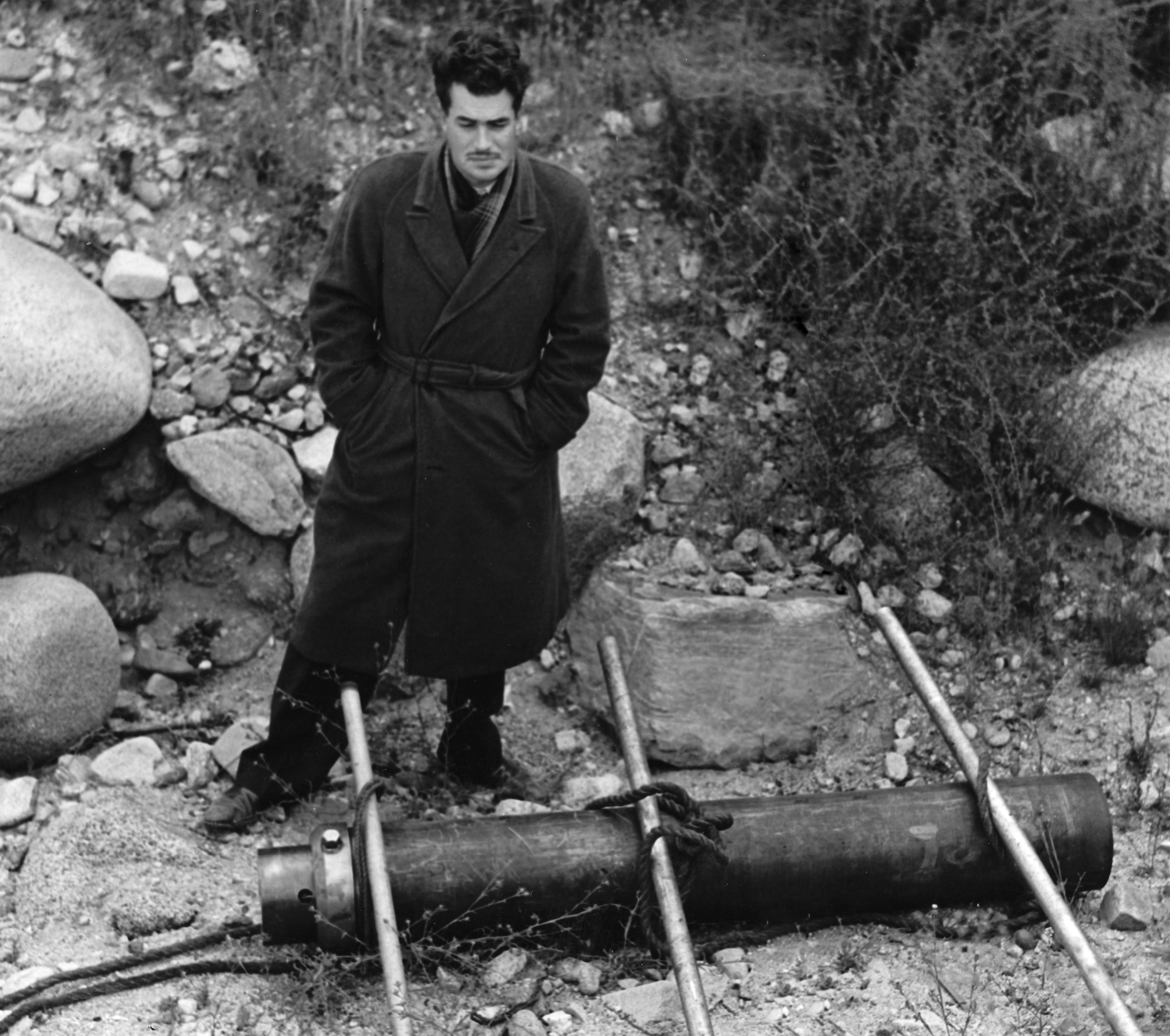
John Whiteside Parsons, known throughout his life as Jack, did not finish university. He built rocket motors in the dry hills behind Pasadena with a circle of friends Caltech called the Suicide Squad, helped the United States acquire jet-assisted take-off in time for the Pacific war, and founded Aerojet Engineering and the Jet Propulsion Laboratory. He was also a sworn member of Aleister Crowley's Ordo Templi Orientis, ran the Agape Lodge out of his house on Orange Grove Avenue, and in early 1946 performed a ritual with L. Ron Hubbard as scribe that he believed had opened a door for a goddess to walk through. He died in his home laboratory on 17 June 1952, age thirty-seven, when a coffee can of fulminate of mercury detonated on his work bench.
A Life
Parsons was the only child of Marvel Whiteside and Marvel Parsons. His father walked out before he was old enough to remember, and his mother raised him in his grandfather's house in well-off Pasadena with an inheritance that ran thin in the Depression. He was christened Marvel Whiteside Parsons after his father, came to detest the name, and by his teens was signing as John, with Jack as the everyday form he kept for the rest of his life. He was a sickly, bookish boy who taught himself the chemistry his school did not teach. The Pasadena papers later said he was building rockets in the back garden by the age of thirteen.
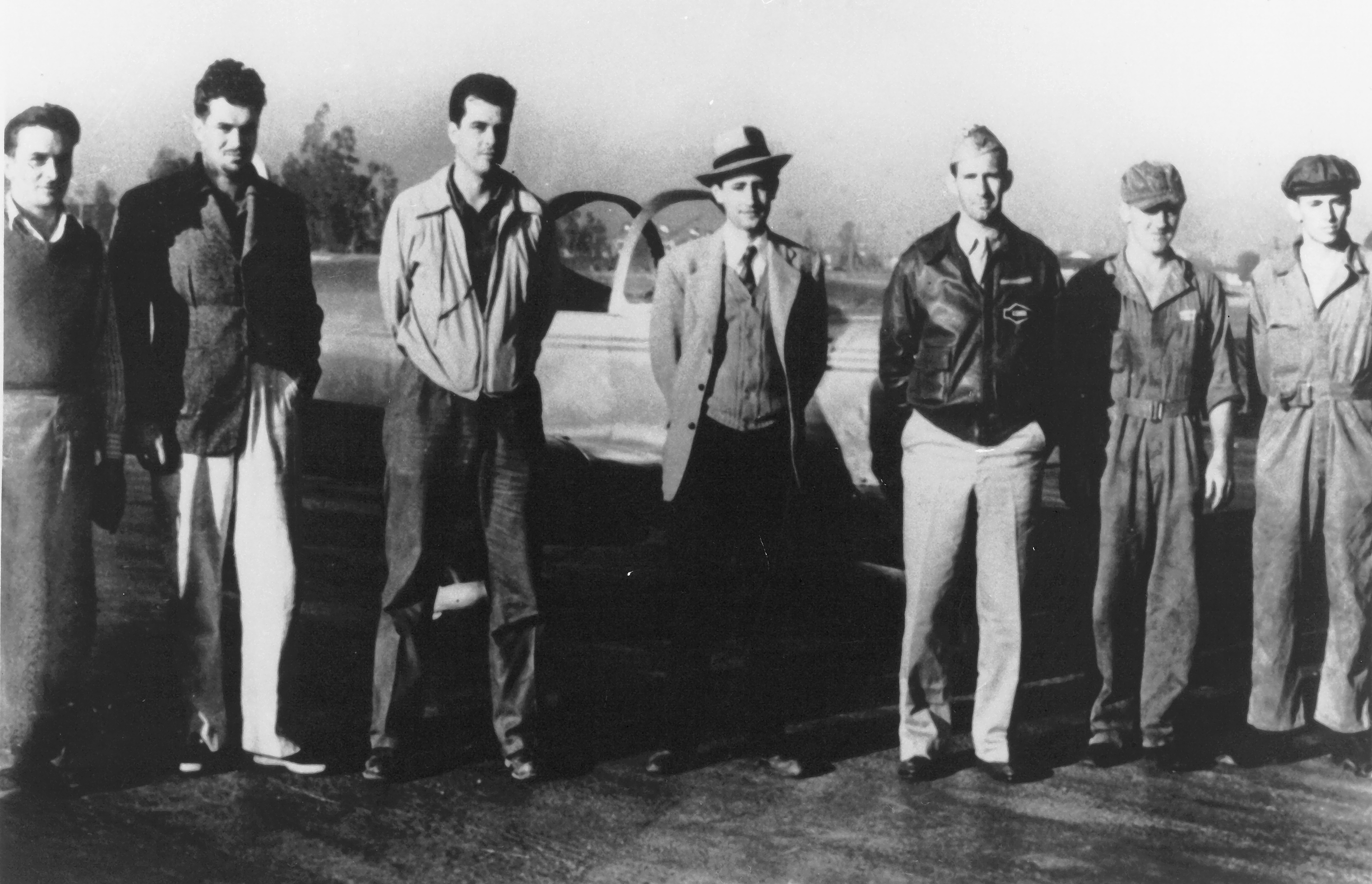
He met Edward Forman at school. The two of them tried gunpowder rockets first, then graduated to liquid oxygen, and by 1934 they had attached themselves to Frank Malina, a graduate student at the Guggenheim Aeronautical Laboratory at Caltech (GALCIT). Theodore von Karman, the laboratory's director, indulged them. The Caltech faculty, less indulgently, called the group the Suicide Squad after they blew up an exhaust port on campus and were exiled to the Arroyo Seco. Parsons had no degree. He was the chemist of the operation because he was the one who could be trusted to mix the fuels.
The Arroyo Seco tests, run on a dusty creekbed in the foothills, became the United States' first serious rocketry programme. By 1939 the National Academy of Sciences was paying GALCIT to develop jet-assisted take-off, or JATO, to get heavily loaded aircraft off short runways. Parsons solved the solid fuel problem by mixing potassium perchlorate with roofing tar, a casting compound nobody else had thought to try. It worked. The Navy adopted JATO in 1942. By the end of the war the Suicide Squad had become the Jet Propulsion Laboratory, with Malina as its first director and Parsons listed as one of the founders.
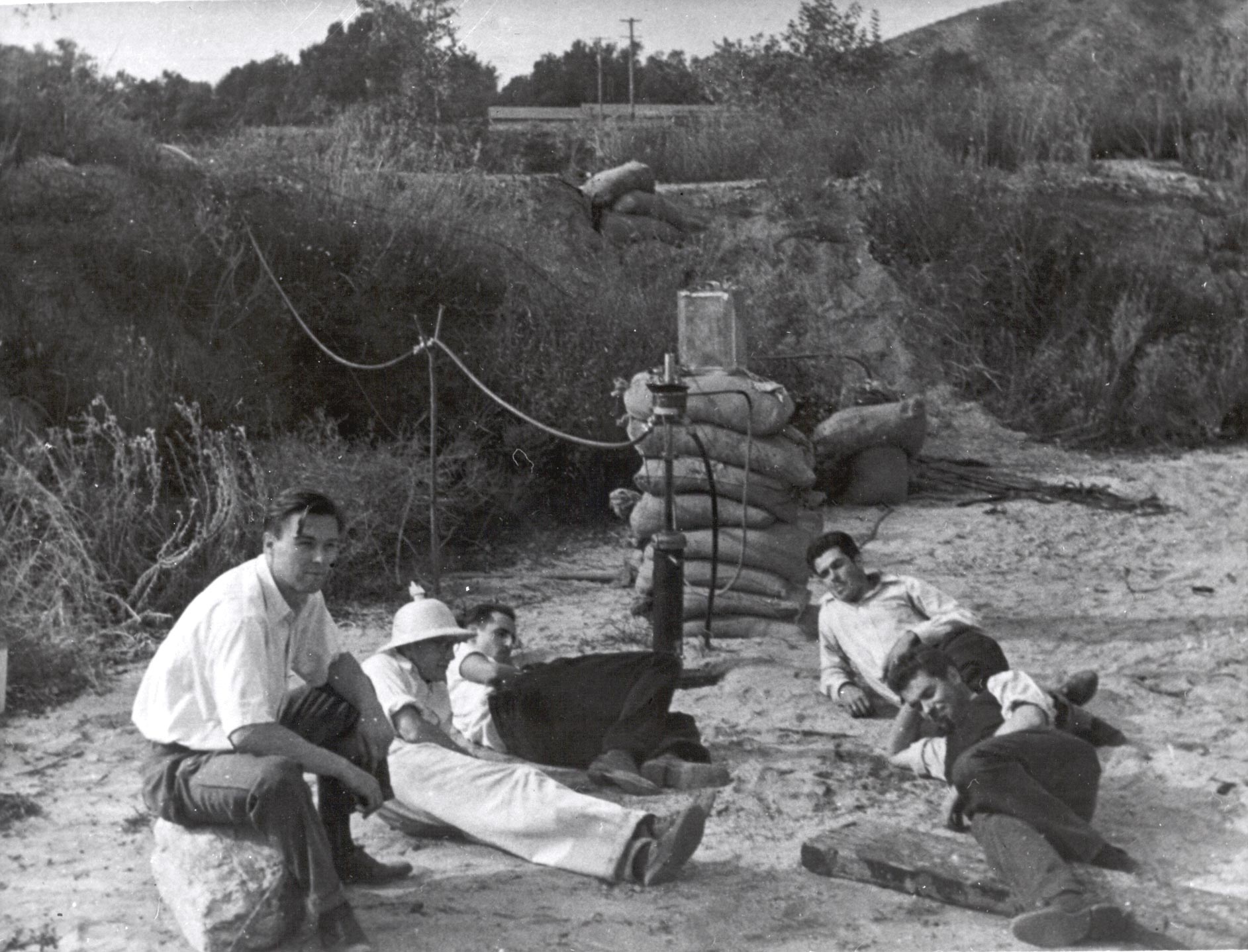
The Suicide Squad were the first Americans to take rocket flight seriously enough to keep doing it after the first explosion.George Pendle, Strange Angel
The other thread of his life was magic. Parsons had read Crowley's Magick in Theory and Practice as a teenager and corresponded with him by 1939. He swore initiation into the Ordo Templi Orientis in 1941 and rose quickly. By 1942 he was the leader of the Agape Lodge in Pasadena, the only functioning OTO lodge in the United States. He kept the work running out of his rambling house on Orange Grove Avenue, which he had converted into a boarding house for what one Federal Bureau of Investigation memorandum called "an organisation dedicated to the practice of black magic."
The arrangement was that the front rooms held the boarders, who were drawn from the wartime Caltech and JPL crowd plus a thinning collection of bohemians, and the basement and the back rooms held the ritual work. Crowley wrote to Parsons in 1943 calling him a son and the OTO's American hope. Parsons wrote back about visions, about being met by a Goddess in the desert, about the war as a thinning of the veil.
Photographs
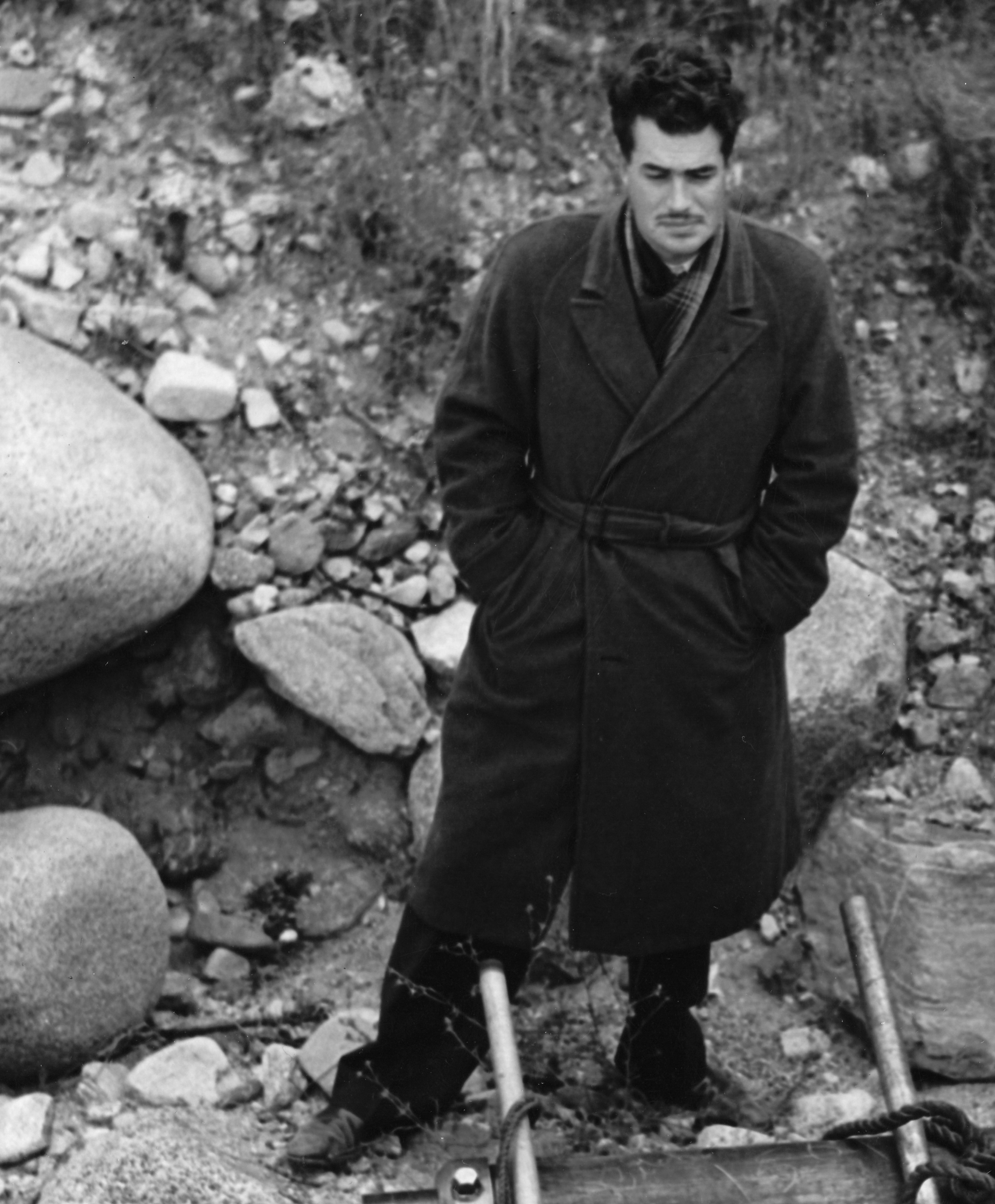
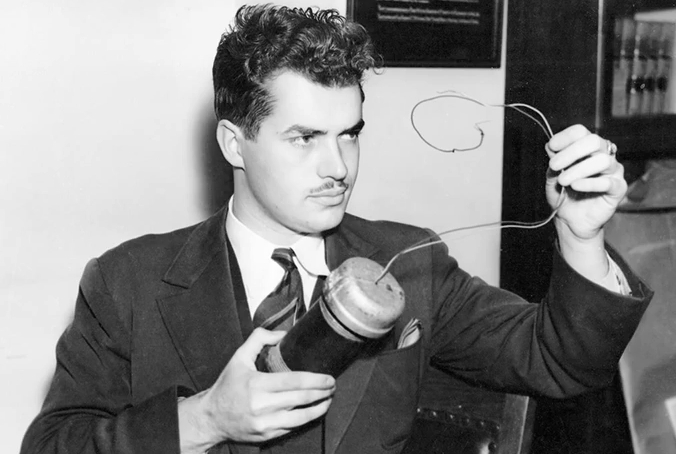
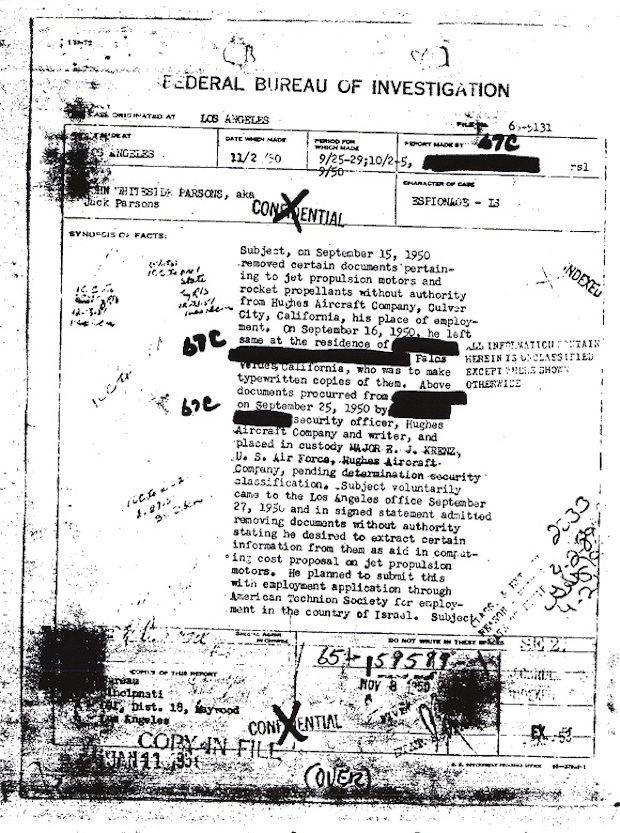
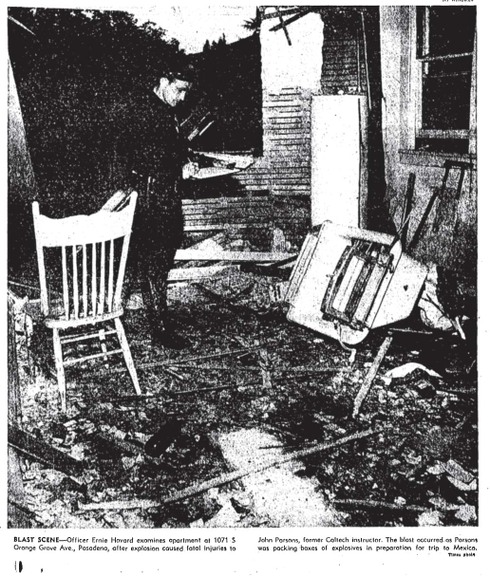
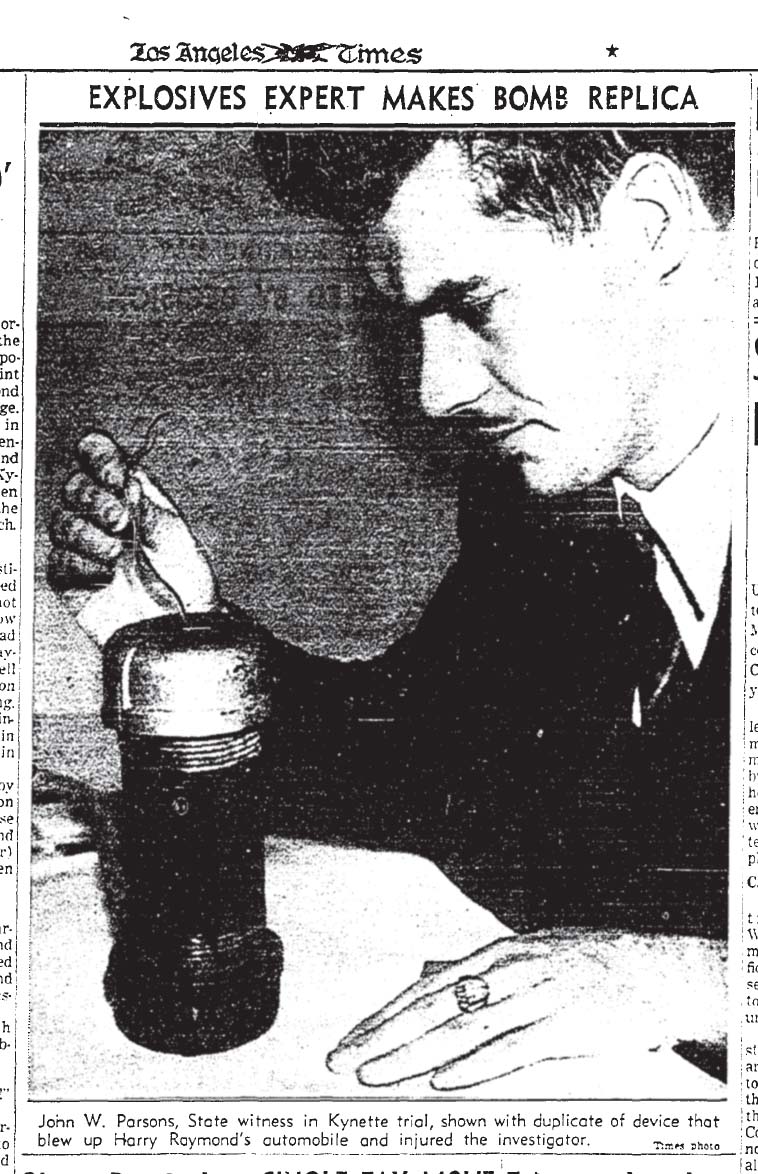
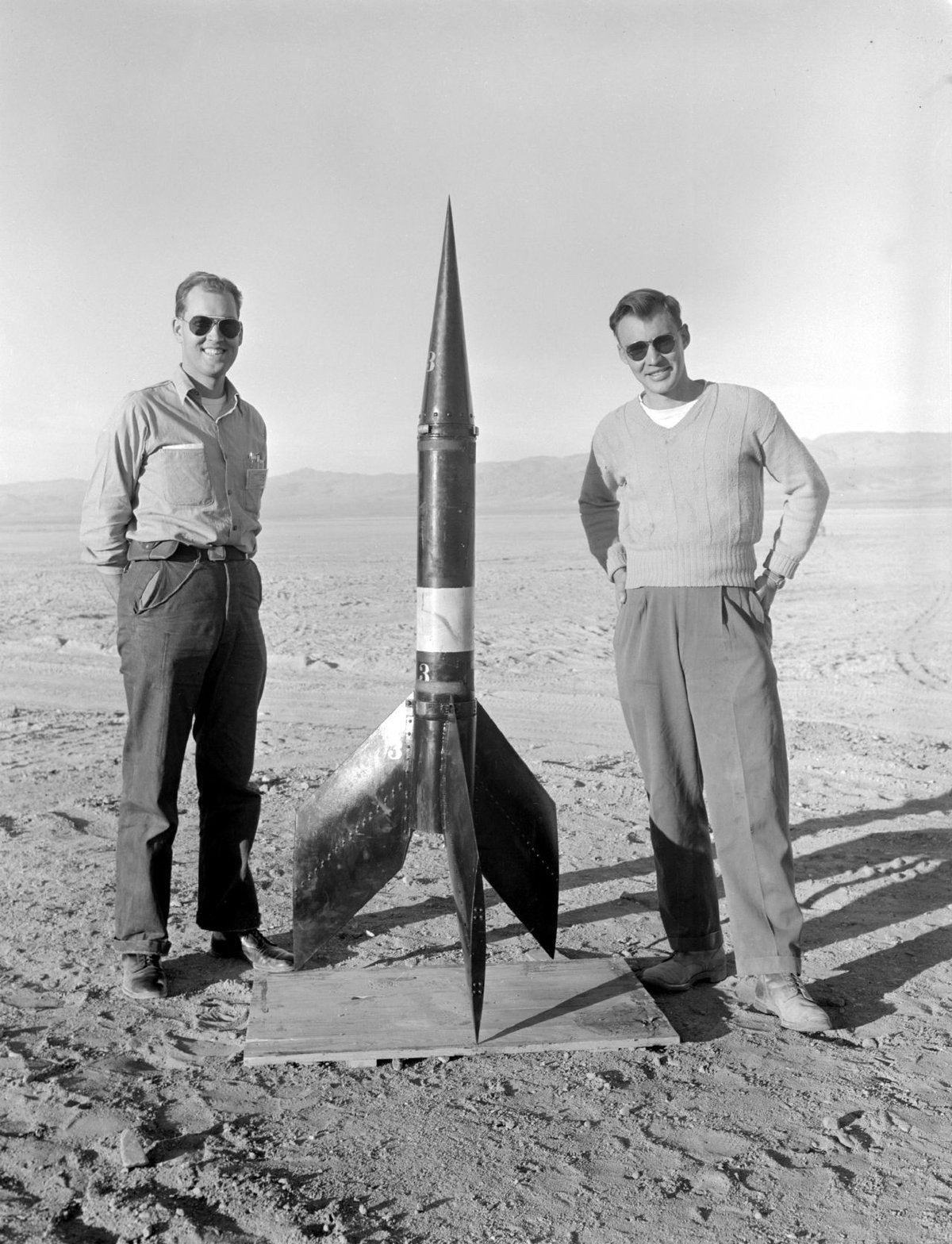
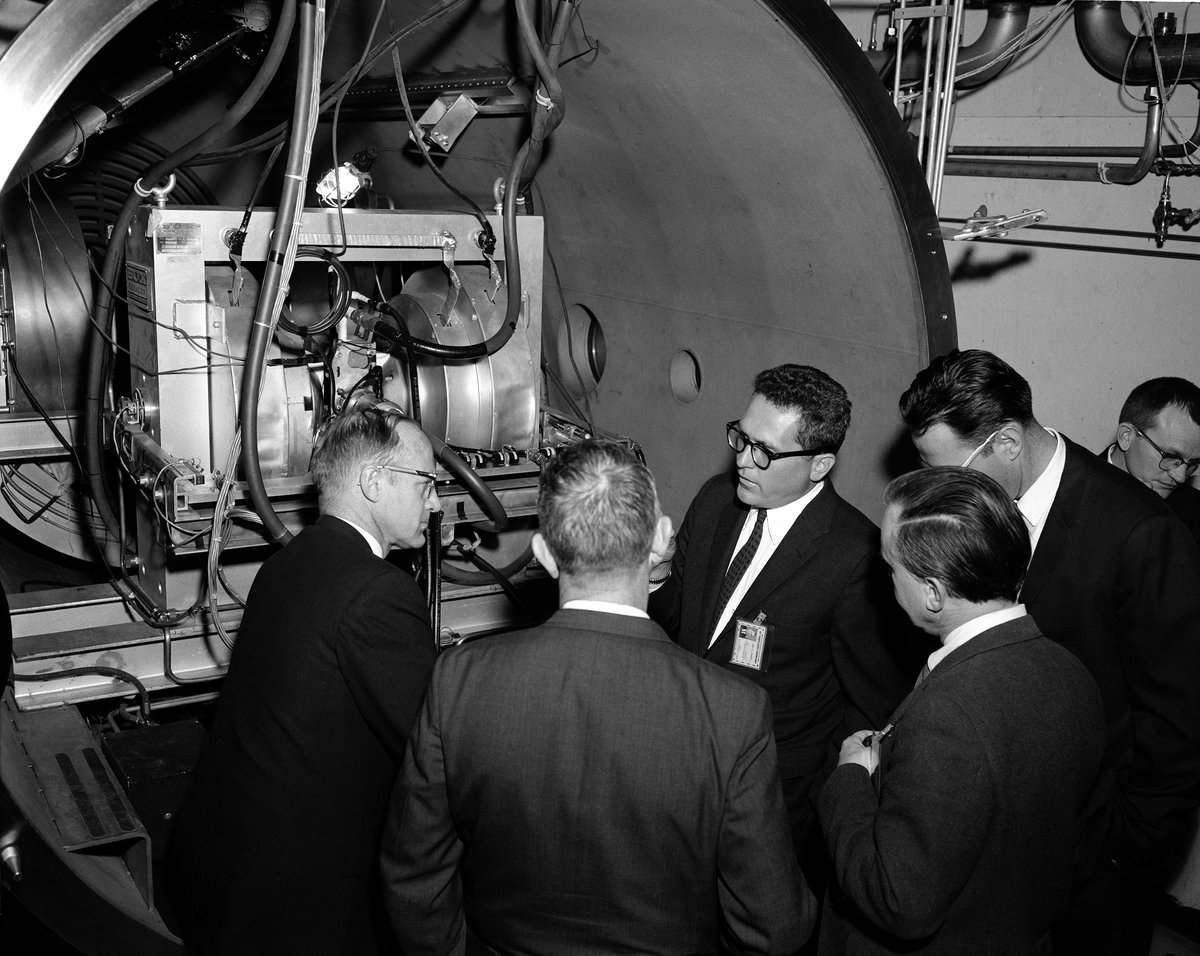
Most of what survives of Parsons' likeness is institutional. Caltech and JPL kept rocket-test photographs because they were programme records. The Federal Bureau of Investigation kept identification headshots because it was running him as a security subject. The Pasadena papers ran a small studio portrait at the time of his death. There is no candid photography of the Agape Lodge years.
The Rocket Work
What Parsons actually built mattered. The 1942 JATO motor was the first practical American solid-propellant rocket. It used a fuel he formulated himself, GALCIT 53, that did not detonate when struck and that could be cast in long burn-stable grains. Earlier American work had relied on smokeless powder formulations that cracked under storage and exploded under shock. GALCIT 53 was the ancestor of every American solid rocket motor that came after, including the boosters that lifted Polaris and the space shuttle.
In 1942 Parsons, Forman, Malina and von Karman founded Aerojet Engineering Corporation to manufacture JATO commercially. They sold their stock in 1944. Parsons put the money into the Agape Lodge and into experimental work he could not get funded any other way. In 1943, when the Suicide Squad's Caltech contract was renamed the Jet Propulsion Laboratory, Parsons was on the masthead as one of its co-founders. He was thirty.
The 1972 International Astronomical Union resolution naming a crater on the far side of the Moon Parsons cited "his pioneering contributions to American rocket propulsion." There is no mention of the OTO. NASA still circulates his JATO photographs in the JPL historical archive.
The Babalon Working
In December 1945 a Navy lieutenant named Lafayette Ronald Hubbard moved into the Orange Grove house. Hubbard had been a science fiction writer for Astounding before the war. He had no formal occult training. Parsons described him in a letter as "the most Thelemic person I have ever met outside of the order itself," and made him scribe and seer for what Parsons called the Babalon Working: a ritual sequence aimed at incarnating the Thelemic goddess Babalon as a human elemental.
The work ran in two phases. The first, January to early March 1946, consisted of nightly invocations in the Pasadena house with Hubbard recording the visions. The second was an open-desert working at the Mojave dunes in late February. Parsons returned and announced that the operation was complete and an elemental had been called. Three weeks later Marjorie Cameron, a former Naval WAVE who had never met Parsons, appeared at his door. Parsons identified her as the elemental and married her in October 1946.
Crowley, by then in declining health in England, wrote that he was disgusted with Parsons and his lieutenant. He saw the Working as embarrassing, undisciplined and the product of a man who had not done the required preliminary training. Hubbard, for his part, took Parsons' partner Sara Northrup and a substantial portion of Parsons' Aerojet money down to Florida in mid 1946 in what Parsons described in legal filings as a partnership fraud. Hubbard would go on to publish Dianetics in 1950 and to found the Church of Scientology in 1952.
Babalon is incarnate upon the earth today, awaiting the proper hour of her manifestation.Jack Parsons, letter to Aleister Crowley, March 1946
The Babalon Working anticipates the language of the postwar contact narratives by exactly four years. The first published account of an organised contactee experience, George Adamski's Flying Saucers Have Landed, appeared in 1953. Both speak of inviting non-human intelligences to step through a thinned veil. Parsons used desert ritual; Adamski used the Mojave in November 1952. The Mojave in 1946 and the Mojave in 1952 are the same desert.
Pasadena, 17 June 1952
By 1952 Parsons was reduced. He had lost his security clearance in 1948 after an FBI investigation triggered by Sidney Weinbaum, a Caltech mathematician indicted as a Soviet spy in the Weinbaum case. The bureau's file on Parsons ran to several hundred pages and recorded the occult work alongside everything else. He had been blacklisted from American defence work and was mixing explosives for a Mexican film production at home.
On the afternoon of 17 June 1952 a one-pound coffee can of fulminate of mercury detonated on the floor of his back-room laboratory at 1003 South Orange Grove Avenue. The blast tore off his right forearm, broke both legs, and severed most of his face. He was conscious when the ambulance arrived. He died on the way to the hospital. His mother Ruth Parsons swallowed a bottle of barbiturates the same evening and was found dead the following morning. He was thirty-seven.
Two coroner's verdicts have ever been entered. The first, in 1952, called it an accident; the senior chemist consulted said the coffee can had been dropped or jarred. The second, raised after the FBI file was declassified in the late 1970s, suggested suicide or murder. Parsons had been planning to leave for Mexico permanently with Cameron the following week. The estate, his papers and most of his ritual library were in shipping crates in the garage.
The official cause is acute trauma from explosion. The coroner concluded a mishandled coffee can of fulminate. Cameron, FBI investigators and several biographers have separately argued for murder, suicide or assassination by parties connected to the Weinbaum case. None of the alternatives has been substantiated. Fulminate of mercury is friction-sensitive; a dropped can is sufficient.
Connected People
English ceremonial magician and head of the Ordo Templi Orientis when Parsons swore initiation. Crowley regarded Parsons as the OTO's American future until the Babalon Working, after which he wrote of Parsons with contempt. Died in Hastings in December 1947.
Caltech aeronautical engineer who supervised the Arroyo Seco tests and went on to direct the Jet Propulsion Laboratory. Left JPL for UNESCO in 1947 partly to escape the security investigations that took Parsons' clearance.
United States Navy lieutenant and former pulp science fiction author. Lived at the Orange Grove house from December 1945 and participated in the 1946 ritual sequence as scribe and seer. Left Pasadena with Parsons' partner Sara Northrup and Aerojet funds; founded Dianetics in 1950 and the Church of Scientology in 1952.
Former Naval WAVE, painter and occultist. Appeared at the Orange Grove house three weeks after the desert Working and was identified by Parsons as the called elemental. Cameron survived him by forty-three years and kept his archive intact.
Hungarian-born aerodynamicist who allowed the Suicide Squad to operate under Caltech's roof when the rest of the faculty wanted them gone. Co-founder of Aerojet with Parsons in 1942.
Parsons' school friend and lifelong collaborator in the Arroyo Seco group. Did the precision machining the rocket motors required. Stayed at Aerojet after Parsons left.
In the Archive
Parsons appears in the archive as a thread running through three otherwise separate collections. The aviation and rocketry holdings, which catalogue the JATO programme and the early JPL years, treat him as a founder. The occult and Thelemic newsletters of the 1950s and 1960s, mostly American and small-press, treat him as a magician of the second rank and a cautionary tale. The Federal Bureau of Investigation collection, declassified in 1979, runs to several hundred pages and is the largest single source of biographical detail on his Pasadena years.
The Pendle biography Strange Angel, published in 2005, is the standard scholarly account. John Carter's Sex and Rockets, 1999, is more sympathetic to the occult work. The CBS All Access dramatisation Strange Angel, 2018, drew on both.
Parsons is connected to the archive's contactee era material through chronology and through the desert Working. He is connected to the archive's L. Ron Hubbard entry through the 1946 partnership. The FBI file on Parsons is held in the United States Government Records collection.
Sources
Pendle, George. Strange Angel: The Otherworldly Life of Rocket Scientist John Whiteside Parsons. Harcourt, 2005. Carter, John. Sex and Rockets: The Occult World of Jack Parsons. Feral House, 1999. Federal Bureau of Investigation file 65-58831 on John Whiteside Parsons, partial declassification 1979, full release 1995. JPL Historical Society archive, JATO programme records 1942 to 1944. NASA image archive, GPN-2000-001537 and related JATO flight test photography. Los Angeles Times, 18 June 1952, page 1.