Jesse Marcel
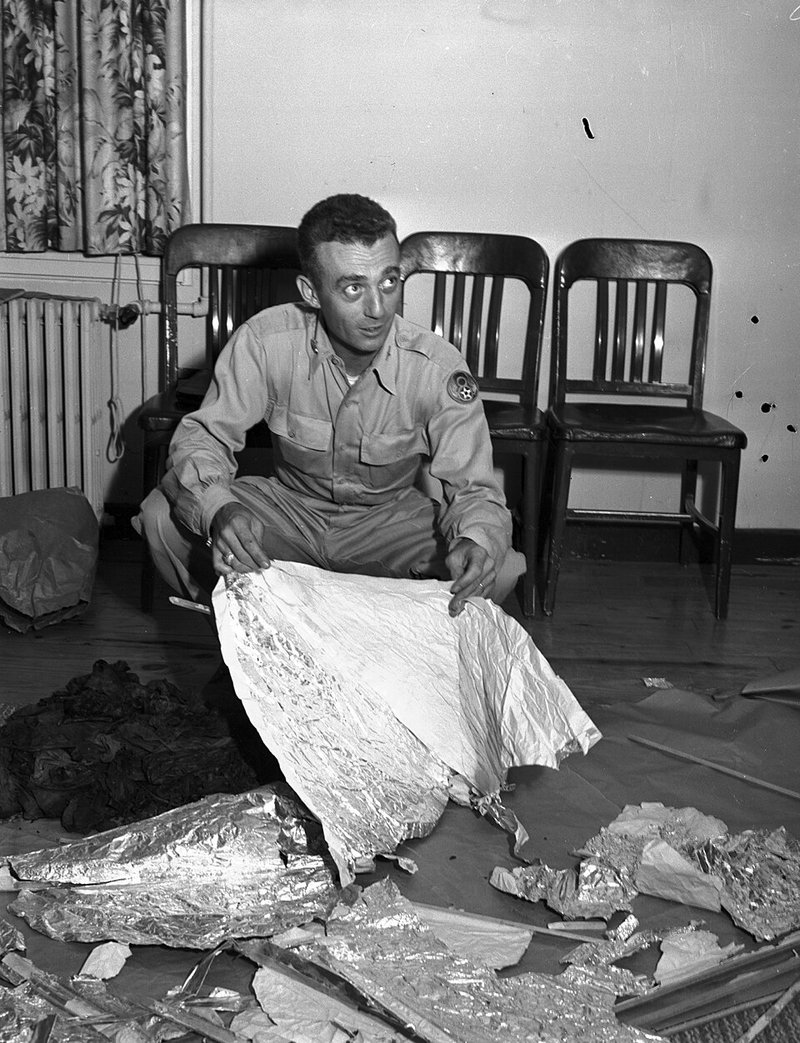
Jesse Antoine Marcel was a major in the United States Army Air Forces and the intelligence officer of the 509th Bomb Group, the unit at Roswell Army Air Field that delivered the atomic strikes on Hiroshima and Nagasaki in August 1945. On 7 July 1947 he drove to a ranch northwest of Roswell with Counter Intelligence Corps agent Captain Sheridan Cavitt, recovered debris that rancher William Brazel had found three weeks earlier, and was photographed the following day in Brigadier General Roger Ramey's office at Fort Worth with material the press conference identified as a weather balloon. Marcel did not speak publicly about the recovery for thirty years. In February 1978, after a telephone call from Stanton Friedman, he gave the first of a series of interviews that reopened the case in the documentary record.
A Life
Jesse Antoine Marcel was born in 1907 in Louisiana, the youngest of seven children of Theodule and Adelaide Bergeron Marcel. He served in the Louisiana National Guard from 1924 to 1927, reaching the rank of sergeant, and in the Texas National Guard from 1936 to 1939. In January 1942 he applied for a commission in the United States Army Air Forces and was commissioned as a second lieutenant in April of that year. He trained as an intelligence officer and combat photo interpreter at the Army Air Forces Intelligence School in Harrisburg, Pennsylvania, where he was retained as an instructor for over a year.
In October 1943 Marcel was assigned as a squadron intelligence officer with the 43rd Bombardment Group in the Southwest Pacific, serving in New Guinea. He was promoted to captain and, in May 1945, to major. He was decorated with the Bronze Star and the Air Medal with oak leaf cluster. After returning to the United States in July 1945, he completed a radar navigation course at Langley Field, Virginia, and in 1946 was attached to the 509th Composite Group for Operation Crossroads, the atomic bomb tests at Bikini Atoll. Brigadier General Roger Ramey and Major General W. E. Kepner each wrote letters of commendation for his performance during the tests.
By mid-1947 Marcel was the intelligence officer of the 509th Bomb Group at Roswell Army Air Field, New Mexico. After his reassignment from Roswell in August 1948, he served with Strategic Air Command at Andrews Air Force Base and then Offutt Air Force Base. He was released from active duty in September 1950 on a hardship discharge and returned to Houma, Louisiana, where he worked as a television repairman. His Reserve commission ended in 1958. He died on 23 June 1986 in Houma, aged 79.
On UAP
On 7 July 1947 Sheriff George Wilcox of Roswell telephoned Roswell Army Air Field to report that a rancher named William "Mac" Brazel had found unusual debris on the Foster Ranch, northwest of the town. Marcel and Counter Intelligence Corps agent Captain Sheridan Cavitt drove to the ranch with Brazel. Marcel in his staff car, Cavitt in a jeep carryall, and Brazel in his pickup crossed open country to reach the site. The debris field, Marcel later recalled, was approximately three-quarters of a mile long and several hundred feet wide. He described the fragments as lightweight, metallic, and resistant to bending or burning.
Marcel reported the find to his commanding officer, Colonel William Blanchard. On 8 July the base public information office issued a press release announcing that the 509th had recovered a "flying disc." The story ran in newspapers across the country. Blanchard ordered the debris flown to Fort Worth Army Air Field, where Brigadier General Roger Ramey, commander of the Eighth Air Force, held a press conference the same day. Marcel was photographed in Ramey's office with material that Warrant Officer Irving Newton identified as a weather balloon and radar reflector. Marcel told the Fort Worth Star-Telegram that he had spent the afternoon "looking for any more parts of the weather device." Retired Brigadier General Thomas DuBose, Ramey's chief of staff, who was present for the photographs, stated in a 1991 affidavit that the weather balloon explanation "was a cover story to divert the attention of the press."
Marcel did not speak publicly about the recovery for thirty years. In February 1978 Stanton Friedman telephoned Marcel at his home in Houma after a television station manager in Baton Rouge identified Marcel as a former Roswell officer. Marcel described the debris and the substitution at Fort Worth. Leonard Stringfield published the first account of Marcel's testimony, under the pseudonym "Major J.M.," in the MUFON UFO Journal in August 1978. Bob Pratt of the National Enquirer taped an extended interview at Marcel's home on 8 December 1979, producing the most detailed primary transcript of Marcel's account. Marcel appeared in the documentary "UFOs Are Real" (1979), his first filmed interview, and on the television programme "In Search Of..." on 20 September 1980.
He took us to that place, and we started picking up fragments, which was foreign to me. I'd never seen anything like that. I didn't know what we were picking up. I still don't know. As of this day, I still don't know what it was.Jesse Marcel, taped interview with Bob Pratt, Houma, Louisiana, 8 December 1979. Transcript reproduced in Karl Pflock, Roswell: Inconvenient Facts and the Will to Believe (Prometheus Books, 2001).
Marcel's later interview accounts contain biographical claims not corroborated by his official USAF personnel file. Karl Pflock, in Roswell: Inconvenient Facts and the Will to Believe (Prometheus Books, 2001), compared the Pratt transcript against the file and documented several discrepancies: Marcel described himself as a pilot, but the personnel file lists his flying experience as "none"; he claimed to have served as an aide to General Henry "Hap" Arnold, a role the file does not record. Pflock's annotated comparison of the transcript and the personnel file is reproduced as an appendix to his book.
Career Record
- 1907, Born, Louisiana. Youngest of seven children.
- 1924 to 1927, Louisiana National Guard. Discharged as sergeant.
- 1936 to 1939, Texas National Guard.
- April 1942, Commissioned second lieutenant, United States Army Air Forces.
- 1942 to 1943, Army Air Forces Intelligence School, Harrisburg, Pennsylvania. Retained as instructor.
- October 1943, Assigned as squadron intelligence officer, 43rd Bombardment Group, Southwest Pacific (New Guinea).
- May 1945, Promoted to major.
- July 1945, Returned to United States. Radar navigation course, Langley Field, Virginia.
- 1946, Attached to 509th Composite Group for Operation Crossroads, Bikini Atoll.
- Mid-1947, Intelligence officer, 509th Bomb Group, Roswell Army Air Field, New Mexico.
- 7 July 1947, Recovered debris from the Foster Ranch with Captain Sheridan Cavitt.
- 8 July 1947, Base press release announced recovery of a "flying disc." Debris flown to Fort Worth.
- August 1948, Transferred to Strategic Air Command, Andrews Air Force Base.
- November 1948, Transferred to Offutt Air Force Base.
- September 1950, Released from active duty, hardship discharge.
- 1958, Reserve commission ended.
- February 1978, Telephone interview with Stanton Friedman.
- August 1978, First published account of his testimony (Stringfield, MUFON UFO Journal).
- 8 December 1979, Taped interview with Bob Pratt, National Enquirer.
- 1979, First filmed interview, "UFOs Are Real" documentary.
- 20 September 1980, "In Search Of..." television appearance.
- 23 June 1986, Died, Houma, Louisiana.
Corroborating Witnesses
Captain Sheridan Cavitt, a Counter Intelligence Corps agent at Roswell Army Air Field, accompanied Marcel to the Foster Ranch on 7 July 1947. Cavitt was later interviewed by the United States Air Force for its 1995 report on the incident and stated that the material was consistent with a weather balloon.
Colonel William Blanchard was the commanding officer of the 509th Bomb Group. He ordered the "flying disc" press release on 8 July 1947 and directed the debris to be flown to Fort Worth. Blanchard later rose to the rank of four-star general and vice chief of staff of the Air Force before his death in 1966.
Brigadier General Thomas DuBose, Ramey's chief of staff at Fort Worth, was present for the press conference photographs. In a 1991 affidavit he stated that the weather balloon identification was a directed cover story.
Jesse Marcel Jr. was ten years old in July 1947 when his father brought debris home to show the family before delivering it to the base. He described handling a small beam with markings he compared to hieroglyphics. Marcel Jr. served in the United States Navy during the Vietnam era, then in the Montana Army National Guard, where he reached the rank of colonel. He deployed to Balad Air Base, Iraq, in 2004 with the 189th Attack Helicopter Battalion as a flight surgeon, logging 225 combat hours. He published The Roswell Legacy (Red Wheel/Weiser, 2008), his account of his father's role and his own experience with the debris. He died on 23 August 2013 in Helena, Montana, and was buried with military honours at the Montana State Veterans Cemetery.
Stanton Friedman, whose February 1978 telephone call to Marcel reopened the Roswell case, is the subject of a separate biography in this archive.
Notable Public Statements
From the taped interview with Bob Pratt at Marcel's home in Houma, Louisiana, on 8 December 1979. Transcript reproduced in Karl Pflock, Roswell: Inconvenient Facts and the Will to Believe (Prometheus Books, 2001).
So, all I could do is keep my mouth shut. And General Ramey is the one who discussed, told the newspapers, I mean the newsmen, what it was, and to forget about it. It is nothing more than a weather observation balloon. Of course, we both knew differently.Jesse Marcel, "In Search Of..." television programme, aired 20 September 1980.
The metal fragments varied in size up to 6 inches in length, but were of the thickness of tinfoil. The fragments were unusual because they were of great strength. They could not be bent or broken, no matter what pressure we applied by hand.Jesse Marcel, as reported by Leonard Stringfield, MUFON UFO Journal, No. 129, August 1978. Stringfield's account was based on a telephone interview with Marcel (identified as "Major J.M.") on 7 April 1978.
Document Trail
The Bob Pratt interview transcript, taped at Marcel's home in Houma on 8 December 1979, is the most detailed primary record of Marcel's account. Pratt forwarded his transcript to researcher Patrick Gross in 2003; it is accessible at ufologie.patrickgross.org. An annotated version comparing the transcript against Marcel's official USAF personnel file appears in Pflock (2001).
The Fort Worth Star-Telegram of 9 July 1947 carries the contemporaneous newspaper account of the Fort Worth press conference, including Marcel's statement about the weather device.
Brigadier General Roger Ramey's letter of commendation for Marcel (26 July 1946) and Major General W. E. Kepner's commendation letter (August 1946) are reproduced at roswellproof.com and document Marcel's service record during Operation Crossroads.
The USAF report The Roswell Report: Fact versus Fiction in the New Mexico Desert (1995) includes Captain Cavitt's interview and the Air Force's assessment of the incident.
Jesse Marcel Jr. and Linda Marcel, The Roswell Legacy (Red Wheel/Weiser, 2008), provides the son's account of the debris and a biographical portrait of his father.
Leonard Stringfield's paper in MUFON UFO Journal No. 129 (August 1978) is the earliest published account of Marcel's testimony.
In the Archive
- Roswell Incident, 1947, the case Marcel's recovery and testimony document
- Stanton Friedman, the researcher whose 1978 telephone call to Marcel reopened the case
- United States, country page
- United States Disclosure Timeline, the Roswell incident in the broader disclosure context
Sources
- Bob Pratt, interview transcript with Jesse Marcel, Houma, Louisiana, 8 December 1979. Transcript at ufologie.patrickgross.org
- Karl T. Pflock, Roswell: Inconvenient Facts and the Will to Believe (Amherst, NY: Prometheus Books, 2001).
- Leonard Stringfield, "Retrievals of the Third Kind," MUFON UFO Journal, No. 129, August 1978, pp. 10 to 11.
- "New Mexico Rancher's 'Flying Disk' Proves to be Weather Balloon-Kite," Fort Worth Star-Telegram, 9 July 1947.
- Jesse Marcel Jr. and Linda Marcel, The Roswell Legacy: The Untold Story of the First Military Officer at the 1947 Crash Site (San Francisco: Red Wheel/Weiser, 2008).
- Brigadier General Roger M. Ramey, letter of commendation for Major Jesse Marcel, 26 July 1946. Reproduced at roswellproof.com.
- Major General W. E. Kepner, letter of commendation for Major Jesse Marcel, August 1946. Reproduced at roswellproof.com.
- James McAndrew, The Roswell Report: Fact versus Fiction in the New Mexico Desert (Washington, DC: United States Air Force, 1995).
- "In Search Of..." Season 4, Episode 2, "UFO Cover-Ups," aired 20 September 1980.
- "UFOs Are Real" (documentary film, 1979).
- Helena Funeral Home obituary for Jesse A. Marcel Jr., 30 August 2013.
- "Ken's Men Against the Empire: The Illustrated History of the 43rd Bombardment Group During World War II," Volume II (2019).
- Thomas DuBose, affidavit, 1991 (reproduced in multiple Roswell publications).