Joseph Rodes Buchanan
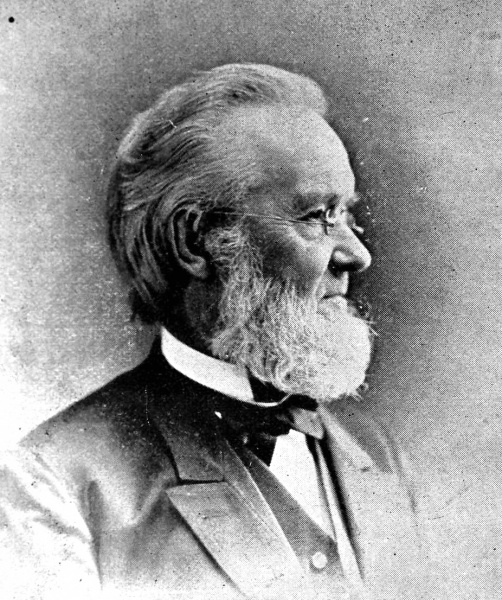
Buchanan took his medical degree at Louisville in 1842. He had already done the work that became the rest of his life. In 1841, working with a sensitive borrowed from a Kentucky judge, he ran the experiments in which subjects identified chemicals and metals from physical contact alone. He coined the word psychometry to describe the faculty and built thirty years of published research around it. He held the Chair of Physiology at the Eclectic Medical Institute in Cincinnati from 1845 to 1861. The Borderland Quarterly profile of July 1897 caught him at eighty-three in retirement at San Jose, California, ten years before his death in 1899. His Manual of Psychometry (1885) and the Therapeutic Sarcognomy (1884) are the substantive American antecedents that Thomson Jay Hudson absorbed and rerouted, and Hudson is the source the Borderland Sciences Research Associates worked from in San Diego in 1945.
A Life
Buchanan was born on 11 December 1814 at Frankfort, Kentucky, the son of Joseph Buchanan, a Frankfort schoolmaster and lawyer who had himself written the 1812 Philosophy of Human Nature, an early American attempt at a materialist psychology in the Hartley and Cabanis tradition. His father died when he was nine and he was effectively self-educated through his teenage years on his father's surviving library. He read law for a year, drifted into medicine, and took his medical degree at Louisville in 1842, by which time he had already been running the experiments that became the substantive subject of his career for over a year.
The psychometric experiments began at the house of Charles Inman, a Kentucky episcopal bishop, in early 1841. Buchanan had read in the contemporary mesmeric and animal-magnetism literature about claims that some sensitive subjects could describe the contents of sealed envelopes or distant scenes through psychic contact alone. He recruited a young man who was both intelligent and sensitive, placed metals and chemicals in his hands, and recorded what the young man described. The results, as he set them out in his subsequent publications, were that the sensitive could distinguish the substances and describe their characteristic effects on his own body and senses. From the test of a metal he could describe a taste in his mouth and a tingling at the relevant sensory locus. From a chemical compound he could describe the typical symptomatic effects of that compound on a patient. Buchanan coined the term psychometry from the Greek psyche (soul) and metron (measure) to describe the phenomenon.
The Eclectic Medical Institute was chartered at Cincinnati in 1845 as a reform-minded medical school in the Thomsonian and botanical tradition, opposing the heroic-bleeding orthodoxy of the established medical profession. Buchanan joined as Professor of Physiology in 1846 and held the chair through to 1862. He published the substantial Outlines of Lectures on the Neurological System of Anthropology at Cincinnati in 1854, setting out his psychometric and craniological work in textbook form, and the Therapeutic Sarcognomy of 1884 from Boston, applying the psychometric framework to therapeutic medicine. The Manual of Psychometry of 1885 from Boston was the substantive late-career exposition.
He held a series of part-time appointments through the 1860s, 1870s and 1880s including at the Eclectic Medical College of New York City (where he served as Dean from 1880 to 1881) and was Professor of Physiology at the College of Therapeutics in Boston from 1884 to 1887. He moved to San Jose, California, in 1888 in his seventy-fourth year and lived in retirement there for the last eleven years of his life. He died at San Jose on 26 December 1899, in his eighty-sixth year, the year of the Borderland Number 18 closing editorial of October 1897 that had been the last substantive English-language treatment of his work in the periodical press.
The dawn of a new civilization, when we shall not only know more, but feel more, when we shall apprehend more in twenty minutes than we now do in twenty years.Joseph Rodes Buchanan, Manual of Psychometry, Boston 1885, opening preface
Psychometry
Buchanan's psychometric framework rested on the proposition that any object that had been handled by a person carries a recoverable trace of that person, and that a sensitive subject can describe the trace through physical contact with the object. The framework was tested by Buchanan in three principal applications: forensic identification of unknown persons from objects they had handled, medical diagnosis of patients from their personal effects, and the historical reconstruction of past events from objects associated with them. Each application produced a published case-report literature.
The framework was inherited by William Denton, the Philadelphia geologist who applied psychometry to mineral samples and meteorites in The Soul of Things (Boston, 1863, with later expanded editions through to 1888). Denton's psychometric programme, working with his wife Elizabeth Denton as the principal sensitive, produced substantial case-report material across geological samples, ancient artefacts, and bone fragments. The Denton material was the principal nineteenth-century corpus of applied psychometry; Buchanan held the theoretical position and Denton ran the substantive experimental programme through the 1860s and 1870s.
The substantive Borderland reception of psychometry came in the Volume 4 Number 3 Gallery profile of July 1897. Stead placed Buchanan in the Borderland Gallery alongside the journal's earlier American treatments of Mrs. Piper and the BSRA-precedent figures of the New England spiritualist community. Buchanan's Number 17 Defence of Primitive Christianity material continued into Article VIII of the closing Number 18 of October 1897. The Borderland Gallery profile is the substantive late-Victorian English documentary treatment of Buchanan's work.
The Buchanan Gallery profile in Borderland Quarterly Volume 4 Number 3 of July 1897 covers Buchanan's psychometric programme from the 1841 Frankfort Kentucky experiments through to his 1885 Manual of Psychometry. The profile carries Buchanan's "Defence of Primitive Christianity" material that continued into the closing Number 18 of October 1897.
The Bibliographic Lineage to BSRA
Buchanan's psychometric framework runs forward into the twentieth-century American psychical-research literature through two principal bibliographic chains. The first runs through Thomson Jay Hudson's The Law of Psychic Phenomena of 1893 (reviewed in Borderland Volume 1 at page 62), which absorbs Buchanan's psychometric vocabulary into its subjective-objective mind framework. The Hudson book is cited directly in Meade Layne's Round Robin in San Diego from November 1945 onwards as a foundational source for the Borderland Sciences Research Associates' etheric framework.
The second chain runs through Denton's The Soul of Things, which entered the postwar American spiritualist and Theosophical-derived literature as the standard exposition of the psychometric programme. The substantive psychometric vocabulary of "object reading" that the postwar American civilian-research community carried forward into the 1950s contactee literature derives from the Buchanan-Denton tradition.
Photographs
Significance to the Archive
Buchanan matters to this archive as the doctrinal source of the psychometric framework that the postwar American civilian-research community carried forward in the contactee and early-UFO literature. The 1841 Frankfort experiments are the documented origin of the term psychometry in the English-language record. The Hudson Law of Psychic Phenomena of 1893, which the Borderland Volume 1 review carried forward into the published Stead-era discourse, was the principal vehicle through which the Buchanan-Denton material reached the early-twentieth-century American psychical-research community and the post-1945 Borderland Sciences Research Associates circle.
The Borderland Volume 4 Number 3 Gallery profile of July 1897 is the substantive late-Victorian English-language treatment of Buchanan and one of the eighteen Gallery profiles that anchored the closing run of the journal. He sits in the archive's pre-1947 reference layer as the American doctrinal counterpart to the English SPR figures the Borderland editorial roster carried.