Borderland
W. T. Stead's quarterly review of psychical research
History
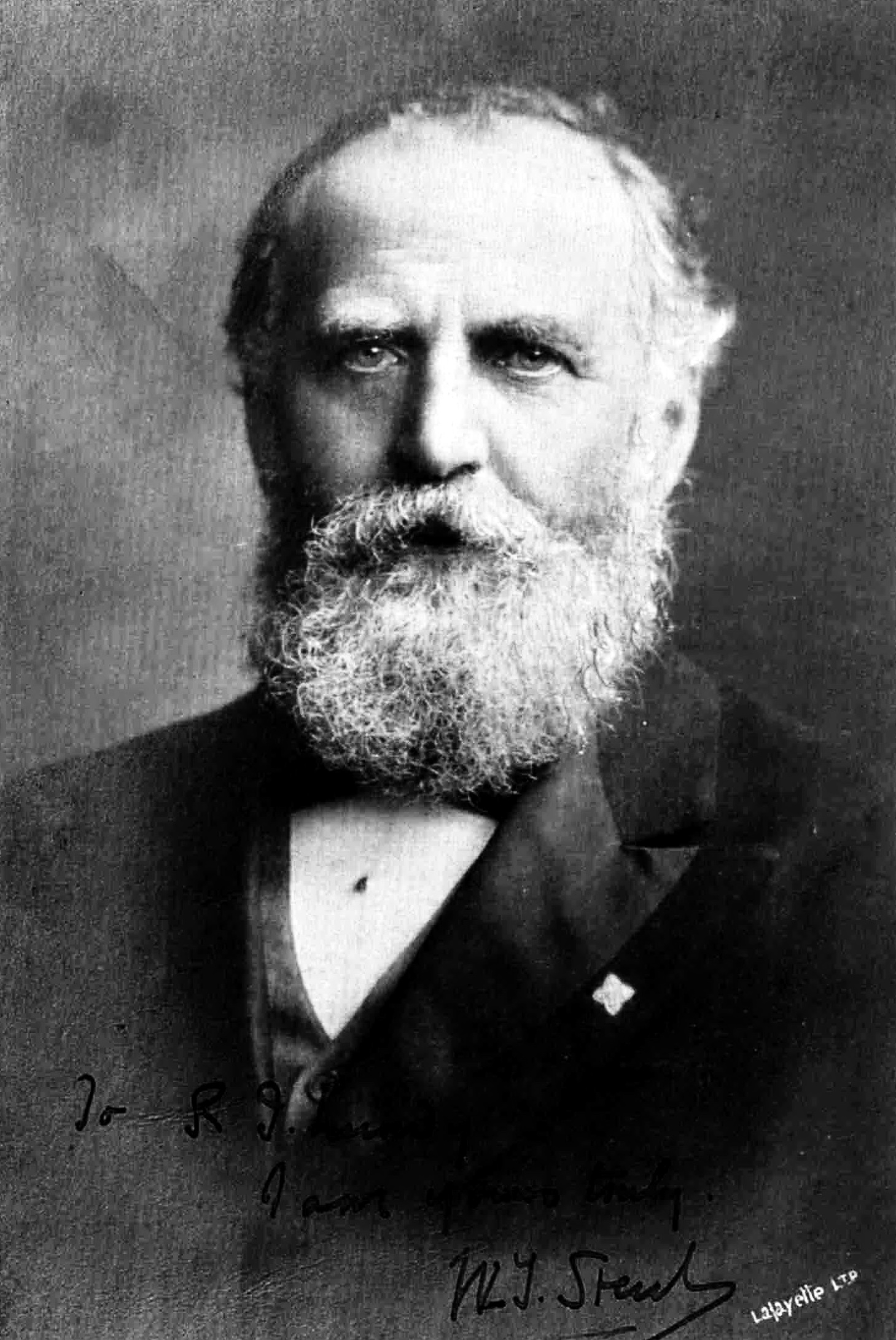
Borderland was founded by William Thomas Stead and issued as a quarterly review from London beginning in July 1893. The editorial office sat at 18 Pall Mall East; the publishing office at 125 Fleet Street. Eighteen quarterly issues appeared across the four-year run, on the January, April, July and October cycle, until the journal closed with the October 1897 number.
The Editorial Project, July 1893
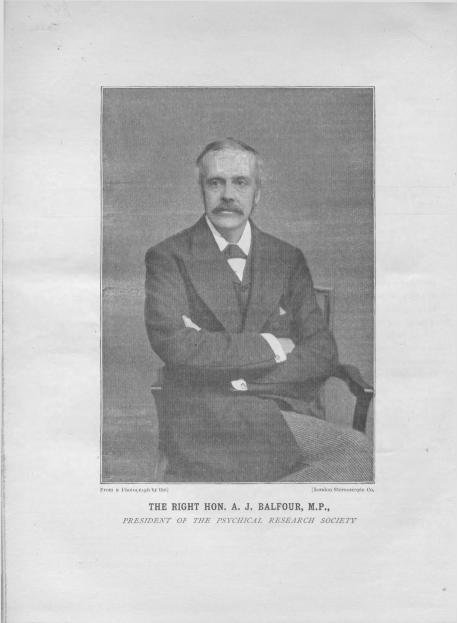
Volume 1 Number 1 opened with the frontispiece portrait of the Right Honourable Arthur James Balfour, M.P., identified beneath the plate as President of the Psychical Research Society. Balfour had been First Lord of the Treasury in his uncle Lord Salisbury's government from 1891 to 1892 and would be Prime Minister from 1902 to 1905; he held the SPR Presidency at the time Borderland launched. The frontispiece signalled the journal's editorial address: psychical research as an establishment-credible investigative subject, not as the fringe register Stead's wider readership might otherwise have placed it in.
The first article of the first issue was Stead's own editorial manifesto, "How We Intend to Study Borderland." The article opens with the Newton epigraph and the central methodological claim. The phenomena Borderland will investigate are to be approached "in the spirit of the principle laid down by Professor Huxley as the fundamental axiom of modern Science, 'to try all things, and to hold fast by that which is good.'" The journal is positioned as "the Method of the Agnostic applied vigorously to the phenomena of the region which has hitherto been relegated to Superstition."
The framing was the framing of the wider late-Victorian psychical-research community at its peak self-confidence. The Society for Psychical Research had been founded eleven years earlier in February 1882, with Henry Sidgwick of Trinity College Cambridge as president and a council that included Frederic W. H. Myers, Edmund Gurney, Frank Podmore, and the brothers William and Henry James as overseas correspondents. The SPR's Phantoms of the Living census had appeared in 1886 with 702 documented cases of apparitions and telepathic communications. The Sidgwick Committee on the Census of Hallucinations, which Borderland would report on across Volume 1, was the SPR's principal continuing investigation across the early 1890s. What Borderland offered that the SPR Proceedings did not was access: the journal carried the investigative seriousness of the SPR programme into a quarterly addressed to the general educated reading public.
The second article of Number 1, "Seeking Counsel of the Wise," set out Stead's editorial method through a worked example. Stead had written to leading figures across British public life inviting their views on Borderland's project, and the responses were published by category across the first issue and into the second. The categories themselves are documentary record of how Stead read the British establishment's relationship to psychical research in 1893. The published responses ran in sections for Prelates (with the Archbishop of Canterbury), Roman Catholics (with the Rev. Father Clarke, S.J.), Nonconformists, Anglican parsons, Psychical Researchers, Men of Science (with Lord Kelvin and Thomas Huxley), Hypnotists, Ladies, Men of Affairs, and Journalists and Men of Letters (with Sir Augustus Paget). Volume 1 records that the editorial appeal had also reached Alfred Russel Wallace, the co-discoverer of natural selection by descent, whose letter to Stead is reproduced in the bound volume at page 274.
Number 1 closed with the inaugural entry in what Borderland called "Borderlanders, Our Gallery of," a quarterly series of biographical profiles of figures the journal considered to have stood at the frontier between the seen and the unseen. The first profile was Jeanne d'Arc, Saint and Clairvoyant, opening at her childhood in Domremy in the closing years of the reign of Charles VI of France. The gallery continued across the volume with Professor Jean-Martin Charcot (Number 2, October 1893, a posthumous tribute following Charcot's death at the Salpêtrière in August), the Prophet Elijah (Number 2 again), Mrs. Piper and Dr. Phinuit (Number 3, January 1894, the Boston medium Leonora Piper whose Dr. Phinuit "spirit control" had been the subject of substantial William James investigation), Colonel Olcott's Madame Blavatsky as written up by Stead from Olcott's reminiscences (Number 4, April 1894), the Reverend William Stainton Moses (Number 5, July 1894, the English medium and former editor of LIGHT who had died the previous year), and Saint Teresa of Avila (Number 6, October 1894). The gallery was the editorial spine of the volume.
The October 1893 Issue and Charcot
Number 2, dated October 1893, was the first issue to test the editorial line in the period that immediately followed it. The two cover-page features named at the head of the issue were "Character Sketch: Dr. Charcot" and "Borderlanders of the Bible, Elijah." Jean-Martin Charcot, Professor of Pathological Anatomy at the Salpêtrière in Paris and the senior nineteenth-century investigator of hypnotism as a clinical phenomenon, had died at Lac des Settons in the Morvan on 16 August 1893. The Borderland profile, appearing two months later, read Charcot's career through the lens of the psychical-research programme: the Salpêtrière hypnotism investigations had documented phenomena which, in Borderland's framing, required the wider Borderland-period explanatory apparatus the journal was setting out.
The October issue carried front-matter advertisements for three publications that locate Borderland inside the wider psychical-occult publishing market of 1893. G. R. S. Mead's Simon Magus: An Essay, advertised at 5 shillings in quarto wrappers or 6s 6d cloth, placed the issue inside the Theosophical Society's publishing apparatus (Mead was Madame Blavatsky's private secretary and would edit the Theosophical Review for the next two decades). H. P. Blavatsky's From the Caves and Jungles of Hindustan at 7s 6d cloth confirmed the Theosophical orientation. The third advertisement was for LIGHT, the weekly journal of psychical, occult, and mystical research that had been founded in 1881 and edited from 1892 onwards by Edmund Dawson Rogers; LIGHT and Borderland were the two principal British psychical-research periodicals of the early 1890s and would compete for the same general-readership subscription base for the rest of Borderland's run.
The January 1894 Issue: Mrs. Piper
Number 3, dated January 1894, was the third quarterly issue and the issue in which Stead's American material first took substantive shape. The cover-page features named "Hypnotism, by Miss X.", "Character Sketch: Mrs. Piper (A Famous American Medium)," and "New Experiments in Crystal Gazing." Front-matter advertisements included the official two-volume record of the 1893 World's Columbian Exposition's World's Parliament of Religions edited by the Rev. John Henry Barrows, D.D., whose delegate roster the advertisement listed: Cardinal Gibbons, Bishop John Keane (Rector of the Catholic University at Washington), Bishop T. U. Dudley of Kentucky for the Protestant Episcopal Church of the United States, Archbishop Dionysios Latas of Zante for the Greek Church, P. C. Mozoomdar of the Brahma-Somaj of India, and the Confucian scholar Pung Kwang Yu. Borderland's Number 3 ran inside the immediate institutional aftermath of the same Chicago Auxiliary Congresses that had hosted the Psychical Congress F. W. H. Myers had attended on behalf of the SPR the previous summer.
The Mrs. Piper Borderlanders Gallery profile, the third in the series, was written by Miss X. (Stead's editorial assistant Ada Goodrich-Freer) and ran from page 226. Miss X. narrated her own first-hand sittings with the Boston medium Leonora Piper during Piper's visit to England in the winter of 1889-1890, when Piper had stayed with members of the Society for Psychical Research at the SPR's invitation for sustained investigation. The sittings Miss X. described took place over three consecutive days, 7 to 9 December 1889, with Professor Charles Richet of Paris and Dr. Walter Leaf of the SPR present at various sittings and F. W. H. Myers attending several others.
Miss X.'s account distinguished consistently between Mrs. Piper, the American woman in trance, and Dr. Phinuit, the alleged "spirit control" speaking through her. Phinuit, on Miss X.'s account, professed to be "a French physician, who, according to one account of himself, has been in the spirit world about thirty or thirty-five years," speaking through Piper in "very imperfect English, addicted to broad personal compliment, very impatient, and swearing freely when annoyed." The Phinuit persona's accuracy on specific personal details about Miss X. and her circle, the article records, was such that "the very strong prejudice against her alleged mediumship which I had brought with me, soon melted away on a closer acquaintance." The article cites the Society for Psychical Research Proceedings Part XVII for the English sittings record and Mr. Hodgson's Report Part XXI for the American sittings record, the latter under the investigation of Richard Hodgson, the Australian-born SPR researcher who had taken charge of the American SPR work from Boston in 1887. The story of Mrs. Piper's mediumship is traced back in the article to 29 June 1884, when, suffering from a tumour, Piper had been persuaded by her husband's parents to visit the blind Boston healing medium Mr. J. R. Cocke.
The April 1894 Issue: Balfour, Stead's American Tour, and Stainton Moses
Number 4, dated April 1894, was the substantive editorial issue of the early Borderland period. The frontispiece was a portrait of Santa Teresa "from a carving by Gregorio Hernandez" (the Spanish baroque sculptor Gregorio Fernández, 1576 to 1636), prefiguring the Saint Teresa Gallery profile Stead announced for the following quarter, drawing on Gabriela Cunninghame Graham's Santa Teresa: Her Life and Times "which reaches me just before going to press." Stead opened the issue with the Chronique of the Quarter dated London, 4 April 1894, announcing that Borderland was beginning its second year of publication "under the double patronage of the Maid of Orleans and the saint of Spain."
The chief psychical event of the quarter, in Stead's own framing, was A. J. Balfour's Presidential Address to the Society for Psychical Research, reprinted in full as Article IX of the issue under the title "Science and Psychical Research." Balfour had been a council member of the SPR since its 1882 foundation and held the Presidency at the time of the address. The address discussed mesmerism, agnosticism, and the speculative theory of psychical phenomena. Stead reproduced Light magazine's assessment of Balfour at the lectern:
The Chronique also covered the SPR's 26 January 1894 meeting, at which Walter Leaf read on Andrew Lang's behalf a paper titled "Cock Lane and Common Sense" (the same Lang work that appeared as a book in 1894 and that the Volume 1 Books about Borderland section reviews at page 480). And the Chronique covered F. W. H. Myers's 9 March 1894 SPR address defending the late-period religious positions of William Stainton Moses against critics from within the council. Myers framed the controversial Imperator scripts (the corpus produced through Stainton Moses's mediumship under the persona "Imperator") as "an uprush of subliminal consciousness" analogous to the visionary material of Swedenborg, the Seeress of Prevorst, Judge Edmunds, and the spiritualist medium D. D. Home. Mr. Barkworth, the SPR council member whose critique of Stainton Moses had prompted the controversy, was addressed in the Chronique with an editorial position which began "Doubting Thomas was probably voted a very disagreeable sceptic by the rest of the Apostles, but his persistent pertinacity in demanding evidence of identity, did more for the Christian Church than the ready belief of the Magdalen."
Article II of the same issue was Stead's own substantive article on the American psychical-research community, titled "The Old World from the New World, Or Psychical Study in the United States," with portraits of Richard Hodgson and the Rev. T. E. Allen. The article documented the late-Victorian British-American psychical-research network at its peak transatlantic coordination period; Hodgson's American investigations of Mrs. Piper would shortly produce the further reports the SPR would publish across 1894 to 1898.
The Borderlanders Gallery profile of Number 4 was the William Stainton Moses sketch by Miss X., with two portraits including (as the photograph caption records) "A Photograph taken after Death." Stainton Moses had died in 1892; the Borderland sketch covers his mediumship, the Imperator scripts that the Myers / Barkworth controversy had then been arguing about, and Stainton Moses's editorial period at LIGHT before his death. The Stainton Moses corpus is the substantive late-Victorian English mediumistic record on which subsequent investigative methodology was built.
Number 4 carried further substantial material from contributors named in the Volume 1 Index. Professor Oliver Lodge of University College Liverpool led the major essay "Can Matter Pass through Matter?" at page 336, with contributions from other physicists. William Quan Judge, the American Theosophical Society co-founder, contributed Article XV "Do Mahatmas Exist?", published immediately before the 1894-1895 Judge Case schism that would split the Theosophical Society into American and Adyar (Annie Besant-led) wings. Joseph Rodes Buchanan, the American psychometry pioneer who would die in 1899, contributed Article VIII "The Divinity of Man." The Astrology section under Article XVII published horoscopes for Queen Victoria for 1894-1895 and for Annie Besant. The Miscellaneous section under Article XX covered Madame Elizabeth d'Espérance and "the Double" phenomenon, and the stigmatisation case material then current in the European press.
The July 1894 Issue: St. Teresa, the Welsh Lourdes, and the American Mediums
Number 5, dated July 1894, opened with the cover features "Some Experiences with American Mediums," "Experiments in Clairvoyance," "Authentic Tales of Haunted Houses," and "St. Teresa, the Borderlander." The front matter carried the substantial press-notices advertisement for Stead's own newly-published If Christ Came to Chicago (Review of Reviews Office, 2s 6d cloth, then in its ninetieth thousand) with reproduced reviews from The World, the Investor's Review, the Daily Chronicle, The Times, the Pall Mall Gazette, and The Speaker. The parallel publication of Borderland and If Christ Came to Chicago across the early summer of 1894 was the substantive working of Stead's editorial position that the New Journalism was a continuous investigative project across social-reform and psychical-research subjects.
The Borderlanders Gallery profile of Number 5 was Stead's own essay on St. Teresa of Avila, the fifth in the Volume 1 series. The article opens with the Spanish-language fragment Stead labels as the Signet of St. Teresa: "Let nothing disturb you. Patience gains everything. Let nothing alarm you. He who possesses God lacks nothing. All things pass away. God alone is All-sufficient. God is unchangeable."
The article reports the Notre Dame Jeanne d'Arc national fête which Stead had announced for the previous quarter at the time of Number 4 going to press, and which had taken place on the second Sunday in May 1894. Stead's own account: "On the eighth of last May I counted twenty-four episcopal and archiepiscopal crosiers carried in the long procession which, in honour of the heroic Maid, wound its stately way from the Cathedral of Orleans to the Isle of the Tourelles, where she gained her first decisive victory." The St. Teresa article runs as an extended editorial pairing of Teresa with Jeanne d'Arc under the framing "Teresa, a Surveyor of Borderland": Stead's editorial position is that Teresa "made an art if not a science of the exploration of Borderland" where Jeanne "prayed and the visions came, she knew not how." The article draws substantially on Gabriela Cunninghame Graham's two-volume Santa Teresa: Her Life and Times (Adam and Charles Black, 1894), which had reached Stead "just before going to press" at the time of Number 4 and which is reviewed in the Volume 1 Books about Borderland section at page 411.
Article II of the same issue continued Stead's American psychical-research tour writeup begun in Number 4 under the title "The Other World from the New World, No. 2." Stead's American material in this number was substantially mediumistic rather than institutional: separate sub-articles cover Mrs. Warne (healer and clairvoyant), Mr. Rogers (slate-writer), and the materializing-seance reports Stead had attended in Boston and New York. The article line that closed Stead's American reportage reads: "remaining faithful to my policy of taking only what came across my path, I can only report that I found nothing that I could consider as unmistakably genuine." A Professor Clifton is mentioned as another materializing medium of whom Stead had heard substantively but had not been able to attend in person.
Number 5 also carried Article X, "Premonitions and Warnings of Death and Disaster," with sub-cases including "Death Predicted by Planchette," "Railway Accident Averted by a Premonition," and "An Apparition of the Dying." The Volume 1 Index notes this article runs at page 451 of the cumulative volume. Article XIII, "The Mechanism of Mind: How we Think and how we Forget," is at the volume's page 464.
The October 1894 Issue: Sidgwick, the Welsh Lourdes, and Olcott's Madame Blavatsky
Number 6, dated October 1894, closed Volume 1. The frontispiece was a portrait of Professor Henry Sidgwick of Trinity College Cambridge, the founding President of the Society for Psychical Research and the senior English psychical-research figure of the period. The portrait at page 494 prefaced Article II of the issue, the substantial report on the SPR's Census of Hallucinations under the Sidgwick Committee. The Census of Hallucinations was the SPR's largest single investigation of the early 1890s, collecting reports of apparitions and hallucinatory experiences across a sustained witness sample; the published report ran across an SPR Proceedings volume and was abstracted for Borderland's wider readership in Number 6.
The front matter of Number 6 carried the closing-volume practical notices: "Cases for Binding Borderland" at one shilling and ninepence with bevelled boards in dark blue Buckram lettered in gold, available through any bookseller or direct from the Publishing Office at 125 Fleet Street, with the announcement that "with the present Issue the First Volume of Borderland is completed." The advertisement for the official two-volume record of the 1893 World's Parliament of Religions ran again, alongside notices for Miss Ross (psychometrist, Smethwick, Birmingham) and Mrs. Graddon (psychometric clairvoyant, 8 Bailey Street, Bedford Square, sittings Mondays and Thursdays 2 to 5).
The Borderlanders Gallery profile of Number 6 was Stead's own substantive editorial essay on Madame Blavatsky, written from Colonel Henry Steel Olcott's then-forthcoming Old Diary Leaves reminiscences. The article opens at page 512 (the Volume 1 Index entry for "Colonel Olcott's Madame Blavatsky, by W. T. Stead, 512") and runs across multiple sub-sections.
Stead's editorial framing for the Blavatsky article is explicitly partial: the title "Colonel Olcott's Madame Blavatsky" is a deliberate signal that the article presents only one of several possible Blavatsky portraits. Stead writes: "I say Colonel Olcott's Madame Blavatsky advisedly. This article makes no attempt to give even a sketch of the real Madame Blavatsky or the totality of her complex personality... In some future number I expect I shall have to give an account of Dr. Leaf's 'Madame Blavatsky,' and then again of Mrs. Besant's 'H. P. B.'" The article's substantive position is that the documentary record of Blavatsky's influence stands separately from the Hodgson Report controversy of 1885 about the Coulomb-letter exposure of the Adyar sliding-panel apparatus.
The other Number 6 substantive articles are Article V (Haunted Houses by Miss X., page 523, the closing-volume Miss X. contribution), Article VII (The Lost Dauphin, an investigation of the Louis XVII pretender material of the period), Article VIII (Stead's own "The Welsh Lourdes" at page 541, a Borderland investigation of the Welsh pilgrimage tradition at Holywell), Article IX (Spiritualism, with the segment "A Message from Stainton Moses" at page 553), Article X (The Problem of Personality, with sub-articles on A Second Self Consciously Evolved and A Clue to Mysterious Disappearances), Article XI (Palmistry: Test Readings of Mark Twain's Hands, with photographic blocks of Mark Twain's actual hand prints at page 558), Article XII (Astrology: A Forecast of Cleveland's Administration, on Grover Cleveland's second presidential term), Article XIII (The Evidence of Anaesthetics, by George Wyld, M.D.), and Article XV (Miscellaneous, with the closing notes on "Remembering the Day of One's Birth," "The Spectre Dog of Peel Castle" the Manthe Dhoo of Walter Scott's Peveril of the Peak, and "Do Men Wish for a Future Life?").
The closing pagination of Number 6 brings the cumulative Volume 1 page count to approximately 700 pages across the six issues. The October 1894 preface Stead writes for the bound Volume 1 is dated London, October 1894 and is the document cited at the head of this collection page; it carries the editorial review of the first year's work that closes the Volume 1 boundary.
Volume 2 (1895)
Volume 2 opened with Number 7, January 1895. The editorial office had moved between Volume 1 and Volume 2 from 18 Pall Mall East to Mowbray House, Norfolk Street, the West Central London office of the Review of Reviews. The publishing office at 125 Fleet Street remained unchanged. Stead's editorial decision to consolidate Borderland into the Mowbray House premises is the substantive editorial fact of the Volume 2 boundary: the journal moves from the standalone Pall Mall office of its first year into the institutional base of Stead's wider publishing operation.
The January 1895 Issue: Robert Louis Stevenson, Julia's Letters Begin, Alfred Russel Wallace
Number 7, dated January 1895, opened with the frontispiece portrait of Robert Louis Stevenson from a photograph by Falke, Sydney, at page 2. Stevenson had died at Vailima on the island of Upolu in Samoa on 3 December 1894. The Borderlanders Gallery profile of Number 7 was a posthumous tribute to Stevenson published just over five weeks after his death, structured as two essays: "Robert Louis Stevenson as Man of Letters, by Mr. Cargill" and "Robert Louis Stevenson as Man of Dreams, by W. T. Stead." Stead's essay read Stevenson's dream-narratives, particularly the Mr. Hyde material that Stevenson had publicly attributed to a dream sequence, as Borderland material proper. The Stevenson Gallery profile is the sixth in the Borderlanders Gallery series and the first profile of Volume 2.
The substantive new editorial thread of Number 7 was the launch of "Life on the Other Side. Letters from Julia" at page 6, the published series of automatic-writing communications that Stead had begun receiving in 1892 from the spirit-control persona he identified as Julia. The Julia in question was Miss Julia Ames, the Chicago journalist and editor of the Union Signal (the official organ of the Women's Christian Temperance Union) who had died in December 1891. Stead had been receiving the automatic-writing communications attributed to Julia since the year following her death and had been publishing selections in the Review of Reviews; the Borderland Number 7 launch was the systematic publication of the Julia material in its dedicated quarterly editorial home. The Letters from Julia series would continue across the run of Borderland and would be the substantive editorial material from which Stead's posthumously-famous Letters from Julia (1897, expanded edition 1905) would subsequently be drawn, and which would provide the foundation for Julia's Bureau, the spiritualist consultation service Stead would found in 1909.
Number 7 also carried a direct contribution from Alfred Russel Wallace under the title "Immortality and Morality" at page 10. Wallace, the co-discoverer of natural selection by descent and one of the senior late-Victorian psychical-research scientific authorities, had been a Volume 1 contributor by letter (the V1 Index reproduces Wallace's letter to Stead at page 274); the Number 7 essay was Wallace's first substantive Borderland article in his own voice. Professor Oliver Lodge's "Report on Eusapia Paladino" at page 46 (Eusapia Palladino, the Italian medium whose seances Cesare Lombroso, Charles Richet, and the SPR network had been investigating across the early 1890s) brought the substantial Continental mediumistic-investigation material into the journal for the first time. John Yarker, P.M. (Past Master), wrote on "The Occult Side of Freemasonry" at page 72, opening the Borderland coverage of esoteric Masonic traditions.
Number 7 also carried Article VI "Recent Exposures in Theosophy and Spiritualism" covering three substantial controversies of the quarter: the W. Q. Judge Case Theosophical Society schism, the Mrs. Williams (Bessie Williams) mediumistic-exposure case, and the Mrs. Mellon case. John Nevil Maskelyne, the conjuror and famous exposer of mediums, contributed "Mr. Maskelyne on Spiritualism" at page 50. Israel Zangwill, the British novelist, was the subject of "How Mr. Zangwill was Convinced" at page 49. Miss X. (Ada Goodrich-Freer) contributed Article V, "The New Witchcraft, or more about Hypnotism," at page 26, and Article IX, "Second Sight in the Highlands: A Provisional Report" at page 65, the latter the opening of Goodrich-Freer's Highland ethnographic-psychical investigation series that would shortly produce her famous 1899 Ballechin House investigation under the wider Marquess of Bute patronage.
The April 1895 Issue: F. W. H. Myers, Molly Fancher, the Judge Case, the Clonmel Witch-Burning
Number 8, dated April 1895, opened with the frontispiece portrait of Frederic William Henry Myers (Honorary Secretary of the Society for Psychical Research), taken from a photograph by Mrs. Myers, at page 98. The portrait prefaced the issue's substantial Myers-authored material on the Stainton Moses defence and the wider SPR institutional position.
The Chronique of the Quarter for Number 8 covered five distinct contemporary matters. The opening section "Witchcraft" addressed the case of Bridget Cleary at Clonmel in County Tipperary, Ireland; Cleary had been burned to death by her husband Michael Cleary and members of his family on the night of 15 March 1895 on the conviction that she had been replaced by a fairy changeling. The case was then dominating the British and Irish press and would shortly produce one of the most-cited late-Victorian legal proceedings on the survival of folk-magical belief into the contemporary period. Stead's editorial response was to issue an open call: "Witches Wanted! ... I would make a special request to readers of Borderland and members of our Circles everywhere, to send me, as soon as possible, after reading this, the name and address, with any authentic particulars, of any reputed witch or wise woman whom they may know personally in their neighbourhood." The "Spiritualist Conference" segment covered the upcoming May 1895 Spiritualist Alliance Conference. The "Immortality" segment discussed an American press syndication of essays by representative men on "Why I believe in Immortality" then in progress. The "Test Séances" segment addressed Colonel Le M. Taylor's proposal in Light for test seances at the Spiritualist Conference. The "Infant Phenomena" segment covered the Berlin boy prodigy, the Moradabad boy of seven who discussed Yoga philosophy, and an English child reported as having unaccountable knowledge of Central African geography.
The Borderlanders Gallery profile of Number 8 was Molly Fancher and her Five Souls, structured in three parts: "The Problem of Multiple Personality" at page 110, "The Strange Story of Molly Fancher" at page 115, and "The Dissection of Consciousness" at page 121. Mary J. "Molly" Fancher of Brooklyn (1848-1916) was the famous American "Fasting Girl" who had claimed not to eat for years following an 1864 horse-tram accident and who exhibited what nineteenth-century medical observers documented as a five-fold multiple-personality phenomenon. The Number 8 Gallery profile is the substantive late-Victorian English documentary treatment of the Fancher case and is read alongside the wider William James / Morton Prince / Pierre Janet multiple-personality research of the same period.
F. W. H. Myers contributed the lead article in Article V, "Spiritualism: As a Working Hypothesis," covering "The Experiences of Mr. Stainton Moses, by Mr. Myers" at page 128, the continuation of Myers's defence of Stainton Moses begun in his 9 March 1894 SPR address that Borderland Number 4 had covered. The Myers Article V opened a wider treatment of the working-hypothesis question, with a parallel sub-article on the Beethoven "Tenth Symphony" material (the alleged posthumous Beethoven composition material some mediums were producing) and on "The Evidence as to Materialisation."
Article VI "Spiritualism: The Search for Alternatives" covered "The Theory of Telekinetics, by Professor Coues" at page 132 (Elliott Coues, the American naturalist and ornithologist who had been one of the senior American Theosophical Society officials before his expulsion from the Society in 1889), and continued the Zangwill thread under "The Man Who Knows all About It; to wit: Mr. Zangwill" at page 133.
The W. Q. Judge Case Theosophical Society schism, which the Volume 1 Number 4 Judge contribution had immediately preceded and which had broken into open division across late 1894 and early 1895, occupied Article XV of Number 8 directly. The article was structured as the three substantial position-papers of the dispute: "Mrs. Besant's Reply to the Westminster Gazette" at page 171, "The Resolution Passed at Adyar" at page 172, and "Mr. Judge's Rejoinder" at page 174. The Number 8 portrait of Mr. Chakravarti at page 170 prefaced the Theosophical Society material; Gyanendra Nath Chakravarti was the Indian Theosophist who would substantially shape Annie Besant's Indian Theosophical work across the following decade.
Article XVI "Blavatskiana" carried Materials for Judgment by those who knew Her, structured as three primary-source contributions: "The Testimony of Solovyoff" (Vsevolod Solovyov, the Russian writer whose 1893 A Modern Priestess of Isis was the principal hostile documentary treatment of Blavatsky), "An Appreciation, by Mr. Lane-Fox," and "An Explanation, by Mr. Edward Maitland." Stead had announced in Volume 1 Number 6 that the Colonel Olcott's Madame Blavatsky Gallery would be followed by parallel "Dr. Leaf's Madame Blavatsky" and "Mrs. Besant's H. P. B." treatments; the Blavatskiana article in Number 8 is the substantive editorial working of that promised programme into a multi-voice documentary record of Blavatsky.
The July 1895 Issue: Annie Besant, Leadbeater, and the Immortality Symposium
Number 9, dated July 1895, opened with the frontispiece reproduction of Sir John Everett Millais's painting "Speak! Oh, Speak!" from the Royal Academy at page 194. The frontispiece prefaced Article II, "Is Man Immortal? A Discussion by Various Thinkers," at page 199, a substantial editorial symposium in which Stead had collected statements on the question of immortality from contributors including W. T. Stead himself, Cardinal Gibbons, Professor Max Muller, Bishop Newman, and W. E. Gladstone. The symposium continued across the journal's autumn coverage into the closing issue of Volume 2.
The Borderlanders Gallery profile of Number 9 was Mrs. Annie Besant, with portrait and accompanying horoscope, at page 207. The profile executes the promise Stead had made in Volume 1 Number 6 to follow Colonel Olcott's Madame Blavatsky with a parallel Annie Besant treatment of the H. P. B. material. Besant had been the senior English Theosophical Society figure since Blavatsky's death in 1891 and was at the centre of the W. Q. Judge Case schism material that had run across Numbers 7 and 8. The Number 9 Gallery is the substantive Borderland engagement with Besant's own position as the principal late-Victorian English public Theosophist; the accompanying horoscope was the journal's standard Astrology-section attachment to a Gallery subject.
Number 9 also carried Article VII, "The Astral Plane and its Inhabitants: A Handy Guide to the Invisibles, by Mr. C. Leadbeater," at page 250. Charles Webster Leadbeater was the senior English Theosophical Society figure of the period whose 1895 Theosophical Manuals series book The Astral Plane: Its Scenery, Inhabitants, and Phenomena was the foundational text for the wider Theosophical "astral plane" tradition. The Borderland article is one of the earliest published Leadbeater treatments of the material that would shortly appear in book form. Franz Hartmann, M.D., contributed Article VIII, "What I think of Theosophy now," at page 254. Hartmann was the German Theosophist who had been at Adyar with Blavatsky and Olcott in the 1880s and had subsequently broken with the Society over the Coulomb-letter exposure; his Number 9 article is the substantive German-language Theosophical engagement with the Judge Case schism.
Article IX "Astrology" carried "Horoscopes of Lord Rosebery and of the New Government" at page 259. Lord Rosebery's Liberal government had fallen on 22 June 1895; Lord Salisbury's third Conservative government took office on 25 June, and the Number 9 horoscopes for the New Government appeared as the standard Borderland Astrology Quarterly assessment of the political transition.
The October 1895 Issue: Closing Volume 2, Spirit Photography, and Stead's Two-Year Retrospective
Number 10, dated October 1895, closed Volume 2. The frontispiece was a reproduction of "His Holiness Pope Leo XIII" from the painting by H. J. Thaddeus, at the opening of the issue. The Chronique of the Quarter, dated October 1895, opened with the section "After Two Years," in which Stead reflected on the journal's two-and-a-quarter-year run since the July 1893 launch.
Stead's retrospective covered five distinct movements of the two-year period. "The Conversions at the SPR" noted the "semi-conversion of Mr. Myers and some of his followers in the Psychical Research Society to the spiritualistic hypothesis" and the parallel movement in the direction of Andrew Lang. "Spiritualists and Theosophists" set out Stead's reading of the post-Judge-Case position: "The Spiritualists are looking up, the Theosophists are looking down." Stead's editorial position at the close of Volume 2 was that Annie Besant remained the substantive figure on whom the Theosophical Society's wider English reception depended ("As long as she remains faithful to the society which H. B. Blavatsky founded, so long will Theosophy command the attention and excite the interest of multitudes far beyond the circle of its members"). "The Appreciation of Telepathy" covered Dr. Ermicora's Italian experimental work on what the journal called the "telepathic agent" of the personality. "Psychic Photographs" covered Mr. Traill Taylor's theory that spirit photographs were not necessarily photographs of spirits but might be thought-photographs from the sitters' subliminal consciousness. "The Press and Occult Things" recorded that Light was now "the only weekly organ of Spiritualism issued in London," James Burns having died and the Medium and Daybreak journal having folded.
The substantive Article III of Number 10 was the fourteen-part Spirit Photography investigation at pages 311 to 324, structured as a sequence of test sittings with the principal British and Continental photographer-mediums then operating. The sittings covered Mr. Evans (page 313), Mr. Goddard (page 315), Mr. Nash (page 315), Miscellaneous Sitters (page 316), Mr. Stead himself (page 316), and Mr. Glendinning (page 322). The investigation closed with What Mr. Traill Taylor says (page 322), Another Spirit Photograph (page 322), Julia's Explanation (page 322), the editorial "How far have we got now?" assessment (page 323), A Theory of Apparitional Forms (page 324), and the "Psychoplasm" concept (page 324). The Julia's Explanation sub-article connects the Spirit Photography material directly into the Letters from Julia editorial thread Stead had launched in Number 7.
The Borderlanders Gallery profile of Number 10 was Louis XVII of France, the Founder of Modern Spiritualism, or the Romance of the Lost Dauphin, by Georgina Weldon, at page 325. Mrs. Georgina Weldon, the English campaigner and contralto whose lawsuits against her husband and Dr. Forbes Winslow had occupied the Pall Mall Gazette across the 1880s, contributed the Borderland Gallery treatment of the Naundorff case (Karl Wilhelm Naundorff, the German clockmaker who claimed in the 1830s to be the surviving Louis XVII of France, and whose movement Mrs. Weldon read as a foundational spiritualist precedent). The article is one of the most substantial late-Victorian English-language treatments of the Naundorff material.
Article V "The Marvels of Psychometry" carried the substantial test-reading article in which the journal had submitted "Four Blank Pieces of Paper touched by Olive Schreiner, Cecil Rhodes, Mr. H. W. Massingham, and the Countess of Warwick" at page 332 to professional psychometrists for character delineation. Schreiner was the South African author of The Story of an African Farm; Cecil Rhodes was at the time of the article the Prime Minister of Cape Colony and the substantive force behind the Jameson Raid that would shortly produce the second Boer War crisis. The Countess of Warwick (Frances "Daisy" Greville, then a confidante of the future Edward VII) and Henry William Massingham (the Liberal journalist) round out the psychometric test panel. The Crucifixion described by Psychometrists at page 336 was a subsequent test in the same series.
The Astrology section of Number 10 (Article X) included Mrs. Besant's horoscope reproduced under Chaldean astrological calculation at page 360, and a substantial seven-astrologer forecast panel under "Can Astrologers predict the Future?" at page 361, with quarterly forecasts from Sepharial, Mercury, Mr. Minchen, Neptune, H. A. B. (the journal's standard weather astrologer), G. Wilde (earthquakes), and Zadkiel. The forecasts ran from October to December 1895.
The closing Miscellaneous section (Article XIII) carried Mark Twain's Experience at page 373 (the continuation of the palmistry-and-handwriting test material from Volume 1), Diabolism in France at page 373, Demoniacal Possession in China at page 374, and Andrew Lang's substantive article "Jeanne D'Arc's Voices" at page 375. Lang's article was the senior British folklorist's late-1895 reading of the Jeanne d'Arc voices material the journal had launched with the Volume 1 Number 1 Gallery profile two years earlier, and it returns the Volume 2 closing issue to the Volume 1 opening editorial frame.
Volume 3 (1896)
Volume 3 opened with Number 11, January 1896. Stead used the volume change to relaunch the journal at an enlarged format and a different price-and-membership structure, addressed to readers in the opening Article I "To My Readers."
The January 1896 Issue: The Relaunch and William Crookes
The opening Article I of Number 11 announced three substantive changes. The cover price rose from eighteenpence to half-a-crown ("the increase in price is more nominal than real"); the Borderland Circles membership structure was scrapped in favour of automatic Circle membership for every subscriber ("I shall regard every reader who registers at my office his name and address as a Borderland student as a member of the Borderland Circle"); and the library access provision was reorganised to allow all readers free use. Stead's editorial framing for the changes was that "every quarter I am more and more submerged by the quantity of matter that ought to be published" and that the original threepenny-monthly possibility had not materialised across the first two years.
The Number 11 frontispiece was Sir William Crookes, F.R.S., the chemist who had discovered thallium (1861), invented the Crookes radiometer (1873) and the Crookes tube cathode-ray apparatus (1875), and who had been a substantial psychical-research investigator since the 1870s through his test sittings with Daniel Dunglas Home and Florence Cook. The portrait identified Crookes as President of the Psychical Research Society, the office he had assumed for the 1896 to 1897 session in succession to A. J. Balfour. The Crookes Presidency is the institutional event of late 1895 and early 1896 that the Borderland Number 11 marks at its frontispiece.
Article VIII was F. W. H. Myers's substantial essay "Mr. Myers on the Subliminal Self," accompanied by a "Map of the Borderland" diagram at page 44. The subliminal-self concept was the substantive Myers position that the SPR Proceedings work had been building towards across the early 1890s and that would receive its full development in Myers's posthumous Human Personality and Its Survival of Bodily Death (1903). The Number 11 article is one of the earliest extended public statements of the Myers subliminal-self thesis and runs alongside the Borderland editorial coverage of the same SPR-period material at Stainton Moses and Mrs. Piper.
Article XI was "The Story of Schlatter, the Healer of the West," with portrait and autograph reproduction at page 62. Francis Schlatter (1856 to 1896 or thereabouts) was the Alsatian-American faith-healer who had become an international sensation through his 1895 Denver healings, drawing crowds reported in the press of up to 20,000 daily before his disappearance from Denver in November 1895. The Borderland article was published a few weeks after Schlatter's disappearance and at the start of the long search for his subsequent movements.
Article XIV "The High Science of Yoga" at page 79 opened the Borderland coverage of Indian and Eastern esoteric material at a substantive depth. The Number 11 Astrology section included "Horoscope of the Royal Baby" (Prince Edward, the future Edward VIII, born 23 June 1894), "A Dream Horoscope by the Dead," and the Mrs. Mellon Materialisation report. The Miscellaneous section carried Andrew Lang on Crystal-Gazing at page 104 and a report on the Third International Congress of Psychology (Munich, August 1896). The Books section included a review of M. Aksakov's Animisme et Spiritisme with portrait at page 108. The Psychical Directory in Article XXII provided the journal's quarterly directory of the Psychical Research Society membership, Theosophy organisations at home and abroad, Spiritualistic organisations in Great Britain, and a "List of Psychics."
The April 1896 Issue: Bulwer-Lytton, Burton's Automatic-Writing, the Tzar's Horoscope
Number 12, dated April 1896, opened with the frontispiece portrait of Edmund Dawson Rogers, Editor of Light, at page 126. Dawson Rogers had been editor of LIGHT since the journal's founding in 1881 and was the senior English Spiritualist editor of the late-Victorian period; the Number 12 frontispiece marked the wider cordial relationship between Borderland and LIGHT that Stead had set out across the Volume 1 and Volume 2 Chronique sections.
The Chronique of the Quarter (Article I, page 127) was followed at Article II (page 130) by Stead's substantial editorial apologia "Thus saith the Lord; or, To the Law and the Testimony: The Teaching of the Bible as to the Study of Borderland." The article was structured as Stead's Scriptural defence of psychical research against contemporary Christian critics, with sub-sections on "The Case Against Borderland," "What the Bible Says," "Only Good Spirits Mentioned," "No Interdict on Spirit Intercourse," "The Patriarchal Age," "In Favour of Crystal-Gazing," and "In Favour of Communications with [the Departed]." The article is the most substantial Stead statement on the theological position of Borderland that the first three volumes record.
The Borderlanders Gallery profile of Number 12 was "Stories from the Life of a Magician" at page 139, an Edward Bulwer-Lytton profile with portrait of Bulwer-Lytton and his pupil. Bulwer-Lytton, the first Baron Lytton (1803 to 1873), was the Victorian novelist whose Zanoni (1842) and A Strange Story (1862) were the foundational Victorian occult novels and whose Hermetic interests connected him to Eliphas Levi and the wider mid-Victorian occult-revival network. The article's "his Pupil" identification connects Bulwer-Lytton to the Rosicrucian-Hermetic publishing tradition of the 1860s and 1870s that would shortly feed into the Golden Dawn material of the late 1880s.
Article IV was Miss X. (Ada Goodrich-Freer) on "Automatism," accompanied by portraits of Sir Richard and Lady Burton at page 152. The article carried what Miss X. described as personal experiences of alleged automatic-writing messages from the late Sir Richard Francis Burton, the Arabian-Nights translator and Cairo Consul who had died at Trieste on 20 October 1890. Lady Isabel Burton's burning of Sir Richard's unpublished papers after his death (the famous bonfire that destroyed the unpublished erotic translations and journals) had been a major Victorian editorial controversy and had been covered substantially in the Pall Mall Gazette across 1891 and 1892; Miss X.'s Borderland automatic-writing material is the published documentary trace of the late-Victorian Spiritualist engagement with the Burton legacy.
Article VI continued the Eusapia Palladino investigation with "The Latest Report on Eusapia Paladino" covering the French Experiments at Choisy-Yvrac (Charles Richet's Riviera villa) and the wider Continental Palladino sittings. Spirit Photography continued in Article VII. Article XIV "Killing by Willing: Some Confessions by the Killer-Willers" at page 211 was the journal's substantial late-Victorian investigation of the asserted phenomenon of remote-malevolent will, with the journal's typical position that the testimony was held as documentary record of what the witnesses claimed.
Article XVI "Millennium according to Theosophy" at page 220 carried two substantial Theosophical contributions: "(1) By Mrs. Besant" and "(2) By Captain Banon" (Captain Robert Banon, the Indian Army Theosophist). The Number 12 Astrology section under Article XIX included "The Horoscope of the Tzar, Nicholas II.," published one month before the Tzar's coronation at the Cathedral of the Assumption in Moscow on 26 May 1896 (the coronation at which the Khodynka Tragedy crowd-crush killing of an estimated 1,389 spectators would occur).
The July 1896 Issue: Gladstone, William James, the X-Ray, George Fox
Number 13, dated July 1896, opened with the frontispiece portrait of the Right Hon. W. E. Gladstone from a Stereoscopic Company photograph. Gladstone, the four-time Liberal Prime Minister, had retired from the leadership in March 1894 and was at the time of the issue eighty-six years old; the frontispiece marked the wider Number 13 editorial engagement with the immortality question through Gladstone's published statements on the future life.
Article II, "Shall We Live After Death; and, if so, How?" at page 258, was a substantial editorial symposium. Stead collected Gladstone's published statements alongside Bishop Butler's classic Analogy of Religion material, an Annie Besant assertion at the Theosophical Society position, C. W. Leadbeater's visionary report of "A Journey of Exploration in the Other World," Alfred Russel Wallace's "Evidence of Facts," and Richard Hodgson's experiential testimony from the Piper investigation period. The Wallace contribution in the Number 13 symposium is Wallace's third substantive Borderland appearance after the Volume 1 Index letter and the Volume 2 Number 7 "Immortality and Morality" essay.
The Borderlanders Gallery profile of Number 13 was George Fox at page 273, with portrait. Fox (1624 to 1691), the founder of the Religious Society of Friends, was the seventeenth-century English mystic and seeker whose visionary experiences and "inner light" doctrine had founded the Quaker movement. The Gallery profile placed Fox alongside the journal's earlier Borderlander treatments of Jeanne d'Arc and St. Teresa as a figure whose claimed direct contact with divine voices required the Borderland-period explanatory apparatus.
Article V "The True Basis of the New Catholicism" at page 297 carried contributions from Edward Clodd (the English banker and rationalist folklorist who would become President of the Folklore Society in 1895 to 1896), Professor Max Müller, Pope Leo XIII, and others, in a multi-voice editorial discussion of the wider Catholic-modernist debate then current. Article VII "The Progress of Psychical Research" carried Professor William James's SPR Presidential Address material at page 308 (William James, the American philosopher and psychologist at Harvard, brother of the novelist Henry James, had held the SPR Presidency for the 1894 to 1895 session) and F. W. H. Myers's substantive "Glossary" of psychical-research terminology that would shortly be incorporated into Myers's wider Human Personality manuscript.
Article VIII "Psychic Photography" at pages 313 to 321 was substantially Continental in coverage. The sub-articles included "Some Recent Experiments by Mr. Glendinning," "The Experiments of M. Baraduc" (Hippolyte Baraduc, the French physician whose 1893 to 1895 photographic apparatus at the Salpêtrière had been producing what Baraduc claimed were thought-images and life-energy photographs), "From the Roentgen Rays to the Existence of the Soul" (the application to psychical research of Wilhelm Roentgen's X-ray discovery, announced 8 November 1895 and published in Nature in January 1896, here adopted by Borderland within seven months of the announcement as evidence that invisible energies were demonstrable and therefore the soul might be detectable), and "The History of Spirit Photography." Article IX carried the strange experiences of Dr. Thomas Barnardo (the founder of Barnardo's Homes for orphan boys) under the "Telepathy and Prayer" frame.
Article X "Miracles: Catholic and Protestant" at page 326 covered the 1891 Holy Coat of Trier pilgrimage and miracle claims, the case of the Healer of the Cévennes, and the wider "Miracles of Suggestion" hypnotic-healing tradition. Article XI "Recent Psychic Phenomena in France" at page 336 covered the Pythoness of Paris, the Apparitions of the Virgin, and other Continental manifestations of the period. Article XV "The Doctrine of the Demon Lover" at page 353 carried Franz Hartmann's substantial article on incubi and elemental beings in the Hermetic and folk traditions. Article XIII Astrology at page 346 carried the Borderland horoscope of William McKinley's nomination at the Republican National Convention in St. Louis on 18 June 1896, ahead of the November 1896 United States presidential election that McKinley would win against William Jennings Bryan.
Article XVIII "Some Books of Borderland" at page 366 carried a substantial review of Thomson Jay Hudson's sequel Scientific Demonstrations of a Future Life (the follow-up to the 1893 Law of Psychic Phenomena that Volume 1 of Borderland had reviewed at page 62 and that the Round Robin / BSRA tradition would later cite as a foundational source), along with A. E. Waite's Devil Worship in Modern France on the Leo Taxil hoax (the famous Masonic-Satanism fabrication that had run from 1885 and would shortly be exposed in April 1897 by Taxil himself), Mrs. Margaret Oliphant's biography of Jeanne d'Arc, and the substantial Borderland-Novels sub-article on the fictional treatments of the period's psychical material.
The October 1896 Issue: Umafela the Isanusi, St. Columba, Stead's Subliminal-Self Question
Number 14, dated October 1896, closed Volume 3. The frontispiece was a photograph of Umafela, the Isanusi of Natal, taken by E. T. Ferneyhough of Pietermaritzburg under the title "A Wizard of To-day: A Native Prophet of Natal." The frontispiece prefaced the issue's Number 14 substantive coverage of southern African psychical traditions, and is the Borderland's first substantive treatment of the wider African isanusi (Zulu spiritual practitioner) tradition that the late-nineteenth century anthropological literature was then beginning to engage.
The Chronique of the Quarter, dated 15 October 1896, opened with the substantive editorial question Stead now asked himself directly: was Julia an external intelligence, or was Julia his own subliminal mind? The opening passage runs "I have to thank the numerous friends who have been good enough to write sympathetically... If Julia be my sub-conscious mind, I wonder why that part of me should so persistently and consistently insist upon" the position Julia had been advancing across the V2 N7 onwards Letters series. The Number 14 Chronique is the substantive editorial response to the question F. W. H. Myers's subliminal-self thesis had raised for Stead's own primary editorial material.
Article II resumed the Letters from Julia series under the title "How to Widen the Chinks: A Message from the Beyond" at page 386. The Borderlanders Gallery profile of Number 14 was Miss X.'s essay "St. Columba of Iona, the Father of Second Sight," with two views of Iona, at page 391. St. Columba (Colmcille, 521 to 597), the Irish missionary who had founded the Iona monastery in 563 and whose biographer Adomnán recorded his prophetic and visionary gifts, was placed by Miss X. in direct documentary genealogy with the Second Sight tradition of the Western Isles she had been investigating across the Volume 2 to Volume 3 period.
Article IV "Suggestions from Science for Psychic Students" at pages 400 to 407 ran across seven sub-articles: "How Electricity Helps," "The Kinetiscope of Nature: A Weird Tale of the Rockies," "The Kinetiscope of the Mind," "The Prayer Telephone," "A Human Phonograph," "A Long Range Camera Obscura," and "Photographing Thought Forms" (illustrated). The Photographing Thought Forms sub-article at page 407 was an early-stage precursor of the substantive Annie Besant and C. W. Leadbeater Thought-Forms publication that would appear as a book in 1901, and is the Borderland editorial publication of the Theosophical thought-form material at its formative stage.
Article V "Thus Saith the Lord" at pages 412 to 417 continued the Stead Scriptural-apologia series launched in Number 12, with "Psychic Phenomena in the Pentateuch" and "The Levitical Law on the Study of Borderland" as the closing sub-articles. Article VI "Dangers and Difficulties of Psychic Study" at pages 420 to 422 covered Obsession, False Message, Evil Influences, and The Demon Lover, working in parallel to Franz Hartmann's parallel coverage in Number 13.
Article VII "The Art of the Water-Finder" by Miss X. at page 423 was the journal's substantive treatment of the dowsing tradition. Article VIII "The Haunters and the Haunted" at pages 433 to 443 included Miss X.'s "More about Haunted Houses up to date" (illustrated) and the substantial "Mr. Podmore and his Poltergeists" article on Frank Podmore, the senior SPR sceptical investigator whose 1896 Studies in Psychical Research had argued for naturalistic explanations of the poltergeist phenomena (Podmore would die in 1910 as the principal SPR-internal sceptic). Article IX "Psychic Photography" at pages 444 to 448 covered Robert Boursnell, the English commercial spirit-photographer who had been working from his Shoreditch studio across the 1890s.
Article X "Hypnotism" at page 449 covered "M. Liébeault at Nancy," reporting on the Nancy School of hypnotism that Ambroise-Auguste Liébeault and Hippolyte Bernheim had developed at the Faculty of Medicine in Nancy as the Continental alternative to Charcot's Salpêtrière hypnotism. Liébeault, the Nancy general practitioner, had been treating hypnotic patients without fee since the 1860s.
Article XII "A Yogi in Europe" by Dr. Hartmann at page 461 covered the visit of an Indian yogi to Continental Europe of the quarter. Article XIII Spiritualism Reports of Progress carried news of the National Federation Conference at Liverpool, the Incorporation of the Spiritualist Alliance, and the Spiritual Evidence Society at Birmingham. Article XV "The Original Unity of All Religions" at page 476 carried Annie Besant's theory, a Buddhist reply to Stead's Eirenicon position, and the "First Fruits of the Parliament of Religions" piece referring back to the 1893 Chicago Auxiliary Congress that had run alongside the journal's launch.
Article XIX "The Fall of the Turkish Power" at page 486 published an Arab prophecy as to the Soudan that anticipated by two years the September 1898 Battle of Omdurman that would close the Mahdist-period dervish-state campaign. Article XXI Some Books of Borderland at page 493 carried reviews of Andrew Dickson White's two-volume A History of the Warfare of Science with Theology in Christendom (then newly published), A. P. Sinnett's The Growth of the Soul, and Swami Vivekananda's The Science of Yoga (Vivekananda having become an internationally recognised figure through his 1893 Chicago Parliament of Religions address that the Volume 1 Number 1 launch had coincided with).
Volume 4 (1897)
Volume 4 opened with Number 1, January 1897 (Number 15 of the journal), and ran to Number 4, October 1897 (Number 18 and the closing number of the entire eighteen-issue run). Stead's January 1897 Chronique opened by noting that this was "the third New Year's number which it has been my privilege to publish" and set the editorial position for the closing year: "If we could but solidly reclaim one per cent of the region that now is within sight, we should achieve" the editorial purpose.
The January 1897 Issue: Sardou Frontispiece, Swedenborg Gallery, the Burton Messages Rejoinder
Number 15, dated January 1897, opened with the frontispiece portrait of Victorien Sardou under the title "Medium and Dramatist." Sardou (1831 to 1908), the French playwright whose La Tosca had been produced at the Théâtre de la Porte Saint-Martin in November 1887 and would shortly become Puccini's Tosca opera (premiered 1900), had been a practising spiritualist medium from the 1850s under the influence of Allan Kardec's circle in Paris. The Number 15 frontispiece set up the substantive Sardou material that would carry through to Number 16's translation of his "Spiritisme" play in the April issue.
Article V, the Borderlanders Gallery profile of Number 15, was Emanuel Swedenborg by G. H. Lock, at page 19, with portrait. Swedenborg (1688 to 1772), the Swedish scientist, Assessor of the Metallic College for thirty-one years, Fellow of the Royal Academy of Sciences at Stockholm and the visionary author of the Arcana Coelestia, was placed by Lock in the Borderland Gallery sequence as the documentary precedent for the journal's investigative position. The profile carried Count Höpken's testimony (Höpken was one of the founders of the Swedish Royal Academy and Swedenborg's daily companion for forty-two years), Chevalier de Sandel's oration delivered at Swedenborg's death in the Swedish Academy of Sciences, the Shearsmiths' affidavit sworn before the Lord Mayor of London on 2 November 1785 attesting to Swedenborg's "sound mind, memory, and understanding, to the last hour of his life," Kant's letter on the Stockholm Fire premonition Swedenborg recorded at a Gothenburg dinner in July 1759, and the M. Thiebault testimony on Queen Louisa Ulrica of Sweden's verification of the receipt-in-Bayle's-Dictionary case for the widow of Count de Marteville, the Dutch Ambassador to Stockholm. The Swedenborg profile is the substantive Borderland documentary treatment of the Theosophical-tradition intellectual ancestor figure, placed by the journal in direct genealogy with the Blavatsky and Olcott material it had carried across Volumes 1 and 2.
Article VI "Psychic Pictures without the Camera" at pages 27 to 32 carried "How I obtained Psychic Pictures" by A. Glendinning (illustrated), "Dorchagraphy as a Social Rage," "Dr. Baraduc's Discovery" (carrying the Hippolyte Baraduc psychic-photography material forward from Volume 3 Number 13), and "French Theories on Thought Photographs." Article VII "Psychic Pictures with the Camera" at pages 33 to 36 carried "Mr. Boursnell's Success" (illustrated, the Shoreditch commercial spirit-photographer Robert Boursnell continuing from V3 N14), "The Cyprian Priestess once more," "Latent Faces in a Painting," "Odylic Force and Radiant Matter," and substantively "Roentgen's Vindication of Reichenbach" at page 35. The Roentgen sub-article is the Borderland editorial closure on the X-ray and odylic-force connection the journal had opened in V3 N13: Reichenbach's odylic force, the nineteenth-century mesmeric vital-energy hypothesis that Carl von Reichenbach had developed in the 1840s, was now claimed by Stead to be vindicated by the Roentgen X-ray discovery which demonstrated that invisible radiant energies were physically detectable.
Article VIII "More about the Burton Messages" by Miss X. at pages 37 to 41 carried "A Rejoinder to some Critics," "A New Version of the Coral Brooch Story," and "Resume of Paper read before Society for Psychical Research." The Burton material covered the messages purporting to come from Sir Richard Burton (the orientalist explorer who had died 20 October 1890) and was the Number 15 closure on Miss X.'s Burton-investigation series. Article IX "Some Psychical Autobiographies" at pages 43 to 47 carried "The Experiences of an Actress," "The Visions of a Dutchman," and "Madame D'Esperance" with portrait. Elizabeth d'Esperance (1855 to 1919), the English-born materialisation medium then resident in Gothenburg, was one of the substantive late-Victorian English mediums whose sittings the SPR investigated through the 1890s.
Article XI "The Development of Psychic Gifts" at pages 51 to 60 reported a year's work at Hertford Lodge, the Stead-circle psychic-training establishment, covering the Subjects and Methods of Study, Results Attained, Clairvoyant Mind Reading, Progress in Psychometry, A Spiritualistic Hotel, and A Proposed Training School for Mediums. Article XVI "The Future. Predictions, Prophecies, and Premonitions" carried "Mr. Rhodes' Horoscope" at page 77, an astrological reading of Cecil Rhodes (the De Beers founder and former Cape Colony Premier whose Jameson Raid of December 1895 to January 1896 had ended his premiership a year before the Number 15 publication) and "The History for 1897 from the Stars." Article XX Miscellaneous carried Louisa M. Alcott on Reincarnation, "How 'Mr. Isaacs' was written" (F. Marion Crawford's 1882 theosophical novel set in Simla), and "Is a Man Responsible for his Double?"
The April 1897 Issue: Crookes Gallery, Lodge Frontispiece, the SPR Inaugural Address
Number 16, dated April 1897, was the editorial centrepiece of Volume 4. The frontispiece was Professor Oliver Joseph Lodge, F.R.S., D.Sc., LL.D., photographed by Barrauds Limited of 263 Oxford Street. Stead's Chronique, dated 15 April 1897, opened with the substantive editorial assessment: "Never since this quarterly was published have I had the good fortune to issue so rich and varied a number as the present. Never have I had the assistance of so many contributors, and never has any quarter yielded a more valuable harvest for the explorer of the Borderland."
Article III, the Borderlanders Gallery profile of Number 16 at pages 124 to 132, was Professor William Crookes. Crookes (1832 to 1919), the chemist and physicist who had discovered thallium in 1861 by spectrum observation, founded Chemical News in 1859, was elected FRS in 1863, invented the Radiometer in 1872, conducted the Royal Society's Bakerian Lectures on Molecular Physics and Radiant Matter, received the French Académie des Sciences gold medal and 3000-franc prize in 1880 for his radiant matter discoveries, was elected President of the Chemical Section of the British Association in 1886 and President of the Society for Psychical Research in 1896, was Stead's editorial choice for the Number 16 Gallery. The profile was structured in two parts: His Scientific Career (drawn from "Men of the Time") and His Psychic Researches.
The substantive editorial connection Stead made in the profile of Crookes was the Crookes-tube to Roentgen-rays lineage. Stead wrote that "the rays which are obtained by the use of a Crookes tube are capable of enabling us to photograph objects, invisible not only to the eye, but to every instrument that has been invented to enable the eye to see" and that "Professor Crookes was away in Africa at the time when Professor Röntgen first made known to the world the extraordinary results that could be obtained by the simple vacuum tube that bears Mr. Crookes's name." The Crookes-Roentgen lineage was Stead's editorial vindication of the Borderland editorial position: the laboratory instrument the editor of Chemical News had invented was the same apparatus that had produced the X-ray discovery the journal had been tracking since V3 N13.
Stead's personal recollection in the profile carried a substantive autobiographical detail. He recalled the first time he encountered the Crookes Radiometer, in "a curious little machine, which was exhibited in a shop window nearly opposite the post office" at Darlington while Stead was editing the Northern Echo there in the 1870s. The Northern Echo was the radical northern daily Stead edited from 1871 to 1880 before joining the Pall Mall Gazette under John Morley.
The second half of the profile, "His Psychic Researches," set out the thirteen categories of phenomena Crookes had verified in his 1870 to 1874 Spiritualism investigation: movement of heavy bodies without contact, percussive sounds, alteration of weight, movements at a distance from the medium, rising of tables and chairs, levitation of human beings, movement of small articles without contact, luminous appearances, appearance of hands self-luminous or visible by ordinary light, direct writing, phantom forms and faces, special instances pointing to exterior intelligence, and miscellaneous complex occurrences. Crookes had added the handling of red-hot coals by the Medium and the materialization of spirit forms as further categories. The profile carried Crookes's substantive Fire Test seance of 9 May 1871 at the house of Miss Douglas, 81 South Audley Street, with D. D. Home as the medium and Crookes's own laboratory notes on the cambric handkerchief that did not burn under the red-hot charcoal Home held to it.
Article IV "A Scientific Gulliver's Travels" at pages 133 to 142 carried Crookes's Inaugural Address to the Society for Psychical Research, delivered when Crookes assumed the SPR Presidency in 1896. Article V "Sardou's 'Spiritisme'" at pages 143 to 152 carried the Borderland translation, interview and letters from Sardou (illustrated), bringing the V4 N1 frontispiece subject into substantive editorial coverage of his medium-and-dramatist double role.
Article VI "The Land of Faery" by Miss X. at page 153 continued the Western Isles Second Sight investigation Miss X. had been developing across V2 and V3 (with her V3 N14 St. Columba of Iona profile as the immediate precedent). Article VII "The Attitude of Spiritualists to Men of Science" by Professor Oliver Lodge at page 160 was Lodge's own contribution to the issue alongside his frontispiece portrait, addressing the Spiritualist community on the question of evidential discipline.
Article XII "The Immortality of the Soul: From the Standpoint of Critical Philosophy" by Polyopo at pages 187 to 196 was the ten-page Kantian exposition Stead's Chronique had described as the issue's philosophical anchor: a treatment of immortality "from the standpoint of Emmanuel Kant by a devoted disciple and countryman of the philosopher," written under the pen-name Polyopo (the meaning given in the issue is "many-eyed").
Article XIV Miscellaneous at pages 200 to 206 carried "The Marconi Waves" at page 200 (Guglielmo Marconi had filed his British provisional patent for wireless telegraphy on 2 June 1896 and given his first public demonstration of long-distance wireless transmission at Salisbury Plain in September 1896, ten months before the Number 16 publication), "Strange Tales of the X Rays," "Dreams and Dreaming," and "Mr. Andrew Lang's Latest Psychic Tale." Article X Spiritualism carried "Mr. Gladstone and Spiritism" at page 180 (Gladstone was at this point in retirement at Hawarden Castle and would die just over a year later, on 19 May 1898) and "Eusapia Paladino again" at page 174. Article XV Books about Borderland reviewed "Life and Letters of Jowett" (the biography of Benjamin Jowett, Master of Balliol, who had died 1893), "Lord Roberts as a Borderlander," and Marie Corelli's Ziska.
The July 1897 Issue: Victorian Era Jubilee, Buchanan Gallery, Leadbeater on Guardian Angels
Number 17, dated July 1897, was the Jubilee number. Queen Victoria's Diamond Jubilee, marking the sixtieth anniversary of her accession on 20 June 1837, had been celebrated with the Thanksgiving Service at St. Paul's Cathedral on 22 June 1897, six weeks before the Number 17 publication. The frontispiece was The Queen and Prince Albert from a Hall engraving of a Miss Lay photograph, placing the Jubilee context at the head of the issue.
Article III, the Borderlanders Gallery profile of Number 17 at pages 234 to 246, was Professor Joseph Rodes Buchanan with portrait. Buchanan (1814 to 1899), the American physician then resident in San Jose, California, had founded psychometry as a putative science in 1841 through his experiments with a "female medium" who handled metals and chemicals and described their properties through psychic contact. Buchanan had been Professor of Physiology at the Eclectic Medical Institute at Cincinnati from the 1840s, had testified before the Senate on his system, and had developed psychometry as the central tenet of his lifelong research programme. The profile placed Buchanan in the Gallery alongside the journal's earlier American-medium treatments of Mrs. Piper and the BSRA-precedent figures who would later cite Buchanan's psychometry as a foundational source. Buchanan's substantive defence of his "Primitive Christianity" material continued into Article VIII of the closing Number 18.
Article IV "The Progress of Psychic Science in the Victorian Era" by Miss X. at page 247 was the substantive Jubilee-aligned essay. Miss X. surveyed the sixty years from Victoria's accession (which coincided with the early American Hydesville-period spirit-rapping phenomena of 1848 onwards), through the Daniel Dunglas Home period of the 1860s, the founding of the SPR in 1882, the Theosophical Society activity from 1875 onwards, and the journal's own four-year publication. Article V Haunted Houses at pages 254 to 263 carried six sub-cases: East Riding, Ayrshire by Mrs. Russell-Davies, the Fens, the Hidden Will, How to release Haunting Spirits, and Haunted Girls in India.
Article VI Spiritualism at pages 264 to 270 carried Canon Wilberforce's Sermon (Basil Wilberforce, the Canon of Westminster Abbey, whose published sermons engaged spiritualism through the 1890s), Mr. Page Hopps on "What Could be Done," "M.A. Oxon." on "Materialisation" (M.A. Oxon. was the pen-name of William Stainton Moses, the medium and former editor of LIGHT whose Number 5 Gallery profile of July 1894 had been the editorial centrepiece of Volume 1), the Photograph of Katie King (the William Crookes and Florence Cook 1874 materialisation series at 20 Mornington Road, in which Cook claimed to materialise the spirit of "Katie King" daughter of "John King"), Painstaking Photographers in Sweden, and Photographs of Psychic Radiation.
Article XII "A Travelling Borderlander in the Western World" at pages 289 to 294 carried West Indian Magic and Keely's Motor. John Worrell Keely of Philadelphia (1837 to 1898), the American perpetual-motion claimant whose "Keely Motor Company" had been receiving investor funding from 1872 onwards on the basis of his "vibratory etheric force" claims, would die seventeen months after the Number 17 publication, at which point his Philadelphia workshop was opened and the rotating-magnet machinery of his demonstrations was revealed.
Article XIII "Col. Olcott; Koot-Hoomi and H.P.B." at page 295 reproduced Colonel Olcott's April 1897 contribution to The Theosophist on the Master "Koot Hoomi" and Helena Petrovna Blavatsky. Article XIV "The New Theory of Guardian Angels" by Mr. Leadbeater at page 299 was C. W. Leadbeater's substantive Theosophical Society treatment of the guardian-angel category, drawing on the same clairvoyant apparatus that would feed his 1901 co-authored Thought-Forms with Annie Besant. Article XVIII (4) "Telegraphy without Wires" carried Marconi's continuing demonstrations from the V4 N2 coverage, and Article XVIII (1) "Predictions of Paris Conflagration" engaged the 4 May 1897 Bazar de la Charité fire in Paris which had killed 126 people including the Duchesse d'Alençon (Sophie Charlotte in Bavaria, sister of Empress Elisabeth of Austria).
The October 1897 Issue: Halt for the Present, Annie Besant Frontispiece, Three Gallery Profiles
Number 18, dated October 1897, was the closing number of the entire Borderland journal. The frontispiece was Annie Besant in 1897 from a Sarony photograph. Besant (1847 to 1933), who had succeeded Helena Blavatsky as the leader of the Theosophical Society's Adyar section after Blavatsky's death in May 1891, was at the time of the Number 18 publication forty-nine years old, two years into her sustained Madras residency, and the Theosophical Society's most prominent living figure.
Article I "Halt for the Present" at pages 339 to 342 was Stead's substantive closing editorial. He opened with the announcement: "Halt, for the Present! is the word of command. Halt, i.e., in the publication of Borderland, but not halt in the investigation of Borderland." He framed the closing by direct reference back to his Volume 1 Number 1 prefatory declaration of July 1893: "Forward is our Watchword; ever forward, let what will betide." He noted "the eighteenth number of which I am now putting to press" and bade his readers "not Farewell! but Au Revoir!" hoping to resume the journal after "a year or two" with results that would justify the suspension. The journal did not resume; the suspension became permanent, and the Borderland-period editorial work was succeeded by Stead's later Julia's Bureau apparatus at Mowbray House from 1909.
The closing editorial set out Stead's own four-year assessment. He identified "the three classes into which Borderlanders may be roughly divided" as the Psychical Researchers, the Theosophists, and the Spiritualists, and claimed for the journal the substantive achievement of having kept "in sympathetic touch with all three sections." He noted Richard Hodgson's then-imminent SPR report on Mrs. Piper, the "temporary set back of Eusapia Paladino incident" (the 1895 Cambridge SPR investigation that had concluded Paladino was fraudulent), the recent "rent in twain" of the Theosophical Society (the 1895 William Q. Judge-Henry Olcott schism that split the Society into Adyar and American sections), and the Rev. Dr. John Watson (the Scottish Presbyterian minister and "Ian Maclaren" of Beside the Bonnie Brier Bush, 1894) as the figure who had brought telepathy into Presbyterian apologetic engagement.
Stead made one substantive admission in the closing editorial: he wrote of F. W. H. Myers that "so far as personal experience goes he is blind and deaf" psychically, identifying the difficulty of harmonious co-operation between the few who possessed both intellectual and psychic qualifications as the chief disappointment of the four-year run.
Article II "Letters from Julia" at pages 343 to 348 carried the closing Julia communications: "A Parting Word" at page 343 and "The Dangers of the Bureau" at page 345. The Bureau material was the substantive editorial setup for Stead's later Julia's Bureau (which he would establish at Mowbray House in April 1909, twelve years after Borderland closed). Julia's "Parting Word" closed the V2 N7 onwards letter series that had run for forty-five months.
Article III, the closing triple Borderlanders Gallery profile, carried three figures: Alfred Lord Tennyson at page 349 (illustrated; the profile drew on Hallam Tennyson's then-recent two-volume Tennyson: A Memoir published 1897, treating the Poet Laureate's documented "passing trances" and "waking visions" Hallam Tennyson had recorded), Socrates at page 359 (illustrated; the Borderland treatment of the daimonion of Socrates as the founding philosophical-tradition precedent for the journal's investigative position), and Elizabeth Barrett Browning by Mrs. Underwood at page 363 (illustrated; Mrs. Browning had attended Daniel Dunglas Home's Ealing seances in 1855 with her husband Robert Browning, an episode that produced Robert Browning's 1864 poem Mr. Sludge, "The Medium"). The three closing Gallery profiles placed the journal's investigative tradition in direct genealogy with the Western philosophical and literary canon.
Article IV "After Four Years" by Miss X. at page 367 was Miss X.'s own closing reflection on the four-year run she had served as the journal's principal contributor (the Crystal-Gazing investigation, the Mrs. Piper Gallery profile, the William Stainton Moses Gallery profile, the St. Columba of Iona Gallery, the Borderlanders of Paris reporting, and the Burton Messages series). Article V "A Visit to Mrs. Piper. By a Travelling Borderlander" at page 372 returned Leonora Piper, the Boston medium whose Number 3 January 1894 Gallery profile had opened the journal's American mediumistic coverage, as the closing-volume figure. Piper would continue to be investigated by the SPR through to her 1911 retirement from public mediumship.
Article VI "The Secret of Magic" by Charles Leland at page 376 (illustrated) was Charles Godfrey Leland's contribution; Leland (1824 to 1903), the American folklorist and translator, would publish Aradia: Gospel of the Witches in 1899, two years after the Number 18 Borderland contribution. Article VII "The Strange Experiences of Mr. Maitland" at page 383 (illustrated) was Edward Maitland (1824 to 1897), the Hermetic Society co-founder with Anna Kingsford whose Mary Magdalene visions had been the substantive Kingsford-Maitland psychical material of the 1880s. Maitland died in October 1897, the same month as the Number 18 publication.
Article X "The Past, Present and Future of Theosophy" at pages 399 to 405 was the issue's substantive Theosophical Society material, organised in five sub-articles: an Interview with Mrs. Besant, the Organ of the Theosophical Society, The True Life-Story of Christ, Colonel Olcott and the Mahatmas, and What is the Theosophical Society? The Theosophy block carried the journal's editorial Theosophical position into its closing number alongside the Annie Besant frontispiece.
Article XI "News from Mars, with alleged Photographs of Martians" at page 406 (illustrated) was published in the same year as H. G. Wells's The War of the Worlds was serialised in Pearson's Magazine from April to December 1897, and three years after Percival Lowell's Mars of 1895 had popularised the Schiaparelli canali (first observed from the Brera Observatory at Milan in 1877) as evidence of artificial irrigation works. The Number 18 News from Mars article is the substantive late-nineteenth-century Borderland documentary engagement with the Mars-life hypothesis that would feed forward into the early-twentieth-century psychic-channelling literature on Martian contact.
Article XV Astrology carried "The Beginning of the next Reign" at page 420 (the journal's astrological forecast for the post-Victorian succession; King Edward VII would accede on 22 January 1901, three and a half years after the Number 18 publication, and reign until May 1910), "A Horoscope of the Little Princess," "The Date of the Next War," and "The Horoscopes of United States and McKinley" (President William McKinley, who would be assassinated by Leon Czolgosz at Buffalo on 6 September 1901). Article XX Books about Borderland reviewed Andrew Lang's The Book of Dreams and Ghosts (1897, just published) by Miss X., the Prophecies of Schlatter the Healer (Francis Schlatter, the Colorado psychic healer who had disappeared in November 1895), Etidorhpa (the 1895 hollow-earth novel by John Uri Lloyd), and Annie Besant's The Ancient Wisdom (1897, the Theosophical Society's principal published exposition of the period). Article XXIV Catalogue of Borderland Library closed the issue and the journal.
Volume 1 across the six issues
The Volume 1 bound index catalogues the substantive case material the journal covered across 1893 to 1894. The recurring topical sections were Astrology, Automatic Writing, Crystal-Gazing, Hypnotism, Palmistry, Psychical Research, Spiritualism, Spirit Photography, Telepathy, Theosophy, Trance Phenomena, and Books about Borderland (a substantial review section). Specific cases catalogued include the ghosts of Hampton Court Palace (page 448), Old Fadanny of Norfolk and other Ghosts (447), the Spectre Dog of Peel Castle on the Isle of Man (472 and 571, identified in the index as the "Manthe Dhoo" of Walter Scott's Peveril of the Peak), A Phantom Coach (332), and the Welsh Lourdes written up by Stead himself (541). The volume also carried the journal's substantial Crystal-Gazing investigation, a sustained series of experiments conducted by Stead's editorial assistant "Miss X." (identified subsequently as Ada Goodrich-Freer) under the patronage of Mr. Dixey, the optician of Bond Street.
The volume's obituary notices recorded the deaths of Dr. Arthur T. Myers (the brother of F. W. H. Myers, page 328), Mr. William Paice (328), and Professor Heinrich Hertz, the German physicist who had died on the first day of January 1894 at the age of thirty-six (328).
The 1893 Chicago Psychical Congress
The journal launched in the same year as the World's Columbian Exposition at Chicago, the great American exhibition that ran from May to October 1893 to mark the four-hundredth anniversary of Columbus's first transatlantic voyage. The exposition's Auxiliary Congresses included a Psychical Congress, which Borderland covered substantially across Volume 1 (the Synopsis of Work at page 26, the Notes on Some of the Papers at page 160). F. W. H. Myers attended on behalf of the Society for Psychical Research; the Congress proceedings would feed substantively into the SPR's mid-1890s publications. Stead drew the parallel between Columbus's voyage and Borderland's project explicitly in his Number 1 editorial: the journal was the "tiny caravel" of a new exploratory programme launching in the same year as the centenary celebration of the previous one. The Borderland-as-Columbus framing recurred across the volume.
Five Borderland-period figures have their own biographical exhibitions in the archive's pre-1947 reference layer. The editor's full career is documented in the W. T. Stead biography (1849 to 1912), covering the Northern Echo editorship, the Maiden Tribute investigation and the Holloway sentence, the Review of Reviews, Julia's Bureau at Mowbray House, and the Titanic. Sir William Crookes (1832 to 1919) carries the Crookes-tube to Roentgen X-ray to psychical-research lineage Borderland Volume 4 Number 2 made explicit, plus the 1870 to 1874 Spiritualism investigation and the 9 May 1871 D. D. Home Fire Test seance. F. W. H. Myers (1843 to 1901) carries the SPR co-founding in February 1882, the coinage of the term telepathy, and the posthumous Human Personality two-volume work of 1903 that is the immediate bibliographic forerunner of the BSRA Survival framework. Joseph Rodes Buchanan (1814 to 1899) carries the American doctrinal source of the psychometric framework that runs forward through Hudson into the postwar civilian-research literature. Richard Hodgson (1855 to 1905) carries the 1885 Blavatsky Report and the substantive eighteen-year Piper investigation methodology that the post-1945 civilian-research methodology applied to UAP witness investigation inherited.
For the BSRA-period inheritance of the Borderland editorial tradition through the Hudson, Myers and Stainton Moses citation chain, see the Round Robin collection (Meade Layne, San Diego, 1945 onwards) and the connected Journal of Borderland Research collection (BSRA, post-1948). For the Fortean tradition that the Andrew Lang material in Volume 1 anchors at the late-Victorian end, see the Fortean Society Magazine collection. For the wider United Kingdom context Stead operated inside as a journalist, see the United Kingdom country page. The Theosophical Society contributors who appear substantively in Volume 1 (Blavatsky, Olcott, Besant, Judge, Sinnett) are the intellectual ancestors of the postwar contactee tradition documented in the archive's contactee-era page; the immediate post-Borderland Theosophical-tradition documentary lineage runs through the early American contactee literature held in the archive's mid-twentieth-century collections.
Browse the Collection
Two ways to explore: by issue (covers, decade-grouped) or by article (search across the run).