F. W. H. Myers
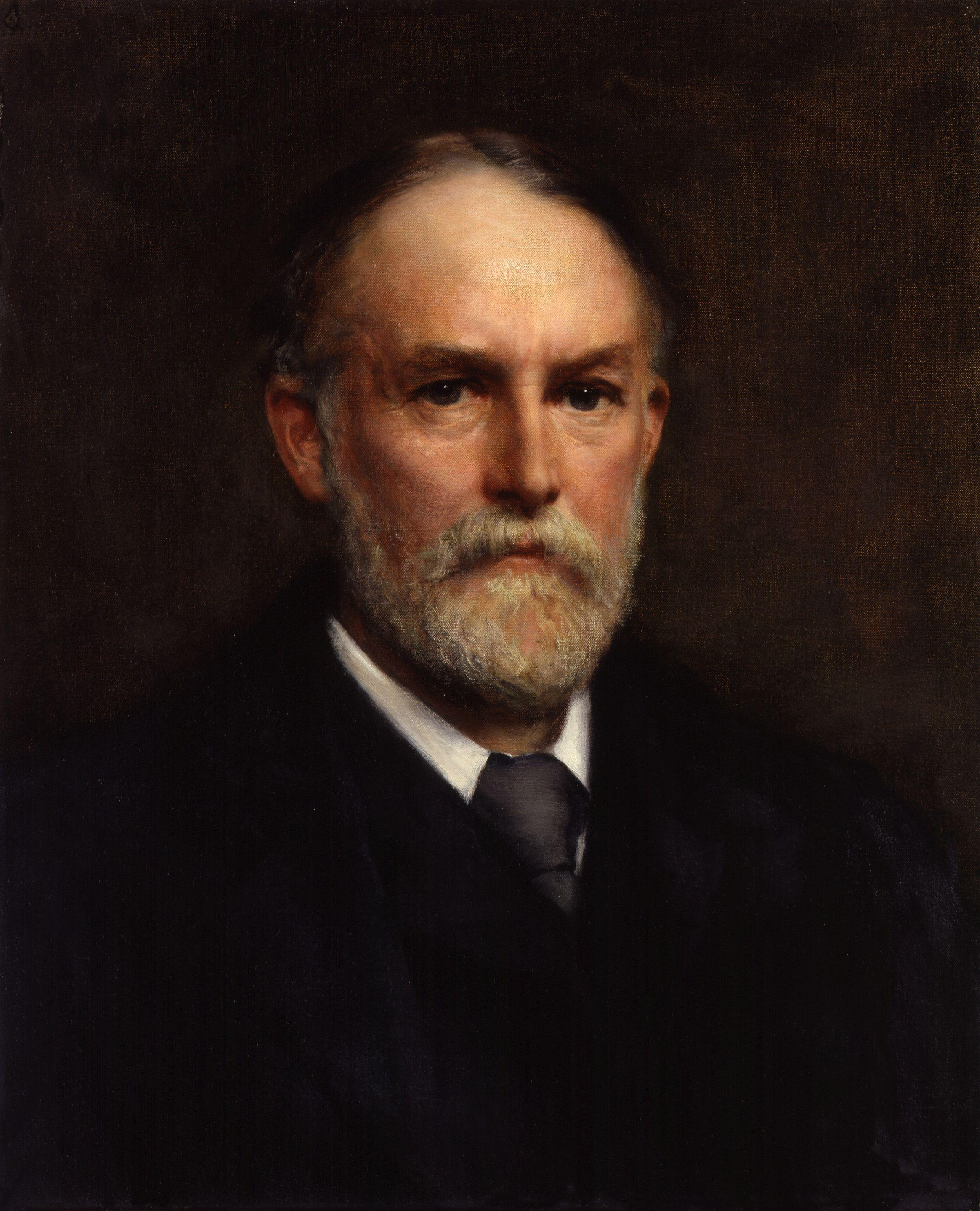
Myers was a Cambridge classicist who took a salaried post as Inspector of Schools because it paid the bills and left him time to do what he considered his actual work, which was psychical research. In February 1882 he co-founded the Society for Psychical Research with Henry Sidgwick and Edmund Gurney. He coined the word telepathy the same year. The vocabulary the field has used ever since for what cannot be sensorily explained ('subliminal self', 'cross-correspondences', 'veridical hallucination') was largely his. He dictated Human Personality and Its Survival of Bodily Death in the last months before he died of Bright's disease in Rome in January 1901. The two-volume book appeared posthumously in 1903 under Hodgson's and Alice Johnson's editorship. It is the immediate published source of the Survival framework that Meade Layne's Borderland Sciences Research Associates picked up in San Diego in 1945.
A Life
Myers was born on 6 February 1843 at Keswick in the Lake District, the eldest of the three sons of the Reverend Frederic Myers, perpetual curate of St. John's, Keswick, and his second wife Susan Harriet Marshall. His father was a working evangelical Anglican; his mother came from the wealthy Marshall family of Patterdale Hall. The Reverend Myers died of pneumonia at thirty-eight when his son was eight. His mother moved the family to Cheltenham and then to Cambridge, and Myers went up to Trinity College in 1860 at seventeen on the classical foundation.
The Cambridge years were the decisive years. He took a First in the Classical Tripos in 1864 and a Fellowship of Trinity College in 1865, and was admitted to the Cambridge Apostles, the elective discussion society whose Victorian membership included Tennyson, Hallam, Sidgwick, Maitland, the brothers Henry and William James, and Bertrand Russell. He held the Trinity Fellowship for six years from 1865 to 1871. His three close Cambridge contemporaries who would matter most for his subsequent work were Henry Sidgwick (the moral philosopher, later Knightbridge Professor and one of the central figures of late-Victorian Cambridge), Edmund Gurney (the polymath who would write the two-volume Phantasms of the Living with Myers in 1886), and the philosopher Henry Jackson.
He resigned the Trinity Fellowship in 1871 to take a paid post as an Inspector of Schools, which he held for the next twenty-nine years until his death. The Inspector's post supplied him with a steady income that funded the psychical-research work he considered his real intellectual contribution. He worked from the Cambridge house at Leckhampton until his marriage in 1880 to Eveleen Tennant (the daughter of the politician Charles Tennant), after which the household moved to Selwyn Gardens, Cambridge, where the remaining twenty years of his working life were based.
The substantive personal experience that shaped Myers's psychical interests was the death of Annie Hill Marshall, his cousin, in 1876. Annie Marshall (who had married Myers's elder cousin Walter James Marshall) had been the central emotional figure of Myers's late twenties, and her drowning in a fit of acute depression at Ullswater on 29 August 1876 produced the long bereavement and the philosophical question that Myers's subsequent work attempted to answer. The Annie Marshall material is documented in Fragments of Inner Life, the autobiographical manuscript Myers wrote in 1893 and sealed for posthumous publication. The 1904 Fragments publication is the substantive personal record of Myers's intellectual trajectory.
The Society for Psychical Research was founded on 6 February 1882 at the rooms of Edmund Gurney at 14 Dean's Yard, Westminster. Henry Sidgwick was the founding President, William F. Barrett of the Royal College of Science Dublin had convened the founding meeting, and Myers and Gurney served as the two Honorary Secretaries from the inception. Myers held the Honorary Secretaryship through the founding decade and was elected President of the SPR for the 1900 session, just months before his death. He coined the word "telepathy" in the SPR's Proceedings Volume 1 in 1882 from the Greek tele (far) and pathos (feeling).
The 1880s and 1890s were the substantive Myers-Gurney working decades. Phantoms of the Living, the two-volume 1886 work co-authored with Edmund Gurney and Frank Podmore, documented 702 cases of apparitions and telepathic communications collected through the SPR's Phantoms of the Living census. Gurney died suddenly at Brighton on 23 June 1888 from a chloroform overdose he had been using to treat his insomnia. Myers continued the SPR investigative programme alone through the 1890s, contributed substantially to the Borderland Volume 1 through 4 editorial roster, conducted the principal Society for Psychical Research investigation of Leonora Piper across his three American tours of 1893 and 1896, and dictated the substantial two-volume Human Personality and Its Survival of Bodily Death manuscript through his last illness.
He died at the Hotel Princes in Rome on 17 January 1901 of Bright's disease and chronic congestion of the lungs. William James, who had crossed the Atlantic to see him, was at his bedside. He was fifty-seven. He was buried in the English Cemetery at Rome with the inscription "Spes Mea Christus" beside his Cambridge friend Symonds. The Human Personality manuscript was completed by his SPR colleagues Alice Johnson and Richard Hodgson and published in two volumes in February 1903.
If a spiritual world exists, and if that world has at any epoch been manifest or even discoverable, then it ought to be manifest or discoverable now.F. W. H. Myers, Human Personality and Its Survival of Bodily Death (1903), Volume I, Introduction
Phantoms of the Living and Human Personality
Myers's working scientific contribution rests on two large books and a sustained vocabulary-building programme. Phantoms of the Living, the 1886 two-volume work he co-authored with Gurney and Podmore, was the first substantial English-language census of spontaneous psychical phenomena. The 702 documented cases were drawn from the SPR's open call to the British public for first-person accounts of apparitions seen at or near the moment of death of a distant person; the methodology required corroborating witness statements, signed first-person accounts, and date-of-death verification through the registrar of births and deaths. The census remains the principal late-Victorian statistical baseline for the type of phenomena it documented.
Human Personality and Its Survival of Bodily Death was the larger work. The two-volume 1903 publication ran to approximately 1400 pages with a substantial appendix on automatic writing, the Imperator-Stainton Moses material, and the Piper investigation. Its substantive intellectual contribution was the subliminal-self framework: the proposition that the human personality is wider than the conscious waking self, that the subliminal self produces dreams, automatic writing, hypnotic states, multiple-personality cases, and the apparent post-mortem communications documented by the SPR, and that the survival hypothesis is one of several explanatory frameworks the subliminal-self account makes compatible with normal scientific psychology.
The Myers vocabulary, much of which he coined, includes telepathy (1882), the subliminal self, supraliminal self, the metetherial environment, veridical hallucinations, and crisis apparitions. The vocabulary entered the late-Victorian and early-Edwardian psychological literature through William James (whose Varieties of Religious Experience of 1902 carries substantial Myers material), through the SPR Proceedings of 1882 onwards, and through the Borderland Glossary in Volume 3 Number 13 of July 1896 that Stead reproduced from Myers's working notes.
Myers was a contributor to and subject of Borderland Quarterly across all four volumes. The Volume 1 Number 4 covered Myers's 9 March 1894 SPR address on William Stainton Moses; Volume 2 Number 8 of April 1895 carried his frontispiece portrait and the lead "Spiritualism: As a Working Hypothesis" article; Volume 3 Number 13 of July 1896 carried his Glossary of psychical-research terminology that would shortly be incorporated into the Human Personality manuscript.
The Bibliographic Lineage to BSRA
Myers's Human Personality is the immediate English-language bibliographic source of the "Survival" framework that the Borderland Sciences Research Associates inherited in San Diego from 1945 onwards. Meade Layne's Round Robin newsletter cited the Myers Human Personality two-volume work directly as a foundational source from the third issue in November 1945 onwards. The citation chain runs through Thomson Jay Hudson's The Law of Psychic Phenomena of 1893 (reviewed in Borderland Volume 1 at page 62 and itself heavily Myers-dependent) and through Sir Oliver Lodge's Raymond of 1916 (which inherited Myers's subliminal-self vocabulary directly).
The substantive editorial position the BSRA carried through the 1940s and 1950s, that the etheric or Borderland phenomena warranted the same investigative discipline working scientists brought to other unknown questions, is the position Myers had set out in the 1886 Phantasms preface and the 1903 Human Personality introduction. The continuity from the Cambridge SPR of February 1882 through to the San Diego Round Robin of November 1945 runs principally through Myers's published work.
Photographs
Significance to the Archive
Myers matters to this archive for two specific reasons. First, the Society for Psychical Research he co-founded at Westminster in February 1882 was the institutional form the late-Victorian English-language psychical-research investigation programme took, and the SPR Proceedings he edited and contributed to through the 1880s and 1890s are the substantive documentary record of that programme. The Borderland Quarterly Stead edited from 1893 to 1897 was the public-facing journal of the same investigative community Myers anchored from the SPR side; the two periodicals are read together.
Second, the Human Personality two-volume work of 1903 is the immediate bibliographic forerunner of the Survival framework BSRA inherited in 1945. The continuous documentary lineage from the 1886 Phantasms of the Living through to the 1945 Round Robin runs through Myers's published work. He is the figure the archive's pre-Roswell reference layer connects to the post-Roswell American civilian-research collection through.