W. T. Stead
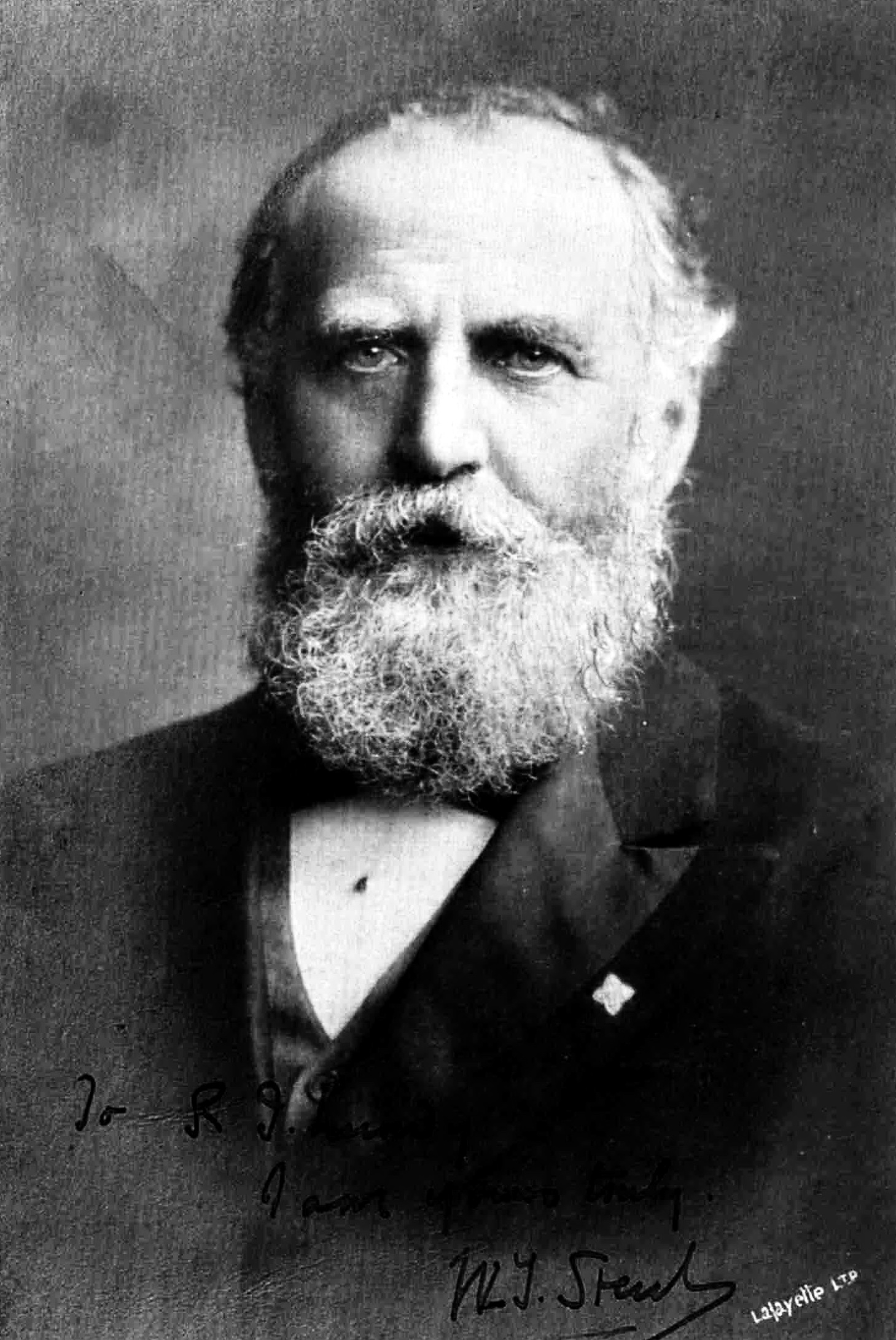
Stead was the son of a Northumberland Congregational minister. He had the editor's chair at the Northern Echo by twenty-two. The Pall Mall Gazette he took over in 1883, and in 1885 he ran the Maiden Tribute of Modern Babylon investigation that put him in Holloway for three months and pushed the age of consent up from thirteen to sixteen. He started the Review of Reviews in January 1890. He started the Borderland Quarterly in July 1893 and ran it for sixteen issues to October 1897. He started Julia's Bureau, his telegraph-style automatic-writing message service, at Mowbray House in April 1909. He went down on the Titanic on the night of 14 to 15 April 1912 on his way to Carnegie Hall to address a peace congress, age sixty-two.
A Life
Stead was born on 5 July 1849 in the village of Embleton on the Northumberland coast, the son of the Reverend William Stead, a Congregational minister, and Isabella Jobson. His father moved the family to Howdon-on-Tyne soon after, and Stead grew up in a Nonconformist household where the editorial discipline he kept for the rest of his life was first set down. He went to Silcoates School at Wakefield from twelve to fourteen, did not go to university, and was apprenticed to a Newcastle merchant's counting-house at fifteen. He kept a journal from the same age and contributed unsigned pieces to the Northern Echo of Darlington from his early twenties.
The Northern Echo's proprietor, John Hyslop Bell, offered Stead the editorship in 1871 when Stead was twenty-two. He took it. He ran the paper for nine years from Darlington, never having lived in London, and turned it into one of the most quoted provincial dailies in England. Matthew Arnold would in 1887 call Stead's editorial style "the New Journalism," meaning the use of the interview, the campaigning leader, the personal voice in the editorial chair, and the willingness to print private testimony from people who had not been quoted in newspapers before. The term stuck.
In 1880 John Morley, then editor of the Pall Mall Gazette, brought Stead to London as assistant editor. Morley left for Parliament in 1883 and Stead succeeded him as editor. The Gazette under Stead became the substantive London evening paper of the 1880s, running on the editorial principles he had developed at Darlington. He gave space to women writers, used the front-page editorial as a campaigning instrument, and brought the interview into English daily journalism as a regular form. He drove the Gordon Relief Expedition campaign that sent Sir Garnet Wolseley up the Nile in 1884, the Imperial Federation debate of the same period, and the Truth About the Navy series that contributed to the Naval Defence Act of 1889.
The 1885 Maiden Tribute of Modern Babylon investigation is the event Stead is most remembered for in the journalism literature. Working with Bramwell Booth of the Salvation Army and Josephine Butler of the Ladies' National Association, Stead ran a four-part exposé in the Pall Mall Gazette in July 1885 documenting the trade in underage girls for prostitution in London. To substantiate the investigation he procured a thirteen-year-old, Eliza Armstrong, from her mother for five pounds, sent her with a chaperone to a Salvation Army shelter in Paris, and then printed the chain of transactions. The series ran from 6 to 10 July 1885. The Criminal Law Amendment Act, raising the age of consent in England from thirteen to sixteen, was passed on 14 August 1885, six weeks later. Stead was prosecuted for technical abduction over the Armstrong transaction and served three months in Holloway Prison, from 24 November 1885 to 18 January 1886. He wore his prison uniform on Sundays for the rest of his life, in the family parlour, as the anniversary discipline of having gone to gaol for the work.
Stead left the Pall Mall Gazette in December 1889 after a disagreement with the new proprietor, William Waldorf Astor, over editorial independence. In January 1890 he founded the Review of Reviews from offices at Mowbray House on Norfolk Street off the Strand. The Review carried his own editorial digest of the month's principal articles from the British, American and Continental press alongside his own essays, character sketches, and the long campaigning leaders he had perfected at the Gazette. It made the New Journalism international. Within ten years Stead had launched the American Review of Reviews (New York), the Australasian Review of Reviews (Melbourne), and a French edition.
From the Review of Reviews offices at Mowbray House, Stead also conducted the substantive non-journalistic work of his last twenty years. The Stop the War Committee of 1899 to 1902 opposed the Second Boer War from a position he held against substantial public hostility. The 1898 Hague peace conference work and the 1907 second Hague conference work brought him into the international peace movement. He met Cecil Rhodes in 1889 and became one of three executors of Rhodes's estate. He was invited to the Carnegie Hall peace congress of April 1912 as one of the principal speakers and was crossing the Atlantic on the Titanic when she struck the iceberg on the night of 14 April. He was last seen reading in the first-class smoking room. He was sixty-two.
The method of the Agnostic applied vigorously to the phenomena of the region which has hitherto been relegated to Superstition.Borderland Volume 1 Number 1 prefatory article, July 1893
The New Journalism
Matthew Arnold's 1887 phrase identified an editorial method that has been the dominant English-language journalistic mode ever since. The interview, the campaigning leader written in the first person, the willingness to give space to voices the dailies had previously excluded, the use of the newspaper as a forum for sustained investigation rather than as a reporting vehicle for the day's events. Stead invented none of these alone but he was the editor who consolidated them into a single working practice and the figure other editors copied.
His daily editorial discipline was set in his office hours from eleven in the morning to seven at night, with the leading articles dictated to a shorthand secretary rather than written by hand. He routinely interviewed the figures of the day in person, including Gladstone, Cardinal Manning, General Booth, Madame Blavatsky, and (across two visits in 1885 and 1888) the American journalists and reformers of the East Coast. The interview-as-form had been used occasionally in American journalism before, but Stead made it the English newspaper's standard tool.
He gave the Pall Mall Gazette and later the Review of Reviews to causes the daily press of the 1880s and 1890s had no interest in covering. Women's suffrage, the cooperative movement, international arbitration, the abolition of capital punishment, the conditions of factory labour. He was both an Imperial Federation man and a Boer War opponent without finding the two positions difficult to hold simultaneously. He treated his readers as adults capable of holding competing arguments in suspension.
Borderland
Stead launched Borderland Quarterly in July 1893 from the editorial office of the Pall Mall East premises at 18 Pall Mall East. The magazine carried his own editorial digest of psychical-research activity worldwide, the substantive Letters from Julia series from the second volume onwards, eighteen Borderlanders Gallery profiles of figures from Jeanne d'Arc and Charcot to William Crookes and Annie Besant, and the Number 18 closing editorial of October 1897 announcing the suspension of publication. The full eighteen-issue run is the earliest periodical the archive holds.
Stead's editorial position in the prefatory article of Volume 1 Number 1 was the "method of the Agnostic applied vigorously to the phenomena of the region which has hitherto been relegated to Superstition." The journal kept that position across its four-year run. It carried Crookes's Inaugural Address to the Society for Psychical Research in Volume 4 Number 2, Oliver Lodge's address to Spiritualists on evidential discipline in the same number, F. W. H. Myers's Glossary in Volume 3 Number 13, Annie Besant's frontispiece portrait at Volume 4 Number 4 in 1897. It also closed the substantive English-language documentary record of the late-Victorian psychical-research moment at the point Stead's own attention had begun to shift to the Bureau apparatus he would establish at Mowbray House twelve years later.
The full eighteen-issue run of Borderland Quarterly has been deep-read and catalogued in the NHI Archive. The collection page carries article-level coverage of every issue from Volume 1 Number 1 of July 1893 to Volume 4 Number 4 of October 1897.
Julia's Bureau
Stead established Julia's Bureau at the Mowbray House offices in April 1909, twelve years after the closing number of Borderland. The Bureau was a free public service. Members of the public who had lost a relative could apply for a sitting with one of the Bureau's small staff of trained mediums, the application would be triaged by Stead's editorial staff, and the sittings would be recorded with the discipline Stead had carried over from the Pall Mall Gazette and the Review of Reviews. The Bureau took its name from the "Julia" communications that had run in Borderland from Volume 2 Number 7 in January 1895 to the closing Number 18 Parting Word of October 1897. Stead's editorial line was that the Bureau was the practical organisational form of the investigation Borderland had carried in editorial print.
The Bureau operated through to Stead's death on the Titanic in April 1912. After his death his daughter Estelle Stead continued the work, first at Mowbray House and then through the inter-war period at the Stead Centre in Smith Square. The Bureau is the direct English organisational antecedent of the inter-war Society for Psychical Research research apparatus and, through Hudson and Layne, of the American Borderland Sciences Research Associates of 1945 onwards.
Photographs
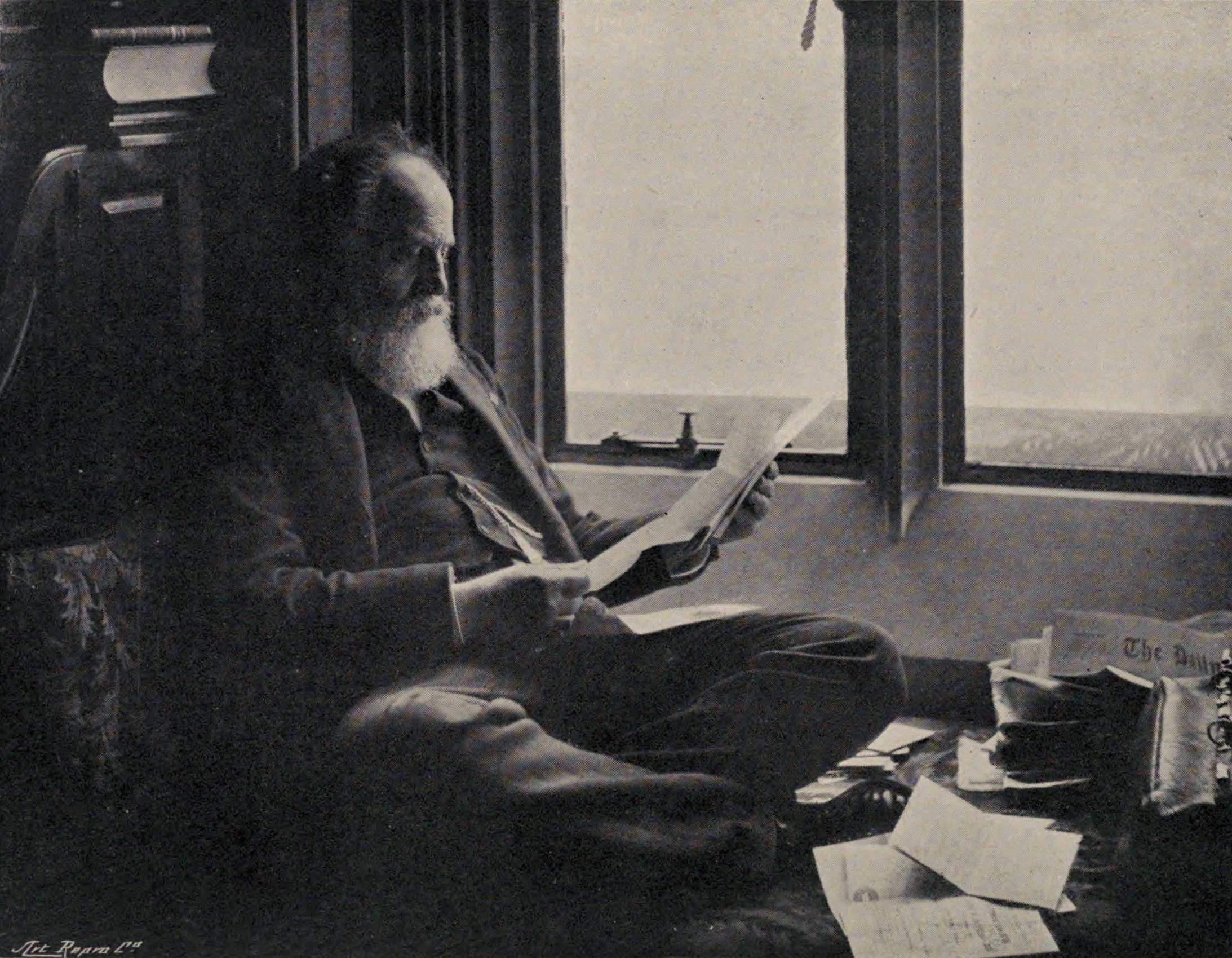
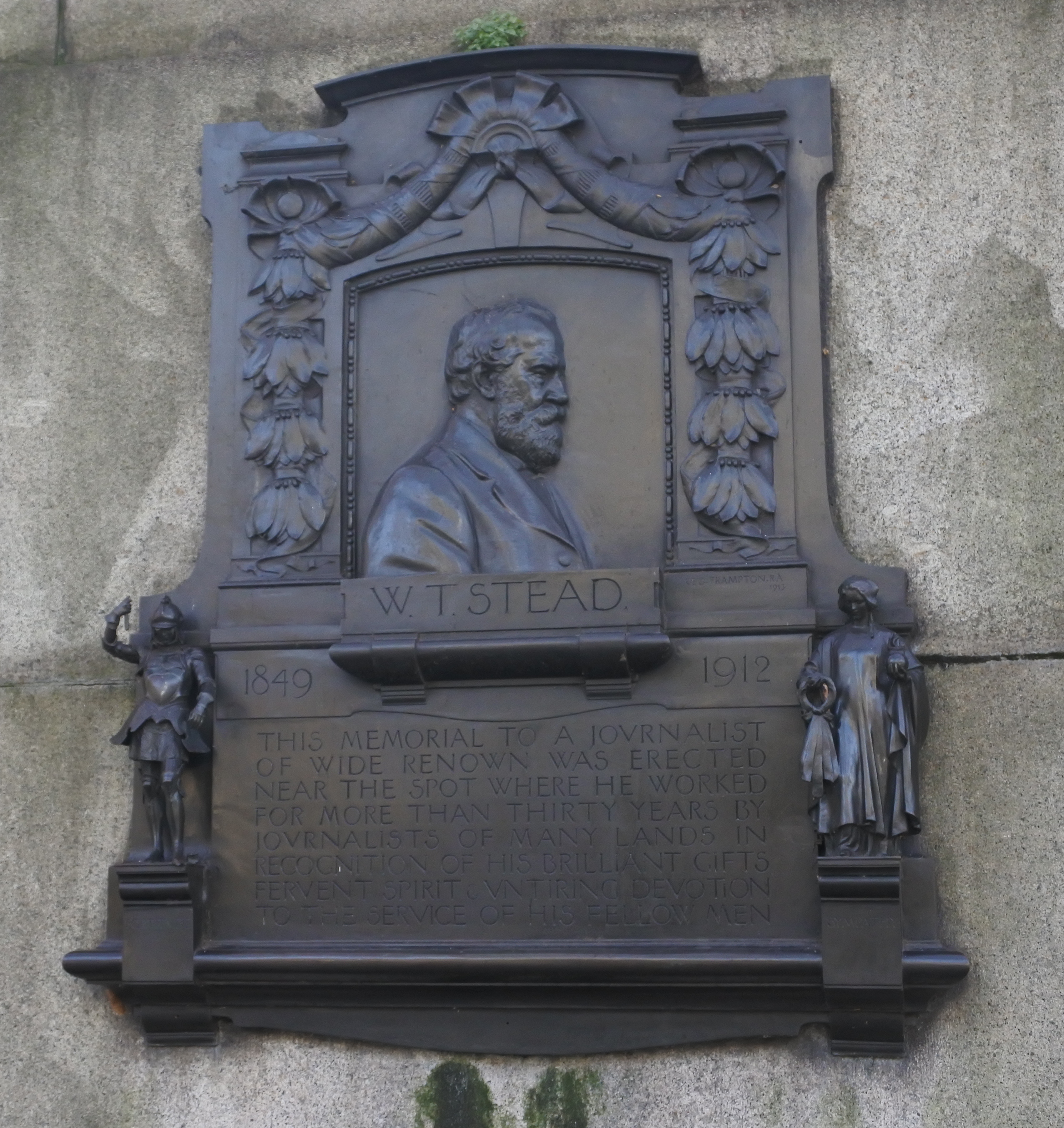
Three photographic records of Stead are reproduced here: the formal Lafayette Limited cabinet portrait inscribed by Stead himself, a working photograph of Stead reading at his Mowbray House desk in his last decade, and the bronze relief memorial sculpted by Sir George Frampton RA in 1912 and erected on the Victoria Embankment in 1913 near the spot Stead had worked at for more than thirty years.
The Titanic
Stead boarded the RMS Titanic at Southampton on 10 April 1912 as a first-class passenger. He had been invited to speak at the Universal Peace Congress at Carnegie Hall, scheduled to convene on 21 April, on the question of international arbitration. He had written extensively in the Review of Reviews against the naval arms race of the 1900s and was at the time of the voyage one of the principal English-language advocates of the arbitration movement that produced the 1899 and 1907 Hague conferences.
The Titanic struck the iceberg at 23:40 ship's time on Sunday 14 April. The ship went down at 02:20 on the morning of 15 April. Stead was last reliably seen by survivors reading a book in the first-class smoking room at around 01:30. His body was not recovered. He had published in the Review of Reviews in March 1886 a short story titled How the Mail Steamer Went Down in Mid-Atlantic by a Survivor, and in the Pall Mall Gazette of 22 March 1886 a piece titled From the Old World to the New imagining a White Star liner colliding with an iceberg. The pieces are often cited as foreshadowings of his own death twenty-six years later. He was sixty-two.
Memorials were erected in London, in Central Park in New York, and in Westminster Abbey. The London memorial, the Frampton bronze reproduced above, was unveiled on the Victoria Embankment in 1913 with the inscription: this memorial to a journalist of wide renown was erected near the spot where he worked for more than thirty years by journalists of many lands in recognition of his brilliant gifts, fervent spirit, and untiring devotion to the service of his fellow men.
Significance to the Archive
Stead matters to this archive for three specific reasons that connect the late-Victorian psychical-research moment to the documentary record the archive holds across the twentieth century.
First, the New Journalism Stead pioneered at the Pall Mall Gazette and consolidated at the Review of Reviews is the editorial tradition the archive's own collection prose attempts to maintain. The interview as primary documentary form, the sustained campaigning leader, the willingness to print witness testimony from voices the dominant press had excluded, the holding of competing positions in suspension without premature closure. The post-2017 investigative journalists working on the disclosure cycle, from Leslie Kean's New York Times Pentagon UAP investigation of December 2017 forward, operate inside the same editorial tradition Stead consolidated in the 1880s.
Second, Borderland Quarterly under Stead's editorship is the earliest periodical in the NHI Archive's collection and the substantive English-language documentary record of late-Victorian psychical research. The eighteen-issue run from July 1893 to October 1897 carried the entire active SPR generation as contributors or subjects, the Theosophical Society material at its formative second-generation moment, and the editorial framework that Hudson's Law of Psychic Phenomena of 1893 and Myers's Human Personality of 1903 would carry forward into the twentieth-century literature Meade Layne's Round Robin would inherit in 1945.
Third, Julia's Bureau at Mowbray House from April 1909 is the direct organisational antecedent of the inter-war psychical-research apparatus and, through the bibliographical chain to Hudson and Layne, of the American civilian-research organisations the archive holds. The continuity from Stead's editorial position in the 1893 Borderland prefatory article to the editorial position the archive itself attempts to maintain in its 2026 collection pages is documentable and direct.