CIA Records
In January 1953, five physicists sat in a CIA conference room for four days and decided the American public should stop thinking about UFOs. Their classified recommendations shaped government policy for the next half century. The documents in this collection tell that story, and what happened when civilian researchers fought to drag it into the open.
The Summer That Changed Everything
Washington, D.C., July 1952. Objects appeared on radar at Washington National Airport on consecutive weekends, tracked by multiple operators, confirmed by Andrews Air Force Base. Fighter jets scrambled. The objects outran them. Newspapers put it on the front page. The Pentagon held the largest press conference since the Second World War.
The Washington sightings did something no previous UFO report had managed: they made the phenomenon a national security problem that could not be ignored. Radar returns were not anecdote. They were data, recorded on military equipment, witnessed by trained operators. The intelligence community had to respond.
The response came from the CIA's Office of Scientific Intelligence, which assembled a panel of cleared scientists to review the evidence and advise on what to do about it. The panel met in January 1953. Its recommendations would remain classified for over twenty years.
The Washington, D.C. 1952 case file contains the radar tracking data, pilot debriefs, and press coverage from the July sightings. The Air Force ran its own parallel investigation through Projects Sign, Grudge, and Blue Book: browse the Blue Book microfilm for the case files the Robertson Panel reviewed.
The Robertson Panel
The panel met from 14 to 17 January 1953, chaired by physicist H.P. Robertson of the California Institute of Technology. The CIA's Office of Scientific Intelligence selected the members: Luis Alvarez, who would win the 1968 Nobel Prize in Physics; Samuel Goudsmit, co-discoverer of electron spin and leader of the wartime Alsos mission that tracked Germany's atomic programme; Thornton Page, astronomer; and Lloyd Berkner, physicist and science administrator who helped establish the International Geophysical Year.
J. Allen Hynek, the Air Force's scientific consultant on Blue Book, briefed the panel on the case files. Edward Ruppelt, who ran Blue Book and would later write a candid account of the Air Force's UFO investigation, presented the military data. The panel spent much of its time reviewing gun camera footage and radar plots.
Four days. That was all it took. The panel concluded that UFOs posed no direct physical threat to the United States. But it found an indirect threat: the volume of sighting reports could clog military communication channels during a Soviet attack. The solution, the panel decided, was not better investigation. It was less public interest.
The Robertson Panel urged the government to strip UFOs of their "aura of mystery" through a public education campaign using mass media, psychologists, and amateur astronomers. It also recommended monitoring civilian UFO organisations for subversive potential. These recommendations remained classified until FOIA litigation in the 1970s forced their release. When researchers finally read the full text, they found exactly what they had long suspected: the policy was suppression, not investigation.
The Citizen Press Responds
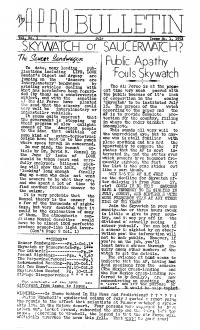
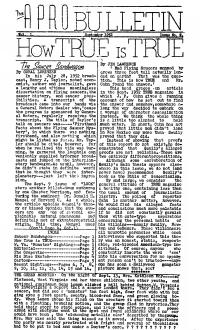
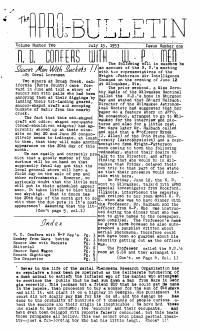
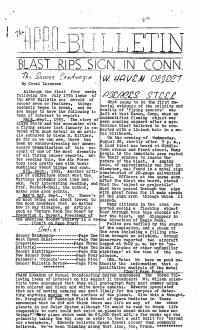
While the Robertson Panel met behind closed doors, civilian organisations were publishing their own investigations. The APRO Bulletin, founded in Sturgeon Bay, Wisconsin, by Coral Lorenzen in 1952, was already in print when the panel convened.
Decades in the Dark
The Robertson Panel's recommendations did not stay in the filing cabinet. They filtered through the military bureaucracy and settled into practice. Air Force officers received informal guidance to downplay sighting reports. Public statements emphasised prosaic explanations. Blue Book, the Air Force's official investigation, became less an inquiry than a public relations exercise. Ruppelt, who had tried to run Blue Book as a serious programme, left the Air Force in frustration.
Meanwhile, a handful of civilians built an alternative infrastructure from scratch. Major Donald Keyhoe, a retired Marine Corps aviator who had written for True magazine, founded the National Investigations Committee on Aerial Phenomena in 1956. NICAP attracted former military officers, scientists, and engineers. Keyhoe believed the Air Force was withholding evidence and said so publicly, repeatedly, on national television. He spent years filing requests for the Robertson Panel report. The Air Force and CIA stonewalled.
Coral and Jim Lorenzen ran APRO from their kitchen table in Tucson, Arizona. They published every issue of the APRO Bulletin themselves, funded by subscriptions and their own wages. When sighting reports arrived from South America, Africa, Australia, places the Air Force never looked, the Lorenzens translated them, investigated them, and printed them. The Robertson Panel had recommended monitoring organisations like APRO. The Lorenzens kept publishing anyway.
"The policy was not investigation. It was suppression of public interest."The Robertson Panel's own text, released through FOIA, 1970s
The FOIA Battles
The Freedom of Information Act passed in 1966, but it took years of litigation to pry the Robertson Panel report from the CIA. Partial leaks emerged in the late 1960s, enough to confirm what researchers had long suspected. The full text arrived in the 1970s, and it was worse than anyone had guessed. The explicit instruction to "debunk," the recommendation to surveil civilian groups: all of it, in plain bureaucratic language, confirmed on government letterhead.
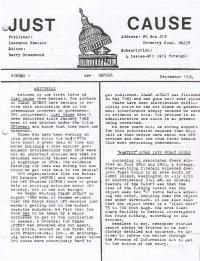
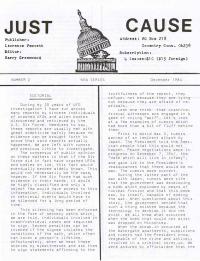
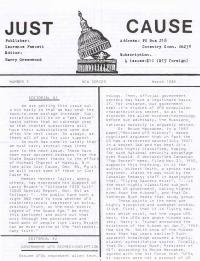
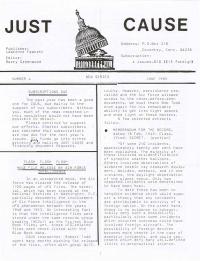
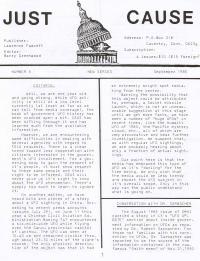
Peter Gersten, a New York attorney, founded Citizens Against UFO Secrecy in 1977 and began filing systematic FOIA lawsuits. His newsletter, Just Cause, tracked every request, every denial, every appeal. Each issue was a legal brief dressed as a newsletter, documenting the government's refusal to release material it simultaneously claimed did not exist.
The FOIA Paper Trail
Just Cause, published by Citizens Against UFO Secrecy, spent a decade filing FOIA lawsuits and documenting every government refusal. Each issue tracked the legal battle to extract CIA documents.
The Agency's Own History
In 1997, CIA historian Gerald Haines published an article in Studies in Intelligence acknowledging Agency involvement but framing it as a minor Cold War anxiety. Haines also floated a claim that U-2 and SR-71 overflights accounted for many 1950s and 1960s sightings. Researchers checked the maths almost immediately. The overflights did not match the sighting dates, locations, or descriptions. The claim quietly faded from official talking points.
FOIA litigation and declassification reviews continued to produce material the Agency had not voluntarily released. In 2021, the CIA delivered a tranche of documents to John Greenewald's Black Vault project after years of sustained FOIA pressure. The release included material that had never appeared in the CIA's own electronic reading room, spanning decades of intelligence assessments and inter-agency correspondence.
The CIA maintained for decades that it had released everything related to UFOs. Then more kept turning up. Each new release came not because the Agency volunteered the material, but because an outside researcher filed the right request and refused to accept no for an answer. The question of what remains unreleased is, by definition, unanswerable.
The People in This Story
Scientists who reviewed the evidence, officers who collected it, and civilians who spent decades fighting to make it public.
Key Documents
Timeline of CIA UFO Involvement
The newsletters that covered the CIA's involvement most extensively are preserved in the archive. The APRO Bulletin published continuously from 1952 to 1986, documenting cases the Air Force dismissed. Just Cause tracked every FOIA battle from 1977 onward. Flying Saucer Review, published from London, provided international coverage of government secrecy that American outlets would not touch. Browse the United States sightings page for the full scope of reports from the 1950s wave that triggered the Robertson Panel.
Document Inventory
| Category | Description |
|---|---|
| Intelligence assessments | CIA analytical products evaluating the UFO phenomenon and its national security implications |
| Inter-agency correspondence | Communications between CIA and other agencies (USAF, NSA, DIA) on specific sighting reports |
| Scientific panel records | Robertson Panel proceedings and related scientific advisory documents |
| Declassified FOIA releases | Documents released through litigation and declassification review |