Historical Archive
Australian Flying Saucer Research Society Newsletter, March 1968
Grassroots UFO research from Adelaide at the height of the McDonald lectures and the Condon Committee
From the NHI Held Archive • Australian Flying Saucer Research Society • Adelaide, South Australia
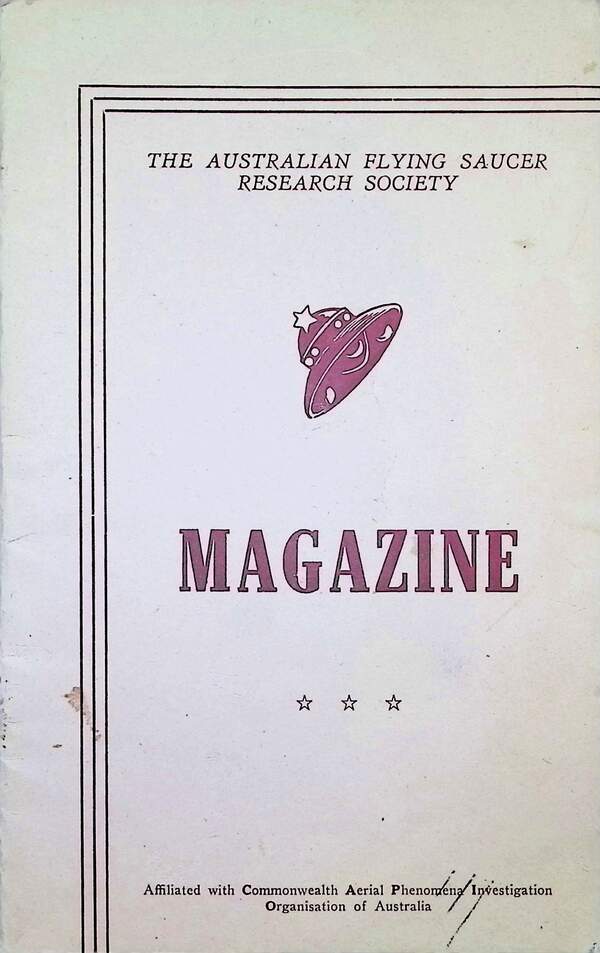
The Australian Flying Saucer Research Society (AFSRS) was founded in Adelaide in February 1955 under Fred Stone. By 1962 leadership had passed to Colin Norris, a former Royal Australian Air Force veteran who became one of South Australia’s most active UFO researchers for the next four decades. The society ran regular public meetings, maintained a lending library, and was affiliated with the national Commonwealth Aerial Phenomena Investigation Organisation (formed in 1965 under the patronage of Air Marshal Sir George Jones).
This is Vol. 2, No. 1 of the AFSRS Newsletter, dated March 1968. It captures a particularly active moment for the group: Professor James E. McDonald of the University of Arizona had just toured Australia the previous year, the U.S. Air Force-funded Condon Committee was deep into its work, and even the Soviet Union had quietly formed its own UFO study group. The eight-page issue reflects the society’s mix of local sightings, international developments, and day-to-day organisational life. The physical copy reproduced here is from the NHI Held Archive.
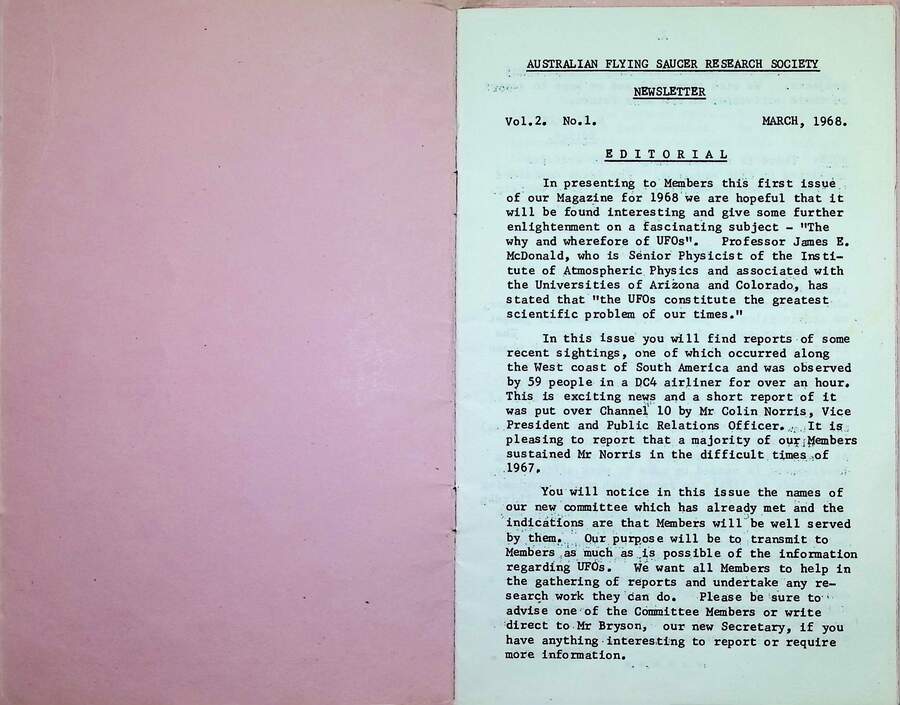
The Editorial
Editor M.E. Dodd opened the year by quoting Professor James E. McDonald, who had publicly described UFOs as “the greatest scientific problem of our era.” Dodd highlighted a recent mass sighting off the west coast of South America in which 59 passengers and crew aboard a DC-4 airliner watched an object for over an hour. The story had already been broadcast locally on Channel 10 by the society’s Vice President and Public Relations Officer, Colin Norris.
Dodd acknowledged the difficult year the society had endured in 1967 but noted that most members had stayed loyal. A new committee had been formed and was already meeting. The society’s simple mission, he wrote, remained unchanged: to pass on as much UFO information as possible to members and encourage everyone to collect reports and carry out their own research.
McDonald’s Melbourne Lecture and JANAP-146
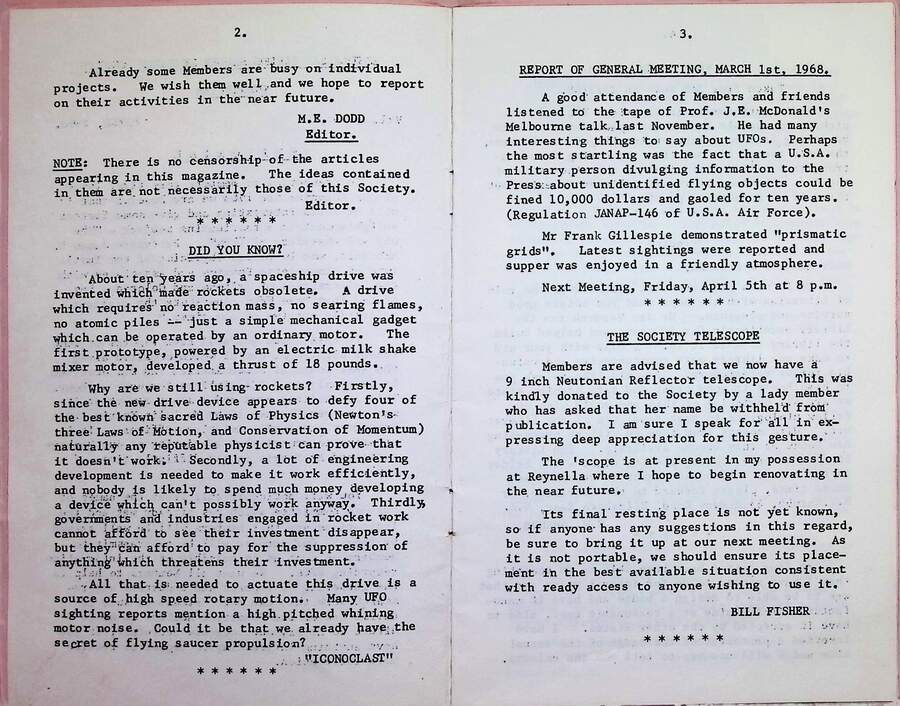
At the society’s general meeting on 1 March 1968, members listened to a tape recording of Professor McDonald’s November 1967 lecture at the University of Melbourne. McDonald had spent several weeks in Australia in mid-1967 investigating cases and speaking at universities. His recordings continued to circulate among Australian groups well into 1968.
One of the most striking points McDonald raised was Regulation JANAP-146, a U.S. military directive that imposed heavy penalties (up to $10,000 fine and ten years imprisonment) on service personnel who released information about unidentified flying objects to the press. The regulation would remain a flashpoint in disclosure debates for decades.
The Condon Committee
Committee member Col. Morris, F.A.I.S., contributed a piece titled “What of Condon?” He described the University of Colorado’s major UFO study, funded by the U.S. Air Force and involving around 200 scientists, post-graduate students, and military personnel, and openly questioned whether it was genuine scientific research or something else. The critique was written months before the Condon Report appeared in late 1968. That report ultimately recommended ending official UFO investigations and directly led to the closure of Project Blue Book in 1969.
Local Sightings from South Australia
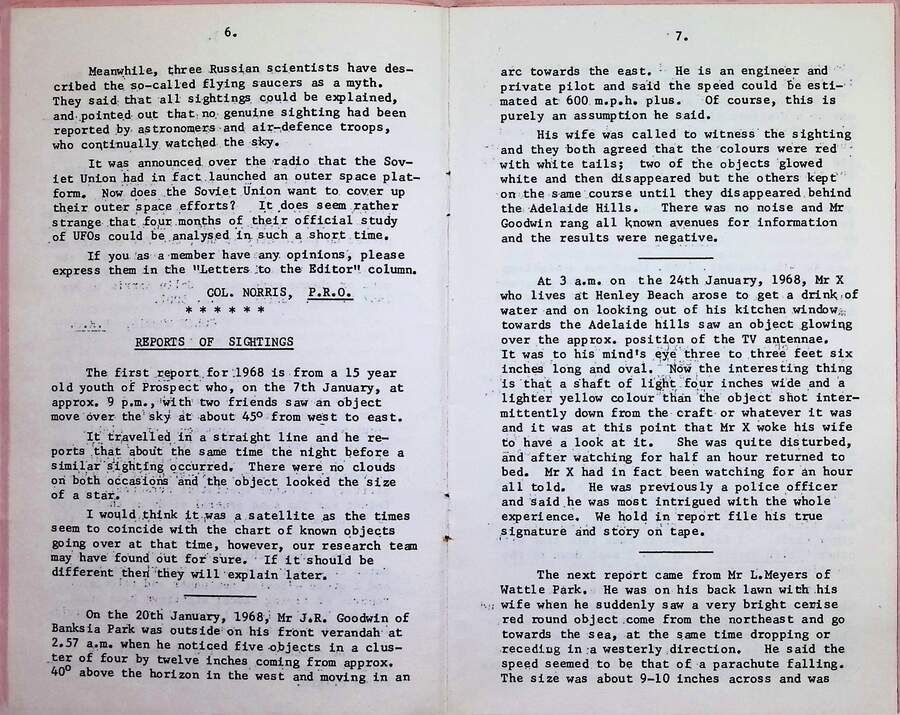
Col. Morris also compiled the issue’s sighting reports, all from South Australian witnesses. Standouts included:
- A ten-year-old boy in Fremantle who watched a bright object moving east to west on 7 February 1968 at about the speed of a car. He insisted it behaved differently from any satellite he had ever seen.
- Multiple evening sightings across Adelaide suburbs (Henley Beach, Upper Sturt, Findon, Edwardstown) between 5:30 pm and 8:30 pm, with objects moving north to east in a curving downward path. Witnesses consistently noted they looked nothing like normal satellites or aircraft.
Soviet Interest
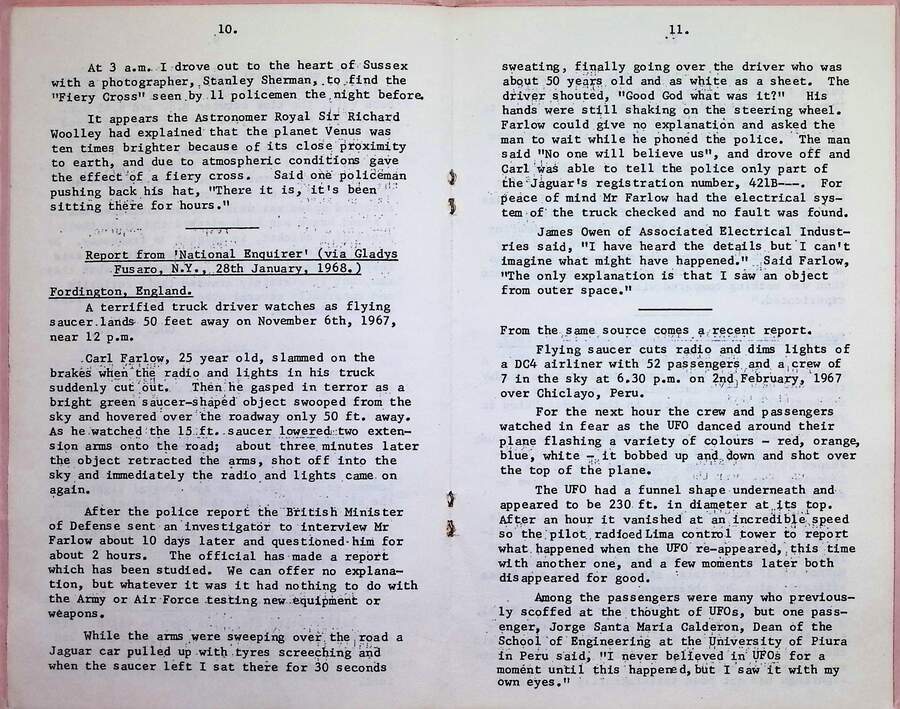
The newsletter reprinted a November 1967 Reuters report announcing that the Soviet Union had formed its own UFO investigation committee. Led by Major-General Stolyarov and including 18 scientists, astronomers, and retired air force officers, the group had already investigated a sickle-shaped object seen over the Caucasus and Black Sea. The newsletter noted that Soviet radar had been tracking UFOs for some time and that initial official dismissal of the phenomenon had begun to shift.
Everyday Society Life
Beyond the big topics, the issue gives a vivid picture of 1960s grassroots UFO research in Australia. The society had just received a donated 9-inch Newtonian reflector telescope (stored in Reynella pending renovation) and ran a lending library built up over ten years by Mr. Van Praag. Members contributed speculative articles on ancient astronauts and lunar anomalies, demonstrated “prismatic grids,” and offered help with film projects. The newsletter carried no advertising and ran entirely on member donations and volunteer effort.
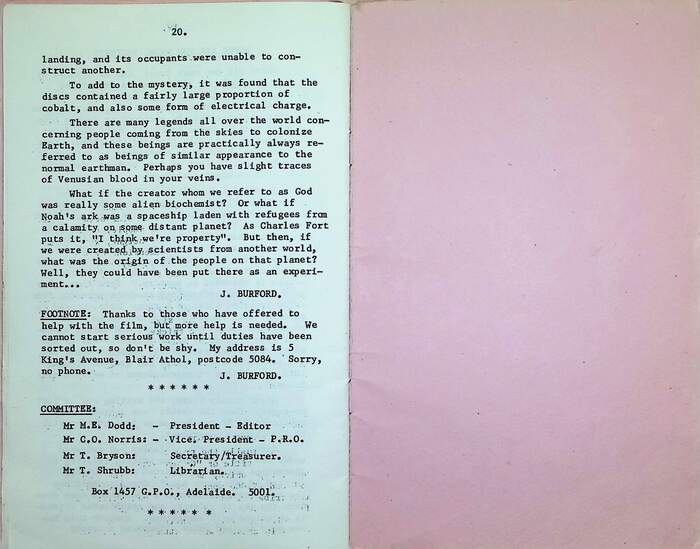
The back page listed the committee: M.E. Dodd (President and Editor), C.O. Norris (Vice President and Public Relations), T. Bryson (Secretary and Treasurer), and T. Shrubb (Librarian). All correspondence went to Box 1457, G.P.O. Adelaide.
See also: Encyclopædia Britannica Confidential Report (1953) • Flying Saucer Review Issue #8 (1953)
Source: Australian Flying Saucer Research Society Newsletter, Vol. 2, No. 1, March 1968. Original document held in the NHI Archive. The AFSRS was affiliated with the Commonwealth Aerial Phenomena Investigation Organisation of Australia. Professor McDonald’s Australian recordings are preserved in the James E. McDonald Papers at the University of Arizona Libraries.