Newspaper Clippings · United States · 1977
Betty Hill and the Exeter Landing Site
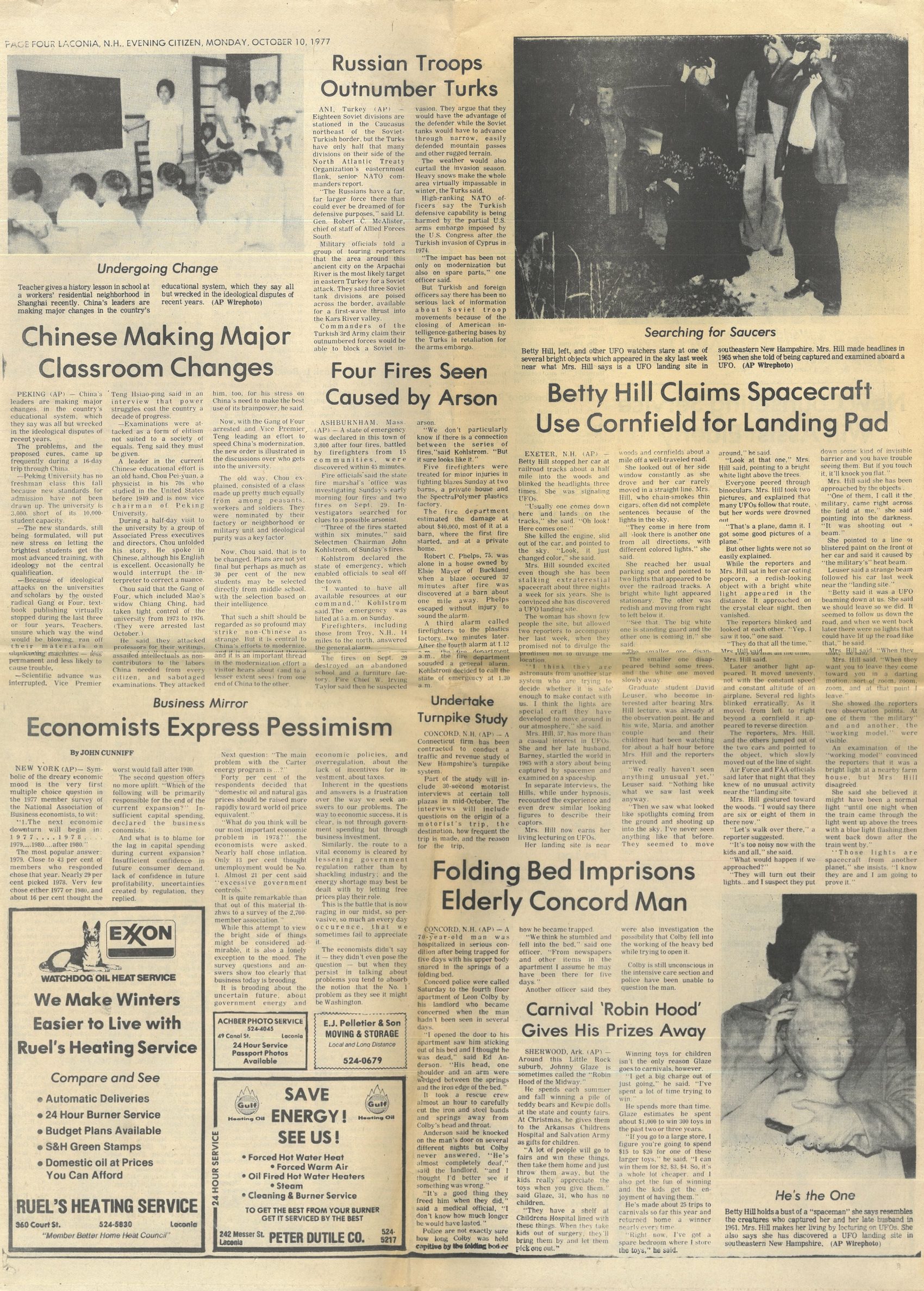
In October 1977, sixteen years after the encounter that made her name, an Associated Press reporter rode along with Betty Hill to the cornfield she called a UFO landing site.
By October 1977, Betty Hill had been a public figure for more than a decade. The 1961 encounter on US Route 3, the 1964 hypnosis sessions with Dr Benjamin Simon, and John Fuller's The Interrupted Journey had made the Hills the first widely documented abduction case in the postwar record. Barney Hill had died in 1969. Betty Hill now earned her living lecturing on UFOs, and she had become convinced that a stretch of woods and cornfield near Exeter, in southeastern New Hampshire, was a UFO landing site. That month an Associated Press reporter went out with her to watch. The account that follows is drawn from that article, carried in the Laconia Evening Citizen on 10 October 1977. The archive presents it as a record of Hill's later public phase and of how the press covered it, distinct from the 1961 case itself.
I think they are astronauts from another star system who are trying to decide whether it is safe enough to make contact with us. I think the lights are special craft they have developed to move around in our atmosphere.
Betty Hill, to the Associated Press, October 1977
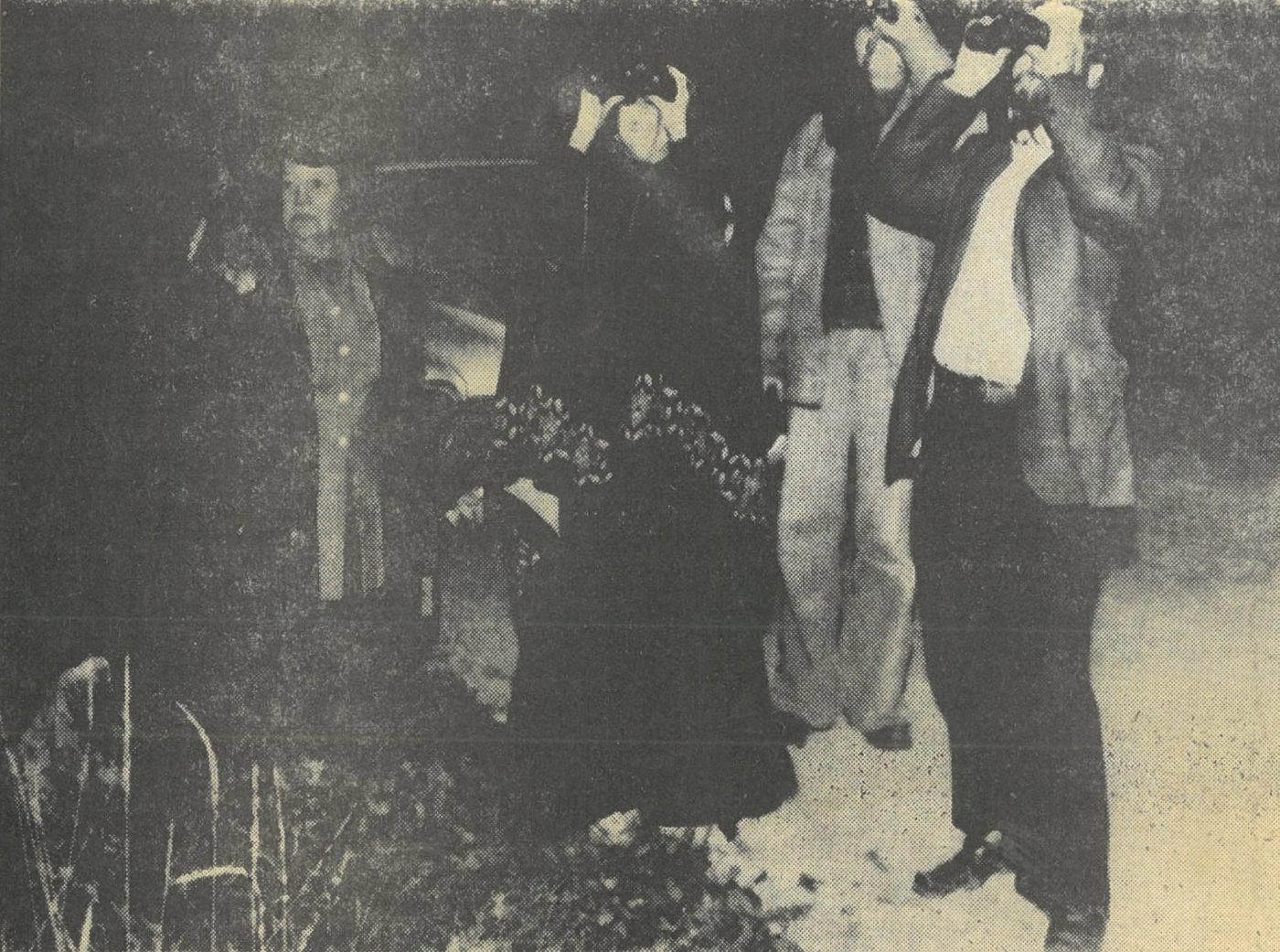
Hill stopped her car at railroad tracks about half a mile into the woods and blinked the headlights three times. She was, she explained, signalling. "Usually one comes down here and lands on the tracks," she said. "Oh look! Here comes one." She killed the engine, slid out, and pointed to the sky. "Look, it just changed colour." By her own account she had been watching for spacecraft about three nights a week for six years, and she spoke as though the lights were familiar company: "They come in here from all directions, with different coloured lights."
She was not alone in the field. David Leuser, a graduate student who had become interested after hearing Hill lecture, was already at the observation point with his wife Maria, another couple, and their children. They had been watching for about half an hour. "We really haven't seen anything unusual yet," Leuser said. "Nothing like what we saw last week anyway." Then, he said, they saw what looked like spotlights rising from the ground into the sky.
Some of what the group saw was readily explained. "That's a plane, damn it," Hill said at one point, after taking two photographs of a light she had insisted many UFOs followed. Other lights were less easily dismissed. While the reporters and Hill sat in her car eating popcorn, a reddish object with a bright white light appeared in the distance on the clear night, then vanished; the reporters agreed they had all seen it. Later a light moved unevenly, without the steady speed and altitude of an aircraft, its red lights blinking erratically, and appeared to reverse direction beyond the cornfield before moving out of sight. Air Force and Federal Aviation Administration officials said that night that they knew of no unusual activity near the site.
Hill's claims went well beyond lights in the distance. She gestured toward the woods and estimated "six or eight of them in there now." Asked what would happen if the watchers approached, she described an invisible barrier: "They will turn out their lights, and I suspect they put down some kind of invisible barrier and you have trouble seeing them. But if you touch it, it will knock you flat." She said the objects had approached her directly. "One of them, I call it the military, came right across the field at me," she said, and pointed to a line of blistered paint on the front of her car that she attributed to "the military's heat beam." Leuser said a strange beam had followed his own car near the site the week before.
She showed the reporters two fixed points she had named. One she called "the military"; another, a steady light, she called "the working model." The reporters examined the working model and concluded it was a bright light at a nearby farmhouse. Hill disagreed. She allowed it might once have looked like an ordinary light, but said that one night, as a train passed, the light had risen above the trees with a blue flash and then settled back. "Those lights are spacecraft from another planet," she said. "I know they are and I am going to prove it."
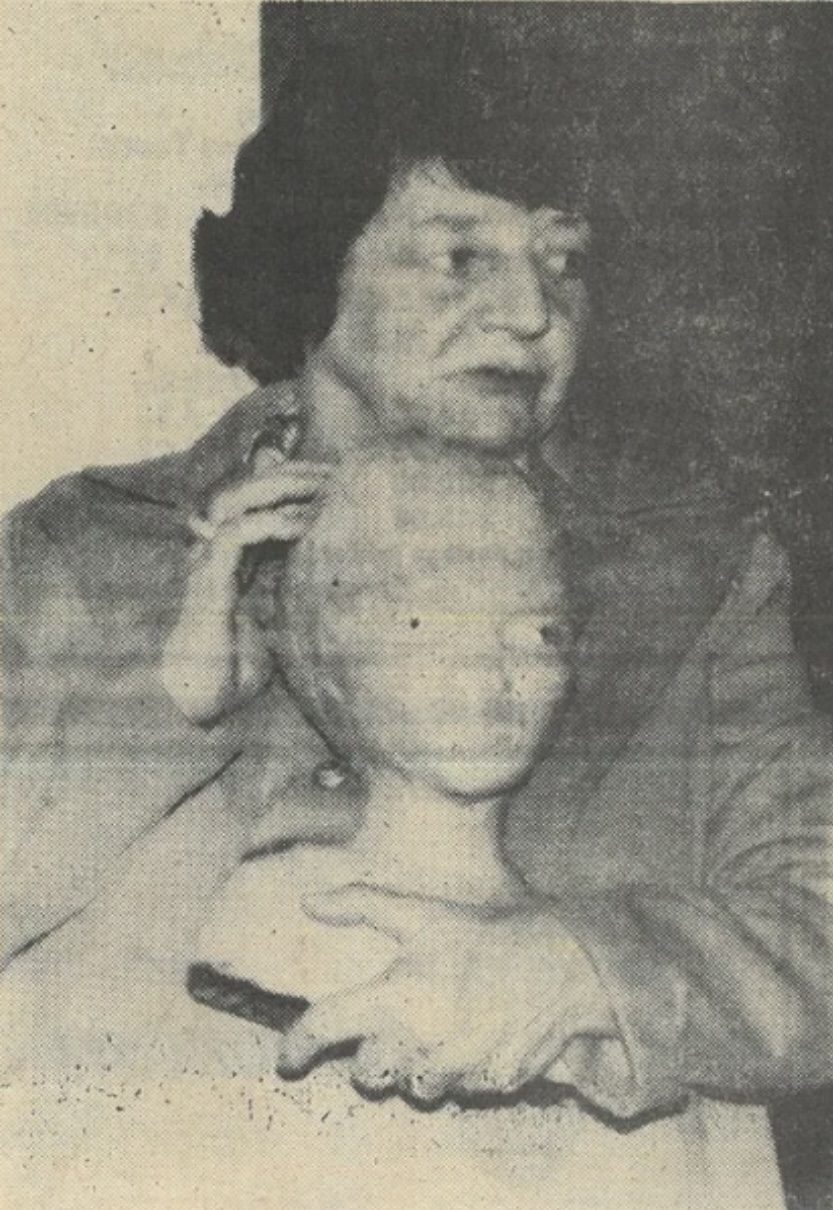
The 1961 case was never far from the 1977 coverage. The same article reminded readers that Hill had made headlines telling of being captured and examined aboard a craft, and that she now lectured on UFOs for a living. The two photo captions even date the case differently: the bust caption gives 1961, the year of the encounter itself, while the sky-watching caption gives 1965, the year the story first reached the press through the Boston Traveler. She kept a bust of a "spaceman" she said resembled the figures from that night. The Exeter landing-site claims belong to this later chapter: a public figure, certain of what she saw, returning to the same fields night after night with watchers, reporters, and a camera. Whether the lights were spacecraft, aircraft, or the farmhouse lamp the reporters settled on, the article records both the claim and the doubt, side by side, as the press of the day set them down.
Elsewhere in the archive