Japan Air Lines Flight 1628
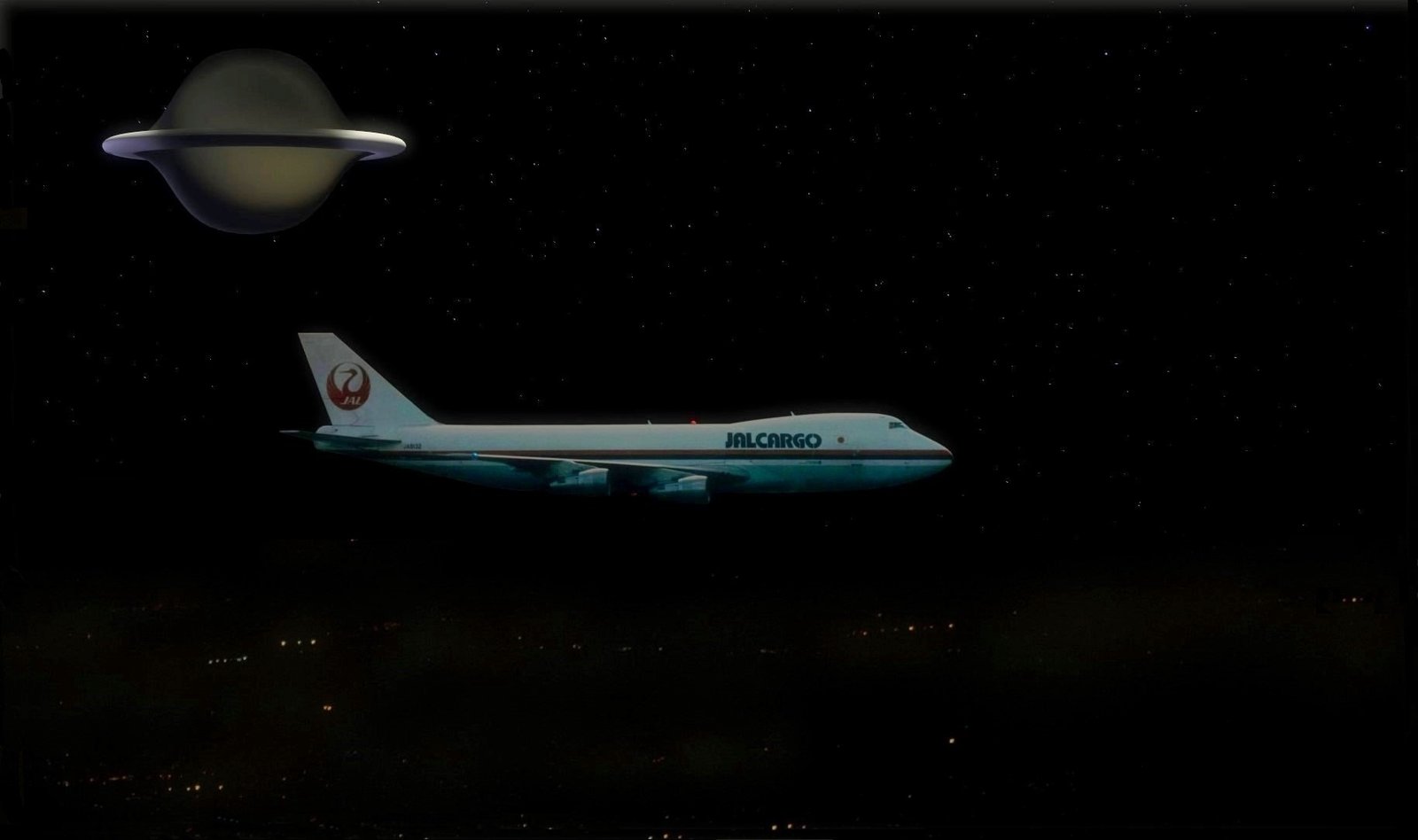
At approximately 5:11 pm local time on 17 November 1986, the three-person crew of Japan Air Lines cargo flight 1628 reported a fifty-minute visual encounter with unidentified objects over northeastern Alaska. The Boeing 747 freighter was inbound to Anchorage on the Paris-to-Tokyo cargo rotation. Captain Kenju Terauchi, co-pilot Takanori Tamefuji, and flight engineer Yoshio Tsukuba all observed the objects. The FAA's Anchorage Air Route Traffic Control Centre recorded simultaneous radar returns near the position of the aircraft. The case became the foundational Japanese aviation UFO incident and is the closest contemporary parallel to the 1976 Tehran F-4 intercept and the 2004 USS Nimitz encounter.
It was a very big one, two times bigger than an aircraft carrier. The size of it was so big, like a big aircraft carrier.Captain Kenju Terauchi, written report filed with Japanese aviation authorities, November 1986
The Encounter
Fifty minutes of visual contact in darkness at cruise altitude.
Japan Air Lines Flight 1628 was a regular cargo rotation routing French wine from Paris to Tokyo via Reykjavík and Anchorage. The Boeing 747 freighter departed Reykjavík and entered Alaskan airspace at cruise altitude in late afternoon local time on 17 November 1986. The sky was clear. The cabin was dark. Captain Kenju Terauchi held the left seat. Co-pilot Takanori Tamefuji held the right. Flight engineer Yoshio Tsukuba sat at the engineer's station behind them. At approximately 5:11 pm local time, Terauchi observed two sets of lights ahead of and below the aircraft. He initially assumed they were military traffic. Over the following minutes, the lights closed on the 747.
Terauchi described the closer object as approximately the size of the Boeing 747 itself, with arrays of square or rectangular illuminations along what appeared to be its sides. He then described a much larger third object, partially silhouetted against the lighter horizon to the west, which he estimated to be approximately twice the apparent size of an aircraft carrier. The two smaller objects appeared to manoeuvre around the larger object before all three departed at speed. The encounter lasted approximately fifty minutes from initial sighting to final loss of visual contact. The 747 continued without deviation to Anchorage.
Co-pilot Tamefuji and flight engineer Tsukuba both confirmed observing lights ahead of the aircraft. Tamefuji's account is more conservative than Terauchi's, focusing on the lights without committing to estimates of size or configuration. Tsukuba corroborated the broad sequence. The three crew accounts taken together established the multi-witness baseline of the case.
The Radar Record
The Anchorage facility's contemporaneous tracking and the split-image debate.
The Federal Aviation Administration's Anchorage Air Route Traffic Control Centre was tracking JAL 1628 throughout the encounter. According to FAA Division Chief John Callahan, who later went on the public record about the case, the Anchorage controllers detected an unidentified radar return near the position of the 747 while the crew was reporting the visual sighting. Anchorage requested confirmation from the United States Air Force's regional surveillance system at Elmendorf Air Force Base. The military radar operators reported a contact at the same approximate position.
The technical dispute that followed centred on whether the FAA radar return was a real object or an artefact of the 747's own primary return. Some FAA officials advanced the position that the unidentified contact was a split image of the 747 itself, a known radar phenomenon in which a single aircraft produces a duplicate return on screen. Other officials and external investigators questioned this explanation, pointing to the differential motion between the two contacts, the simultaneous visual observation by the cockpit crew, and the secondary confirmation from Elmendorf's military radar.
The FAA administrator overseeing the agency at the time did not issue a formal closure of the case. The investigation's conclusions remained officially unresolved within the agency's public record. The radar data tape from the Anchorage facility was preserved in the case file.
The Callahan Briefing
The closed-door FAA meeting and the agencies who attended.
John Callahan, the FAA Division Chief responsible for the Anchorage facility's operations, has stated publicly that the FAA conducted a formal investigation in the days and weeks following the encounter. According to Callahan's on-record account, a closed-door briefing was held at FAA headquarters in Washington to review the cockpit voice transcript, the radar data tape, and the crew written reports. Callahan has said that officials from the Central Intelligence Agency, the Federal Bureau of Investigation, and other unspecified agencies attended the briefing. Callahan has further stated that he was instructed at the conclusion of the briefing that the meeting had not officially taken place and that he was not to discuss the case publicly.
Callahan retained personal copies of the radar data tape, sections of the cockpit voice recorder transcript, and FAA correspondence relating to the case. Years after the incident, after his retirement from the FAA, Callahan released the retained materials publicly. The Callahan materials became the primary archival source for civilian researchers and the basis for the case's continuing presence in the disclosure-era documentary record.
The Callahan account has not been formally confirmed by the FAA, the Central Intelligence Agency, or the Federal Bureau of Investigation. None of the three agencies have officially denied it either. The retained materials have been examined by independent researchers; their authenticity as FAA documents has not been disputed.
This is the first time that we had on the FAA's radar system, in real time, an object that was unidentified, that was much larger than the 747 in front of us.John Callahan, former FAA Division Chief, on-record statement, 2001
Aftermath
The crew's professional consequences and the case's slow public surfacing.
Following the public reporting of the encounter, Captain Terauchi was temporarily removed from flight duties by Japan Air Lines. The administrative action followed Terauchi's public statements about the encounter in news interviews. He was subsequently reinstated to flight status. Terauchi continued his career with Japan Air Lines through to retirement and maintained the substance of his account in subsequent decades.
The aviation-trade press in Japan covered the encounter contemporaneously, with the broader Japanese press treating it cautiously. The English-language coverage was led by Philip J. Klass, the senior editor of Aviation Week and Space Technology and a long-standing UFO sceptic, who proposed natural explanations for the lights including Jupiter and Mars and dismissed the radar evidence as artefact. The civilian investigative community pushed back, with researchers including Bruce Maccabee and the Center for UFO Studies obtaining FAA file releases through Freedom of Information Act requests. The Klass and Maccabee positions became the canonical sceptical and pro-anomalous readings of the case respectively.
The case remained a known but secondary file in the aviation-UFO literature through the 1990s and 2000s. Callahan's emergence as a public source in the late 1990s and early 2000s lifted the case back into broader attention. The post-2017 disclosure cycle further re-elevated JAL 1628 as one of the foundational pre-Nimitz aviation cases, frequently cited in the same breath as Tehran 1976 and the Belgian Wave radar tracks of 1989 to 1990.
The Case in Continuing Reference
JAL 1628 in the modern aviation-UAP and disclosure record.
Japan Air Lines Flight 1628 sits in a small group of cockpit-witness UAP cases with simultaneous independent radar tracking by an aviation authority. The closest contemporary parallels are the 19 September 1976 Tehran case, in which Imperial Iranian Air Force F-4s vectored on a luminous object that defeated their fire-control radar, and the 14 November 2004 USS Nimitz Tic Tac encounter, in which Navy F/A-18s vectored on an object tracked by the Princeton's AN/SPY-1 radar system. The three cases together form the spine of the aviation-UAP record. JAL 1628 is the earliest of the three to be supported by an open civilian-authority investigation file.
The case is referenced in the December 2017 New York Times disclosure article that launched the modern UAP cycle, in subsequent congressional testimony covering the historical aviation record, and in the post-2024 Japanese Parliamentary League for Unraveling UAP's review of the Japanese aviation pre-history. The 11 May 2026 statement by Chief Cabinet Secretary Minoru Kihara that Japan possesses its own UAP video footage was framed by Japanese press coverage against the longer Japanese aviation record reaching back to JAL 1628.
The Callahan materials, retained from the FAA case file and released publicly by Callahan after his retirement, comprise the radar data tape from the Anchorage facility, sections of the cockpit voice recorder transcript, and FAA internal correspondence on the November and December 1986 investigation. The Federal Aviation Administration has not officially confirmed or denied the materials' authenticity. The materials are available through the Centre for UFO Studies and the Sign Historical Group archival collections.
See the standing post at JAL Flight 1628: Pilot Encounter Over Alaska. The case is referenced on the Japan country page as the foundational Japanese aviation incident and on the United States country page for the FAA investigation. Related: USS Nimitz Tic Tac, the 2004 Pacific encounter that re-elevated the aviation-UAP record into the post-2017 disclosure cycle.
Key People
The cockpit crew, the FAA officials, and the civilian researchers whose work shaped the case record.