The July 1953 issue of Space Review was dedicated to Gail Sprague of Wausau, Wisconsin, for exceptional service. It would be the last issue published before the IFSB’s mysterious October shutdown, and it carried more content, from more contributors, across a wider intellectual range than any issue before or after it. Reading it with the knowledge of what came next gives every page a quality its authors did not intend: the quality of something about to end.
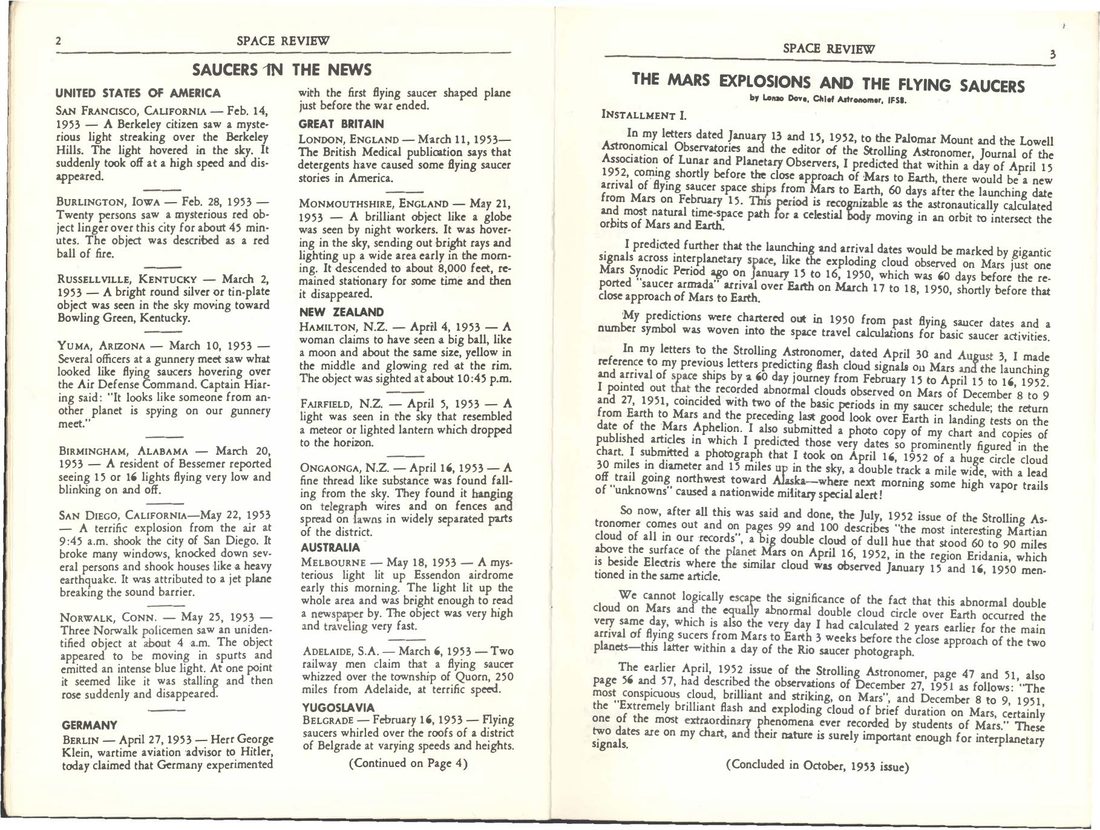
Lonzo Dove, the IFSB’s Chief Astronomer, contributed the most technically ambitious article the newsletter had published. “The Mars Explosions and the Flying Saucers” ran four dense columns, citing correspondence with the Palomar Mount and Lowell Astronomical Observatories and the editor of the Strolling Astronomer, the journal of the Association of Lunar and Planetary Observers. Dove claimed to have predicted the April 1952 saucer wave by calculating a sixty-day transit period from Mars to Earth coinciding with the Mars Synodic Period. He cross-referenced abnormal cloud formations observed on Mars on 16 April 1952 with a “huge circle cloud 30 miles in diameter” photographed over Earth on the same date, which he said had triggered “a nationwide military special alert.” His methodology was his own, his astronomical references were real, and the article ended with “(Concluded in October, 1953 issue).” The conclusion never appeared.
From England came Graham F. N. Knewstub, whose credentials (A.M. Brit. I.R.E., A. Inst. E.) made his article the most academically credentialed piece Space Review had published. “A New Approach to the Saucer Problem” analysed the flying disc as an engineering problem rather than a mystery. Knewstub identified five fundamental unanswered questions, noted that “every technique known to modern science, from photography and radar to jet interceptor aircraft, has been employed to try and solve the problem by direct observation but has failed,” and proposed working backward from the disc’s shape to infer its propulsion. His analysis drew on ancient Greek discus aerodynamics, rolling-motion physics, and torque dynamics to argue that “two distinct dynamic principles of flight” applicable to a flying disc were “independent of motive power or aerodynamics,” making the disc “suitable for space flight as an alternative to the rocket.” A team of engineers and physicists in Bristol, he reported, were analysing the data.
Dominick C. Lucchesi, the IFSB’s Chief Aeronautics Engineer, went further. In “Fantasy Versus Logic,” he dismissed theories of extraterrestrial origin as “nothing more than illusions created by the fervid and over-active imagination of too many science-fiction fans” and asserted that “the discs, their occupants, and their propulsive force are entirely within the reach of the research divisions of some of our larger aeronautical corporations.” He then claimed: “I hereby claim, that within my possession rests the complete technical data necessary to construct a vehicle that would fulfill all requirements and more, than are claimed by said saucer observers.” The drawings, he said, were nearing completion and would soon be submitted to the Director.
The Director was Albert K. Bender, though his title had changed. “IFSB now has a Director rather than a President,” a notice on page one reported. “We have eliminated several positions on the International Staff due to better arrangement of our group.” Krengel remained Associate Editor and assistant to the Director. The restructuring was presented as administrative efficiency. Whether it reflected something else is a question the archive’s reader can consider alongside the October issue that followed.
On the front page, a Mrs. D. M. Woodall of Bristol reported the results of the IFSB’s World Contact Day experiment. On 15 March 1953, a message had been sent by mental telepathy to “various members and officers over the world” at a coordinated time. The IFSB acknowledged they “did not know if it would be a success.” Mrs. Woodall, who claimed to hold regular séances with the deceased Senator Marconi, asked him whether the appeal had been understood by the occupants of the saucers. “Answer: YES.” Where do the saucers come from? “Mars.” Is there life on Mars? “Yes.” Are the saucers flown by human beings? “Yes.” What will be the result of the IFSB’s appeal? “Peace.”
The issue also carried August C. Roberts’ first-person account of his July 1952 sighting over New York, describing the object in detail (orange with reddish brown rim, two half-dollars held at arm’s length, fifty to one hundred feet in diameter, no sound, “powerful and deadly”) and the visceral experience of seeing it (“that odd feeling in the pit of my stomach”). A pre-1900 sightings catalogue by Donald G. Wiggins traced reports back to 1878 (Denison, Texas: a farmer describing an object the “size of an orange” that grew to “the size of a large saucer”) and 1897 (Sisterville, West Virginia: a torpedo-shaped craft two hundred feet long with searchlights, stubby wings, and red and green lights, circling the town for ten minutes). Florence Kalan of California contributed a self-deprecating essay that opened by quoting Will Rogers: “All I know is what I read in the newspapers.”
Edgar Jarrold reported from Australia. The AFSB held global sightings in its files “dating from 1661 onwards” and was exploring statistics suggesting saucer reports occurred in two-year cycles coinciding with Martian approaches, anticipating “even greater sightings in 1954 and 1956 when Mars comes even closer to earth.” Captain Plunkett reported from Bristol on the British branch’s formation, its members (electronic experts, radar personnel, ex-officers, amateur astronomers), and its ambition to build a model saucer, hampered by the lack of a suitable workshop. The Associate Editor reviewed APRO (the Aerial Phenomena Research Organisation), a peer organisation directed by Mrs. Coral E. Lorenzen, noting its anti-Communist clause, its 42 members, and its “commendable job.”
And on the same page as the APRO review, a small notice: “Mr. Frank Scully, author of ‘Behind the Flying Saucers’, is now a member of the International Council of IFSB.” His article was promised for the October issue.
George Adamski himself had written in to correct errors in the April account: there had been seven people present, not four; Desert Center was in California, not Arizona; there had been no two-hour interval; and he had touched the ship. “When my book comes out it reveals all of this word by word, step by step.” The Director appended a note: “any erroneous statements regarding this affair in the April, 1953 issue were due to misinformation supplied to the Bureau.”
The October issue would carry no Scully article, no Dove conclusion, no Lucchesi saucer drawings. It would carry instead a “Statement of Importance” that read: “The mystery of the flying saucers is no longer a mystery. The source is already known, but any information about this is being withheld by orders from a higher source. We advise those engaged in saucer work to please be very cautious.” In July, the IFSB was still planning, still promising, still building. Dove was mid-argument. Lucchesi’s drawings were nearing completion. Knewstub’s Bristol engineers were analysing data. Scully had just joined the Council. The next issue, everyone understood, would contain revelations. It did, though not the ones they expected.