For one shilling, a browser at an Australian newsstand in December 1953 could pick up the latest Australasian Post and find, past the cover portrait of Beverley Prowse (Toowoomba’s prize beauty) and below the masthead of The Argus and Australasian Limited, a promise in bold type: “Flying Saucers: More Startling Facts.” Inside, spread across six pages of the Melbourne-published weekly, was Part Five of a serial the magazine had been running for weeks. George Adamski, an amateur astronomer based at Palomar Gardens in California, was describing the moment he said he met a man from Venus.
The instalment was titled “The Venusian Speaks.” It was not original reporting. The Post was packaging a book for its general Australian readership: Flying Saucers Have Landed, by Desmond Leslie and George Adamski, first published in London by T. Werner Laurie earlier that year. Leslie, an Irish writer and former RAF Spitfire pilot, had contributed the first half, a historical and theoretical survey drawing on ancient records and Theosophical sources. Adamski supplied the second: his first-person account of what he claimed happened near Desert Center, California, on 20 November 1952.
The account as published
Adamski’s narrative, as the Post presented it, was specific in its physical details. The being he said he encountered stood about five feet six inches tall, weighed approximately 135 pounds, and appeared to be about twenty-eight years old. His hair, Adamski wrote, was sandy in colour and “hung in beautiful waves to his shoulders, glistening more beautifully than any woman’s I have ever seen.” He wore a chocolate-brown one-piece garment with a broad embossed band around the midsection, and shoes Adamski described as oxblood in colour. Communication, in Adamski’s telling, occurred through a combination of telepathy and gesture. The only spoken word he reported hearing from the being was a response to a question about atomic weapons: “Boom! Boom!”
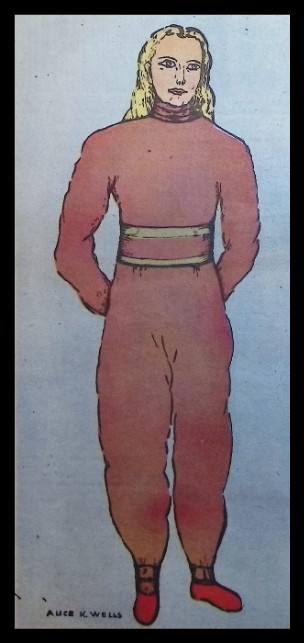
The Post illustrated the account with a full-colour figure captioned as derived from a sketch by witness Alice K. Wells, who had observed the encounter through binoculars from a distance. The published illustration, a standing figure in a coral-coloured suit against a desert backdrop, was a professional magazine rendering rather than a field sketch. Whatever Wells observed or drew, the Post’s art department had produced something fit for the page: a composed, symmetrical figure that could sit beside the advertisements for Dry Fly Sherry and Brandauer’s pens without unsettling the weekly’s layout.
The affidavit page
The most striking editorial choice in the Post’s presentation appeared under the headline “We Were Witnesses to the Event.” The magazine reproduced photographic copies of sworn statements from six named witnesses: Alice K. Wells, Lucy McGinnis, George Hunt Williamson, Al C. Bailey, Betty J. Bailey, and Betty Williamson. The affidavits attested that the signatories “were a party to and saw the personal contact between George Adamski and a man from another world.” They had been sworn before notaries public, and the reproductions carried visible signatures.
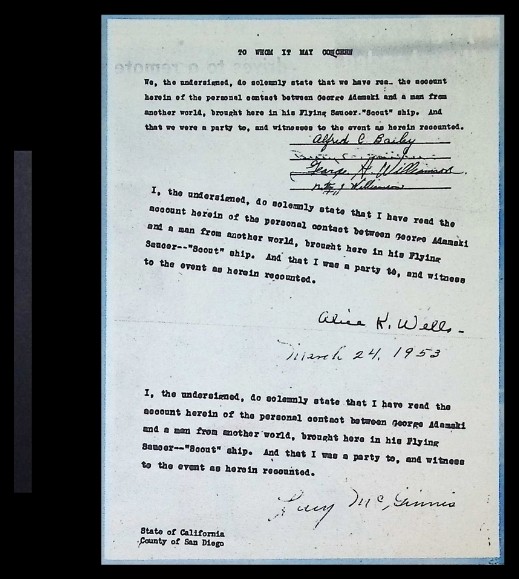
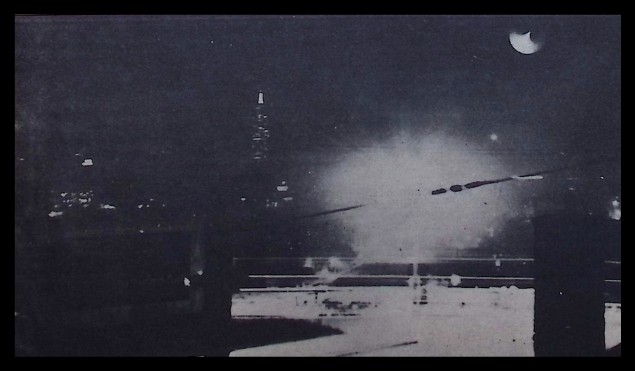
This was documentary apparatus. The Post was presenting its readers with the architecture of legal testimony: named individuals, sworn oaths, notarised documents. Whether the editors believed Adamski’s account is unknowable from the pages themselves. What is visible is that they chose to frame the serial with the trappings of evidentiary procedure, lending it a weight the first-person narrative alone would not have carried. On the same page, below the affidavits, the Post placed a photograph of a luminous object over the New York skyline, attributed to a U.S. Civil Defense sergeant in July 1952. The image had no connection to Adamski’s account. Its placement was editorial reinforcement, a visual suggestion that the flying saucer phenomenon extended beyond one man’s story in the California desert.
The book and its moment
Flying Saucers Have Landed went through six impressions by December 1953 and would sell over 200,000 copies by 1960. No distinct Australian edition has been identified in available records. The Post’s serialisation was one of the primary channels through which the material reached Australian readers at the time of the book’s first commercial wave.
The timing was not incidental. In late 1953, the Australian institutional response to flying saucer reports was taking shape. Edgar Jarrold had founded the Australian Flying Saucer Bureau in Sydney. The RAAF had begun its formal investigation of sighting reports. The Australasian Post, then in transition from a middlebrow civic weekly toward the populist picture-magazine format that would define its later decades, was positioning flying saucer material as general-interest content, the kind of feature that belonged alongside horoscopes, beauty competitions, and serial fiction.
Adamski’s six witnesses occupied different positions in relation to his claims. Wells was his financial backer, who had helped fund the purchase of the Palomar Gardens property in 1944. McGinnis was his secretary, who had ghostwritten his 1949 science fiction novel Pioneers of Space. Williamson was a fellow contactee who claimed to have taken plaster casts of the alleged visitor’s footprints after the encounter. Al C. Bailey later told the UFO investigator James Moseley that he had not seen a UFO or alien during the desert trip, a statement that contradicted the affidavit he had signed. The witnesses were members of Adamski’s immediate circle, and the sworn statements documented their involvement as much as they documented the claimed event.
From the Archive
These six pages of the Australasian Post survive as one record among many in the archive’s documentary holdings on the early flying saucer period. The Australian country profile documents the broader institutional response: the RAAF investigation, the founding of Jarrold’s bureau, and the press coverage tracked across more than a thousand newspaper clippings. The United States country profile covers the military and intelligence framework within which Adamski’s claims circulated, from Project Blue Book to the Robertson Panel of January 1953. The IFSB’s Space Review, held in the archive’s newsletter collection, was publishing at that same moment, documenting the Mojave Desert sighting wave from a different vantage point.
Adamski’s account set the template for the contactee genre that followed. The Australasian Post’s serialisation is one measure of how quickly that template travelled: from a London publisher’s office to an Australian newsstand in the space of a few months, arriving not in a specialist journal but in a one-shilling weekly bought for its horoscopes and its cover girls.