The Desert Center Contact
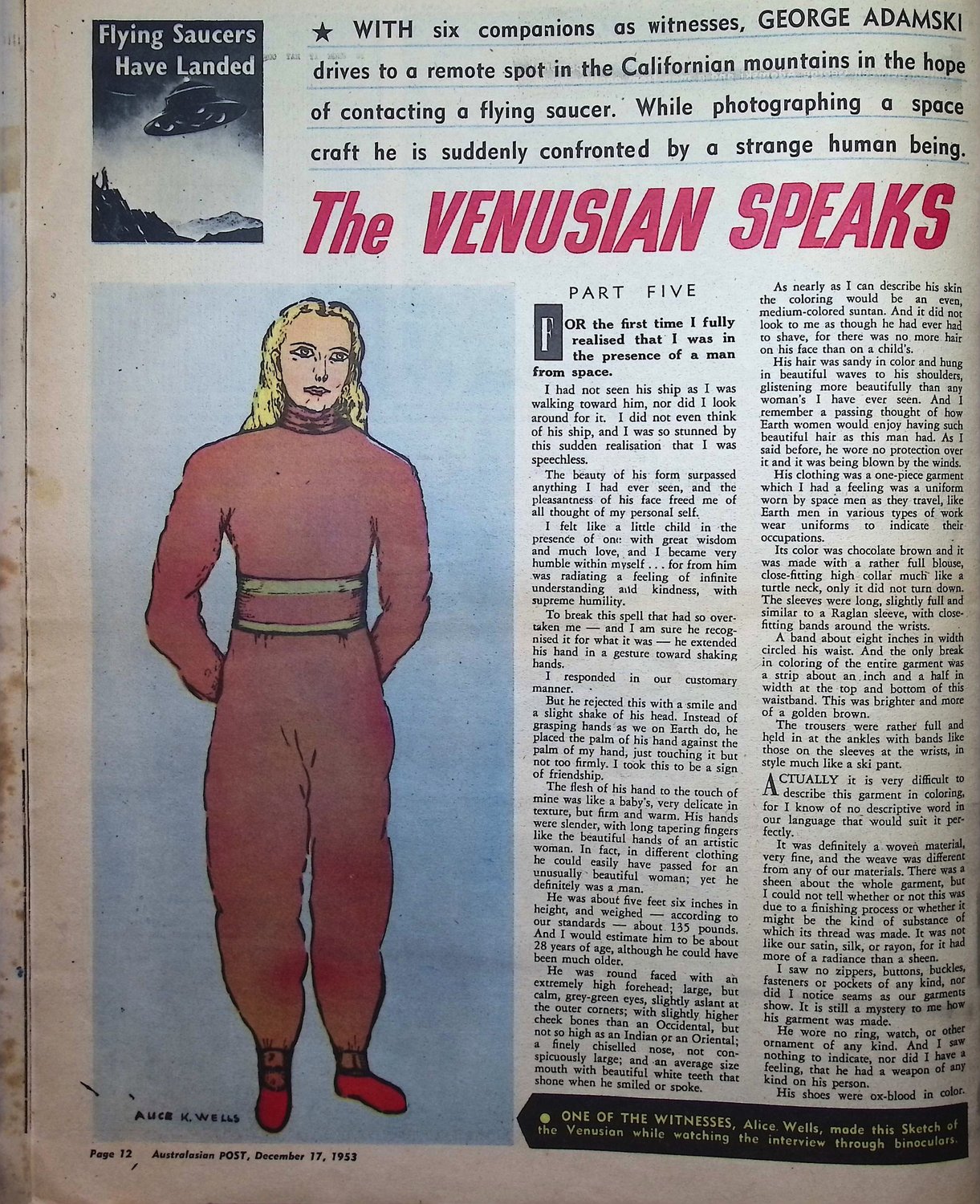
On 20 November 1952, the Palomar Gardens astronomer George Adamski drove into the California desert near Desert Center with six companions. Adamski said that he walked away from the group, watched a bell-shaped craft settle among the hills, and met a being he took to be from Venus. He communicated with it, he wrote, through telepathy and gesture, and photographed the craft he called a "scout ship." The six companions signed sworn statements that they had witnessed a contact. Published the following year in Flying Saucers Have Landed, the account became the founding text of the contactee genre.
"These unidentified flying objects are not a military problem, but they do constitute a scientific problem."
J. Allen Hynek, quoted in the contemporary press as the contactee accounts spreadThe Encounter
By his own account, Adamski had been trying to photograph craft from the grounds of his Palomar Gardens campground and diner for several years. On 20 November 1952 he travelled to the desert near Desert Center with six others. He said he left the group and walked toward a bell-shaped craft that had come down among the hills, where he met a being who appeared to be a young man. Adamski described him as about five feet six inches tall, roughly 135 pounds, and about twenty-eight years old, with sandy hair worn to the shoulders, a chocolate-brown one-piece garment, and oxblood shoes. The only spoken sound Adamski reported was a reply to a question about atomic weapons: "Boom! Boom!" Everything else, he wrote, passed between them by telepathy and hand signs. He said the visitor came from Venus and was concerned about radiation from nuclear testing on Earth.
The Witnesses and the Affidavits
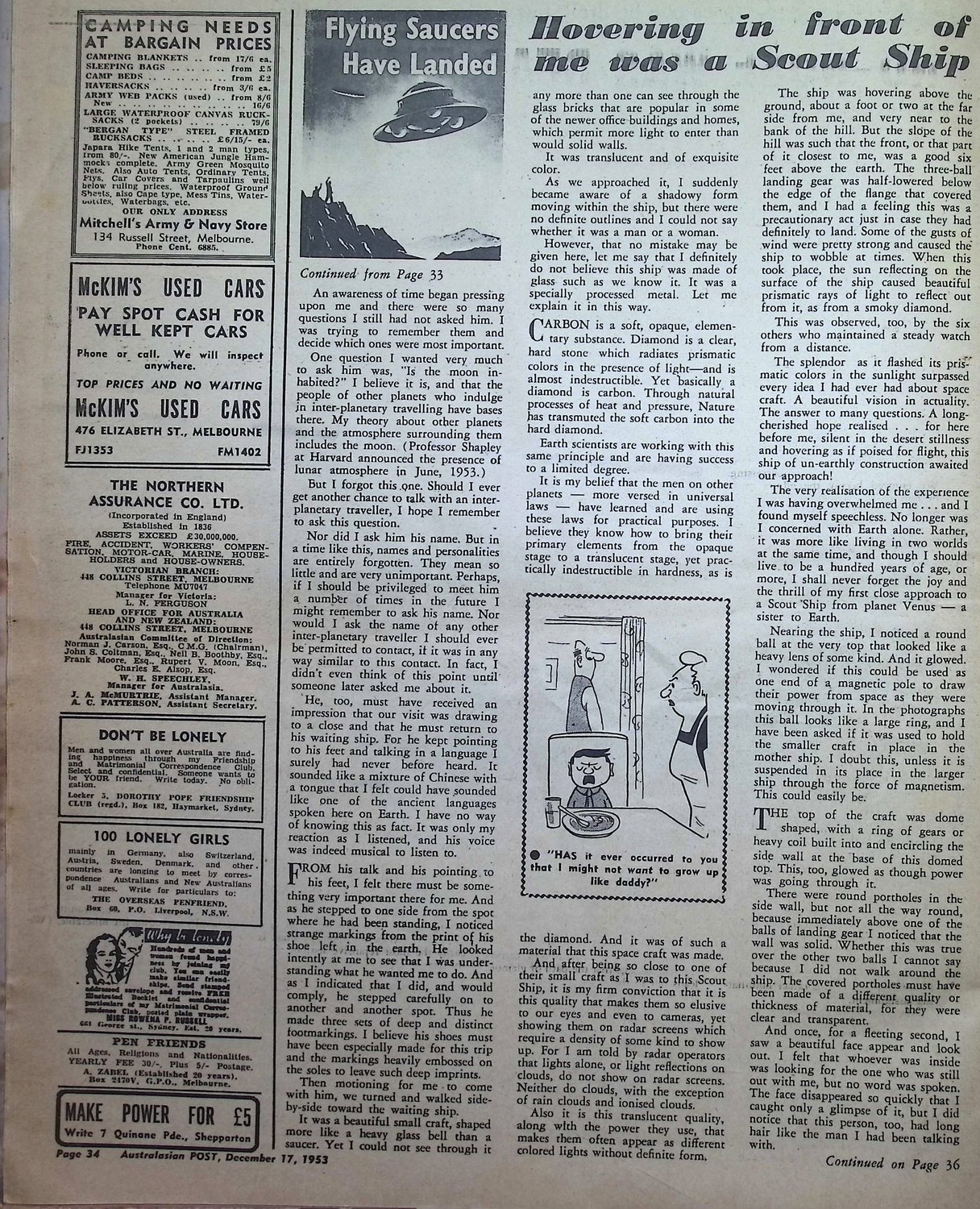
Six people who travelled to the desert that day signed sworn statements, witnessed before notaries, attesting that they "were a party to and saw the personal contact between George Adamski and a man from another world." They were Alice K. Wells, who had helped fund the Palomar Gardens property in 1944; Lucy McGinnis, Adamski's secretary, who had ghostwritten his 1949 novel Pioneers of Space; the fellow contactee George Hunt Williamson, who said he had taken plaster casts of the visitor's footprints; Williamson's wife Betty; and Al C. and Betty J. Bailey. The signed, notarised affidavits became part of the account's presentation in print, lending it the apparatus of legal testimony.
The witnesses were members of Adamski's immediate circle, and the statements documented their involvement as much as the claimed event. Years later, Al C. Bailey told the UFO investigator James Moseley that he had not seen a UFO or an alien during the desert trip, a recollection that contradicted the affidavit he had signed.
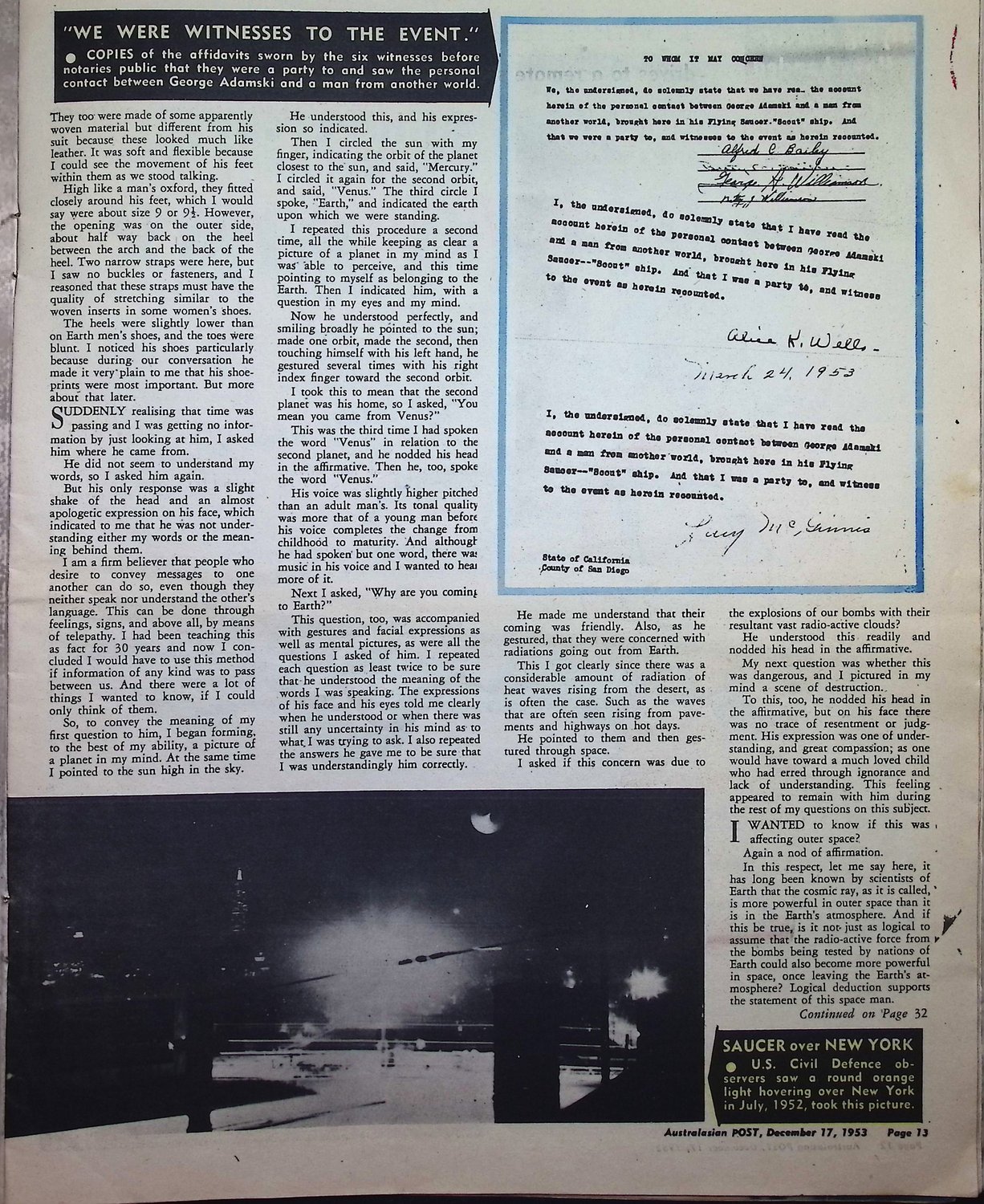
Flying Saucers Have Landed, by Desmond Leslie and George Adamski, was published in London by T. Werner Laurie in 1953 and ran through six impressions by December that year. Leslie, an Irish writer and former RAF pilot, contributed a historical survey; Adamski supplied the first-person Desert Center account. The book sold more than 200,000 copies by 1960 and carried the contactee narrative around the world.
The Account in Print
The Desert Center account reached readers less through specialist journals than through the popular press. In December 1953, the Melbourne weekly Australasian Post serialised Flying Saucers Have Landed across six pages, billing it on the cover and packaging it with a commissioned colour illustration, a photograph of a luminous object over New York, and the reproduced affidavits. It was one of the primary channels through which the contactee narrative entered Australian public consciousness.
The archive holds the Australasian Post's six-page serialisation as a documentary record of how this account was packaged for a mass readership. Read the breakdown: Flying Saucers Have Landed: The Australasian Post Serialisation, 1953.
The United States country profile covers the military and intelligence framework of the period, from Project Blue Book to the Robertson Panel of January 1953. The Australian country profile documents the response where this serialisation reached newsstands, including the RAAF investigation and Edgar Jarrold's Australian Flying Saucer Bureau. The IFSB's Space Review was publishing from Connecticut at the same moment, documenting the Mojave Desert sighting wave from a different vantage point.