Buzz Aldrin
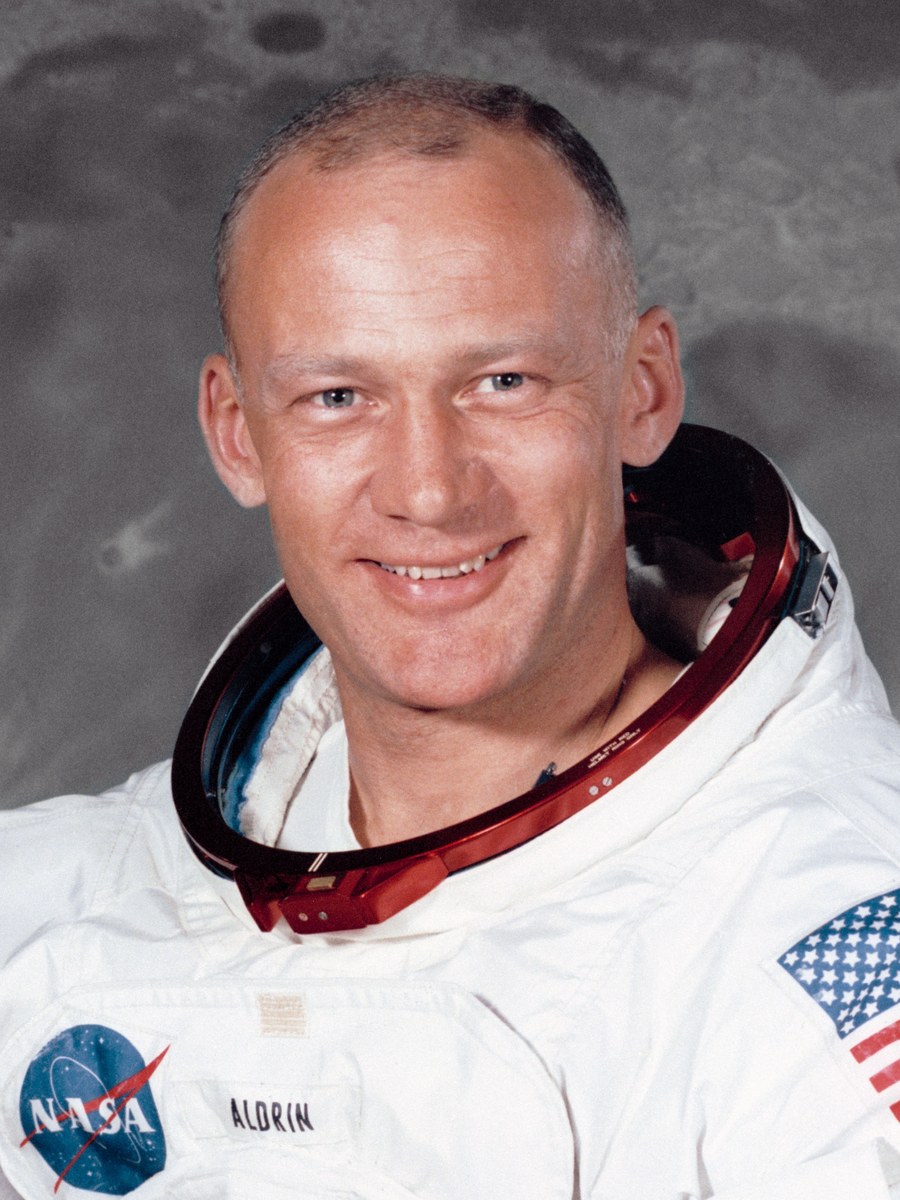
Edwin Eugene Aldrin Jr., known throughout his Air Force and NASA career and across his subsequent public life as Buzz, was the Lunar Module Pilot of Apollo 11 and the second human to walk on the Moon on 20 July 1969. The childhood nickname stuck (his elder sister Fay Ann mispronounced 'brother' as 'buzzer' before he was old enough to remember; the family shortened it to Buzz; he legally adopted Buzz Aldrin as his given name in 1988). He graduated third in the West Point class of 1951, flew sixty-six F-86 Sabre combat missions in Korea, took a doctorate in astronautics from MIT in 1963 on a thesis on orbital rendezvous techniques that NASA used directly in the Gemini and Apollo programmes, walked in space for five and a half hours on Gemini 12 in November 1966, and walked on the lunar surface for two hours and thirty-one minutes on the night of 20 to 21 July 1969 Eastern Standard Time. The in-flight luminous-object observation Apollo 11 reported on the second day of the lunar transit, sometimes circulated in the postwar civilian-research literature as a UFO encounter, Aldrin has consistently attributed across more than five decades of interviews to one of the four Saturn V S-IVB stage spacecraft-lunar-module-adapter panels that separated during trans-lunar injection.
A Life
Edwin Eugene Aldrin Jr. was born on 20 January 1930 in Montclair, New Jersey, the third child and only son of Marion (Moon) and Colonel Edwin Eugene Aldrin Sr. His father had been a pioneer of American military aviation, a student of Robert Goddard, a colleague of Orville Wright and a Theodore Roosevelt aviator at the time of the First World War; his mother's maiden name was Moon, a coincidence the family found amusing and the press subsequently found irresistible. The nickname Buzz came from his elder sister Fay Ann who as a small child could not say "brother" and substituted "buzzer." The household shortened the name to Buzz and it stayed.
He went through Montclair High School, won an appointment to the United States Military Academy at West Point on a senatorial recommendation, and graduated third in the class of 1951 with a Bachelor of Science in mechanical engineering. He took his commission in the United States Air Force and went immediately to pilot training. The Korean War was on. Aldrin flew sixty-six combat missions in the F-86 Sabre as a member of the 51st Fighter-Interceptor Wing, shot down two MiG-15s and received the Distinguished Flying Cross. He returned to the United States in 1953 and spent the second half of the decade in Air Force test-pilot, instructor and air-defence postings including a tour at Bitburg Air Base in West Germany.
The route to the astronaut corps went through MIT. Aldrin entered the Massachusetts Institute of Technology in 1959 to read for a doctorate in astronautics. His thesis, completed in January 1963, was titled "Line-of-Sight Guidance Techniques for Manned Orbital Rendezvous" and developed the orbital-mechanics framework for the rendezvous problem the Gemini and Apollo programmes would have to solve. The thesis dedication was "to the men in the astronaut programme: oh that I were one of them." Within weeks of his thesis defence Aldrin was named to NASA Astronaut Group 3 (October 1963) along with thirteen others including Roger Chaffee, Ted Freeman, Charlie Bassett, Eugene Cernan, Michael Collins and Donn Eisele.
Gemini 12 in November 1966 was Aldrin's first spaceflight. He flew with Jim Lovell on a four-day mission and conducted a five-and-a-half-hour extravehicular activity that demonstrated, for the first time on the American programme, that an astronaut could work productively outside the spacecraft without the exhaustion and overheating problems that had plagued earlier Gemini EVAs. The work-rest cycle, the foot restraints, the body positioning and the task pacing Aldrin developed on Gemini 12 became the standard procedures used on all subsequent Apollo and Skylab EVAs. The 1966 work was the methodological proof of concept that EVA in deep space and on the lunar surface was viable.
Apollo 11 launched from Pad 39A at the Kennedy Space Center at 13:32 UTC on 16 July 1969 with Neil Armstrong as Commander, Aldrin as Lunar Module Pilot, and Michael Collins as Command Module Pilot. Armstrong and Aldrin landed the Lunar Module Eagle in the Sea of Tranquillity at 20:17 UTC on 20 July 1969. Armstrong stepped onto the lunar surface at 02:56 UTC on 21 July. Aldrin followed nineteen minutes later. They spent two hours and thirty-one minutes outside the Lunar Module deploying experiments, collecting samples and photographing the landing site. They returned to lunar orbit, rendezvoused with Collins in the Command Module Columbia, and splashed down in the Pacific on 24 July 1969. The mission was the substantial public event of the second half of the twentieth century.
The post-Apollo period was difficult. Aldrin has written extensively across multiple books about the depression and alcoholism that followed his return from the Moon, the failure of his first marriage, and the slow process of his recovery across the 1970s and into the 1980s. Return to Earth (1973) is the principal contemporaneous account. He resigned from NASA in 1971, retired from the Air Force in 1972 with the rank of Colonel, and has spent the subsequent five decades as an author, public-speaking veteran of the Apollo programme, advocate for human Mars exploration, and the most-photographed survivor of the moonwalking era. He lives in Florida. He has been married three times. He published Magnificent Desolation: The Long Journey Home from the Moon in 2009 and No Dream Is Too High in 2016.
There was something out there that was close enough to be observed, and what could it be?Aldrin, Science Channel interview, 2005, on the Apollo 11 second-day observation
Photographs
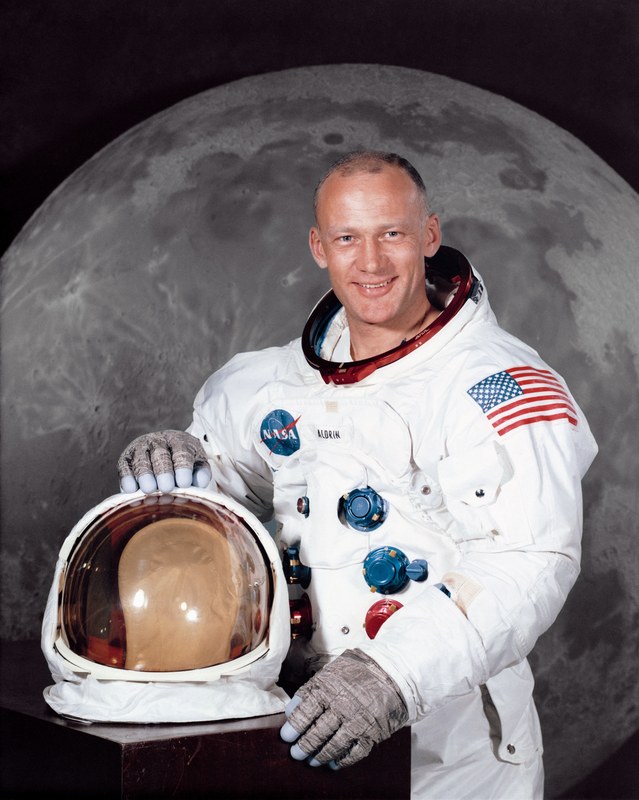
Aldrin was photographed extensively by NASA throughout the Gemini and Apollo programmes. The official Apollo 11 portraits, the lunar surface photography (including the iconic Armstrong-taken Aldrin-on-the-Moon image AS11-40-5903, which is the most-reproduced photograph in the history of the Apollo programme), the post-mission press coverage, the White House and parade photography, and the subsequent five decades of speaking-engagement and public-appearance photography together make Aldrin one of the most photographed astronauts in NASA history.
The Apollo 11 Second-Day Observation
On the second day of the Apollo 11 trans-lunar coast, on 17 or 18 July 1969 (the precise time within the coast window is variously given), the crew observed a luminous object outside the Command Module Columbia that appeared to be travelling on a path parallel to their own. The observation is recorded in the Apollo 11 mission transcript and was reported by the crew to Mission Control in Houston. The crew did not, on the available record, suggest at the time of observation that the object was of extraterrestrial origin. They asked Mission Control to confirm the location of the Saturn V S-IVB stage that had performed the trans-lunar injection burn and had subsequently been jettisoned. Mission Control reported the S-IVB to be approximately six thousand miles away. The observation was not pursued further during the mission.
The observation has subsequently been circulated in some sections of the postwar civilian-research literature as a possible UFO encounter on the Apollo 11 lunar transit. Aldrin has addressed the question repeatedly across the five decades since the mission, in print, in television interviews, in radio appearances and in his own books. His consistent position, restated in the Science Channel interview of 2005, in interviews with Larry King and on the BBC, and in his 2009 memoir Magnificent Desolation, has been that the most likely explanation for the second-day observation was one of the four S-IVB Spacecraft-Lunar-Module-Adapter (SLA) panels that had separated during trans-lunar injection. The four SLA panels, each approximately five and a half metres wide, would have been the largest fragments of the launch hardware travelling on roughly the same trajectory as the spacecraft itself for some hours after the burn. Their reflectivity, their proximity, and their unfamiliar shape (as seen through the spacecraft's optical instruments at uncertain range) account, in Aldrin's reading, for the luminous and possibly oscillating appearance the crew observed.
Aldrin has been consistent on three further points across the period. He has not claimed the observation as evidence of extraterrestrial contact. He has not asserted certainty about the S-IVB SLA panel attribution; he has stated it as the most probable explanation but has been clear that the object was not formally identified at the time. He has remained open, in interviews on the wider question, about the possibility of extraterrestrial intelligence in the universe and has engaged the question constructively, but has consistently distinguished between his own Apollo 11 mission observation (which he treats as conventional spacecraft hardware) and the wider astrobiological and SETI questions (which he treats as live scientific questions).
The Apollo 11 second-day observation has been circulated in some sections of the postwar civilian-research literature in framings that Aldrin himself has not endorsed and that the available Apollo 11 mission record does not support. The substantive position Aldrin has stated across more than five decades of interviews and across multiple published books is that the most probable explanation for the observation is conventional Saturn V launch hardware. Anyone working from the second-day observation should cite Aldrin's own published statements as the primary source for what Aldrin reported, what he subsequently concluded, and what he has consistently declined to claim, rather than the inherited civilian-research framings that have circulated the observation independently of Aldrin's own account.
Post-NASA and the Mars Advocacy
Aldrin's substantial post-NASA contribution to the wider American space-policy debate has been the advocacy for human Mars exploration and the development of the orbital-mechanics framework he calls the Aldrin Mars Cycler. The Cycler concept, developed in technical papers across the late 1980s and 1990s, specifies a class of orbits between Earth and Mars on which a permanently crewed transit station could provide regular service to and from Mars without the energy expenditure of independent launches. The Aldrin Cycler papers are held in the AIAA conference proceedings and have been the basis for subsequent NASA and SpaceX architectural studies of human Mars missions.
Aldrin has been a recurring public-speaking figure at the principal American space-advocacy events across the five decades since Apollo 11, has appeared in numerous documentaries on the Apollo programme and the wider space-exploration question, and has been a sustained advocate for the position that the next substantial human space programme should be the human exploration and eventual settlement of Mars. He has not been a substantial public-speaking figure on the wider UFO question. His engagement with that question has been the consistent attribution of the Apollo 11 second-day observation to conventional launch hardware and the consistent openness to the wider astrobiological question.
The Sibrel Incident, September 2002
On 9 September 2002, at the Luxe Hotel on Rodeo Drive in Beverly Hills, California, the documentary filmmaker Bart Sibrel approached Aldrin in the lobby with a Bible and demanded that Aldrin swear on the Bible that he had walked on the Moon. Sibrel was a long-standing proponent of the moon-landing-hoax position and had been pursuing Apollo astronauts for similar confrontations across the preceding period. The encounter became confrontational. Aldrin, then aged seventy-two, struck Sibrel once in the face. Sibrel filed assault charges with the Beverly Hills Police Department; the District Attorney's office declined to prosecute on the basis of the available video record and the determination that Sibrel had been the aggressor.
The incident has been cited subsequently in two distinct contexts: as evidence of the persistence of the moon-landing-hoax tradition in American conspiracy culture, and as evidence of the steadfastness of the Apollo astronauts in their defence of their mission record. The incident is one of the most-circulated single events in Aldrin's post-NASA public career.
Connected People
American naval aviator and test pilot (1930 to 2012), Commander of Apollo 11, first human to set foot on the lunar surface on 21 July 1969. Aldrin's commander on the mission. Armstrong was the more reserved public figure of the two and gave substantially fewer post-mission interviews than Aldrin did across the subsequent four decades. Died of cardiovascular complications in August 2012.
American test pilot and Apollo 11 Command Module Pilot (1930 to 2021) who remained in lunar orbit aboard Columbia while Armstrong and Aldrin worked the surface. Director of the Smithsonian National Air and Space Museum 1971 to 1978. Author of Carrying the Fire (1974), one of the principal astronaut memoirs of the Apollo era. Died of cancer in April 2021.
United States Army Air Corps officer and pioneer aviator (1896 to 1974). Student of Robert Goddard, colleague of Orville Wright, founding member of the early American aviation establishment. Married Marion Moon. The father whose institutional connections facilitated his son's entry to West Point and whose long aviation career formed the family backdrop to the son's astronaut career.
United States Navy test pilot and astronaut (b. 1928), Gemini 12 Commander on the November 1966 mission on which Aldrin conducted his five-and-a-half-hour spacewalk. Subsequently Commander of Apollo 13 in April 1970, the famous near-loss mission. Author of Lost Moon (1994), which became the basis for Ron Howard's 1995 film Apollo 13.
American engineer (1901 to 1987), founder of the MIT Instrumentation Laboratory (later renamed the Draper Laboratory) which designed the Apollo guidance and navigation system. Supervised Aldrin's doctoral work on orbital rendezvous techniques. The institutional connection between Aldrin's MIT thesis and the operational Apollo programme was substantial.
American filmmaker who has produced a body of work asserting that the Apollo lunar landings were staged. Confronted Aldrin in Beverly Hills on 9 September 2002 in the incident described above. Has subsequently confronted other surviving Apollo astronauts in similar encounters. The wider moon-landing-hoax tradition Sibrel represents has been the subject of extensive technical refutation across the astronomical and engineering literature.
United States Navy test pilot and astronaut (1930 to 2016) who walked on the Moon on Apollo 14 in February 1971. The Apollo astronaut whose post-NASA public engagement with the extraterrestrial question was the most direct, including specific Roswell-era claims that placed him at the substantively assertive end of the astronaut-disclosure register, where Aldrin's own engagement has been more measured.
In the Archive
Aldrin appears across three sections of the archive. The Apollo 11 mission record and the wider Apollo programme documentation runs through the NASA technical reports, the Apollo 11 Preliminary Science Report, and the Lunar and Planetary Institute photographic archive. The astronaut-disclosure register, in which Aldrin's measured engagement contrasts with the more direct statements of Edgar Mitchell, Gordon Cooper and Al Worden, is documented through the archive's wider astronaut-disclosure coverage. The Apollo 11 second-day observation, sometimes circulated in the postwar civilian-research literature, is held in the archive as documentary record of Aldrin's own consistent attribution to conventional Saturn V launch hardware.
Aldrin's Apollo career sits inside the wider space-race history documented through the archive's Space Race longform and the connected NASA-era posts. The astronaut-disclosure register including the Mitchell, Cooper and Worden parallel statements is documented through the archive's astronaut-disclosure page and through the connected biographies of Al Worden and (when built) Edgar Mitchell and Gordon Cooper.
Sources
Aldrin, Buzz and Wayne Warga. Return to Earth, Random House, 1973. Aldrin, Buzz and Ken Abraham. Magnificent Desolation: The Long Journey Home from the Moon, Harmony Books, 2009. Aldrin, Buzz and Marianne Dyson. No Dream Is Too High, National Geographic, 2016. Aldrin, Buzz. Mission to Mars: My Vision for Space Exploration, National Geographic, 2013. Aldrin, Edwin E. Jr. "Line-of-Sight Guidance Techniques for Manned Orbital Rendezvous," ScD thesis, Massachusetts Institute of Technology, January 1963. NASA. Apollo 11 Mission Report (MR-69-69), November 1969. NASA. Apollo 11 Preliminary Science Report (NASA SP-214), 1969. Lunar and Planetary Institute, Apollo 11 photographic archive, lpi.usra.edu/resources/apollo/. Aldrin interviews on the Apollo 11 second-day observation: Science Channel interview, 2005; Larry King Live, CNN, multiple appearances; BBC, multiple appearances. Sibrel incident: Beverly Hills Police Department incident report, 9 September 2002; District Attorney's office declination, September 2002. Collins, Michael. Carrying the Fire, Farrar Straus and Giroux, 1974, for the parallel Apollo 11 crew account.