J. Allen Hynek
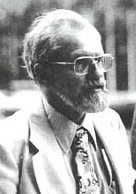
Josef Allen Hynek was the working astrophysicist who served as scientific consultant to the United States Air Force UFO programmes for twenty-one years across Project Sign, Project Grudge, and Project Blue Book. He began the assignment in 1948 as a sceptic. By 1973, when he founded the Center for UFO Studies in Evanston, he had become the discipline's most consequential institutional advocate for sustained scientific inquiry. His Close Encounters classification system entered both the academic literature and, through Steven Spielberg's 1977 film, the popular vocabulary.
A Life
Josef Allen Hynek was born on 1 May 1910 in Chicago, Illinois. He enrolled at the University of Chicago, completed a Bachelor of Science in 1931, and earned his doctorate in astrophysics in 1935 at the university's Yerkes Observatory in Williams Bay, Wisconsin, under the supervision of Otto Struve and William Wilson Morgan. His doctoral research focused on stellar spectroscopy.
Hynek joined the astronomy department at Ohio State University in 1936, where he advanced from instructor to professor over two decades. Throughout the 1950s he wrote "Scanning the Skies," a weekly astronomy column for the Columbus Dispatch. He took a leave of absence in 1956 to work at the Harvard-Smithsonian Astrophysical Observatory, and in 1959 accepted an appointment at Northwestern University in Evanston, Illinois. He became chairman of the astronomy department in 1960 and held the position until his retirement in 1978.
Hynek died of a brain tumour on 27 April 1986 at Memorial Hospital in Scottsdale, Arizona, aged 75. Obituaries appeared in the New York Times, the Chicago Tribune, the Los Angeles Times, Time, and Newsweek. His wife Miriam Curtis Hynek donated his papers to the Northwestern University Archives in 1992, where they are held as the J. Allen Hynek Papers: fourteen boxes of correspondence, case files, and research materials spanning 1953 to 1988.
On UAP
The United States Air Force recruited Hynek as a scientific consultant to Project Sign in 1948, the service's first formal investigation of reported unidentified flying objects. His assignment was narrow: review sighting reports and identify astronomical explanations for them. He was a working astrophysicist, not an advocate, and he began the work as a sceptic who considered the reports a public nuisance. He continued in a minimal role through Project Grudge and, from 1952, served as scientific consultant to Project Blue Book until the programme's closure in 1969. The consulting relationship lasted twenty-one years across three successive programmes. Hynek reviewed thousands of sighting reports, interviewed witnesses across the country, and provided the Air Force with astronomical and atmospheric assessments.
The event that damaged Hynek's public standing and catalysed his private reassessment occurred in March 1966 in Michigan. Residents near Dexter reported a large object with pulsating red and green lights near a farmhouse on 20 March. A second cluster of sightings occurred the following night at Hillsdale College, sixty miles to the southwest. The Air Force dispatched Hynek to investigate. At a press conference in Ann Arbor on 25 March he attributed the sightings to swamp gas, the spontaneous ignition of marsh gases released from decaying vegetation during the spring thaw. The explanation was ridiculed in the press and in Congress. Representative Gerald Ford, whose Michigan district included witnesses, called for a congressional inquiry. The Air Force responded by commissioning the University of Colorado's Condon Committee in late 1966 to conduct a two-year independent study. The episode, by Hynek's own later account, compelled him to reconsider the cases he had spent two decades setting aside.
A dismal swamp is a most unlikely place for a visit from outer space.J. Allen Hynek, press conference, Ann Arbor, Michigan, 25 March 1966. Reported in Lara Zielin, "Flying Saucers and Swamp Gas," Bentley Historical Library Magazine, University of Michigan.
The UFO Experience: A Scientific Inquiry (Henry Regnery, 1972) was the product of that reconsideration. In it, Hynek introduced the Close Encounters classification system: Close Encounters of the First Kind (visual sighting at close range), the Second Kind (physical effects on the environment or the observer), and the Third Kind (observation of occupants or entities associated with the object). He argued that after two decades of consulting work and hundreds of personal investigations, a residue of cases resisted all conventional explanation and warranted sustained scientific inquiry rather than institutional dismissal. The classification gave the field a common descriptive language it had lacked.
In 1973 Hynek founded the Center for UFO Studies (CUFOS) in Evanston as a clearinghouse for civilian sighting reports and a base for systematic research outside the Air Force's institutional constraints. Northwestern University was uncomfortable with the association; university officials were anxious, as the archival record notes, that the Centre "not be identified as a Northwestern project." Hynek published The Edge of Reality: A Progress Report on Unidentified Flying Objects with Jacques Vallée in 1975 and The Hynek UFO Report through Dell in 1977. A final book, Night Siege: The Hudson Valley UFO Sightings, co-authored with Philip J. Imbrogno and Bob Pratt, was published by Ballantine in 1987, the year after his death.
Steven Spielberg drew the title and taxonomy of Close Encounters of the Third Kind (1977) directly from Hynek's classification system. Hynek appears in the film's final sequence at the Devil's Tower landing site, a grey-haired man in glasses and a pipe, observing the disembarkation from the mothership.
Career Record
- 1910, Born 1 May, Chicago, Illinois.
- 1931, University of Chicago. Bachelor of Science.
- 1935, University of Chicago, Yerkes Observatory. Doctor of Philosophy in astrophysics. Advisors Otto Struve and William Wilson Morgan.
- 1936, Joined Ohio State University astronomy department.
- 1948, Appointed scientific consultant to Project Sign, United States Air Force.
- 1949, Continued as consultant under Project Grudge (minimal role).
- 1952 to 1969, Scientific consultant to Project Blue Book, United States Air Force.
- 1953 to 1959, Wrote "Scanning the Skies" column for the Columbus Dispatch.
- 1956 to 1960, Leave of absence at Harvard-Smithsonian Astrophysical Observatory.
- 1959, Appointed to Northwestern University, Evanston, Illinois.
- 1960, Chairman of the Northwestern University astronomy department.
- 1966, Michigan "swamp gas" press conference, 25 March.
- 1972, Published The UFO Experience: A Scientific Inquiry (Henry Regnery). Introduced the Close Encounters classification system.
- 1973, Founded the Center for UFO Studies (CUFOS), Evanston, Illinois.
- 1975, Published The Edge of Reality with Jacques Vallée (Henry Regnery).
- 1977, Published The Hynek UFO Report (Dell). Steven Spielberg released Close Encounters of the Third Kind, drawing title and taxonomy from Hynek's system. Hynek appeared in the film.
- 1978, Retired from Northwestern University chairmanship. Addressed the United Nations General Assembly Special Political Committee, 27 November.
- 1986, Died 27 April, Memorial Hospital, Scottsdale, Arizona.
- 1987, Night Siege: The Hudson Valley UFO Sightings, with Philip J. Imbrogno and Bob Pratt, published posthumously (Ballantine).
Notable Public Statements
"I confess much pleasure in providing discomfiture to such groups or to misguided and excitable UFO report generators... But the 237 original Project Sign reports were not convincing and did not support 'visitors from space.'" The UFO Experience: A Scientific Inquiry (Chicago: Henry Regnery, 1972), Chapter 1.
"I cannot presume to describe, however, what UFOs are because I don't know; but I can establish beyond reasonable doubt that they are not all misperceptions or hoaxes." The UFO Experience: A Scientific Inquiry (Chicago: Henry Regnery, 1972), Preface.
"Mr. Chairman, I have not always held the opinion that UFOs were worthy of serious scientific study. I began my work as Scientific Consultant to the U.S. Air Force as an open skeptic, in the firm belief that we were dealing with a mental aberration and a public nuisance. Only in the face of stubborn facts and data similar to those studied by the French commission... have I been forced to change my opinion." Address to the United Nations General Assembly Special Political Committee, 27 November 1978.
Document Trail
Hynek's four published books constitute his primary documentary contribution. The UFO Experience (1972) and The Hynek UFO Report (1977) are the most substantial treatments of his twenty-one years of consulting work.
The J. Allen Hynek Papers are held at the Northwestern University Archives in Evanston, Illinois (identifier 11/3/5/6). The collection spans fourteen boxes and covers the period from 1953 to 1988. The finding aid is publicly accessible at the Northwestern University Library website. Materials were donated by Miriam Curtis Hynek in 1992.
The Bentley Historical Library at the University of Michigan holds primary documentation of the March 1966 Michigan sightings and the swamp gas press conference. Project Blue Book case files, including reports reviewed by Hynek, are held at the National Archives and Records Administration. The programme generated over twelve thousand case files between 1952 and 1969.
In the Archive
- APRO Bulletin Collection, 258 issues, 1952 to 1988. APRO and CUFOS operated as parallel civilian research organisations during the 1970s and 1980s.
- Socorro Landing, the 1964 Lonnie Zamora case Hynek investigated for Project Blue Book as Case 8766.
- United States country profile.
- United States Disclosure Timeline, Project Blue Book in the broader disclosure context.