Jules Verne
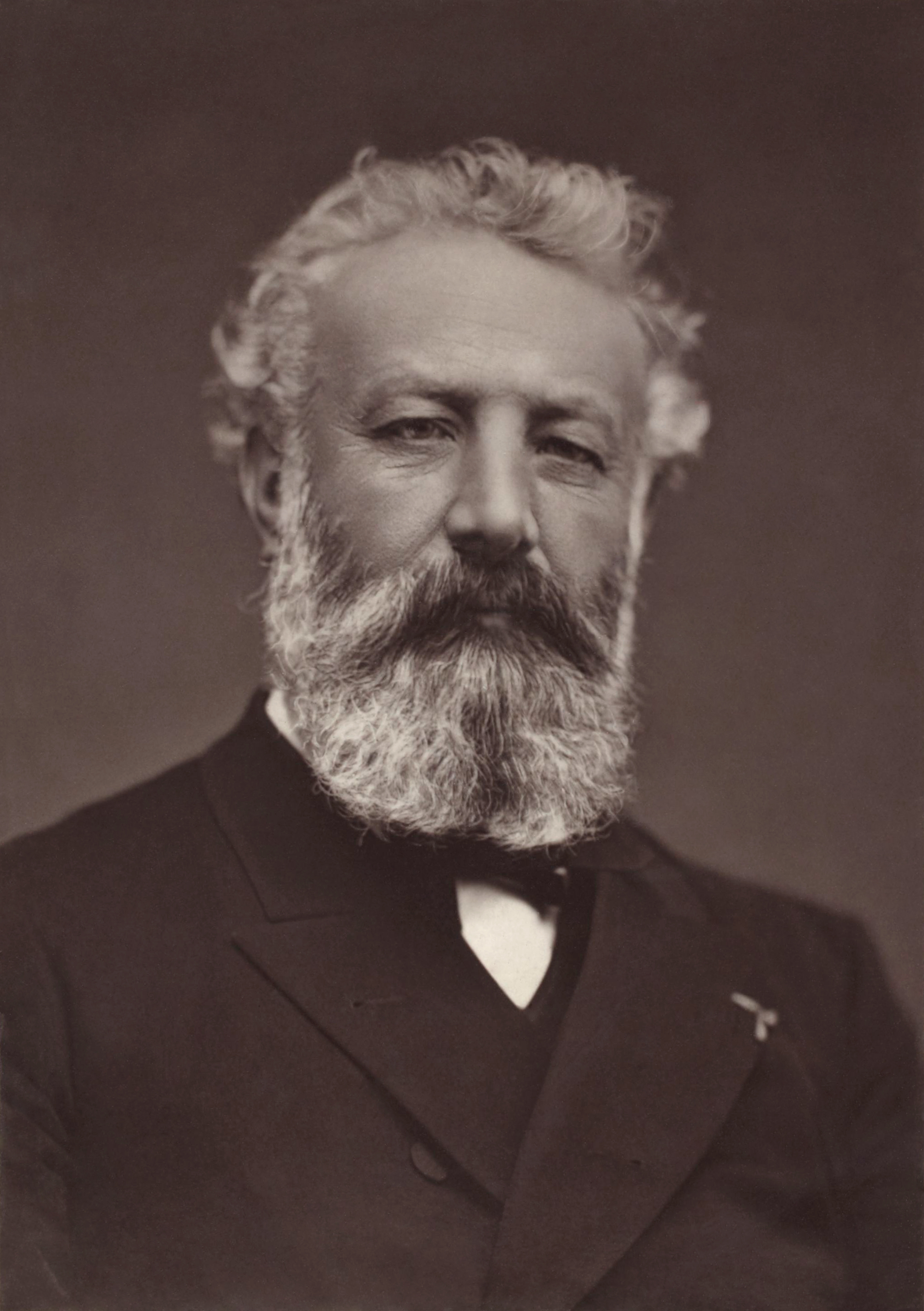
Verne wrote sixty-two novels for the Voyages Extraordinaires across fifty-four years. Five Weeks in a Balloon (1863) opened the series and made his name overnight. Journey to the Centre of the Earth (1864) took the hollow-Earth tradition out of Symmes and Poe and put it on the bestseller list. From the Earth to the Moon (1865) is a lunar-gun launch calculation good enough that Konstantin Tsiolkovsky adapted the figures into the rocket equation thirty years later. Twenty Thousand Leagues Under the Sea (1870) gave us Captain Nemo and the Nautilus. Robur the Conqueror (1886) put a heavier-than-air dirigible called the Albatross into the popular imagination ten years before the November 1896 American mystery-airship wave began at Sacramento with witnesses describing an aerial engineer at the helm. He died at Amiens on 24 March 1905, age seventy-seven.
A Life
Verne was born on 8 February 1828 at the Île Feydeau in Nantes, the eldest of the five children of Pierre Verne, a Nantes lawyer of Provençal extraction, and Sophie Allotte de la Fuÿe, daughter of a Nantes shipping family with maritime trading interests in the West Indies. The Île Feydeau location on the Loire put him close to the substantive Nantes maritime trade of the 1830s and the family had ship-owning connections through his mother's family that gave him sustained childhood exposure to ocean-going vessels and the men who worked them.
His father intended him for the legal profession and sent him to Paris in November 1848 to read for the Paris law degree. He took the law degree in 1851 but declined to enter the legal profession. He had met Alexandre Dumas père through a Parisian literary salon in 1849 and had begun writing for the theatre. His one-act comedy Les Pailles rompues was produced at the Théâtre Historique on 12 June 1850 under Dumas's patronage. He worked across the 1850s as secretary of the Théâtre Lyrique, as a stockbroker on the Paris Bourse from 1857 to 1862, and as the author of short stories and novellas published in the Musée des familles family weekly. He married Honorine de Viane Morel on 10 January 1857 at Paris; she was a widow with two daughters from her first marriage.
The substantive working career began on 23 October 1862 at the offices of the publisher Pierre-Jules Hetzel in Paris, when Verne presented the manuscript of Un voyage en l'air, an aeronautical novel of African exploration by hot-air balloon. Hetzel proposed substantial revisions, retitled the book Cinq semaines en ballon (Five Weeks in a Balloon), and published it in January 1863 as the opening volume of a contracted Verne series. The Hetzel-Verne contract of 1864 committed Verne to producing three volumes per year at twenty thousand francs per year and ran for the rest of Hetzel's life. The series acquired the collective title Voyages Extraordinaires from the third novel and ran through approximately sixty-two volumes across the fifty-four-year working period.
The Hetzel partnership shaped the substantive Verne output across the 1860s, 1870s and 1880s. Hetzel was an active editor who returned manuscripts for substantive revision, commissioned the illustrations from Édouard Riou, Léon Benett, Alphonse de Neuville and the other Hetzel-house artists, and oriented the series toward the substantive educational market of the French Second Empire and Third Republic. The Verne novels were principal birthday and prize-day gifts across the French educational system from the 1860s through to the First World War period.
Verne moved from Paris to Amiens in 1871, partly for the lower cost of provincial living and partly for proximity to the Crotoy estuary on the Channel coast where he kept the successive yachts Saint-Michel I, II and III across the 1868 to 1886 period. He served on the Amiens municipal council from 1888 as a Republican-supported candidate and held the seat through to 1905. He was shot in the leg on 9 March 1886 by his nephew Gaston Verne, who had developed acute paranoid delusions and believed Verne was preventing his marriage; Verne recovered from the wound but lost the use of his right leg and gave up the yachting that had been the substantive recreational habit of the prior twenty years.
The later Hetzel-house collaboration ended on 17 March 1886 with the death of Pierre-Jules Hetzel; Verne continued the series under Hetzel's son Louis-Jules Hetzel through to his own death. The substantive late-career Verne work of the 1890s and 1900s included the substantive sequel and posthumous-completion works that the Voyages Extraordinaires bibliography catalogues. He died at his Amiens house at 44 boulevard Longueville on 24 March 1905 of complications of diabetes, age seventy-seven. The substantive posthumous Verne literature was edited and completed by his son Michel Verne across the 1905 to 1919 period.
Anything one man can imagine, other men can make real.Jules Verne, conversation with R. H. Sherard, Amiens, January 1894, McClure's Magazine
From the Earth to the Moon
De la Terre à la Lune appeared serially in the Journal des débats from 14 September to 14 October 1865 and as a Hetzel volume in October 1865. The novel sets out the substantive lunar-gun launch calculation that the Baltimore Gun Club, a post-Civil-War American artillery society, undertakes from a substantive central-Florida launch site at "Stones Hill" near Tampa. The substantive engineering calculation Verne ran through with the assistance of his Polish-born mathematician cousin Henri Garcet of the Lycée Henri-IV gave the lunar-gun shot a velocity of 11.2 kilometres per second (the actual cosmic-escape velocity from Earth) and produced the substantive correct quantitative answer for the energy required.
The substantive influence on the early twentieth-century spaceflight engineering programmes is documented. Konstantin Tsiolkovsky, the Russian schoolteacher and founder of theoretical astronautics, wrote in his autobiographical sketch of 1932 that his substantive interest in spaceflight had been ignited at sixteen on first reading Verne's lunar-gun novel in Russian translation in 1873. The Tsiolkovsky rocket equation of 1903 was the substantive engineering response to the lunar-gun framework Verne had set out. Robert Goddard, the American rocket pioneer, wrote in his 1907 Worcester Tech autobiographical note that his substantive boyhood interest in rocketry had been formed by reading Verne and Wells together. The substantive Apollo programme reference to Verne is documented: the Apollo 11 launch site at Cape Canaveral is approximately one hundred miles east of Verne's "Stones Hill" location, and the substantive Apollo 8 Christmas-Eve broadcast of December 1968 carried Frank Borman's reference to "Jules Verne and his Columbiad gun." The Apollo 11 Command Module was named Columbia, the same name Verne had used in 1865.
Robur and the November 1896 American Mystery Airships
Robur le Conquérant appeared serially in the Journal des débats from 29 June to 18 August 1886 and as a Hetzel volume in August 1886. The novel introduces the engineer Robur and his heavier-than-air dirigible Albatross, a substantively-large mast-and-helicopter-rotor aerial vessel powered by electric batteries and capable of sustained transatlantic and transpacific flight. The novel was widely translated and entered the American press from the 1886 H. L. Williams English translation onwards as the substantive contemporary literary depiction of an advanced aerial vessel.
The substantive November 1896 to spring 1897 American mystery airship sighting wave began at Sacramento, California on 17 November 1896 with the first documented public sighting of a large illuminated aerial vessel at altitude, attributed by witnesses to an unknown inventor. The sighting wave ran across the Pacific coast through November and December 1896, crossed the Sierra Nevada through January 1897, ran across the Plains states through February and March 1897, and concluded at the Aurora, Texas crash report of 17 April 1897. The substantive sighting press coverage of the period frequently referenced Verne's Robur and the Albatross as the literary precedent witnesses drew on in describing what they were seeing. The November 1896 onwards American mystery airship wave is the first mass-press UAP sighting event in American history and the substantive precedent of the twentieth-century UAP literature the archive's collections document.
Maître du monde, the Robur sequel published posthumously in August 1904, introduces the "Terror" hovering and submerging vehicle that the substantive late-Verne corpus carried into the immediate pre-First-World-War period. The Verne hovering-vehicle imagery is substantively documented as the cultural-grammar precedent of the postwar UFO imagery the contactee literature inherited.
The substantive November 1896 onwards American mystery airship sighting wave is the documented first mass-press UAP event in American history. The Verne cultural-grammar precedent runs through the Robur 1886 novel, the Master of the World 1904 sequel, and the American press reception of the Voyages Extraordinaires across the 1870s and 1880s. The substantive twentieth-century spaceflight engineering programmes of Tsiolkovsky and Goddard documented their inheritance from Verne directly.
An Antarctic Mystery and the Verne-Poe Lineage
Le Sphinx des glaces appeared in two volumes from Hetzel in 1897, the same year as Borderland Quarterly closed and as H. G. Wells's The War of the Worlds was serialised in Pearson's Magazine. The Verne novel is the substantive sequel Verne wrote to Edgar Allan Poe's The Narrative of Arthur Gordon Pym of 1838. Verne had been a sustained reader of Poe across the 1850s in the Baudelaire French translations of the Poe tales (Baudelaire's translation of Pym appeared in 1857) and had published his own substantive critical essay on Poe in 1864.
The substantive Sphinx des glaces narrative reopens the Pym frame, sends an Anglo-French rescue expedition to the South Polar regions in search of Pym and Peters, and provides Verne's own resolution to the open-ended closing chapter of Poe's 1838 novel. The substantive Verne-Poe lineage is documented across the Verne corpus: Journey to the Centre of the Earth of 1864 inherits the Symmes-Pym hollow-Earth tradition, the substantive Voyages Extraordinaires use of the imaginary-voyage form inherits from the Pym narrative method, and the closing Verne sequel of 1897 is the explicit substantive textual completion of the Poe novel.
Photographs
Significance to the Archive
Verne matters to this archive for three specific reasons. First, the November 1896 onwards American mystery airship sighting wave is the documented first mass-press UAP event in American history, and the substantive cultural-grammar precedent witnesses drew on in describing what they were seeing was Verne's Robur le Conquérant of 1886 and its Albatross heavier-than-air dirigible. Second, the substantive early-twentieth-century spaceflight engineering programmes of Tsiolkovsky and Goddard documented their substantive inheritance from Verne's 1865 lunar-gun calculation. Third, the substantive Verne-Poe lineage through Le Sphinx des glaces of 1897 carries the Pym hollow-Earth tradition into the substantive late-nineteenth-century imaginative literature that fed forward into the postwar hollow-Earth and contactee material the archive's mid-twentieth-century collections document.
The substantive Verne 1897 publication year is the same year as the closing of Borderland Quarterly and the serialisation of H. G. Wells's The War of the Worlds, and the substantive Mars-life speculation that the Borderland Volume 4 Number 4 of October 1897 carried in its "News from Mars" article was the contemporary cultural moment Verne, Wells, and the Borderland editorial community were responding to simultaneously.