Edgar Allan Poe
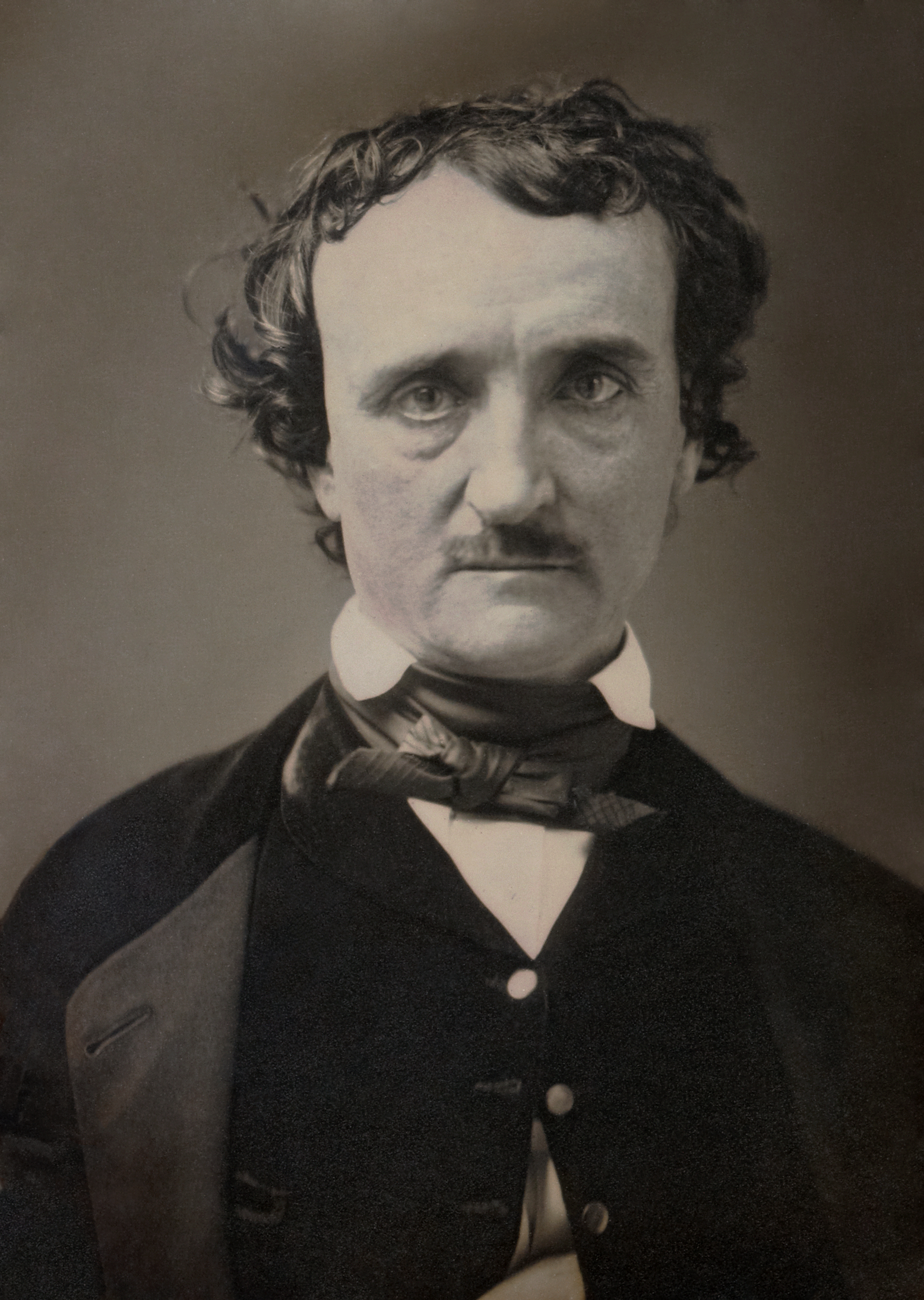
Poe wrote for twenty years and three of his works carried across into the archive's later material. The Narrative of Arthur Gordon Pym of Nantucket (1838) ends in white South Polar light at the opening to a hollow Earth, and the line from John Cleves Symmes Jr.'s 1818 polar-opening tract runs through Pym into H. P. Lovecraft, then into the postwar hollow-Earth literature and the Admiral Byrd Operation Highjump material. Mesmeric Revelation (1844) and The Facts in the Case of M. Valdemar (1845) are the American mesmeric fiction that turned up in the Borderland-period investigation literature five decades later as evidence for the practice they fictionalised. Eureka: A Prose Poem (1848) is the cosmological treatise he wrote in the year before his death. It posits a Big-Bang-like primal unity, the expansion and eventual collapse of the universe, and a finite speed of gravitational propagation, and it gives Olbers's dark-night-sky paradox its first published resolution. Charles Fort named Poe as his precursor.
A Life
Poe was born on 19 January 1809 at Boston, the second of the three children of David Poe Jr., an actor of Irish extraction from a Baltimore family, and Elizabeth Arnold Poe, an English-born actress of considerable reputation in the American provincial theatre. His father abandoned the family in 1810 and disappeared from the record. His mother died of tuberculosis at Richmond on 8 December 1811 when Poe was two years old. He was taken in by John Allan, a Richmond tobacco merchant of Scottish extraction, and Allan's wife Frances Keeling Allan. The Allans never formally adopted him, but Allan gave him his middle name and the schooling that produced the writer.
The Allan household moved to London from 1815 to 1820 for John Allan's tobacco business. Poe attended the Manor House School at Stoke Newington from 1818 to 1820, where the boarding-school setting subsequently entered "William Wilson" of 1839 as the substantive autobiographical element. The family returned to Richmond in 1820 and Poe completed his school education there. He entered the University of Virginia at Charlottesville in February 1826 as one of the first cohort of students, lasted ten months on Allan's inadequate allowance, accumulated gambling debts of approximately 2,500 dollars he could not pay, and was withdrawn from the University at Christmas 1826.
The Allan-Poe rupture that followed the Charlottesville debts was substantive. Poe left Richmond for Boston in March 1827, paid for the publication of Tamerlane and Other Poems at his own expense in May 1827 from a Boston printer, and enlisted in the United States Army at Fort Independence Boston Harbor on 26 May 1827 under the assumed name Edgar A. Perry. The military service ran from 1827 to 1829 at Fort Independence, Fort Moultrie Charleston, and Fortress Monroe Virginia, and produced the Sullivan's Island setting that subsequently entered "The Gold-Bug" of 1843. He bought out his Army enlistment in April 1829, briefly reconciled with Allan after Frances Allan's death the same year, and was admitted to the West Point Military Academy on 1 July 1830. He deliberately failed his West Point examinations in January 1831 to secure his court-martial discharge, having decided on a literary career.
The substantive published career began with Poems of 1831 (paid for in advance by his West Point classmates from the regimental pay) and the "MS. Found in a Bottle" prize tale of October 1833 in the Baltimore Saturday Visiter. He moved to Richmond in August 1835 as assistant editor of the Southern Literary Messenger under Thomas W. White, and married his thirteen-year-old first cousin Virginia Eliza Clemm on 16 May 1836 at Richmond. He held the Messenger editorship through to January 1837, the Burton's Gentleman's Magazine assistant editorship at Philadelphia from May 1839 to June 1840, the Graham's Magazine editorship from February 1841 to April 1842, the Evening Mirror editorship at New York from October 1844, and the Broadway Journal editorship from February 1845. He owned the Broadway Journal briefly during 1845 to 1846 in the only proprietary editorship of his career.
Virginia Poe died of tuberculosis at the Poe cottage at Fordham, New York, on 30 January 1847, after five years of consumptive illness from a January 1842 throat haemorrhage. Poe's last two years of life through 1847 to 1849 were the substantive Eureka period: the cosmological treatise was delivered as a lecture "On the Universe" at the New-York Society Library on 3 February 1848 and published in book form by Putnam in July 1848. He travelled to Richmond in July 1849 in apparent good health, was engaged to remarry his Richmond first-fiancée Sarah Elmira Royster Shelton, and set out from Richmond by steamer for Baltimore on 27 September 1849 en route to Philadelphia on an editorial-engagement journey.
He was found on the street outside the Gunner's Hall public house at Baltimore on 3 October 1849 in a state of acute delirium, wearing clothes that were not his own. He was admitted to the Washington College Hospital, where he died on 7 October 1849 without recovering coherent speech. The medical cause of death was certified as "phrenitis" (inflammation of the brain), and no autopsy was performed. The substantive medical-historical literature on the death has documented Cooper's-encephalitis, rabies, alcoholic delirium, and the cooping electoral-fraud hypothesis as candidate explanations across the century and a half since. He was forty.
I have no desire to live since I have done Eureka. I could accomplish nothing more.Edgar Allan Poe to Maria Clemm, July 1849, on the publication of Eureka
The Narrative of Arthur Gordon Pym
The Narrative of Arthur Gordon Pym of Nantucket was the only novel-length work Poe published. It appeared in serialised form in the Southern Literary Messenger of January and February 1837 and as a Harper Brothers book volume in July 1838. The narrative follows the Nantucket boy Arthur Gordon Pym through a series of substantive South Pacific and South Polar maritime catastrophes culminating in the polar approach and the famous unresolved closing chapter where the narrator and his companion Dirk Peters approach the South Pole in a canoe across a white ocean and encounter a "shrouded human figure, very far larger in its proportions than any dweller among men" with skin "of the perfect whiteness of the snow." The narrative ends mid-sentence at chapter twenty-five.
The substantive intellectual context of the closing chapter is the John Cleves Symmes Jr. hollow-Earth doctrine that the Ohio Army captain had been propagating across the United States since his 1818 Cincinnati circular announcing that the Earth was "hollow and habitable within" with substantial openings at the Poles. The 1828 to 1830 Reynolds-Symmes campaign for a United States naval expedition to the South Pole had been the substantive American political background to the South Polar imagination of the 1830s, and the United States Exploring Expedition under Charles Wilkes was being prepared at the time Poe was writing Pym. The closing chapter of Pym is the substantive American literary inheritance of the Symmes hollow-Earth doctrine into the imaginative tradition.
The Pym closing chapter ran forward through Jules Verne's An Antarctic Mystery of 1897 (which was Verne's sequel to Pym), through H. P. Lovecraft's At the Mountains of Madness of 1936 (which is the substantive Antarctic horror inheritance of Pym), and through the Admiral Richard E. Byrd Operation Highjump 1946-47 material that the archive's Byrd biography documents. The substantive postwar hollow-Earth tradition the archive's mid-twentieth-century collections carry runs forward from the Symmes-Pym Antarctic-opening framework.
Eureka
Eureka: A Prose Poem appeared in July 1848 from George Putnam at New York in a small print run of five hundred copies. Poe described it as "An Essay on the Material and Spiritual Universe" and inscribed it "with very profound respect" to the German naturalist Alexander von Humboldt, whose Cosmos volumes Poe had read closely in their 1845 to 1847 American translation. The treatise is approximately a hundred and forty printed pages in its first edition and is structured as a substantive single-trajectory cosmological argument.
The substantive claims Poe set out in Eureka include the proposition that the universe expanded from an initial primordial particle through a single creative act, that the substantive force holding the universe together is gravitational attraction balanced against an expansive repulsive force, that the universe will collapse back on itself through gravitational reversal once the expansive force is exhausted, that the cyclical expansion-and-collapse may repeat infinitely, that the apparent finite age of the universe explains the dark-sky paradox (the Olbers paradox of why the night sky is dark if the universe contains infinitely many stars), and that the substantive cosmological argument requires the universe to be considered as a single substantively-real entity in which the observer is constitutively involved.
The substantive correspondence of these claims with subsequent twentieth-century cosmology is documented across the literature. The dark-sky-paradox explanation by finite age of the universe matched the substantive 1929 Hubble redshift discovery of cosmic expansion and the 1948 Bondi-Gold and Hoyle steady-state-rejection arguments. The single-creative-act primordial-particle framework matched the 1927 Lemaitre primeval-atom hypothesis and the substantive 1948 Alpher-Bethe-Gamow Big Bang nucleosynthesis paper. The cyclical-collapse framework matched the substantive twentieth-century oscillating-universe cosmologies. The substantive observer-involved argument matched the twentieth-century anthropic-principle framework. The Eureka treatise has been recognised across the twentieth-century cosmological literature as the substantive American intellectual precedent of the cosmological revolution.
Poe's substantive precedents for the postwar American UAP and contactee literature run through three principal channels. The Pym Antarctic-opening framework runs forward through Symmes to the Byrd-period hollow-Earth material the archive's Byrd biography documents. The Eureka cosmological treatise runs forward into the substantive twentieth-century cosmological literature the archive's contactee-era material draws on. The Mesmeric Revelation and Valdemar mesmeric-fiction precedents run forward into the Borderland-period mesmeric and psychometric tradition the Borderland Quarterly carried.
Mesmerism and the Charles Fort Inheritance
The substantive mesmeric-fiction sequence Poe published across the 1844 to 1845 period included "A Tale of the Ragged Mountains" of April 1844 (the mesmeric-trance Indian-mutiny vision), "Mesmeric Revelation" of August 1844 (the deathbed mesmeric dialogue on the nature of God and matter), and "The Facts in the Case of M. Valdemar" of December 1845 (the mesmerised dying man held in trance across the moment of death). The three tales were widely read in the contemporary American and British mesmeric-investigation community and were the substantive American literary precedents of the Borderland-period mesmeric investigation Stead would carry across the 1893 to 1897 Borderland Quarterly run.
The Charles Fort inheritance is documentable through Fort's own published claims. Fort wrote in The Book of the Damned of 1919 that he had been a substantive admirer of Poe from his Albany boyhood and that the Fortean editorial position of cataloguing the anomalous phenomena the established sciences had excluded was the substantive inheritance of the Poe editorial sensibility. The Fortean tradition that the archive's Fortean Society Magazine collection carries forward into the postwar UAP literature runs through the Poe-Fort lineage.
Photographs
Significance to the Archive
Poe matters to this archive for three specific reasons. First, the 1838 Narrative of Arthur Gordon Pym is the substantive American literary inheritance of the Symmes hollow-Earth doctrine and the documented precedent of the postwar hollow-Earth tradition the archive's Byrd material runs into. Second, the 1848 Eureka cosmological treatise is the substantive American precedent of twentieth-century cosmology and one of the documented American sources the postwar speculative-cosmology literature drew on. Third, the 1844 to 1845 mesmeric-fiction sequence is the substantive American precedent of the Borderland-period mesmeric investigation tradition.
Poe is the documented American writer Charles Fort claimed as his immediate precursor, and the documentary lineage from Poe through Fort to the postwar American civilian-research community is one of the substantive American intellectual continuities the archive's pre-1947 reference layer runs through.