Terence McKenna
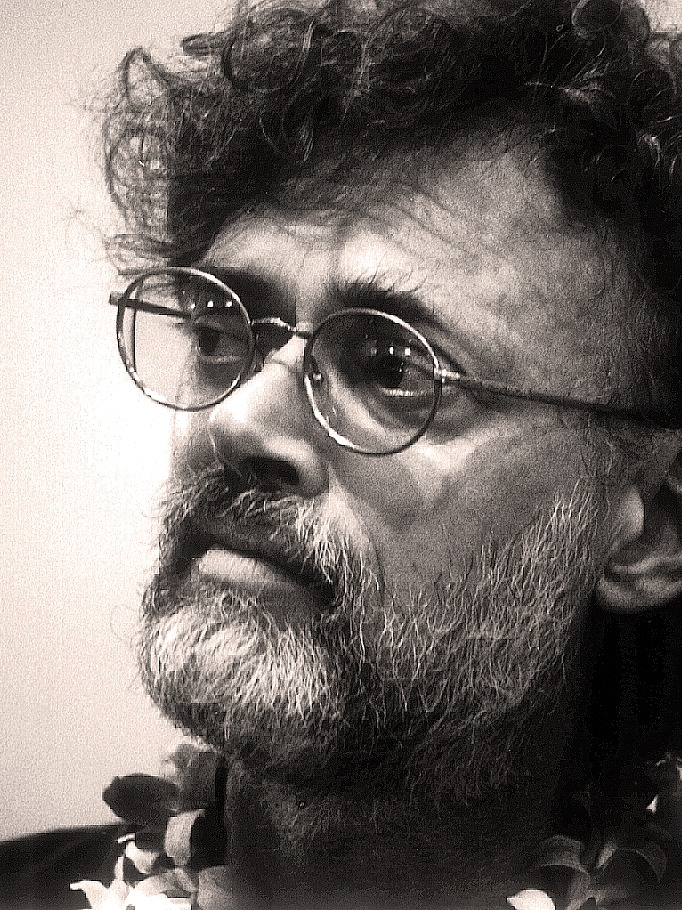
Terence McKenna occupies a position in this archive that is adjacent to, but distinct from, the UAP and contactee traditions. His subject was non-human intelligence, but the contact framework he proposed did not require physical interstellar craft. He argued that the Other can be encountered through consciousness, that the encounter has been catalogued for millennia in indigenous shamanic practice, and that the modern Western experience of unidentified intelligences (in DMT states, in folklore, in the UFO literature) sits in continuity with that older record. The position is on the public record in his published books between 1975 and 1993, in his lectures at Esalen and elsewhere preserved on audio, and in the trialogue conversations with Ralph Abraham and Rupert Sheldrake.
A Life
Terence Kemp McKenna was born on the night of 16 November 1946 in Paonia, a small town on the western slope of the Colorado Rockies. His father Joseph was a travelling salesman for Westinghouse; his mother Hazel was a schoolteacher. Dennis, his only sibling and the eventual scientific co-author of his first major book, was born in 1950. The family library held a 1954 Encyclopaedia Britannica that Terence began reading at eight and finished at thirteen. He left Paonia at sixteen to attend a boarding school in Los Altos, California.
He arrived at the University of California, Berkeley, in 1965. He completed his degree in 1969 through the Tussman Experimental College, a short-lived interdisciplinary programme, with a distributed major he called ecology, resource conservation, and shamanism. The undergraduate years brought him into contact with the published work on the Mexican mushroom traditions documented by R. Gordon Wasson, and the ethnographic literature on Amazonian ayahuasca that would direct his subsequent travels. He spent the years between 1969 and 1971 in Asia, principally in Nepal and Indonesia, before flying to South America in early 1971 with his brother Dennis and three companions.
The La Chorrera expedition, conducted in the Colombian Amazon between February and April 1971, was the formative event of his career. The brothers had travelled in search of a tryptamine snuff used by the Witoto, and instead encountered a large fruiting of Psilocybe cubensis growing in the cattle pastures around the mission village of La Chorrera. The experiences during the weeks that followed produced what Terence and Dennis later termed the experiment at La Chorrera, a sustained attempt to investigate the structural properties of consciousness through psilocybin and a hypothesised tryptamine-DNA interaction. The expedition formed the basis of their 1975 book The Invisible Landscape, written largely by Dennis as a doctoral-thesis-level text, and of Terence's 1993 personal memoir True Hallucinations.
He returned to California in late 1971, married Kathleen Harrison in 1976, and co-founded with her in 1985 the Botanical Dimensions ethnobotanical preserve in Captain Cook, Hawaii. Their two children were born in 1979 and 1982. Through the 1980s he supported himself by giving paid lectures, principally at the Esalen Institute on the Big Sur coast and at independent gatherings, where his recorded talks were taped, circulated, and eventually digitised. By the early 1990s the lecture circuit produced the income that allowed him to write Food of the Gods (Bantam, 1992), The Archaic Revival (HarperSanFrancisco, 1991), and True Hallucinations (HarperSanFrancisco, 1993) in close succession.
He was diagnosed with glioblastoma multiforme in May 1999 after a seizure at his home in Hawaii. He moved to California for treatment and died at the home of his brother in San Rafael, California, on 3 April 2000. He was fifty-three.
The Other can be approached and engaged. It is not a phantom. It speaks. The question that occupies the rest of my career is what to make of that.Lecture at the Esalen Institute, audio archive, late 1980s, paraphrased in The Archaic Revival, 1991
On Non-Human Intelligence
McKenna's framework for non-human intelligence is the part of his work that places him in this archive. He argued that the contact experience is not new, that it has been documented in indigenous shamanic traditions for at least three thousand years, and that the modern Western encounter with unidentified intelligences (in dimethyltryptamine states, in folklore, in the post-1947 UFO literature) sits in continuity with that older record. His position was that physical interstellar travel is one possible explanation for some of those encounters, but that it is the least parsimonious of the available frameworks, and that consciousness itself functions as a medium through which contact is possible. He developed the position across the 1980s lecture circuit and finalised it in The Archaic Revival (1991).
Within the DMT experience he reported a recurring class of entities he termed self-transforming machine elves. The description, repeated across his published lectures and in True Hallucinations, was of small jewelled beings who appeared to demonstrate impossible feats of linguistic and morphological invention, who appeared to be engaged in offering objects, and who appeared to be conscious of being observed. He stopped short of asserting their ontological status. His published framing was that the entities are encountered, that the encounter is structured, that the structure is consistent across reporters who have never met one another, and that the documentary record of similar encounters in folklore (fairy traditions, jinn, the Magonia material catalogued by Jacques Vallée) extends back through pre-industrial Europe and beyond.
His novelty theory, the mathematical model he derived from the King Wen sequence of the I Ching with his brother Dennis at La Chorrera, plotted what he called the ingression of novelty into time against a projected zero-novelty endpoint of 21 December 2012. The model was published in The Invisible Landscape (1975) and reissued with new introductions in 1993. The 2012 endpoint did not produce the predicted singularity. McKenna himself had treated the date as provisional. The model remains documented in his publications as his proposed framework, not as adjudicated science.
The stoned-ape hypothesis, advanced in Food of the Gods (1992), proposed that the inclusion of psilocybin-containing mushrooms in the late-Pleistocene hominid diet on the African savannah catalysed the cognitive transitions that produced linguistic and reflective consciousness. The hypothesis has been debated extensively in subsequent ethnobotanical and palaeoanthropological literature without empirical resolution, and the archive catalogues it as his published position rather than as established fact.
McKenna's contribution to the broader NHI conversation is the framework, not the specific theories. His proposition that the Other is encountered through consciousness as well as through aviation incidents, that the encounters share structural features across cultures and centuries, and that the modern documentary record extends a continuous tradition rather than beginning with Kenneth Arnold in 1947, runs parallel to the parallel framework Jacques Vallée developed in Passport to Magonia (1969) and to the psychiatric work John Mack conducted at Harvard from the late 1980s.
The Invisible Landscape (Seabury Press, 1975; HarperSanFrancisco, 1993, with Dennis McKenna). The Archaic Revival (HarperSanFrancisco, 1991). Food of the Gods (Bantam, 1992). True Hallucinations (HarperSanFrancisco, 1993). Trialogues at the Edge of the West (Bear and Company, 1992, with Ralph Abraham and Rupert Sheldrake). The Evolutionary Mind (Trialogue Press, 1998, posthumously expanded). Chaos, Creativity and Cosmic Consciousness (Park Street Press, 2001, posthumous).
Notable Public Statements
McKenna's lectures were recorded, circulated as cassette duplicates through the 1980s, digitised through the 1990s, and form the bulk of the public-record material referenced below. The published books contain edited transcriptions of substantial lecture material. Direct quotation here is preserved verbatim from the published editions.
On the consistency of the entity-encounter reports: "What is striking is not that one person reports it. What is striking is that the reports converge across people who have never spoken to each other, who do not share a vocabulary, who do not share a culture, and who are nonetheless describing something with similar internal structure." (The Archaic Revival, 1991, page 38.)
On the limits of the extraterrestrial framing: "The flying-saucer literature has spent forty years asking whether they came from another planet. It is the wrong question. The right question is what category of phenomenon is producing the encounters, and whether that category sits inside what we presently call physics or outside it. Both possibilities are open and the literature has been asked the wrong question." (Lecture, Esalen Institute, recorded April 1987, transcribed in The Archaic Revival.)
On novelty theory after 2012 had not delivered the predicted singularity: McKenna died in April 2000, twelve years before the predicted endpoint, and did not have the opportunity to revise his published position. His 1996 statements in interviews indicated that he treated the date as provisional and that the model itself was the contribution, not the specific endpoint. The Invisible Landscape carries those qualifications in its 1993 introduction.
Document Trail
The published-book record is held in major library collections internationally. The audio lecture archive is preserved by Lux Natura and by the Internet Archive, with additional unofficial transcriptions distributed across the web. Botanical Dimensions, the ethnobotanical preserve he co-founded with Kathleen Harrison in Hawaii in 1985, continues to operate and maintains an archive of his correspondence and lecture-tour records. Dennis McKenna, his brother and surviving co-author, has continued to publish in ethnopharmacology and maintains a public position on his and Terence's shared work; his 2012 memoir Brotherhood of the Screaming Abyss carries the most extensive biographical record from inside the family.
Press obituaries appeared in the San Francisco Chronicle on 5 April 2000, in Salon on 12 April 2000, in The Guardian on 11 April 2000, and in The Independent in London on 13 April 2000. A short Wired magazine obituary appeared in May 2000. None of the contemporary press coverage placed McKenna in the UFO-research lineage; the placement here is editorial and draws on his explicit alignment in The Archaic Revival with the comparative folklore framework Vallée developed in Passport to Magonia.
McKenna's framework runs parallel to Jacques Vallée's Magonia hypothesis and to the consciousness-based contact research John Mack conducted at Harvard Medical School from 1990 onwards. See also the archive's Contact and Abduction tradition pages for the broader documentary lineage in which McKenna's contribution sits.