Mars has been a target of robotic exploration since the early 1960s. As of 2026, multiple space agencies have sent orbiters, landers, and rovers to the planet, producing a substantial body of scientific data about its geology, atmosphere, and potential for past or present habitability.
Early Missions (1960s: 1970s)
The first successful Mars flyby was achieved by NASA’s Mariner 4 on July 15, 1965, which returned 22 close-up photographs of the Martian surface. Mariner 9 became the first spacecraft to orbit another planet in November 1971, mapping 85 percent of Mars’s surface and revealing features including Olympus Mons and Valles Marineris.
The Soviet Mars 3 lander achieved the first soft landing on Mars on December 2, 1971, though it transmitted for only 14.5 seconds before contact was lost. NASA’s Viking 1 and Viking 2, which arrived in 1976, were the first missions to successfully land on Mars and operate for extended periods. Viking 1 operated until November 1982.
Rover Era (1997: Present)
NASA’s Mars Pathfinder mission landed on July 4, 1997, deploying Sojourner, the first rover to operate on another planet. Subsequent rover missions expanded surface exploration:
- Spirit (2004, 2010): Landed in Gusev Crater. Operated for over six years, far exceeding its 90-day primary mission.
- Opportunity (2004, 2018): Landed in Meridiani Planum. Operated for nearly 15 years and travelled 45.16 kilometers, the longest distance driven by any off-Earth wheeled vehicle.
- Curiosity (2012, present): Landed in Gale Crater via the Sky Crane system. Confirmed that Mars once had conditions suitable for microbial life, including liquid water and organic molecules.
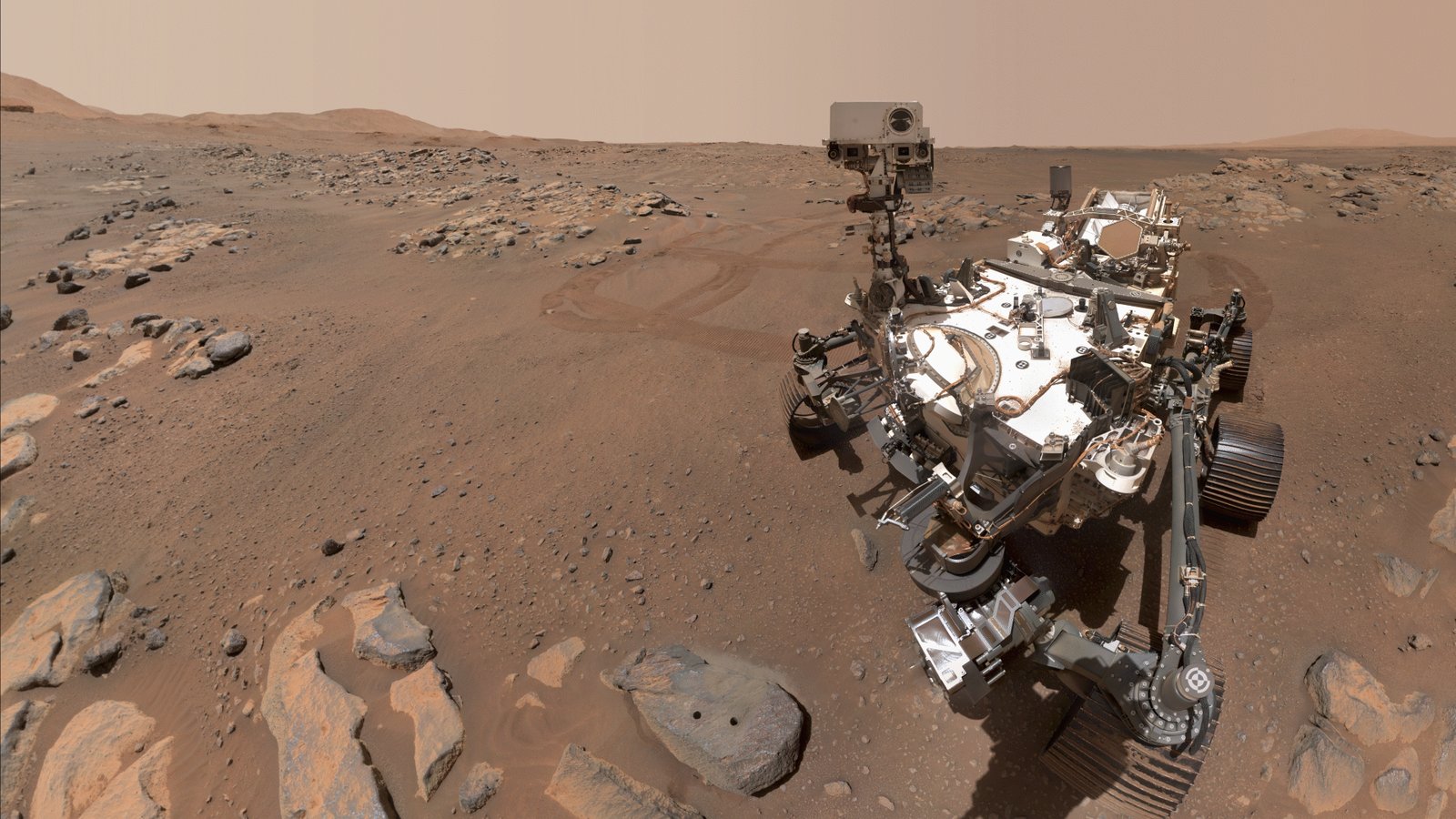
- Perseverance (2021, present): Landed in Jezero Crater, a former lake bed. Equipped with sample caching system for future sample return. Deployed Ingenuity, the first powered aircraft to fly on another planet, which completed 72 flights before its mission ended in January 2024.
International Missions
Mars exploration is not exclusively American. Notable international missions include ESA’s Mars Express orbiter (2003, present), India’s Mars Orbiter Mission (Mangalyaan, 2014, 2022), the UAE’s Hope orbiter (2021, present), and China’s Tianwen-1 mission (2021), which included the Zhurong rover that operated on the surface for approximately one year.
Mars Sample Return
NASA and ESA have been developing the Mars Sample Return campaign, designed to retrieve sample tubes cached by Perseverance and return them to Earth for laboratory analysis. The programme has undergone multiple redesigns due to cost and schedule challenges. As of 2026, the architecture remains under review.