The post office at 1712 Van Court
By the time the November 1957 issue of the APRO Bulletin reached its subscribers, the Aerial Phenomena Research Organisation had moved its headquarters from Sturgeon Bay, Wisconsin to Alamogordo, New Mexico. The masthead now read “1712 Van Court, Alamogordo, New Mexico.” The address was approximately three miles from Holloman Air Force Base. Within thirty miles were the White Sands Proving Ground, the Trinity test site, the Manzano Mountains weapons storage facility, and the Mescalero Apache Indian Reservation. The Lorenzens had relocated to the centre of the American atomic-weapons testing landscape. By the November 1957 issue, the cases they were covering started reflecting that.
The November 1957 Bulletin runs more than 150 clippings on the Levelland, Texas event of 2 to 3 November 1957. Pedro Saucedo, a farm worker driving with his friend Joe Salaz, reported that an unidentified object passed directly over their truck “with a great sound and a rush of wind” and that the lights and motor died at the moment of passage. The same event sequence produced multiple electromagnetic interference cases across the Texas Panhandle that weekend. The Bulletin treats Levelland as the documented opening of the next major American wave.
At 8:55 p.m. on 4 November 1957, the telephone rang in the Lorenzens' home at Alamogordo. The caller identified himself as James W. Stokes, a personal acquaintance of the Lorenzens. Stokes was 46, a retired Navy man, currently working in high-altitude research as an electrical engineer at Holloman Air Force Base. He had been driving south on U.S. Highway 54 on his way to El Paso. The trip was without incident until he reached a point approximately ten miles south of Orogrande, a small desert coffee stop. The first indication of anything unusual followed. The APRO Bulletin's account of the Stokes case is the most complete and accurate to date, partly because the witness called the Director of APRO at home within hours of the event.
Stokes was a Holloman engineer reporting a UFO encounter directly to APRO’s Director by telephone the same evening, from a road ten miles from the Holloman gate. This is the kind of case that the geographical move from Sturgeon Bay to Alamogordo had made possible. The Lorenzens were not waiting on press clippings or correspondence chains. They were within local telephone distance of the witnesses.
Carl Jung, Psychology Consultant
By the July 1958 issue, APRO’s masthead listed three international staff positions: “Professor Dr. Carl G. Jung, Ph.D. Consultant in Psychology”; “Dr. Olavo Fontes, M.D. Special Representative, Brazil”; “Murray Sale, Special Representative, Australia.” The same issue also lists A. E. Brown as Director of Research, Elinore Brown as Secretary, Terry Clarke as Assistant Director of Public Relations, and John T. Hopf and Oliver Dean as Photographic Consultants. The Lorenzens by 1958 are running a small staffed organisation, not a two-person mailing list.
Jung’s place on the APRO masthead is the more historically remarkable of the three international positions. The Swiss psychologist was at the time eighty-three years old, in the final years of his life, and engaged in the writing that would become his 1958 book Flying Saucers: A Modern Myth of Things Seen in the Skies. The book treats the UFO phenomenon as a modern mythological event, analysable through depth psychology, but takes the phenomenon’s reality as an open empirical question rather than dismissing it.
The same July 1958 APRO Bulletin issue carries a full feature article titled "DR. CARL JUNG On Unconventional Aerial Objects." The article opens: "Dr. Jung, world-famous Swiss psychologist, APRO member, was asked what he thought of Flying Saucers by the Association Mondial Interplanetaire. Here is his answer, reproduced from the FLYING SAUCERS book." Jung is identified in the Bulletin's own framing as an "APRO member," not as a passive name on a masthead. The article reproduces Jung's substantive response to the Mondial Interplanetaire question alongside the Brazilian Air Force material from Fontes and the Aimé Michel orthoteny review. The editorial integration of Jung into the issue is documented and active, not nominal.
Jung’s relationship with APRO has been mentioned in passing in the Jung secondary literature. The primary documentation is here: a masthead listing, an “APRO member” description in the Bulletin’s own editorial framing, and a full feature article reproducing Jung’s analytical position on the UFO question in the same issue as the Trindade Island and Fontes material.
Olavo Fontes and the Brazilian correspondence pipeline
Dr. Olavo Fontes was a Brazilian gastroenterologist at the Santa Casa da Misericordia Hospital in Rio de Janeiro, born in 1924. The Bulletin’s introduction of him to subscribers in the July 1958 issue states the basics: medical doctor, gastroenterology speciality, position at Santa Casa da Misericordia, and the role description “chief chronicler of UAO activity over [South America].” Fontes had been corresponding with APRO since at least early 1958, providing case material from Brazil that could not otherwise be obtained by English-speaking researchers without the language and the local network. The July 1958 Bulletin runs the third and final part of his “Shadow of the Unknown” series, a substantial analytical piece on the implications of the disc question. The same issue runs a previously unpublished photograph of a 7 April 1958 incident at Trento, Italy, with the editorial note: “Photo and report courtesy of Dr. Olavo Fontes. This is the first publication of this photo, the original negative of which reposes in Brazilian AF UAO files.”
A Brazilian medical doctor running a correspondence pipeline between the Brazilian Air Force UFO archives and a Wisconsin-then-New-Mexico civilian research organisation, with first publication rights to photographs that the Brazilian Air Force itself held, is an institutional arrangement that has no parallel in 1958 American civilian UFO research. NICAP did not have it. The Air Force’s own Project Blue Book did not have it. Fontes’s pipeline is what made APRO’s claim to be “the chief chronicler of South American UAO activity” a documented operational reality rather than a publicity claim.
Trindade Island, 16 January 1958
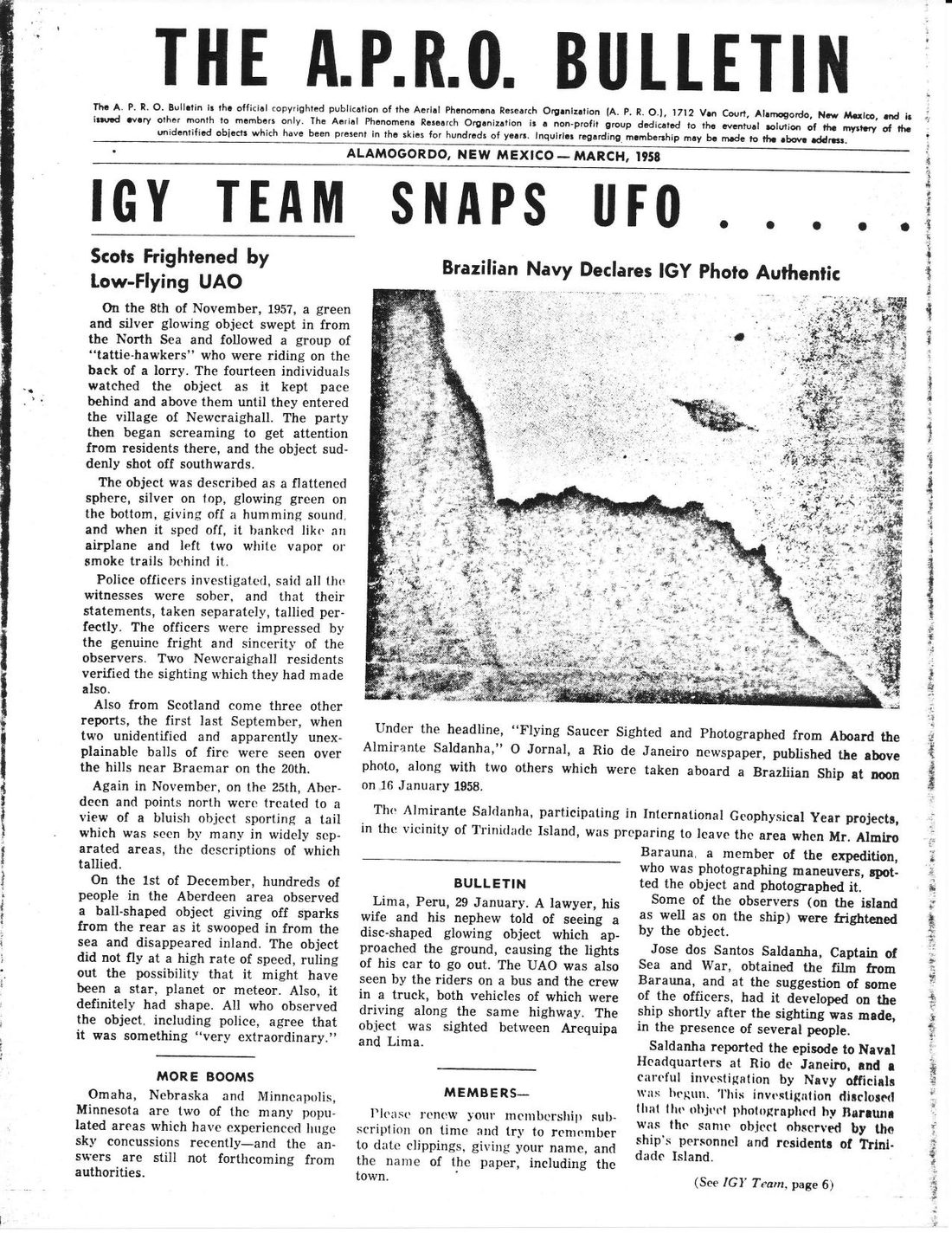
The headline of the March 1958 Bulletin reads: “IGY TEAM SNAPS U F O - Brazilian Navy Declares IGY Photo Authentic.” On 16 January 1958, the Brazilian Navy ship Almirante Saldanha was at Trindade Island in the South Atlantic for International Geophysical Year observations. Almiro Barauna, a member of the expedition who was photographing manoeuvres, spotted the object and photographed it. Several observers, on the island as well as on the ship, witnessed the same object. Some were frightened. Jose dos Santos Saldanha, Captain of Sea and War, obtained the film from Barauna and, at the suggestion of officers, had it developed on the ship shortly after the sighting in the presence of several people. The Captain reported the incident to Naval Headquarters at Rio de Janeiro, which conducted a careful investigation and determined that “the object photographed by Barauna was the same object observed by the ship’s personnel and residents of Trindade Island.” The day before the photograph was taken, 15 January 1958, what was described as a similar object had been picked up on the Almirante Saldanha’s radar.
This is the case the APRO Bulletin made the centrepiece of its March 1958 issue, four to six weeks after the photograph was taken. The Brazilian Navy’s authentication, the existence of a radar track from the day before, the multiple-witness ship-and-island documentation, and the Bulletin’s first English-language coverage of the photographs together establish APRO’s claim to be the primary English-language source on South American UAP material from 1958 onwards.
Aimé Michel, orthoteny, and the French connection
Less remarked on than the Brazilian material but operationally significant: the July 1958 Bulletin runs Jim Lorenzen’s analytical piece on Aimé Michel’s orthoteny theory. Michel was the French researcher whose 1957 to 1958 work on the geometric distribution of UAP sightings, particularly during the 1954 French wave, argued that sighting locations fell along straight lines (orthotenies) that could not be accounted for by chance. The theory was a major topic in French ufology in 1957 to 1958. Jim Lorenzen’s review in the July 1958 APRO Bulletin is one of the earliest English-language engagements with Michel’s analytical method. By providing it, APRO extended its international reach to include not just Brazilian field cases and Swiss psychological theorising but also French analytical methodology.
By July 1958, the Lorenzens’ network had four geographical poles: Alamogordo, New Mexico (American Southwest case material); Rio de Janeiro (Brazilian Air Force archive access via Fontes); Switzerland (psychological theorising via Jung); and France (analytical methodology via the Michel review by Jim Lorenzen). No other American civilian UFO research organisation had this kind of international reach in 1958. NICAP would not become operational until later in the year. MUFON would not exist for another eleven years.
The pattern
Read together, the 1957 to 1958 APRO Bulletin issues establish the operational shape that the Lorenzens had built in their first six years. From a post office in a small Western desert town, they were running an international correspondence and analysis network that connected the Brazilian Navy’s investigation of the Trindade Island photographs to the depth psychology of Carl Jung to the geometric analyses of Aimé Michel to the high-altitude research engineers at Holloman Air Force Base. The network was not informal. By the July 1958 issue, three of the consultants were publicly listed on the masthead with their professional titles.
What this network did differently from contemporary American civilian research was treat the UAP question as an international scientific problem rather than as a domestic American press question. The cases worth investigating were in Brazil and Argentina and France and Italy and Sweden as readily as in New Mexico and Texas. The methodologies worth applying were geometric analysis from French researchers, psychological analysis from Swiss researchers, and field investigation from Brazilian physicians. The result, in print, is the APRO Bulletin’s claim to documentary primacy on a substantial portion of the cases that the historical UFO research literature would later cite as foundational.
The APRO Bulletin's South American case material from 1957 to 1958 onwards is, in many instances, the primary English-language documentary source. Trindade Island, the Villas-Boas case (which would receive its full English-language treatment in subsequent issues through 1965), Colares Island, the Ubatuba magnesium fragment, and dozens of occupant encounters from Argentina and Chile entered the English-language UFO literature through Olavo Fontes's correspondence pipeline with the Lorenzens at Alamogordo. The archive's holdings of the APRO Bulletin from 1957 to 1958 onwards therefore carry documentary weight that no later secondary literature can replace.
What we still do not know
Carl Jung’s correspondence with the Lorenzens has not been documented in the NHI Archive’s current holdings. Whether direct letters were exchanged, or whether the masthead listing reflected a more limited consulting relationship, is unclear from the Bulletin alone. The same question applies to Murray Sale, the Australian Special Representative whose role across 1957 to 1958 is mentioned on the masthead but not extensively documented in the issues. Olavo Fontes’s full correspondence with APRO would, if it survives, form one of the most substantial bodies of 1958 to 1980 South American UFO documentation. Whether the Brazilian Air Force UFO files that Fontes had access to in 1958 have been declassified is not known to this archive at the time of writing.
The 1957 to 1958 Bulletin issues are six issues in a sequence that runs to 1988. The deep-read of the 1959 to 1965 period, when Fontes brought the Antonio Villas-Boas case to English-language publication, is the next obvious step. The deep-read of the 1965 to 1973 period, when Coral Lorenzen and Hynek were in regular professional contact through the parallel rise of CUFOS, is the further step beyond that.
APRO Bulletin November 1957 (Levelland, Stokes), March 1958 (Trindade Island), May 1958 (Fortune/Mescalero photograph at Holloman), July 1958 (Olavo Fontes conclusion of "Shadow of the Unknown," Aimé Michel orthoteny review by Jim Lorenzen, Carl Jung listed on masthead). For the institutional pattern of academically credentialed civilians working with active-duty officers on the UAP question, see The Investigator Who Was Everywhere: Lincoln La Paz Across the 1948 to 1954 Documentary Record and Sixteen Years Early: The J. Allen Hynek That APRO Recorded, 1953 to 1955. For the contemporary contactee-religious tradition, see Etheria Calling: The BSRA Ether-Ship Doctrinal Lineage, 1945 to 1956.