The public Hynek of 1953
Dr. Josef Allen Hynek was thirty-three years old in June 1953. He held a chair in astrophysics at Ohio State University in Columbus. He had been on the Air Force consultancy roster since 1948, when Project Sign was set up at Wright-Patterson Air Force Base to evaluate the post-Arnold reports. He was officially the Air Force scientific consultant on the UFO question, attached to what was then called Project Grudge and would soon be renamed Project Blue Book. His public position was the Air Force’s public position. Most reports were misidentifications. The ones that resisted identification were intelligence failures rather than evidence of anything anomalous. The press coverage was inflated. The serious work was being done inside the Air Force, by qualified personnel, and the public could leave the question to them.
This is the Hynek who would stay in place, on the public record, for the next sixteen years. He would not publicly break with the Air Force position until 1969, after the Condon Report had appeared and after his swamp-gas explanation of the Michigan Dexter and Hillsdale sightings had made him a national punchline in 1966. The break in 1969 has been treated in the secondary literature as Hynek’s late conversion: a scientifically cautious man finally willing, after twenty years, to follow the evidence where it led.
The APRO Bulletin record disagrees with that timeline.
The June 1953 meeting
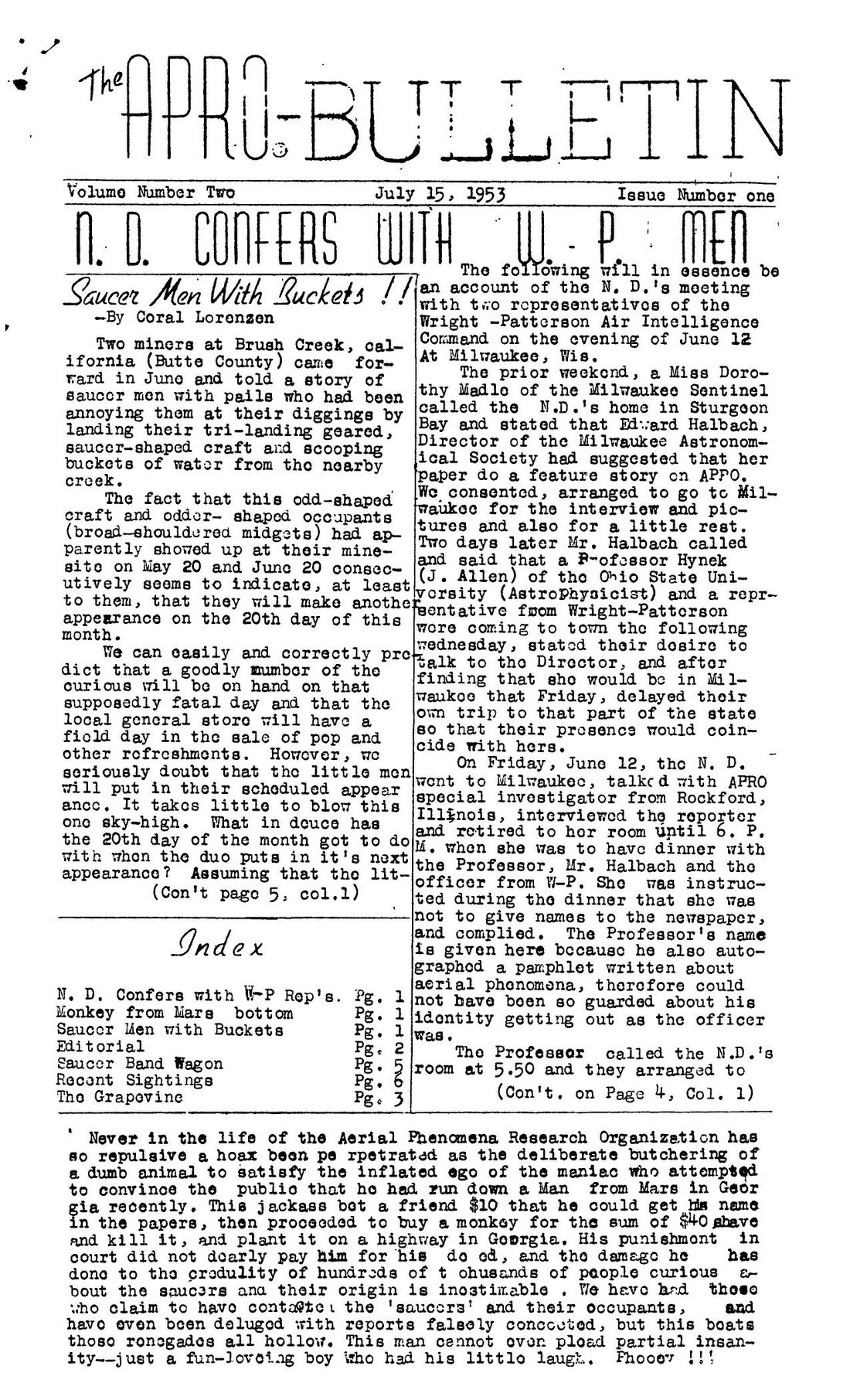
On the Saturday morning of 12 June 1953, Hynek arrived in Milwaukee in the company of an active-duty officer of the Air Technical Intelligence Command at Wright-Patterson. Coral Lorenzen, co-founder and Director of the Aerial Phenomena Research Organisation, was in Milwaukee that weekend for a separate interview with Dorothy Madlo of the Milwaukee Sentinel. The meeting between the two parties had been arranged by Edward Halbach, Director of the Milwaukee Astronomical Society, who had called Lorenzen on the Friday evening to say that Hynek and a Wright-Patterson representative wanted to talk to her.
The conversation lasted approximately four hours. APRO Bulletin Volume 2 Number 1, published 15 July 1953, ran the account that Coral Lorenzen wrote on her return to Sturgeon Bay. The Bulletin records Hynek as “Professor Hynek (J. Allen) of the Ohio State University, AstroPhysicist.” The Wright-Patterson officer is described as “a representative from Wright-Patterson.” Both men, the Bulletin reports, were “detailed to investigate a report at Darlington, Wisconsin,” and Lorenzen notes that they had “made many other similar trips after that.” The officer’s name appears in a later issue of the Bulletin. APRO v3 n5 of April 1955 identifies him as Lt. Olsson of Air Technical Intelligence.
The phrasing is Lorenzen’s, paraphrasing Hynek. What it records is Hynek arriving at her interview carrying an autographed pamphlet that he presented to her in person. The pamphlet was not for the Air Force. It was for Lorenzen’s APRO files. Its content, Lorenzen wrote, “proves in her mind at least, that here is one astronomer who does not laugh at the saucers, and at the same time does not take the light-inversion reflection attitude.” The light-inversion reflection was the Air Force’s standard explanation for the kind of reports Hynek was officially supposed to be supporting. Lorenzen’s reading of the pamphlet was that Hynek, the Air Force’s scientific consultant, was distancing himself from his department’s own preferred dismissal in print.
What Hynek told Lorenzen
The Bulletin reproduces the substance of the four-hour conversation in summary form rather than transcript. Three points are consistently recorded across the issues of APRO Bulletin that cover the period:
First, Hynek agreed with Coral Lorenzen’s assessment that the press had damaged the public understanding of the saucer question. The Bulletin records that “Hynek and the W-P man agreed 100% to this criticism, the officer adding that of course, the press writes stories that sell papers, and in the case of saucers are not particularly interested in gathering facts that may help in the eventual solution of the mystery.” This is the scientific consultant of the Air Force criticising the Air Force’s own ally on the press question, with the Air Force’s own active-duty intelligence officer agreeing with him.
Second, Hynek’s position on individual cases was that “each intelligent report is entitled to a hearing without prejudice, or ridicule.” This was not the public Air Force position of 1953. The public Air Force position was that the percentage of unexplained cases was small and shrinking, and that intelligent reports could be safely consolidated into a manageable backlog. Hynek’s private position, as transmitted through Lorenzen, was the position he would eventually publish in 1972 under his own name as the case-by-case methodology of The UFO Experience.
Third, Hynek was, in 1953, already collecting case material independently. The Bulletin records the Darlington, Wisconsin report as the active investigation Hynek and Lt. Olsson were on at the time. Lorenzen’s later note that they “made many other similar trips after that” indicates that the pattern of academically credentialed consultant plus active-duty intelligence officer travelling together to investigate civilian reports was operating across the upper Midwest in the early-to-mid 1950s. None of this work was visible in the Air Force’s public communications.
"Talked personally to Dr. J. Allen Hynek, professor of astronomy and physics at Ohio University at Columbus, and Lt. Olsson of Air Technical Intelligence in June 1953, for a period of about 4 hours. Both of the men were detailed to investigate a report at Darlington, Wisconsin, and made many other similar trips after that. Although the talk was invaluable..."
What the public Hynek of the period was saying
The 1953 to 1955 public Hynek is harder to capture in detail because it is the period before he wrote the book-length statements that defined his later position. What can be said is that his published work in the period was either neutral or supportive of the Air Force’s position. His earliest paper in the Journal of the Optical Society of America, reprinted with permission by Max B. Miller in Saucers magazine, is a technically focused piece on the relation between unidentified aerial objects and astronomical phenomena, written in language that does not commit to any particular interpretation. His statements to the Robertson Panel of January 1953, five months before the Milwaukee meeting, were broadly aligned with the Panel’s conclusion that the UFO question did not constitute a national security problem.
By 1966 he would be on national television trying to explain the Dexter swamp gas. By 1969 he would have resigned from the Air Force consultancy. By 1972 he would publish The UFO Experience and codify the close-encounter classification that bears his name. The standard account treats this as a slow-burn conversion, taking shape under the pressure of accumulated case evidence over two decades.
The APRO Bulletin record is incompatible with the slow-burn account. By June 1953, Hynek was already privately telling civilian investigators that each intelligent report deserved a hearing without prejudice or ridicule. He was already personally delivering autographed material that contradicted the Air Force’s preferred dismissal mechanism. He was already travelling with an active-duty intelligence officer to investigate civilian cases that did not appear in the public Air Force record. The private position that would become the public Hynek of 1972 was, in summary form, in print in the APRO Bulletin in July 1953.
Lt. Olsson and the institutional pattern
The naming of Lt. Olsson in APRO Bulletin v3 n5 of April 1955 is, for the documentary record, an important detail. The standard narrative of the 1950s Air Force investigation is that civilian researchers were kept at arm’s length and that direct contact between active-duty intelligence officers and civilian organisations was rare. Lt. Olsson’s presence in Milwaukee in June 1953, in an active investigation, accompanied by the Air Force’s official scientific consultant and meeting with the Director of one of the two major American civilian UFO organisations, contradicts the standard narrative directly.
The pattern, in fact, is the same one documented in the Lincoln La Paz cross-collection thread. Academically credentialed civilian scientists working with active-duty intelligence officers on the UFO question, with both parties moving freely between government investigations and civilian organisations, is the institutional shape that the early Air Force investigation actually had. It was not the arm’s-length structure that the Air Force’s public communications implied. Hynek in Milwaukee in 1953 with Lt. Olsson is the same institutional pattern that La Paz in Albuquerque in 1949 with Sandia security personnel had been operating under five years earlier.
The APRO Bulletin's documented record of Hynek in 1953 to 1955 is not a secret revelation. The Bulletin was a public mail-order subscription publication available to anyone willing to pay $3 a year. APRO did not classify it. The Lorenzens did not bury it. What happened, in the standard accounts of Hynek's career, is that the civilian publications of the 1950s were treated as unreliable secondary sources and the primary documentary trail of his private position simply was not consulted. The PURSUE programme's 2026 release of the Sandia file did the same kind of historical work for La Paz that the APRO Bulletin had done for Hynek in 1953. In both cases, the documentary record was already present. What changed was the willingness to treat the available record as serious evidence rather than secondary noise.
What we still do not know
The four-hour conversation in Milwaukee was not transcribed in full in the Bulletin. Lorenzen worked from her own contemporary notes, and the published account is a summary. Lt. Olsson’s first name and full unit assignment are not in the Bulletin. Whether his trip report from the Darlington, Wisconsin investigation survives in the Project Blue Book file series is not currently known to this archive. Hynek’s autographed pamphlet, mentioned in the APRO Bulletin account, is not specifically identified by title or by publication date and may have been a privately circulated piece rather than a published paper. The trail of “many other similar trips” Lorenzen attributes to Hynek and Lt. Olsson after the Darlington investigation has not been mapped against the Project Blue Book travel records.
The 1955 to 1957 APRO Bulletin issues continue to mention Hynek in passing, and the 1961 to 1969 issues mention him with increasing frequency as his public position began to shift. The full mapping of Hynek’s APRO trail across the 1953 to 1969 period is a substantial undertaking that this archive has not yet completed. What is clear, from the 1953 to 1955 issues already on the public record, is that the slow-burn account of Hynek’s conversion is wrong about the timeline.
APRO Bulletin v2 n1 (15 July 1953), v2 n4 (15 January 1954), v2 n5 (15 March 1954), and v3 n5 (15 April 1955) are the primary documentary sources used in this article. Saucers (Max B. Miller) reprinted Hynek's Journal of the Optical Society of America paper in an early issue, providing a contemporary parallel record of his publicly visible position in the same period. For the institutional pattern of academically credentialed civilians working with active-duty officers on the UFO question, see The Investigator Who Was Everywhere: Lincoln La Paz Across the 1948 to 1954 Documentary Record.