Saucers (Max B. Miller)
Flying Saucers International, Los Angeles
History
Max B. Miller printed the first issue of Saucers in 1953 from a P.O. Box in Los Angeles. Four pages, mimeograph format, fifteen cents. The opening editorial gave the extraterrestrial hypothesis as fact: "The 'Space Visitors' are, of course, of interplanetary origin. They are here for a purpose." Within months Miller had organised the World's First Flying Saucer Convention at the Hollywood Hotel, August 16th to 18th, 1953. Frank Scully spoke. Truman Bethurum spoke. George Adamski was in the room. Mimeograph-age ufology was underway, and Miller's journal sat at its Los Angeles centre.
The geography helped. Miller's mailbox at Preuss Station sat a short drive from the aerospace plants at Lockheed and Douglas. Edwards Air Force Base lay across the Antelope Valley to the north. Giant Rock and the Mojave contactee scene were two hours east. One issue of Saucers would carry John Otto's circuit schematics for a photo-cell light-beam receiver alongside Orfeo Angelucci's writings on his Forrest Lawn cemetery contacts. In 1953 the field had not yet drawn its later boundaries. Miller published the contactee material because the question of whether the contactees were telling the truth was still open.
A Five-Year Transformation
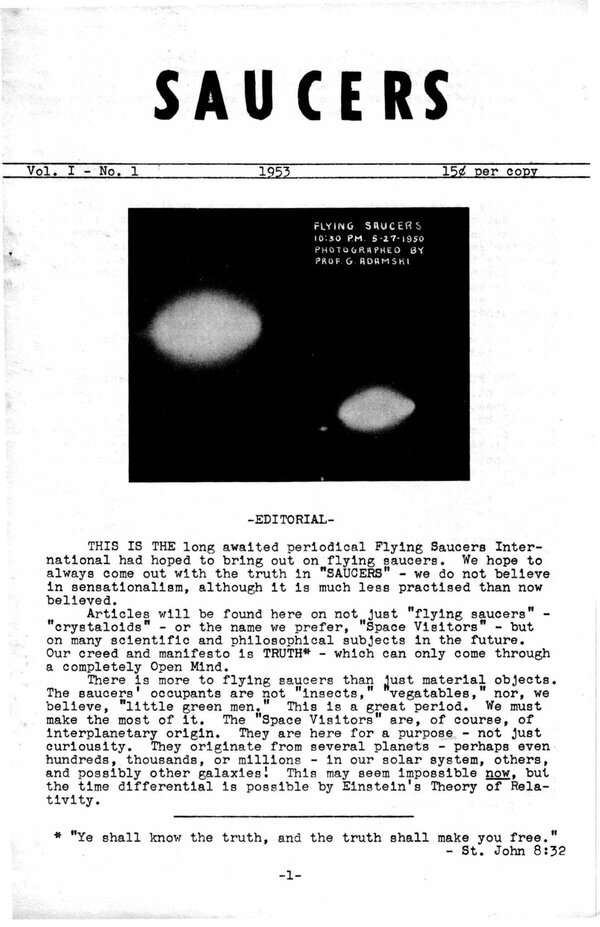
The defining feature of Saucers across the five years from 1953 to 1957 is its editorial arc. Miller began as the contactee wing's most prominent California outlet. He sold Adamski's book through Flying Saucers International, gave Truman Bethurum and George Hunt Williamson convention platforms, ran Daniel Fry's White Sands account, and ran St. John 8:32 ("And ye shall know the truth, and the truth shall make you free") on the masthead. By the autumn of 1954, the editorial position had begun to shift.
Three movements mark the change. In Volume 2 Number 4 (December 1954), Miller wrote: "We have recommended Desmond Leslie's and George Adamski's book, as interesting and informative reading, but we have not endorsed it nor Mr. Adamski's account therein." This was the first explicit non-endorsement of an Adamski work in Saucers. In Volume 3 Number 1 (March 1955), Miller refused to stock Cedric Allingham's Flying Saucer From Mars: "WE ARE NOT STOCKING THIS BOOK... Not recommended." First explicit rejection. And in Volume 2 Number 1 (March 1954), Miller had reported, without editorial comment, that Silas Newton and Leo GeBauer (the central sources for Frank Scully's Behind the Flying Saucers crash-retrieval narrative) had been convicted of a $250,000 doodlebug fraud on December 29, 1953.
By 1956 the content had shifted decisively. Volume 4 Number 1 (March 1956) carried a direct statement from Edward J. Ruppelt, former head of Project Blue Book, calling the Air Force's own Special Report Number 14 "worthless." The same issue carried Wilbur B. Smith's statement from Canada's Project Magnet: "90 to 95 per cent probability that the flying saucers do exist: 60% alien vehicles, 10% Earth origin, 30% inconceivable to man." Volume 4 Number 2 (June 1956) reproduced verbatim Major Donald Keyhoe's eleven-question letter to Senator Harry Flood Byrd, alongside the Department of the Air Force reply from Major General Joe W. Kelly. Volume 4 Number 3 (September 1956) reprinted J. Allen Hynek's "Unusual Aerial Phenomena" from the Journal of the Optical Society of America. Volume 4 Number 4 and Volume 5 Number 1 carried R.M.L. Baker Jr.'s photogrammetric analyses of the Tremonton, Utah and Montana UFO films. Volume 5 Number 3 (September 1957) carried Dr. Olavo Fontes' "Conclusive Proof That Saucers Exist," the chemical analysis of metallic fragments recovered in Brazil.
In June 1957 Miller wrote the line that summarised the transformation. The field, he said, suffered from "a lack of discrimination, by excessively imaginative and unsubstantiated claims, and by not exposing the obvious frauds which are prevalent." Three months later, in Volume 5 Number 3 (September 1957), he endorsed NICAP directly: "We recommend that we all support NICAP to the fullest extent possible." He listed NICAP's board, gave the address at 1536 Connecticut Avenue NW Washington 6, and described their work as "tireless and selfless." Miller had moved across five years from the masthead's St. John 8:32 to a formal alignment with the investigative establishment.
The Convention Run
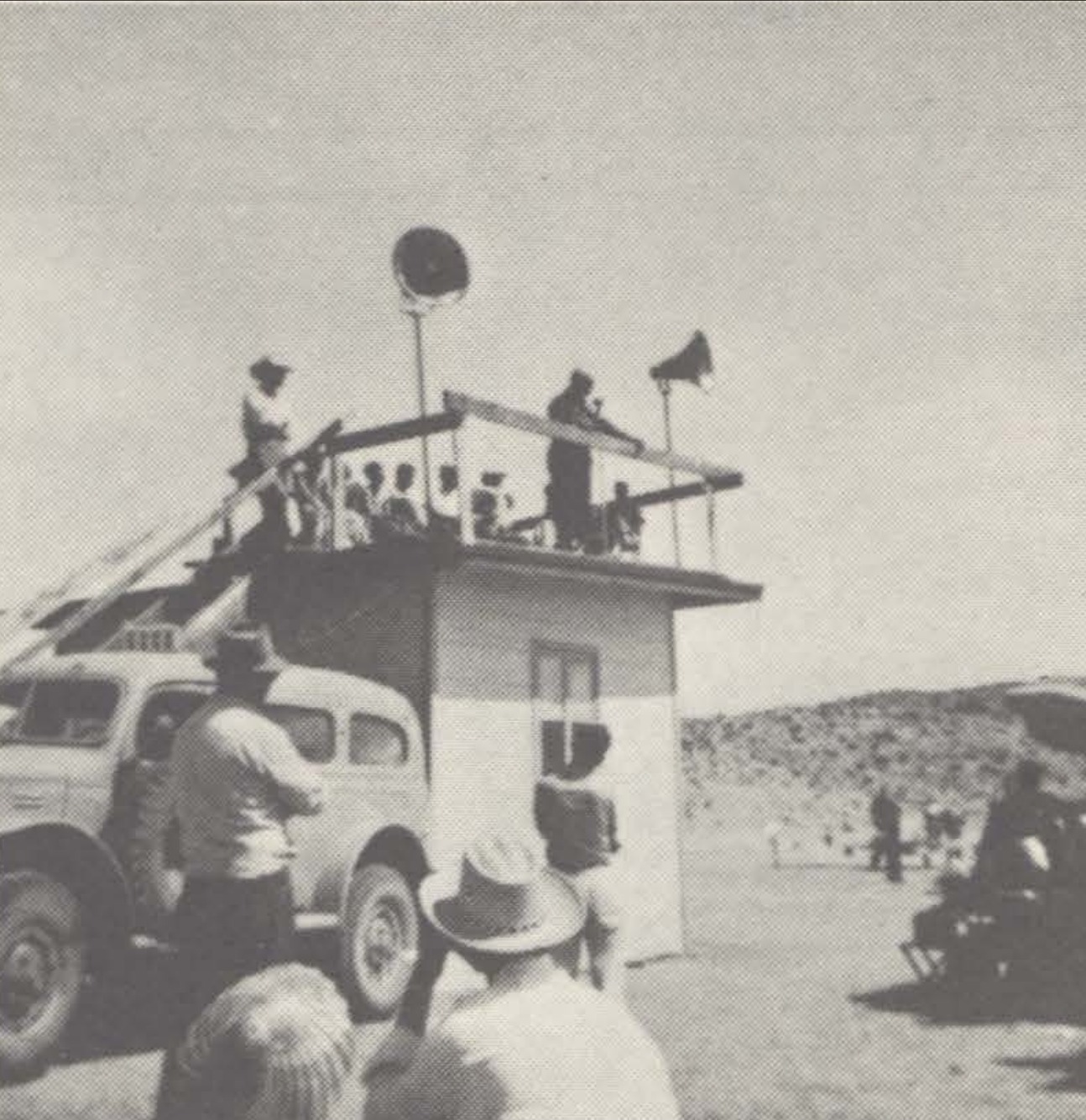
Miller covered five major conventions between 1953 and 1956, and his journal preserves the documentary record of an organising tradition that has otherwise mostly vanished from the printed record. The World's First Flying Saucer Convention at the Hollywood Hotel ran August 16 to 18, 1953, with around 1,500 attendees. The First Annual International Flying Saucer Convention at the Carthay Circle Theatre in Los Angeles ran June 4 to 6, 1954, organised by the Saucer Research Foundation. George Van Tassel's World's First Interplanetary Spacecraft Convention met at Giant Rock in the Mojave Desert on April 4, 1954, the inaugural meeting of the Spacecraft Convention series Van Tassel would run annually for decades. Coverage of all three appears on the archive's Foundational Civilian Conventions section.
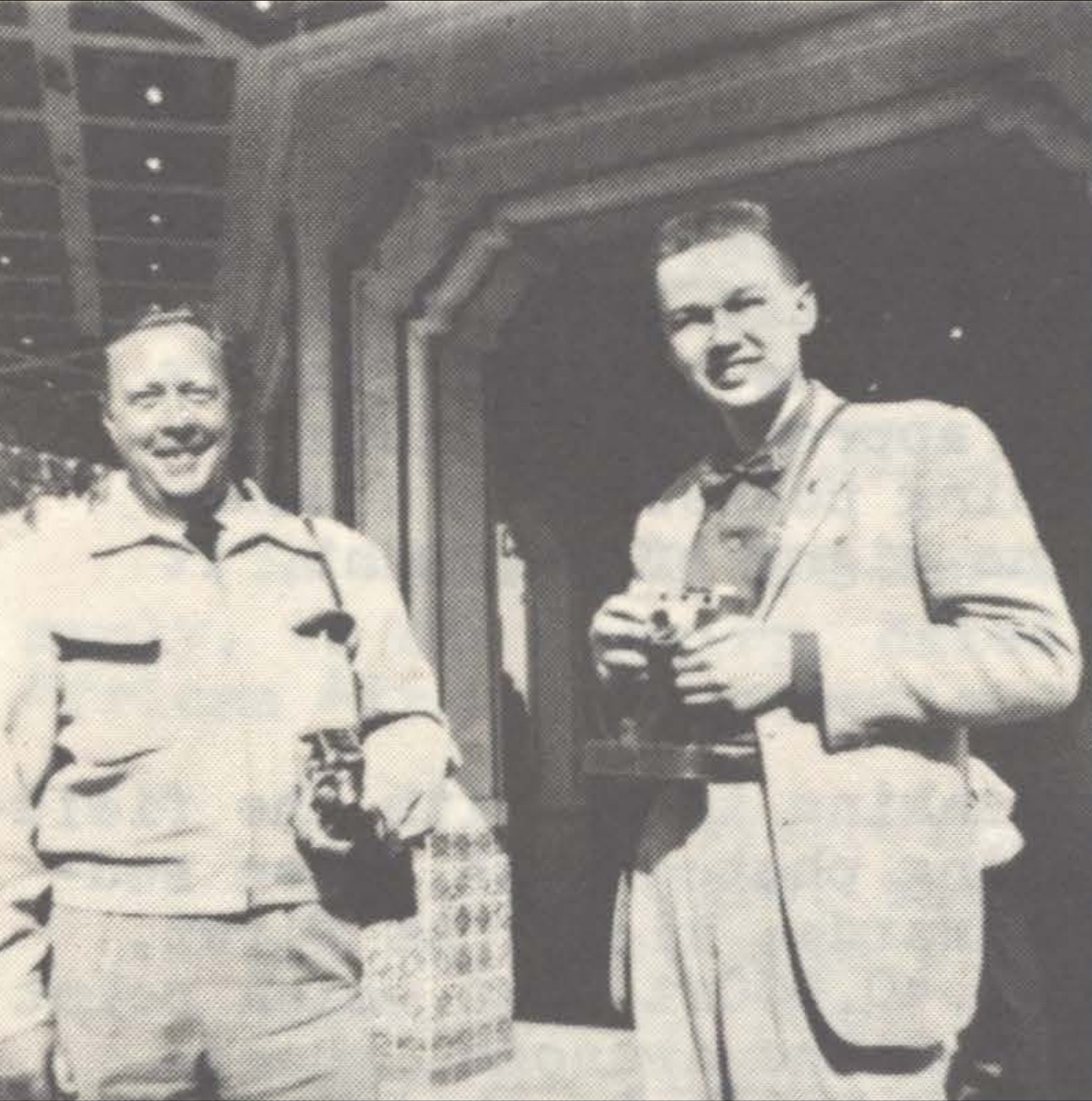
Van Tassel's second annual Giant Rock convention, March 12 and 13, 1955, drew over a thousand attendees on the Saturday. Two Air Force Intelligence members attended without speaking. At least one FBI representative attended. Captain Edward Ruppelt, formerly of Project Blue Book, attended silently. This is the moment, recorded in Volume 3 Number 2 (June 1955), when the silent presence of government observers at Giant Rock began to be documented in the civilian press. Van Tassel's third annual convention met at Giant Rock on April 28 and 29, 1956, with Miller's coverage in Volume 4 Number 1.
John Otto's Light-Beam Communication Project
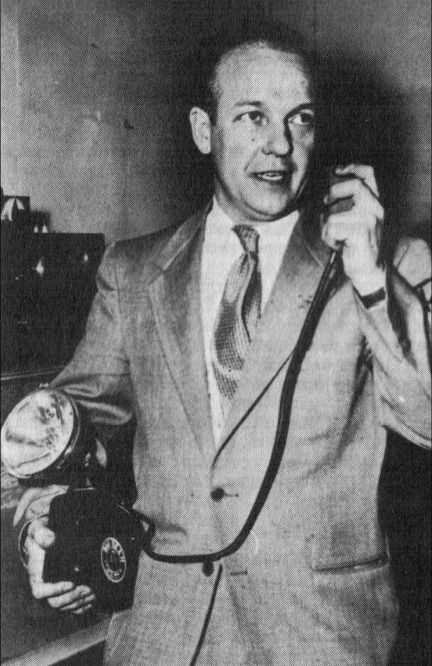
John Otto's attempt to communicate with extraterrestrial intelligence using modulated light beams ran across at least eight issues, from December 1954 to June 1957, making it the publication's longest-running technical thread. Otto, appointed Director of Investigation in Volume 2 Number 1 (March 1954), was an experimenter in the audio-electronics field operating from Chicago. His circuit schematics for an RCA 923 photo-cell receiver appeared in Volume 2 Number 4. Volume 3 Number 1 added component values. By Volume 3 Number 2, Otto reported field contact 500 miles from Chicago and provided the transmitter diagram for a Centralab Ampec PC-200.
The project broke into the broadcast media on November 28, 1954, when WGN Chicago carried the system's signals with an oscillographed wave form. The October 28, 1955 broadcast on KFI Los Angeles with Ben Hunter (NBC) drew a series of corroborating reports. A San Diego recorder picked up the signals at 2:10 AM. A Marine Sub Station's telemetering equipment was disturbed. A Monterey amateur intercepted code. A calculation put the signal strength at 25 million watts. When Miller and Otto attempted to retrieve the tape from a scientist's office the following day, a helicopter circled overhead. Volume 4 Number 1 records the sequence in detail. George Hunt Williamson's Telonic Research Center adopted the light-beam method, building an "Interstellar Communicator" with a CE-705-A photocell and Unitron telescope, photographed in Volume 4 Number 3 alongside Williamson, Michael Fitzpatrick, and Betty J. Williamson on October 23, 1955.
The Bender Visitors
Albert K. Bender, President of the International Flying Saucer Bureau in Bridgeport, Connecticut, appeared in Volume 1 Number 1's cooperating-organisations list. By Volume 1 Number 2 the listing was gone. Miller did not explain the omission until Volume 2 Number 1 (March 1954), when he reproduced from the Bridgeport Sunday Herald the account of Bender's three visitors: dark suits, credentials "showing them to be representatives of the 'higher authority'", instructions to stop publishing delivered "not roughly, but sternly and emphatically." Bender's statement: "I was scared to death and actually couldn't eat for a couple of days." Bender's Space Review was discontinued. The 1954 Saucers item is the earliest civilian-newsletter documentation of what would later be called the Men in Black phenomenon.
The Grassroots Network
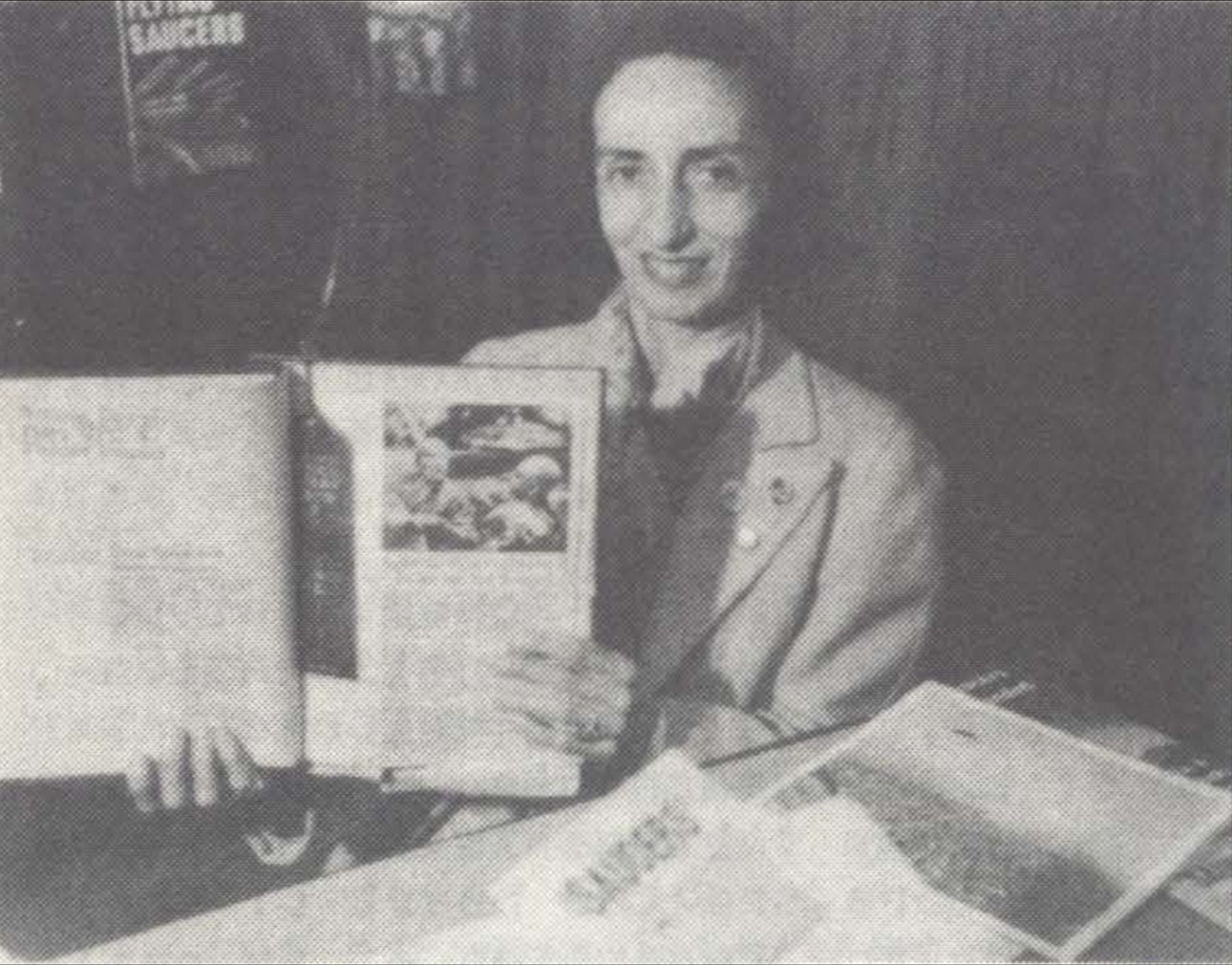
Volume 5 Number 2 (June 1957) carried a photo spread of Mrs H V Goodells operating a flying saucer booth at the 9th Annual California Hobby Show in Los Angeles, held at the Shrine Exposition Hall from April 5 to 14, 1957. Mrs Goodells does not appear in the secondary historical literature on civilian UFO research and is not documented in other holdings the archive has surveyed. Miller's photo spread is the only record the archive has located of her work at the show.
The grassroots organising the Goodells coverage represents continues across the publication's run. Volume 4 Number 1 (March 1956) carried a UFO Group Meetings Directory listing eight regional bodies by name, contact, and meeting schedule: the Fontana Space Craft Research Group (second Tuesday), the Flying Saucer Book Club in North Hollywood (second and fourth Thursday), the San Jose Cosmic Observers (third Sunday), the Flying Saucer Research Group of Daytona Beach (first and third Friday), the Chicago UFO Group, the Study Group on Interplanetary Relationships in Grand Rapids, the North Jersey UFO Group in Morristown, and the Saucer Round Table in Everett, Washington. None of these organisations are documented in the secondary historical literature the archive has surveyed. Miller's directory is the only place each entry still exists in published form.
The Book
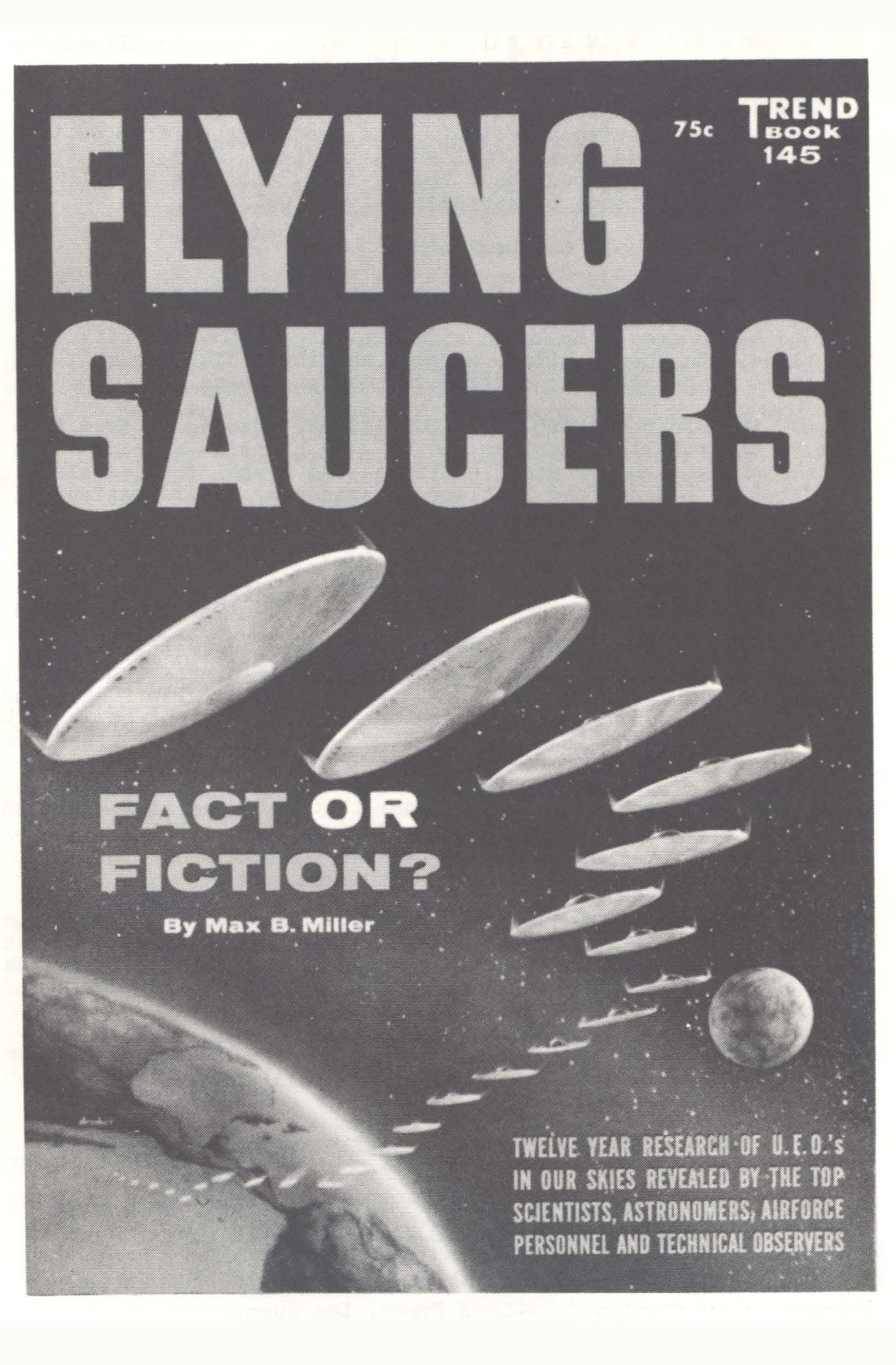
Miller published Flying Saucers: Fact or Fiction? as Trend Book 145 in late 1956, around 70,000 words at 75 cents. The book is first referenced in Volume 4 Number 4 (December 1956) and actively promoted from Volume 5 Number 1 onward. Tom Towers, writing in Volume 5 Number 1: "Max Miller has authored a well-documented book on 'flying saucers.'" By 1957 the Flying Saucers International catalogue carried it as one of around twenty titles, alongside Ruppelt's Report on Unidentified Flying Objects, Keyhoe's Flying Saucer Conspiracy, and Wilkins's Flying Saucers Uncensored. Samuel J. Ciurca Jr. compiled a detailed index of the book serialised across Volume 7 Numbers 1 and 2 in 1959.
Sceptical Maturity
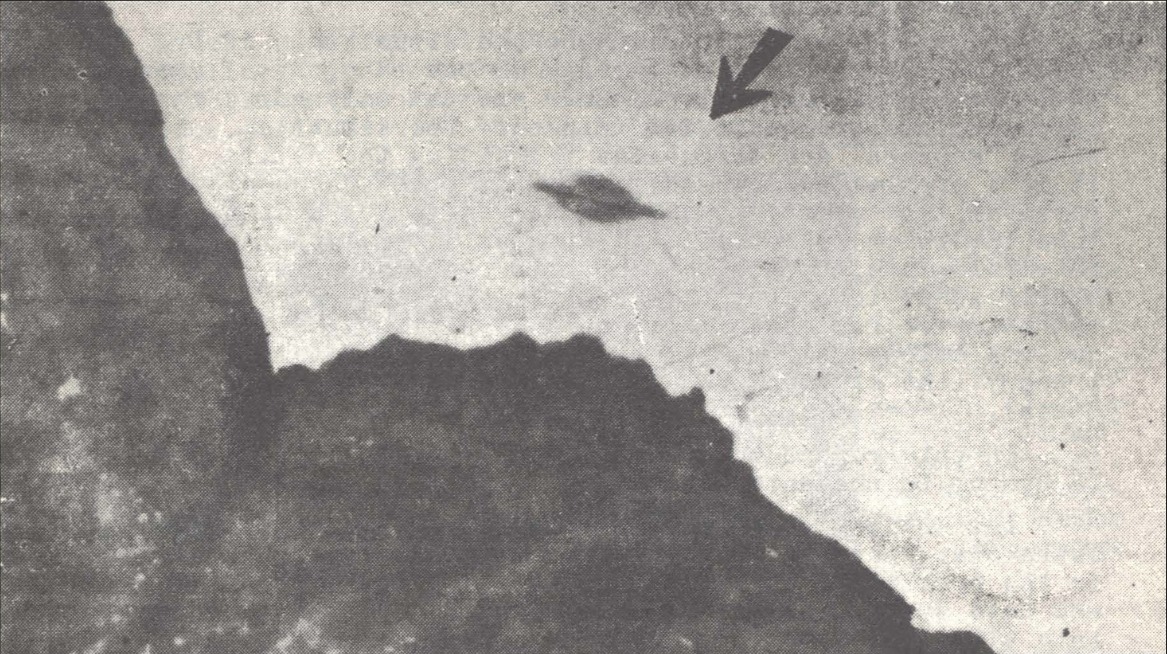
The 1958 issues mark Miller's most sceptical editorial phase. Volume 6 Number 1 (early 1958) gave the cover to the Trindade Island photographs taken by Almiro Barauna from the Brazilian Navy ship NEé Almirante Saldanha on January 16, 1958, during the International Geophysical Year programme. The four-shot Barauna sequence was processed aboard the ship in the presence of Navy officers, which Miller treated as the strongest documentary protocol any civilian UFO photograph had ever met. The same issue carried Ralph E. Benn's "I Photographed Four UFO's," the East Los Angeles 8mm film case of December 1, 1957. Benn shipped the original to Wright-Patterson, the Air Force praised the film, then returned it with splices Benn had not made and could not explain.
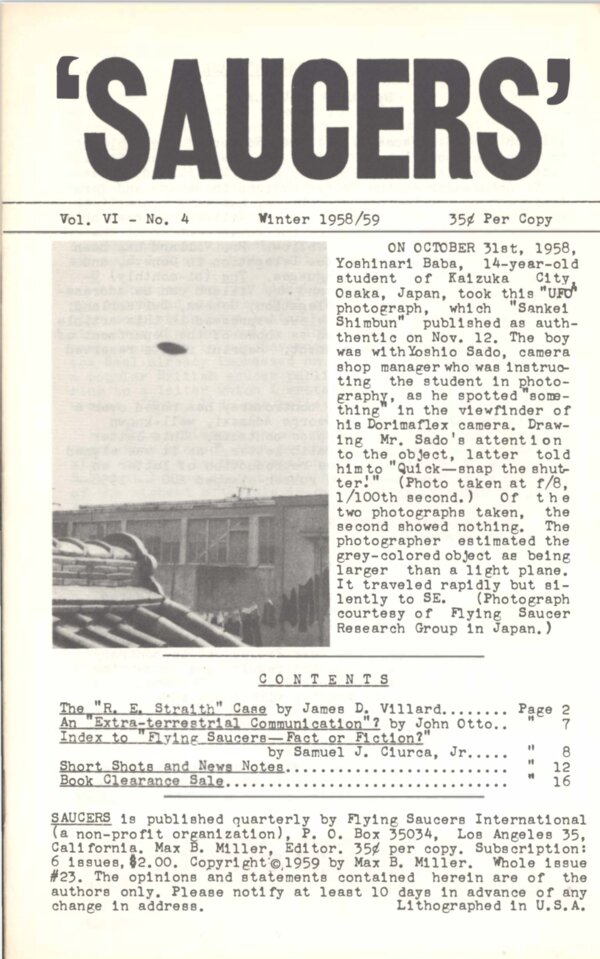
Volume 6 Number 2 contains Miller's most pointed editorial act in the entire run. The cover photograph was a deliberate fake. Miller's text inside the issue declared it openly: he had faked the photograph "to show the ease with which UFO photos may be faked." The same issue carried Major Donald Keyhoe's "Questions About NICAP Answered," a structured Q&A about the organisation's investigative work. By Volume 6 Number 3, George Adamski (a fixture of 1953 and 1954 coverage) was being treated with analytical distance as "the controversial Mr. Adamski." Volume 6 Number 4 placed the November 1957 American sighting wave in the context of the post-Sputnik geopolitical moment, with Japanese material supplied by the Flying Saucer Research Group of Japan. The price had risen to thirty-five cents. A Book Clearance Sale notice in the same issue signalled the financial pressure that would shape the final volume.
Closing the Door
The 1959-60 issues appeared as combined double numbers, Volume 7 Number 1-2 and Volume 7 Number 3-4, published "for purposes of survival" at seventy cents each. Miller's editorial "Where Do We Stand?" in the first double issue acknowledged the field had been "deluged with wholesale garbage." The same issue carried M.K. Jessup's "Ufology: A Plea and a Warning," catalogue of the field's fragmentation. Jessup died in April 1959 in Florida. His Saucers piece is among his last published essays.
The final double issue (V7N3-4, Fall and Winter 1959/60) carried the announcement: "It is with deepest regret that we announce the termination of publication of SAUCERS with this issue." The reason was monetary. "This issue alone cost more to print than we have in our UFO fund." The same issue carried Robert C. Beck's "Instrumentation for UFO Detection," the most technically sophisticated article in the seven-year run, and Richard Hall's "The Future of UFO Investigation." Hall was Keyhoe's assistant at NICAP. Miller's closing material referenced Project Ozma, the National Radio Astronomy Observatory programme to scan for intelligent radio signals from nearby stars, and quoted Philip Morrison and Giuseppe Cocconi of Cornell: "The probability of success is hard to estimate; but if we never search, the chance of success is zero." The publication that opened in 1953 with the masthead St. John 8:32 closed in 1960 with an instrumentation manual and the Cornell radio astronomers' line.
Connections
Every named figure, convention, and sister publication in this collection has its own home in the archive. This section is the spine of the braiding work: a reader who has followed Miller's editorial arc through 1953 to 1960 can leave from here into any of the individual lives, events, or publications that crossed his pages.
People in this collection
The editor and the figures whose words and work appeared on Miller's pages across the seven-year run. Each link routes to the figure's record in the archive; figures with full canonical biographies are noted.
- Max B. Miller, editor (1953 to 1960), founder of Flying Saucers International
- George Adamski, whose Flying Saucers Have Landed Miller initially sold and later distanced from in 1954
- J. Allen Hynek, whose Optical Society of America paper Miller reprinted in Volume 4 Number 3
- Major Donald E. Keyhoe, whose eleven-question letter to Senator Byrd Miller reproduced verbatim in 1956
- Edward J. Ruppelt, former Project Blue Book chief, who called Special Report 14 "worthless" in Volume 4 Number 1
- Wilbert B. Smith, whose Project Magnet statement Miller printed in the same March 1956 issue
- George Van Tassel, organiser of the Giant Rock Spacecraft Conventions Miller covered from 1954
- Dr. Olavo T. Fontes, whose Brazilian metal-fragment analysis Miller published in Volume 5 Number 3 (September 1957)
- George Hunt Williamson, contactee author and convention speaker
- Daniel W. Fry, whose White Sands account Miller carried
- Frank Scully, author of Behind the Flying Saucers, the source narrative for the doodlebug-fraud reporting Miller carried in March 1954
- Silas Newton, the convicted "doodlebug" promoter named in Scully's book
Connected events
The conventions, foundational and documentary events that Saucers reported on, several of which are now Disclosure Network entries in their own right.
- World's First Flying Saucer Convention, Hollywood Hotel, 16 to 18 August 1953, around 1,500 attendees
- First Annual International Flying Saucer Convention, Carthay Circle Theatre, Los Angeles, 4 to 6 June 1954
- World's First Interplanetary Spacecraft Convention, Giant Rock, California, 4 April 1954, inaugural meeting of the Spacecraft Convention series
Related publications
The publications that share Saucers' editorial moment, its contactee subculture, or its institutional descendants.
- APRO Bulletin, the Aerial Phenomena Research Organisation publication where Dr. Olavo Fontes' Brazilian work continued after his Saucers contribution
- UFO Contactee, the English-language GAP-Japan bulletin under Hachiro Kubota, the Adamski-tradition correspondent who built the international contactee network Miller had documented at its Los Angeles inception
- Flying Saucer Review, the London journal whose translation lineage carried American contactee material into the international research community
Cross-cutting themes and surfaces
- Contactees, the theme page for the entire contactee tradition in the archive
- United States, the country exhibition Saucers' record sits inside
- Disclosure Network: United States, where the convention era is documented in the foundational events section
- Newsletter Archive, the catalogue surface for all 246 newsletter collections in the archive
Browse the Collection
Two ways to explore: by issue (covers, decade-grouped) or by article (search across the run).
16 articles catalogued, grouped by issue