Henry Steel Olcott
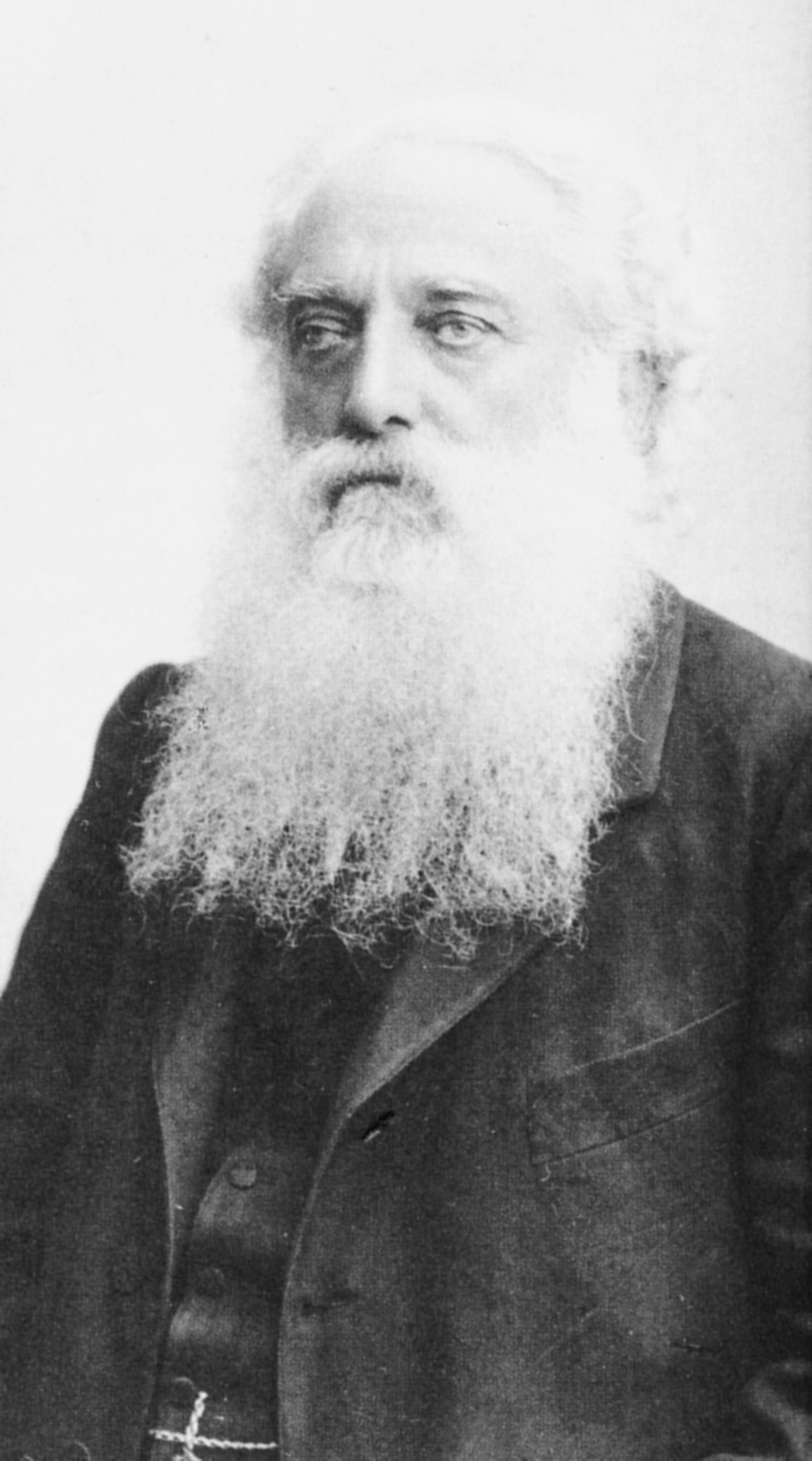
Olcott had three working lives before the Theosophical one. He was an agricultural-investigation journalist in New Jersey in the 1850s, a Union Army Special Commissioner investigating Federal contract fraud during the Civil War, and a New York lawyer from 1868. On 14 October 1874 he went up to the Eddy Brothers seances in Chittenden, Vermont on assignment for the New York Sun and met Helena Petrovna Blavatsky there. They co-founded the Theosophical Society in New York a year later. He ran the organisation: the constitution, the membership rolls, the international branches, the move to India in 1879, the permanent Adyar Madras headquarters from December 1882. In Ceylon from 1880 he wrote the Buddhist Catechism that the Sinhalese revival movement adopted as standard, took the Buddhist Five Precepts himself, and is still officially honoured at the Vesak full moon. He held the Society Presidency for thirty-one years and died at Adyar on 17 February 1907.
A Life
Olcott was born on 2 August 1832 at Orange, New Jersey, the eldest of the six children of Henry Wyckoff Olcott, a New Jersey businessman of substantial Presbyterian stock, and Emily Steel. He was educated at the Columbia College preparatory school and entered Columbia College in 1848 but the family business failed during his second year and he was withdrawn from college without completing the degree. He moved to Newark, Ohio in 1851 to live with a maternal uncle and worked the family farm there through his teenage years.
The working career opened with agricultural-investigation journalism. He returned to New Jersey in 1855 and established the Westchester Farm School at Mount Vernon, New York, in 1856, the first agricultural college in the state. He served as Associate Agricultural Editor of the New York Tribune from 1858 to 1860 under Horace Greeley, and produced the 1860 Tribune report on the African American cotton-farming experience that was one of the pre-Civil-War agricultural surveys of the period. He travelled to Mount Vernon, Virginia in 1859 as a Tribune special correspondent to cover the execution of John Brown.
The Civil War years from 1861 to 1865 placed him in military-investigation work. He served as a Signal Corps officer at the Burnside North Carolina expedition of 1862, was promoted to the Special Commissioner role under the War Department in 1863, and was assigned to investigate Federal contract fraud across the Army of the Potomac. The 1864 to 1865 investigation he led at the New York Navy Yard recovered approximately one million dollars in fraudulent contracts and produced the Navy Department reorganisation of 1866. He was discharged at the end of the war with the rank of Colonel. He was assigned by Secretary of War Stanton in April 1865 as one of the three special investigators of the Lincoln assassination in the immediate aftermath of the 14 April 1865 shooting.
He read law privately through 1866 and 1867 and was admitted to the New York Bar in 1868. He practised as a New York lawyer with substantial business clients across the 1869 to 1875 period and produced the treatise Sorgho and Imphee, the Chinese and African Sugar Canes in 1857 from his earlier agricultural-journalism years. He married Mary Epplee Morgan in 1860; the marriage produced two sons, William Topping Olcott and Henry Steel Olcott Jr. The marriage ended in divorce in 1874 over Olcott's emerging interest in spiritualism.
The decisive encounter of his life came on 14 October 1874 at the William and Horatio Eddy farmhouse at Chittenden, Vermont. Olcott had been commissioned by the New York Sun in September 1874 to investigate the Eddy Brothers materialisation seances that had been running as a press sensation across the autumn. He had been resident at the Eddy farmhouse for approximately three weeks producing the published Sun and Daily Graphic reports. Helena Petrovna Blavatsky travelled to Chittenden from New York to meet Olcott on the strength of his published Graphic articles. The two formed the working partnership that produced the Theosophical Society on 17 November 1875 at the rooms of the lawyer William Quan Judge in New York.
The 1875 to 1878 New York period of the Society opened the working partnership. Olcott served as President, Blavatsky as Corresponding Secretary, Judge as Counsel. The 1877 publication of Blavatsky's Isis Unveiled from J. W. Bouton at New York was the doctrinal foundation of the Society's early position; Olcott served as editorial collaborator across the 1876 and 1877 production period. He took American citizenship on 8 July 1878 in preparation for the move to India.
The Indian period opened with the December 1878 departure of Olcott and Blavatsky from New York for Bombay. They arrived at Bombay on 16 February 1879 via Liverpool and the overland route through the Suez Canal. They established the Theosophical Society's Indian headquarters at Girgaum in Bombay through to December 1882, then moved the permanent headquarters to the Adyar Madras estate on the Coromandel Coast that has remained the Society's international headquarters from December 1882 to the present day.
The Sinhalese Buddhist revival work opened in May 1880 with Olcott's first visit to Ceylon. Olcott and Blavatsky took the pansil (the five Buddhist precepts) at the Vijayananda Vihara at Galle on 25 May 1880, becoming the first Western converts to Buddhism in the nineteenth-century Sinhalese tradition. Olcott produced The Buddhist Catechism in 1881 in collaboration with Sumangala Thero of the Vidyodaya Pirivena at Maligakanda; the Catechism ran through approximately forty-four editions across the Sinhalese Buddhist educational system over the following fifty years and is the Western-authored Buddhist text the modern Sri Lankan educational system inherited. The Buddhist flag he designed in collaboration with the Colombo Buddhist Defence Committee in 1885 was adopted as the international Buddhist flag at the 1950 World Fellowship of Buddhists conference and remains in current use.
The late-Olcott period from 1885 to 1907 ran the Society through the 1885 Hodgson Report crisis, the 1888 Secret Doctrine publication, the 1891 death of Blavatsky in London, the 1894-95 W. Q. Judge Case schism between the American and Adyar sections of the Society, and the succession question of his own old age. He died at Adyar of heart failure on 17 February 1907, age seventy-four, and was succeeded as Theosophical Society President by Annie Besant, who held the office through to her own death in September 1933.
I am Buddhist enough to believe that nothing happens by chance, and that the meeting of any two persons has its meaning in some past relationship which is to be developed in the future.Henry Steel Olcott, Old Diary Leaves, Volume I (Adyar, 1895), Chapter 1 on first meeting Blavatsky
The Theosophical Society Founding
The Theosophical Society was founded on the evening of 17 November 1875 at the rooms of William Quan Judge at 46 Irving Place, New York. The attendance at the founding meeting was approximately sixteen people, drawn from the New York spiritualist and Masonic circles of the mid-1870s. Olcott was elected the founding President and held the office continuously from that meeting through to his death thirty-two years later. The founding objects of the Society, as adopted at the November 1875 meeting and revised across the subsequent decades, were the formation of a universal brotherhood of humanity without distinction of race, creed, sex, caste or colour; the encouragement of comparative study of religion, philosophy and science; and the investigation of the unexplained laws of nature and the powers latent in man.
The Olcott Old Diary Leaves chronicle, published in six volumes between 1895 and 1935 (the last two posthumous), is the first-hand chronicle of the Society's founding and the 1875 to 1898 period. The Olcott role across the working partnership with Blavatsky was the organisational, administrative, and public-engagement role. Olcott conducted the Society correspondence, managed the financial and property affairs, conducted the public lecture tours across India and Ceylon, and produced the Adyar bureaucratic apparatus the modern Society inherited. Blavatsky produced the doctrinal content of the Society's published positions; Olcott produced the organisational form.
Olcott's 1894 Borderland Quarterly contribution on Blavatsky was reproduced in Borderland Volume 1 Number 4 of April 1894 as the source for W. T. Stead's Gallery profile of Blavatsky. The Olcott contribution at Number 13 of July 1896 ran under the title "Colonel Olcott; Koot-Hoomi and H.P.B." in the journal's Volume 3 closing material. The Theosophical Society material across all four Borderland volumes drew principally on Olcott as the English-language editorial source.
Significance to the Archive
Olcott matters to this archive as the organisational founder of the Theosophical Society and as the editorial source the Borderland-period English-language psychical-research community drew on for its Theosophical Society coverage. The 1875 New York founding, the 1879 Bombay move, the 1882 Adyar Madras headquarters establishment, and the 1875 to 1907 thirty-two-year Presidency are the documented organisational acts that produced the Theosophical Society institutional apparatus the modern Society inherited.
The Theosophical-tradition lineage that runs forward from the Blavatsky-Olcott working partnership through Annie Besant and C. W. Leadbeater (the twentieth-century Theosophical leadership succession) into the American contactee tradition the archive documents in its contactee-era material runs through the organisational form Olcott produced as much as through the doctrinal content Blavatsky produced.