Helena Petrovna Blavatsky
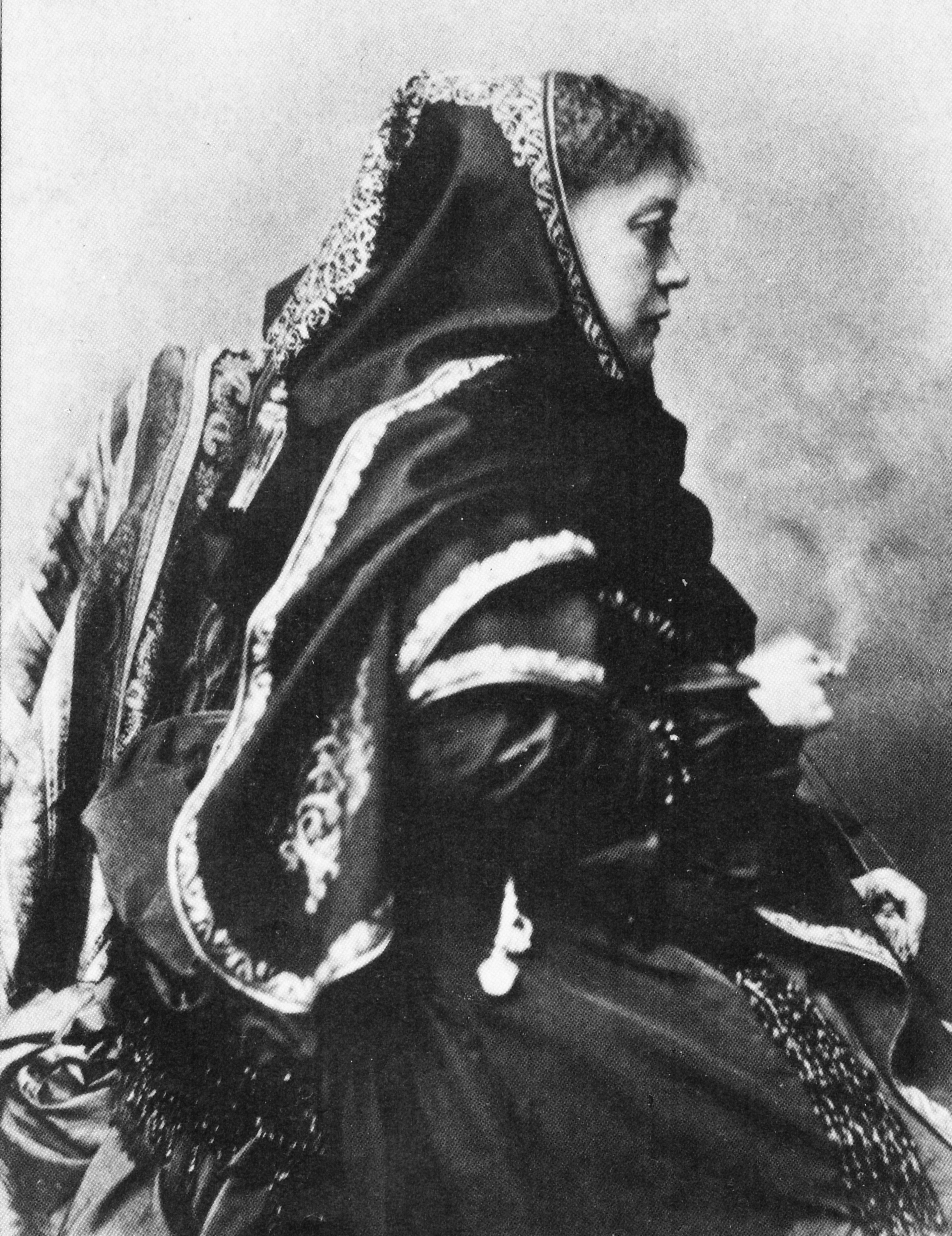
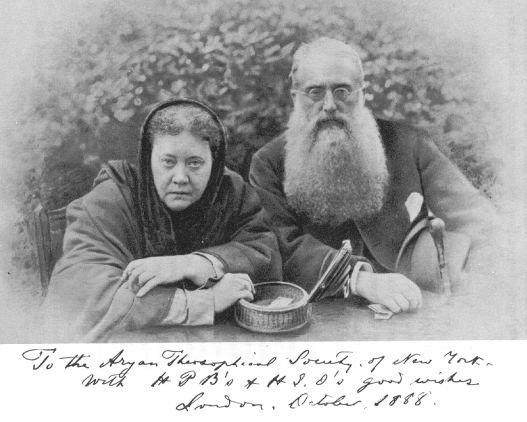
Blavatsky met Henry Steel Olcott at the Eddy Brothers seances in Chittenden, Vermont in October 1874. They co-founded the Theosophical Society in New York a year later, in November 1875. Isis Unveiled appeared in two volumes from J. W. Bouton in September 1877, sold its thousand-copy print run in ten days, and put her on the map. The Society moved to Bombay in 1879 and to Adyar Madras in 1882. In December 1884 the SPR sent Richard Hodgson out to Adyar to investigate the phenomena (the Mahatma letters dropping from ceilings, the apparitions of the Masters Morya and Koot Hoomi); he came back in 1885 with a 207-page report that called the letters forgeries and her a fraud. She left India and never returned. The Secret Doctrine appeared in London in two volumes in October and December 1888 and ran to roughly 1,500 pages. She died at 19 Avenue Road, St John's Wood, on 8 May 1891. The cosmological vocabulary the postwar American contactee tradition lives inside (Root Races, the Masters, the seven planes) is hers.
A Life
Blavatsky was born Helena Petrovna von Hahn on 12 August 1831 at Yekaterinoslav, an Imperial Russian provincial capital on the Dnieper river in what is now Ukraine. Her father was Peter von Hahn, a Mecklenburg-born Russian artillery officer of minor Baltic-German noble extraction; her mother Helena Andreyevna von Hahn was a novelist who published the early Russian feminist novels of the 1830s under the pen name Zenaida R-va. Her mother died of tuberculosis at twenty-eight in 1842 and Helena was raised by her maternal grandmother Helena Pavlovna Dolgorukov at Saratov. The Dolgorukov maternal grandfather had been a senior Imperial Russian administrator, and the Saratov household exposed her to the Russian aristocratic culture of the 1840s.
She married Nikifor Vladimirovich Blavatsky, an Imperial Russian provincial vice-governor at Yerevan, on 7 July 1849 at sixteen. The marriage lasted three months. She left Blavatsky in October 1849 and travelled abroad without his consent, retaining the Blavatsky surname for the rest of her life. The next twenty-five years of her life, from 1849 to 1873, are the documented Wandering Years of her biographical record: she travelled across Egypt, Greece, the Levant, the Black Sea, the Balkans, Western Europe, the United States, India, Tibet, and the Russian provinces, supported herself by music teaching, by inheriting from her family, by managing a Tiflis cork-import business in 1860, and by mediumistic sittings in the European spiritualist circuit of the 1860s.
She arrived in New York from Le Havre on 7 July 1873 at forty-one with no English. She lived in tenement housing on East 14th Street through the autumn of 1874, supporting herself by piecework needlework and by limited mediumistic activity. The decisive encounter came on 14 October 1874 at the William and Horatio Eddy farmhouse at Chittenden, Vermont, where Henry Steel Olcott had been investigating the Eddy brothers' materialisation seances on commission from the New York Daily Graphic. The Eddy Brothers material had been running in the Graphic from September 1874 as a press sensation of the period; Olcott had been resident at the Eddy farmhouse for the previous three weeks producing the published reports. Blavatsky travelled to Chittenden to meet Olcott on the strength of his published Graphic articles and the two formed the working partnership that ran for the rest of her life.
The Theosophical Society was founded in New York on 17 November 1875 at the rooms of the lawyer William Quan Judge. The founding meeting was attended by approximately sixteen people; Olcott was elected President, Judge was the Counsel, and Blavatsky was the Corresponding Secretary. The intellectual position the Society set out was that there exists an ancient wisdom-tradition common to all the major world religions, that this tradition has been preserved by a group of Adept Masters (the Mahatmas) in the trans-Himalayan region, that contact with the Masters is possible through trained psychical methods, and that the Society's purpose is to make the wisdom-tradition available to Western readers. The doctrinal framework was elaborated in Isis Unveiled across the next two years, dictated by Blavatsky through 1876 and 1877 with Olcott assisting as editorial collaborator.
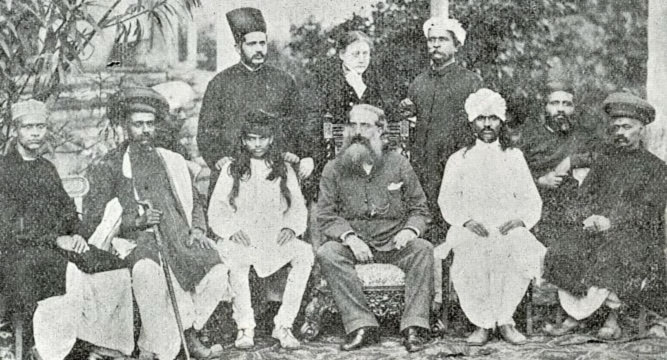
The Indian period of the Society opened in 1879 when Blavatsky and Olcott moved the Society's headquarters from New York to Bombay. They arrived at Bombay on 16 February 1879 and established the headquarters at Girgaum. The Society moved to its permanent headquarters at Adyar, Madras on 19 December 1882 on a substantial estate that remains the Society's international headquarters to the present day. Blavatsky was resident at Adyar from 1882 to February 1885 producing the Mahatma-letter material that became the central evidential question of the subsequent SPR investigation. The Coulomb dispute of February 1884, in which the Adyar housekeeper Emma Coulomb and her husband Alexis Coulomb broke with Blavatsky and produced their correspondence with her demonstrating fraud in the production of the Mahatma letters, was the crisis of the Adyar period.
The Society for Psychical Research sent Richard Hodgson to Madras from November 1884 to March 1885 to investigate the phenomena at first hand. The Hodgson Report appeared in the SPR Proceedings for December 1885 and rejected the Adyar phenomena as fraudulent in the technical sense documented in the Hodgson biography. The Report concluded that Blavatsky was "one of the most accomplished, ingenious, and interesting impostors in history" and produced the Theosophical Society-SPR rupture that ran across the rest of the late-Victorian psychical-research period.
Blavatsky left India in March 1885 for health reasons (her kidney disease was already advanced by this point) and returned to Europe via Naples, Würzburg, Ostend and London. She produced The Secret Doctrine across the 1885 to 1888 period from these European bases, with William Quan Judge and the Theosophist Bertram Keightley acting as editorial collaborators in London. The two-volume work appeared from the Theosophical Publishing Company at London in October and December 1888. She moved permanently to London in May 1887 and established the Blavatsky Lodge of the Theosophical Society at 17 Lansdowne Road, Holland Park. Annie Besant joined the Society in 1889 after reviewing The Secret Doctrine for W. T. Stead's Pall Mall Gazette; the late-Blavatsky London period from 1887 to 1891 produced the next-generation Theosophical leadership Besant would inherit. Blavatsky died of influenza on 8 May 1891 at the 19 Avenue Road, St John's Wood Theosophical premises she had been resident at since 1890. She was fifty-nine.
There is no religion higher than truth.The Theosophical Society motto, adopted by Blavatsky and Olcott at the founding November 1875 New York meeting
Isis Unveiled and The Secret Doctrine
Isis Unveiled: A Master-Key to the Mysteries of Ancient and Modern Science and Theology appeared from J. W. Bouton at New York in September 1877 in two volumes of approximately 650 pages each. The first volume, subtitled "Science," surveyed the late-nineteenth-century scientific and philosophical literature against the Theosophical position; the second volume, subtitled "Theology," surveyed the comparative religion literature. The doctrinal framework set out across both volumes was the proposition that the great religious and philosophical systems of antiquity had a common esoteric origin in an ancient wisdom-tradition preserved by the Brotherhood of Adept Masters.
The Secret Doctrine: The Synthesis of Science, Religion, and Philosophy appeared from the Theosophical Publishing Company at London in October 1888 (Volume I "Cosmogenesis") and December 1888 (Volume II "Anthropogenesis") in an expanded and reframed version of the Isis Unveiled material. The two volumes ran to approximately 1,500 pages combined and were structured around the "Stanzas of Dzyan," a putatively ancient esoteric text Blavatsky claimed to be translating from a manuscript in the trans-Himalayan Senzar language. The doctrinal content covered cosmological evolution from the unmanifest absolute through to the material universe, anthropological evolution through seven Root Races across the earth-evolutionary cycle, and a comparative-religion analysis placing the Stanzas of Dzyan at the root of the world's religious and philosophical traditions.
The intellectual inheritance of The Secret Doctrine across the twentieth century is documented across the Theosophical, post-Theosophical, and contactee literature. The Annie Besant and Charles Webster Leadbeater Theosophical leadership from 1907 onwards produced the elaboration of the Blavatsky framework into the twentieth-century Theosophical doctrinal corpus. The Alice Bailey post-Theosophical sequence of the 1920s and 1930s, the Guy Ballard and Edna Ballard I AM Activity of the 1930s, and the American contactee tradition the archive documents from 1947 onwards each inherited elements of the Blavatsky Master-and-Adept framework into the American post-war UAP literature.
The Blavatsky Theosophical doctrinal framework runs forward into the American contactee tradition the archive documents in its contactee-era material. The Master-and-Adept framework that George Adamski, George Hunt Williamson, George Van Tassel, Truman Bethurum and the 1950s American contactee figures inherited derives directly from the Blavatsky Mahatma-of-the-Himalayas framework set out in Isis Unveiled and The Secret Doctrine. The Borderland Quarterly Volume 1 Number 4 of April 1894 Gallery profile by W. T. Stead carried Olcott's reminiscences of Blavatsky as the principal English-language editorial account of her Russian and Wandering Years.
The Hodgson Report and the Theosophical-SPR Rupture
The 1884 Coulomb dispute at Adyar, in which the Theosophical Society housekeeper Emma Coulomb and her husband Alexis Coulomb broke with Blavatsky and produced their correspondence with her demonstrating the technical means of producing the Mahatma-letter phenomena, was the crisis that occasioned the SPR investigation. The Society sent Richard Hodgson to Madras from late November 1884 to March 1885 to investigate the phenomena and the Coulomb correspondence at first hand. The Hodgson Report appeared in the SPR Proceedings for December 1885 as approximately 250 pages of technical investigation and rejected the Adyar phenomena as fraudulent.
The Theosophical Society response, the 1885 W. T. Brown Adyar Report, contested the Hodgson methodology and rejected his conclusions. The Hodgson-Blavatsky dispute ran across the rest of the late-Victorian psychical-research period and produced the editorial position the Borderland Quarterly took across all four volumes of holding both the SPR and the Theosophical Society communities in editorial conversation without taking sides on the underlying Hodgson Report. The twentieth-century Theosophical literature has continued to reject the Hodgson Report; the SPR itself commissioned the 1986 Vernon Harrison reassessment H.P. Blavatsky and the SPR, which argued that Hodgson's handwriting-comparison methodology was inadequate by modern forensic standards and that the conclusions of the Report required revision.
Photographs
Significance to the Archive
Blavatsky matters to this archive as the doctrinal founder of the Theosophical Society and as the immediate intellectual ancestor of the postwar American contactee tradition. The Mahatma-and-Adept framework she set out in Isis Unveiled of 1877 and elaborated in The Secret Doctrine of 1888 is the documented intellectual source of the 1950s American contactee literature the archive holds across its mid-twentieth-century collections. The George Adamski, George Hunt Williamson, Guy Ballard, Truman Bethurum, and Edna Ballard contactee material of the 1930s, 1940s and 1950s each inherits elements of the Blavatsky framework into the postwar American UAP literature.
The Theosophical-tradition lineage from Blavatsky through Annie Besant and C. W. Leadbeater (the principal twentieth-century Theosophical leadership succession) into the twentieth-century occult and esoteric literature is one of the four principal English-language pre-1947 intellectual currents the archive's documentary record runs through. The Borderland Quarterly Volume 1 Number 4 of April 1894 Gallery profile of Blavatsky by W. T. Stead via Olcott's reminiscences is the documented principal English-language editorial treatment of her work in the late-Victorian periodical press.