Annie Besant
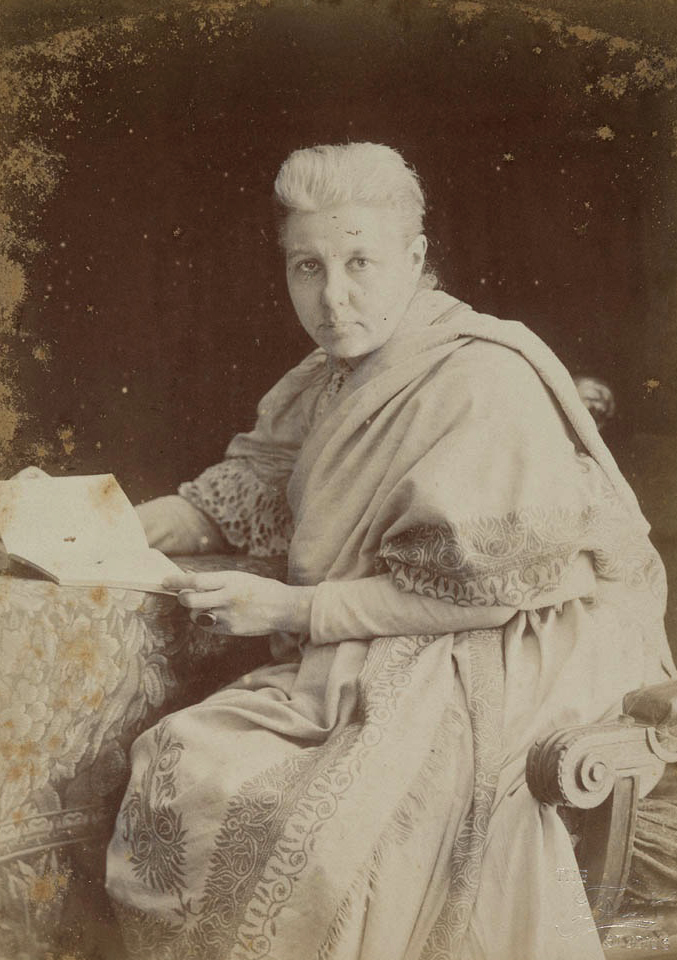
Annie Besant succeeded Henry Steel Olcott as Theosophical Society President in 1907 and held the office until her death at Adyar Madras in September 1933. Before Theosophy she was a London freethought lecturer. She stood trial with Charles Bradlaugh in 1877 over the birth-control pamphlet The Fruits of Philosophy. She was one of the founding members of the Fabian Society in 1884. The turn came in 1889 when the Pall Mall Gazette sent her Blavatsky's Secret Doctrine to review, and she joined the Theosophical Society within months. She moved to Adyar Madras in 1893 and spent the next forty years there, founding the Indian Home Rule League in 1916 and organising politically across India until her death. The Borderland Quarterly closing number of October 1897 carried her frontispiece, from a Sarony photograph, in her sixth year of the Adyar leadership.
A Life
Besant was born Annie Wood on 1 October 1847 at Clapham, London, the second of the three children of William Persse Wood, a Trinity College Dublin medical graduate who worked in the London commercial sector, and Emily Morris. Her father died of tuberculosis when she was five and she was sent at eight to live with Ellen Marryat, the unmarried sister of the novelist Frederick Marryat, at Charmouth in Dorset. The Marryat household provided her with an evangelical Anglican upbringing and an excellent classical-and-modern-languages education across the 1855 to 1863 period.
She met Frank Besant, a Lincolnshire clergyman, at her brother's Cambridge boarding house in summer 1866 and married him on 21 December 1867 at Manchester, age twenty. The marriage produced two children, Arthur Digby Besant born January 1869 and Mabel Emily Besant born August 1870. The religious crisis of 1872 to 1873 produced her break with Anglican Christianity; she could not in conscience receive Communion at Frank Besant's Sibsey, Lincolnshire parish on Easter Day 1873 and the separation followed in October 1873. The legal separation was formalised through to 1878 with custody of Mabel to Annie Besant and Digby to Frank Besant; the arrangement was substantially revised through subsequent litigation across the 1870s.
The London freethought period opened in August 1874 when Besant attended a lecture at the Hall of Science by Charles Bradlaugh, the editor of the National Reformer and President of the National Secular Society. She joined the NSS shortly after and became Bradlaugh's editorial collaborator on the National Reformer through to 1885. The Knowlton Trial of 1877 ran from 18 June 1877 at the Court of Queen's Bench at Westminster; Besant and Bradlaugh had jointly republished the Charles Knowlton 1832 American birth-control pamphlet The Fruits of Philosophy as a challenge to the 1857 Obscene Publications Act. They were convicted at the jury trial on a verdict that the pamphlet was likely to deprave but that the defendants had not been "actuated by corrupt motives," sentenced to six months' imprisonment and a 200-pound fine, and the conviction was quashed on appeal in February 1878 on a technical defect in the indictment.
The social-democratic period of 1884 to 1889 placed her in the Fabian Society founding membership of January 1884 and the London matchgirls' strike organisation of June and July 1888. The matchgirls' strike at Bryant and May factory at Bow, organised by Besant in response to her Halfpenny Weekly investigation of the working conditions, was the English-language industrial-organising precedent of the late-Victorian period. She joined the London School Board in November 1888 representing Tower Hamlets and held the seat through to 1891. She joined the Social Democratic Federation in 1888 and the Bloomsbury Socialist Society in the same period.
The Theosophical conversion came in 1889. W. T. Stead, then editor of the Pall Mall Gazette, sent her a review copy of Blavatsky's two-volume Secret Doctrine in early 1889 with the editorial request to produce a critical review for the Gazette. She read the work across the spring of 1889, produced the review (which appeared in the Gazette on 25 April 1889 in favourable terms), and requested a meeting with Blavatsky. She met Blavatsky at the 17 Lansdowne Road, Holland Park premises of the Blavatsky Lodge of the Theosophical Society on 10 May 1889 and joined the Society on 21 May 1889. The 1889 conversion was one of the editorial sensations of the late-Victorian London press and produced extensive contemporary commentary in the freethought, socialist, and Anglican press across the autumn of 1889.
The late-Blavatsky period from 1889 to May 1891 produced the working relationship that prepared the succession. Besant served as the co-editor of Lucifer, Blavatsky's monthly Theosophical journal, from 1890 onwards, and as the co-secretary of the Inner Group of the Esoteric Section. Blavatsky died on 8 May 1891 of influenza at the 19 Avenue Road premises in St John's Wood; Besant inherited the London Lodge leadership and the editorship of Lucifer in the immediate aftermath. The 1891 to 1907 period placed her at the Adyar Madras headquarters from 1893 onwards as Olcott's working second-in-command and ran her through the 1894 to 1895 W. Q. Judge Case schism between the American Section under Judge and the Adyar Section under Olcott.
The 1907 succession to Olcott's Presidency on his death at Adyar in February 1907 placed her at the head of the Theosophical Society for the next twenty-six years. The Krishnamurti period from 1909 to 1929 ran the identification of the Madras-born Theosophical pupil Jiddu Krishnamurti as the World Teacher of the coming age, the Order of the Star in the East organisational apparatus around the World Teacher mission, and the November 1929 Ommen dissolution of the Order by Krishnamurti himself in his "Truth is a pathless land" address. The Indian Home Rule League founding of September 1916, the 1917 to 1923 Indian National Congress leadership, and the 1917 internment by the Madras Presidency colonial administration produced the Indian political-organising contribution that ran alongside the Theosophical leadership across the 1916 to 1933 period.
She died at Adyar Madras on 20 September 1933, age eighty-five, after a working career of approximately sixty years across freethought, socialist, Theosophical, and Indian political organising. The Adyar Theosophical Society headquarters has remained the international centre of the Society from her Presidency through to the present day.
It does not matter what religion a man holds, so long as he holds it strongly enough to live it.Annie Besant, Theosophical Society Presidential Address, Adyar 1907
The 1889 Conversion and Theosophical Leadership
The 1889 conversion was the editorial event of the late-Victorian London press from the freethought side, and the testing event of the Theosophical Society's English-language reception from the Theosophical side. Besant's freethought reputation rested on the twenty-year working partnership with Bradlaugh, on the Knowlton Trial, on the National Reformer editorship, and on the London School Board work. Her 1889 movement to the Theosophical position was widely understood across the London press as an intellectual conversion of the late-nineteenth-century freethought generation toward the esoteric tradition that the Society represented.
The doctrinal output across the 1890 to 1933 period was the co-authored Thought-Forms of 1901 with Charles Webster Leadbeater (the Theosophical illustrated treatment of the clairvoyantly-perceived form of thoughts), the twelve-volume Adyar Pamphlets series, the Esoteric Christianity of 1901, the The Ancient Wisdom of 1897 (reviewed in the closing Borderland Volume 4 Number 4 of October 1897), and the Lectures on the Bhagavad Gita of 1906. The Adyar Library and Research Centre was established under her Presidency in 1886 and built into the twentieth-century South Asian Theosophical scholarly apparatus across her three decades of Presidency.
Besant features across the Borderland Quarterly editorial roster: as contributor across all four volumes, as subject of editorial coverage including the "Shall We Live After Death?" symposium of Volume 3 Number 13 of July 1896, as the Volume 4 Number 4 of October 1897 closing-number frontispiece from a Sarony photograph, and as the author of The Ancient Wisdom reviewed in the same closing number. The Stead-Besant working relationship from the 1889 Secret Doctrine review onwards is documented across the Borderland editorial record.
Indian Home Rule
The Indian political-organising period from 1913 onwards placed Besant in the Indian National Congress as the senior English Theosophical figure aligned with the Home Rule movement. She established the Indian Home Rule League on 1 September 1916 at Madras as the Theosophical-aligned parallel to the Bal Gangadhar Tilak Home Rule League founded earlier the same year. The 1916 to 1917 Home Rule campaign produced the June 1917 internment of Besant and the collaborators George Arundale and B. P. Wadia by the Madras Presidency colonial administration under the Defence of India Act 1915. She was held at Ootacamund through to September 1917.
The release of Besant in September 1917 produced her election as President of the Indian National Congress at the December 1917 Calcutta session, the first woman to hold the office. She held the Congress Presidency for the one-year term through to December 1918. The late-Besant Indian political period from 1918 to 1933 placed her in continuing working relationship with the Congress leadership, including with Gandhi from 1919 onwards (though the Besant-Gandhi positions diverged across the 1919 to 1922 non-cooperation movement period). She continued the Theosophical leadership at Adyar across the same period.
Significance to the Archive
Besant matters to this archive as the second-generation Theosophical leader who carried the Blavatsky doctrinal tradition into the twentieth-century English-language Theosophical and esoteric literature. The twenty-six-year Presidency from 1907 to 1933 covered the Theosophical Society institutional consolidation, the Krishnamurti World Teacher mission, and the Indian Home Rule contribution. Her editorial and lecturing output across the 1889 to 1933 forty-four-year period is the English-language Theosophical doctrinal corpus the postwar American contactee tradition the archive documents in its contactee-era material inherited.
The Borderland Quarterly Volume 4 Number 4 of October 1897 closing-number frontispiece from a Sarony photograph carried her at the editorial centrepiece of the closing volume, alongside the closing "Halt for the Present" editorial of W. T. Stead and the three closing Borderlanders Gallery profiles of Tennyson, Socrates, and Elizabeth Barrett Browning. The Stead-Besant editorial relationship from the 1889 Secret Doctrine Pall Mall Gazette review through to the closing Borderland number eight years later is documented across the Borderland editorial record.