Sigmund Freud
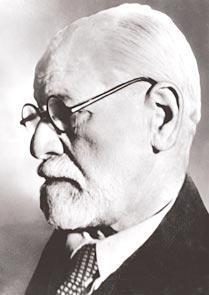
The founding-father literature of psychoanalysis tends not to mention that Freud was a working member of the Society for Psychical Research from 1911 and of the American SPR from 1915. He had been arguing with Jung about parapsychological phenomena since 1907. In August 1921 he dictated 'Psychoanalysis and Telepathy', which Ernest Jones talked him out of publishing. He published 'Dreams and Telepathy' in Imago the following year. The 1925 edition of The Interpretation of Dreams added a chapter on the occult significance of dreams. The 1933 New Introductory Lectures on Psychoanalysis included Lecture 30, 'Dreams and Occultism', in which he set out what he had concluded across thirty years of private case material: that thought-transference, in the controlled clinical setting, was real, even if the mechanism remained unexplained. He died in London on 23 September 1939.
A Life
Freud was born on 6 May 1856 at Freiberg in Moravia (now Příbor in the Czech Republic), then the Austrian Empire, the eldest of the eight children of Jakob Freud, a Jewish wool merchant of small means, and Amalia Nathansohn, Jakob's third wife and twenty years younger than her husband. The Freud household moved to Vienna in 1860 and Freud lived there for the next seventy-eight years, at the apartment at Berggasse 19 from 1891. He took the University of Vienna medical degree in March 1881 at twenty-four after a long student career, then worked at the Vienna General Hospital under Theodor Meynert (the brain anatomy chair) and Hermann Nothnagel (internal medicine) through to 1885.
The decisive professional turn came with the five-month residency at the Salpêtrière in Paris from October 1885 to February 1886 under Jean-Martin Charcot, the neurologist of the period and the principal investigator of hysteria. Freud returned to Vienna from the Charcot studies in February 1886, set up his private neurology practice at Maria Theresienstrasse 8, married Martha Bernays on 13 September 1886 at Wandsbek near Hamburg, and across the 1886 to 1895 period developed the working methods that would become psychoanalysis: free association, the abandonment of hypnosis in favour of the talking cure, the working analysis of dreams as material, the concept of resistance and transference. The 1895 Studies on Hysteria with Josef Breuer is the published opening of the psychoanalytic literature; The Interpretation of Dreams, completed in 1899 and dated 1900 by the publisher Franz Deuticke, is the working foundation of the field.
The international psychoanalytic movement developed from the 1902 Vienna Wednesday Society meetings at the Berggasse 19 apartment, through the 1908 First International Psychoanalytic Congress at Salzburg, the 1909 lectures at Clark University in Worcester Massachusetts (the only American visit Freud made, with Carl Jung accompanying him), the 1910 International Psychoanalytic Association founding at Nuremberg, and the 1911 Adler break and 1913 Jung break. Freud's six daughters and son included Anna Freud, born 3 December 1895, who would become the principal continuer of his work and the founder of child analysis. The Wednesday Society at the Berggasse 19 apartment ran from autumn 1902 until 1938, with Ferenczi, Abraham, Jones, Rank, Eitingon, Reik, and the wider Vienna circle as its core membership.
The First World War interrupted the practice and produced the 1920 Beyond the Pleasure Principle and the 1923 The Ego and the Id with their new tripartite structural model of the mind (ego, id, super-ego) that superseded the unconscious-preconscious-conscious topographic model of the 1900 Interpretation of Dreams. The April 1923 diagnosis of cancer of the jaw and palate produced the substantial physical decline of his last sixteen years: thirty-three operations between 1923 and 1939, the use of a prosthetic palate that he called "the monster," and continuous discomfort. He continued working through to his death.
The Anschluss of 12 March 1938 placed Vienna under Nazi rule. The Berggasse 19 apartment was raided by the Gestapo on 22 March 1938. Anna Freud was interrogated by the Gestapo on the same day. The Freuds were granted exit visas after sustained negotiation by Ernest Jones in London, the American Ambassador William Bullitt, the British Ambassador Sir Walford Selby, and the Princess Marie Bonaparte (who paid the exit tax). The household left Vienna by train on 4 June 1938 and arrived in London on 6 June 1938. Freud took up residence at 20 Maresfield Gardens, Hampstead, on 27 September 1938. He died at the Hampstead house on 23 September 1939 at eighty-three after Max Schur, his physician of twenty years, administered the morphine doses Freud had requested when his pain became unmanageable. He had been a naturalised British subject for two weeks. The Berggasse 19 apartment was preserved as the Sigmund Freud Museum in Vienna; 20 Maresfield Gardens is preserved as the Freud Museum London.
If I had my life to live over again, I should devote myself to psychical research rather than to psychoanalysis.Sigmund Freud, attributed in conversation with Carl Jung c. 1911, recorded in Jung's Memories, Dreams, Reflections (1962)
The Telepathy Question
Freud's documented engagement with telepathy and thought-transference ran across forty years of the practice. He had read F. W. H. Myers's Human Personality and Its Survival of Bodily Death of 1903 in the first edition and the Vienna Psychoanalytic Society included Myers material in its Wednesday Society discussions of the early 1900s. He was elected an Honorary Associate Member of the Society for Psychical Research in 1911 and an Honorary Member of the American Society for Psychical Research in 1915. The Jung correspondence of 1907 to 1913 carries the working discussions of parapsychological phenomena between Freud and Jung that Jung documented in his 1962 Memories, Dreams, Reflections.
The published Freud literature on telepathy consists of: "Psychoanalysis and Telepathy," dictated in August 1921 and circulated as a private paper to Sándor Ferenczi and Ernest Jones, on whose advice Freud held back from publication and which was published posthumously in 1941 in the Gesammelte Werke; "Dreams and Telepathy," published in Imago in 1922, working through three telepathic-dream case reports from his practice; the new chapter "The Occult Significance of Dreams" added to the 1925 edition of The Interpretation of Dreams; "Some Additional Notes on Dream-Interpretation as a Whole" of 1925, the section on prophetic dreams; and Lecture 30 "Dreams and Occultism" of the 1933 New Introductory Lectures on Psychoanalysis, which Freud presented as the closing working statement on the question.
The position Freud held across these papers was that the thought-transference phenomenon was likely real but that the psychoanalytic apparatus could account for it as a regression of the unconscious to an older mode of communication that had preceded language. He took the position publicly with reluctance, against the advice of Ernest Jones and the wider psychoanalytic movement that feared the credibility cost of being associated with parapsychology. The 1933 Lecture 30 closing position was that the question of telepathy "is not bound up with psychoanalysis... but it is itself a topic of psychological investigation."
Freud's 1911 SPR Honorary Associate election and the documented 1907 to 1913 Jung correspondence on parapsychological phenomena place him alongside the late-Victorian psychical-research investigation community the archive documents through the F. W. H. Myers, Oliver Lodge, and Richard Hodgson biographies. The Vienna Wednesday Society held Myers's 1903 Human Personality as a working reference text.
Photograph
Significance to the Archive
Freud matters to this archive as the founding figure of psychoanalysis whose forty-year private interest in telepathy is documented across the 1911 SPR Honorary Associate election, the 1921 "Psychoanalysis and Telepathy" private paper, the 1922 "Dreams and Telepathy" Imago publication, the 1925 chapter addition to The Interpretation of Dreams, and the 1933 closing Lecture 30 of the New Introductory Lectures on Psychoanalysis. The Freud position on telepathy is the documented engagement of one of the major working psychological investigators of the period with the late-Victorian psychical-research tradition the archive's pre-1947 reference layer documents through Myers and Lodge.
The Jung correspondence of 1907 to 1913 and the Carl Jung post-Freud career (the documented Jung interest in flying saucers across the 1947 to 1958 period, culminating in the 1958 Flying Saucers: A Modern Myth of Things Seen in the Skies) traces forward from the Freud-Jung working partnership through to the late twentieth-century psychoanalytic engagement with the UAP question that the archive's mid-twentieth-century collections document.