Sir Oliver Lodge
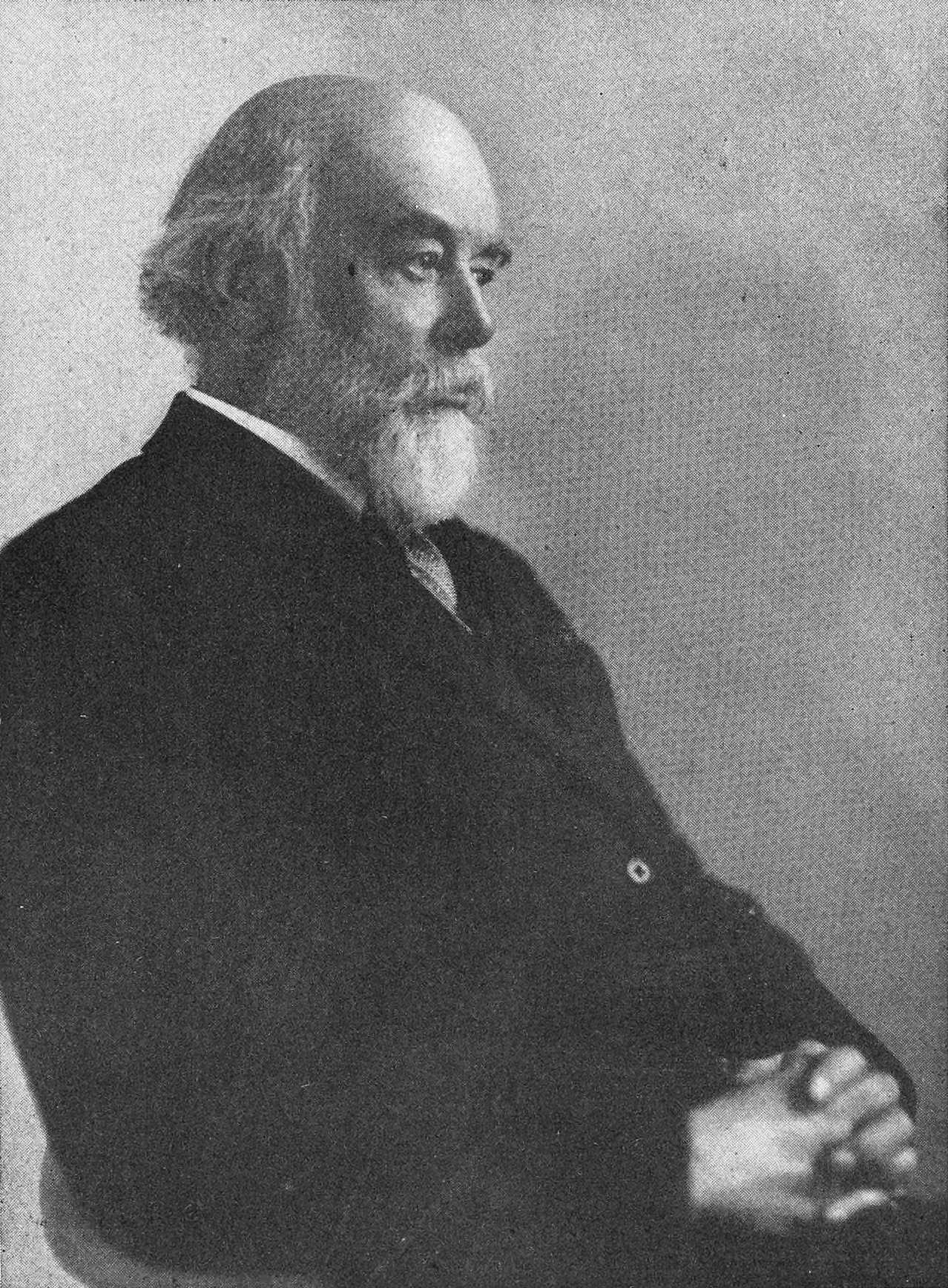
Lodge held the foundation Chair of Physics at University College Liverpool from 1881 and was the first Principal of the new University of Birmingham from 1900 to 1919. On 14 August 1894, at the British Association meeting in Oxford, he demonstrated wireless telegraphic transmission across a lecture theatre. Marconi filed his improved circuit eight months later and took the credit for the rest of the century. The SPR side ran in parallel. Lodge joined in 1884, sat with Mrs Piper at Cambridge and Liverpool through the 1889-90 winter alongside Myers and Sidgwick, and held the SPR Presidency from 1901 to 1904. His son Raymond was killed at Hooge in the Ypres salient on 14 September 1915. Raymond, or Life and Death appeared in November 1916, ran through twelve editions in five years, and is the substantive English-language psychical-research book of the First World War.
A Life
Lodge was born on 12 June 1851 at Penkhull, a village outside Stoke-on-Trent in the Staffordshire Potteries, the eldest of the nine children of Oliver Lodge senior, a ball-clay merchant who supplied the local Staffordshire pottery industry, and Grace Heath. He was educated at Newport Grammar School and was set by his father to work in the family clay business at sixteen. He read for his BSc from London at evening classes while working in the clay trade by day, took the degree in 1872, and finally broke free of the Potteries to attend the Royal College of Science in South Kensington as a research student in 1873. He took the London DSc in 1877 and was elected a Fellow of University College London in 1879.
In April 1881 he was appointed to the foundation Chair of Physics at the new University College Liverpool, then a constituent college of Victoria University Manchester. He was twenty-nine. He held the Liverpool chair for the next nineteen years and built up the physics department to international standing through his own teaching and through the workshop tradition he established. He met Mary Marshall in Liverpool, married her in 1877 just before the appointment, and the marriage produced twelve children, six sons and six daughters, of whom Raymond Lodge was the sixth son and the seventh child.
The substantive Liverpool research programme was on the propagation of electromagnetic waves through space. He demonstrated the coherer principle in 1894 at the British Association meeting at Oxford on 14 August. The coherer was a small glass tube containing iron filings that became conductive when an electromagnetic wave passed through it, allowing the wave to be detected on a galvanometer at a distance from the transmitter. He used the coherer to detect a Morse-code signal transmitted from one Oxford lecture-theatre to a neighbouring one and demonstrated the principle of wireless telegraphy in front of the British Association audience. The patent he subsequently filed was for the syntonic tuning system that allowed multiple wireless signals to be transmitted on different frequencies without interference. Guglielmo Marconi filed his British provisional patent for wireless telegraphy on 2 June 1896, twenty-two months after the Lodge Oxford demonstration, with the improvements that made commercial wireless telegraphy possible.
In April 1900 Lodge was appointed the first Principal of the University of Birmingham, the new civic university that had been chartered the previous year. He held the Principalship for nineteen years through to his retirement in 1919, building the institution from its first cohort to its position as the principal Midlands research university. He was knighted in 1902 in the King's Birthday Honours List for his contributions to physics.
He had been admitted to the Society for Psychical Research in 1884 at the suggestion of his Cambridge contemporary William F. Barrett and joined the SPR Council in 1888. He took the SPR Presidency for the 1901 to 1904 sessions, succeeding F. W. H. Myers (who had held the post in 1900 just before his death). His own SPR Presidential Address in 1902 set out the methodological position he held to the end of his life: that the question of post-mortem survival was empirically investigable, that the SPR census of cases warranted a survival hypothesis as the best fit, and that physicists in particular had no special difficulty with the framework given the ether-and-energy vocabulary of late-Victorian physics.
The substantive personal turning point of his late life was the death of his sixth son Raymond Lodge on the night of 14 September 1915 at Hooge in the Ypres salient. Raymond Lodge was a Second Lieutenant in the South Lancashire Regiment, twenty-six years old, struck by a shell fragment that pierced his right lung. Sittings with Mrs. Osborne Leonard in October and November 1915 produced communications that Lodge identified as substantively coming from Raymond, including the famous "photograph reference" of November 1915 in which Raymond described a photograph of himself with fellow officers that had been taken in August 1915 and was unknown to the Lodge family at the time of the sitting. The photograph subsequently arrived at the Lodge family home in December 1915 and matched Raymond's description. Lodge published Raymond, or Life and Death in November 1916, which ran through twelve editions in the first five years and became the substantive English-language psychical-research book of the First World War.
He continued working through the 1920s and 1930s on both his physics interests and his psychical research. He died at Lake House, Wilsford, Wiltshire on 22 August 1940 at eighty-nine, having outlived the Marconi priority dispute, the First World War, and the substantive late-Victorian psychical-research community in which his SPR career had been formed.
I tell you with all my strength of conviction that we do persist, that people still continue to take an interest in what is going on, that they still help us and know far more about things than we do.Sir Oliver Lodge, Raymond, or Life and Death (London, 1916), Part III
Wireless Telegraphy
The Lodge coherer of 1894 was the substantive British wireless-detection apparatus that preceded Marconi's improved British circuit. The 14 August 1894 demonstration at the British Association meeting at Oxford was the first public demonstration in Britain of wireless transmission and detection at a useful range. Lodge's 1898 syntonic tuning patent, which allowed multiple wireless circuits to operate on distinct frequencies without mutual interference, was the substantive intellectual property at issue in the subsequent Lodge-Marconi priority dispute of the early 1900s. The Marconi Company acquired the Lodge patents in 1911 in a substantive commercial settlement that resolved the priority question.
The wireless work mattered to Lodge's psychical-research position. The substantive editorial argument he set out across his SPR addresses and in The Ether of Space of 1909 was that the demonstrated existence of invisible electromagnetic radiation propagating through space without a material medium was a substantive physical precedent for considering other forms of invisible communication. The Crookes-tube to Roentgen-rays lineage that the Borderland Volume 4 Number 2 of April 1897 carried in his frontispiece issue was the parallel substantive argument from the Crookes side, and the two arguments were held in conversation across the SPR Proceedings of the period.
Borderland and the Piper Investigation
Lodge was a sustained contributor to Borderland Quarterly across all four volumes. The Volume 2 Number 7 of January 1895 carried his substantive "Report on Eusapia Paladino" at page 46, the first English-language SPR-positive report on Eusapia Paladino following the summer 1894 sittings at Charles Richet's Mediterranean island Île Roubaud where Lodge had attended alongside Myers and Richet. The Volume 4 Number 2 of April 1897 carried his frontispiece portrait at the editorial centrepiece of the closing volume and his own "Attitude of Spiritualists to Men of Science" article at page 160.
The substantive Piper investigation he had conducted at Cambridge and Liverpool through the winter of 1889 to 1890 was the documented late-Victorian transatlantic mediumistic-investigation sequence the SPR Proceedings carried at greatest length. Richard Hodgson, the principal Boston investigator of Mrs. Piper, had arranged for Piper to be brought to England in November 1889 and to be kept under surveillance by Lodge at Liverpool, by F. W. H. Myers and Henry Sidgwick at Cambridge, and by other SPR investigators across the period. The English sittings of November 1889 to February 1890 produced the substantive transatlantic confirmation of the Piper case that Hodgson's 1898 SPR Report relied on.
Lodge's full Borderland-period editorial contribution is documented across all four volumes of the Borderland Quarterly collection page, with the Volume 2 Number 7 of January 1895 Eusapia Paladino report and the Volume 4 Number 2 of April 1897 frontispiece-and-article appearance as the two substantive contributions. The Piper investigation he conducted alongside Myers and Hodgson is the documented late-Victorian transatlantic investigative methodology that the post-1945 American civilian-research community inherited.
Raymond
Raymond, or Life and Death appeared in November 1916 and ran through twelve editions in the first five years. The book is in three parts: the substantive biographical record of Raymond Lodge through Eton, Birmingham University, his commissioning into the South Lancashire Regiment in September 1914, the front-line service in France from March 1915, and his death at Hooge on the night of 14 September 1915; the substantive sittings record of the October 1915 onwards communications received through Gladys Osborne Leonard and other mediums that Lodge identified as substantively coming from Raymond; and the substantive philosophical reflection on the survival evidence.
The "photograph reference" of November 1915 was the most-cited evidential element in the published case. Raymond's communicator, speaking through Mrs. Osborne Leonard at a sitting on 17 November 1915, described a photograph that had been taken of Raymond and fellow officers of his battalion in August 1915 in front of a French farmhouse, with Raymond seated in the front row and a fellow officer leaning on his shoulder. Neither Mrs. Leonard nor Lady Lodge had seen the photograph or knew of its existence at the time of the sitting. The photograph, taken on 24 August 1915 by Captain Cheves of the South Lancashires, was forwarded to Lady Lodge by Captain Cheves's mother on 7 December 1915, three weeks after the sitting, and matched Raymond's communicated description in respects Lodge documented at length in the book.
The Raymond book inherited F. W. H. Myers's subliminal-self vocabulary directly and applied it to a single substantively-documented case. It is the substantive English-language psychical-research book of the First World War period and is read alongside Myers's posthumous Human Personality of 1903 as one of the two principal late-Victorian and Edwardian bibliographic sources of the post-1945 BSRA Survival framework.
Significance to the Archive
Lodge sits in the archive's pre-1947 reference layer as the late-Victorian physics counterpart to Crookes, with the substantive wireless-telegraphy programme of the 1890s providing the parallel physical precedent the SPR psychical-research community drew on. The 14 August 1894 Oxford demonstration of wireless transmission is the documented British origin of the technology Marconi commercialised two years later. The substantive SPR Presidency of 1901 to 1904 and the Raymond book of 1916 carry the late-Victorian psychical-research investigative discipline into the early-twentieth-century literature that the postwar civilian-research community inherited.
The substantive editorial appearance in Borderland Quarterly Volume 4 Number 2 of April 1897 as the frontispiece subject of the closing volume's central issue, alongside the William Crookes Gallery profile, is the documentary record of Lodge as one of the two principal late-Victorian physics figures the Borderland editorial community drew on. The Crookes-Lodge late-Victorian physics pairing is the substantive intersection the archive's pre-1947 reference layer runs through.