Thomas Edison
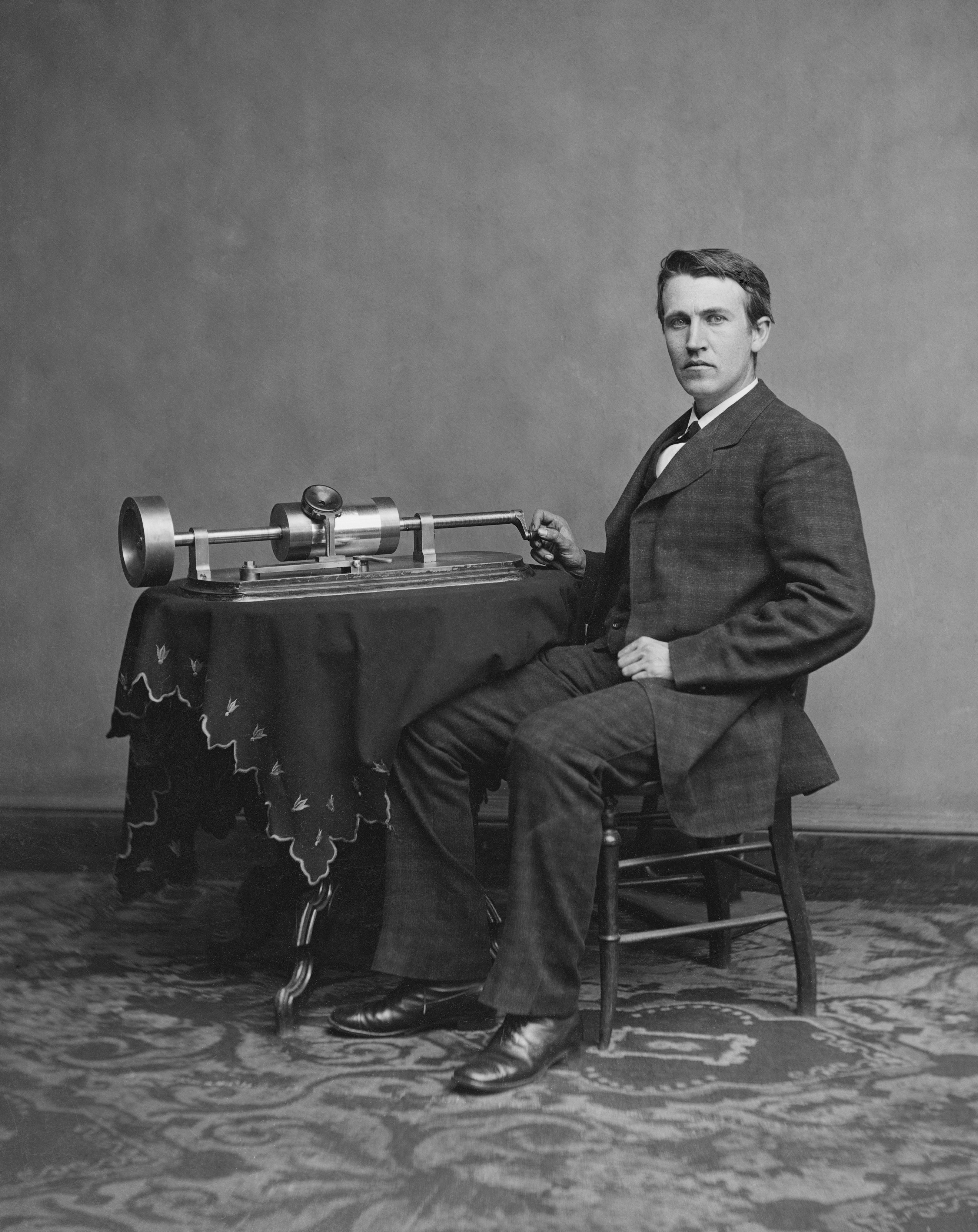
Edison filed his first patent in 1869, a vote-recording machine Congress declined to buy. By the time he died in 1931 he had 1,093 American patents to his name, including the phonograph (December 1877), the practical incandescent light (October 1879), the carbon microphone, the kinetoscope, and the Edison Effect that became the vacuum diode. He is in this archive for the October 1920 interview B. C. Forbes ran in American Magazine, and the Scientific American interview the same month, in which Edison said he was working on a valve apparatus sensitive enough to receive communications from the dead. He told both interviewers it was a serious engineering proposal and not a metaphor. The apparatus was never finished. No working diagrams survived him. The spiritualist press of the 1920s called it the Edison Spirit Phone and ran with it, and the proposal has cycled through the contactee literature ever since.
A Life
Edison was born on 11 February 1847 at Milan, Ohio, the seventh and youngest child of Samuel Ogden Edison Jr., a Canadian-born exiled rebel from the 1837 Upper Canada rebellion who had become a shingle merchant at Milan, and Nancy Matthews Elliott, a Connecticut Yankee schoolteacher. The family moved to Port Huron, Michigan in 1854 when the Milan canal trade collapsed. Edison was educated at home by his mother after a brief 1854 to 1855 Port Huron public-school period in which the teacher reported him as "addled" (later attributed to the partial deafness Edison had carried from a childhood scarlet-fever attack, which by his teenage years had progressed to near-total deafness in the left ear and deafness in the right). The mother's home schooling ended at twelve when Edison began working as a Grand Trunk Railway newsboy on the Port Huron to Detroit line.
The decisive professional turn came in 1862 at the Mount Clemens Michigan railway station, where Edison rescued the three-year-old Jimmy MacKenzie from an oncoming freight wagon. Jimmy's father, the Mount Clemens station-master James MacKenzie, taught Edison telegraphy in gratitude across the following months. Edison became an itinerant telegraph operator across the Midwest from 1863 to 1868, finally settling at Boston in 1868 with the Western Union account that gave him the laboratory income to begin private inventing work. His first patent, US 90,646 of 1 June 1869, was for an electrochemical vote-recording machine the United States Congress declined to adopt on the working principle that recording the vote slowly was the politically useful feature of the existing manual count. Edison subsequently set himself the rule of never again inventing a device the public did not want.
The 1870s ran the early-career inventions: the universal stock printer of 1869 (which Edison sold to Western Union for $40,000, his first capital base), the Newark New Jersey laboratory from 1870 to 1876, the carbon microphone of 1877 (which made the telephone Bell had patented the previous year commercially viable), and the phonograph of December 1877 (US Patent 200,521, filed 24 December 1877). The Menlo Park New Jersey laboratory complex opened in March 1876 as the first organised industrial research-and-development facility in the United States. The October 1879 demonstration of the practical incandescent light bulb (with a carbonised cotton filament that burned for forty hours at the Menlo Park laboratory) opened the electric-light-and-power period of his career.
The 1880s and 1890s saw the commercial work: the Edison Electric Light Company (founded 1878), the Pearl Street Station in lower Manhattan (the first commercial central-station electric supply in the United States, opened September 1882), the Edison Phonograph Company (1887), the Edison Manufacturing Company (1889), the kinetoscope motion-picture system (1891), the Black Maria film studio at West Orange (1893), and the iron ore concentration mills at Ogdensburg New Jersey (which lost Edison approximately two million dollars across the 1890s and is the principal commercial failure of his career). The direct-current versus alternating-current dispute with Westinghouse and Nikola Tesla ran across 1888 to 1893; Westinghouse and Tesla won the dispute with the AC adoption at the 1893 Chicago World's Fair and the Niagara Falls power station that followed.
The West Orange laboratory at Llewellyn Park (Edison's home and laboratory from 1886 to his death) ran the 1890s through 1920s inventing output: the alkaline storage battery (1901), the Ediphone office dictation machine (1908), the kinetophone synchronised-sound motion picture system (1913), the Edison Disc Record (1913), and the United States Navy Consulting Board chairmanship (1915 to 1918) during the First World War. He continued the working laboratory schedule of approximately eighteen hours a day across into his late seventies.
The 1920 Spirit Phone proposal opened in the October 1920 American Magazine interview with B. C. Forbes, which Forbes had conducted at the West Orange laboratory across the summer of 1920. The Scientific American October 1920 interview with Edward Marshall followed within weeks. Edison set out the proposal that he was working on "a valve apparatus" that would amplify the communications from the dead, on the working theory that personality persisted after physical death and that the persistence might be amenable to engineering detection. He did not commit to the spiritualist position; the working framing was that the apparatus would test whether such communications were detectable. The apparatus was never completed. Edison did not return to the proposal in any subsequent published interview, and the West Orange laboratory notes from 1920 to 1923 show no working construction of the device. Edison's secretary William H. Meadowcroft subsequently stated that the 1920 interviews had been a "kind of joke" Edison had played on the press; Edison's son Charles Edison maintained the sincerity of the proposal across his subsequent life. The historical record does not resolve the question.
Edison died of complications of diabetes at the West Orange home Glenmont on 18 October 1931 at eighty-four. President Herbert Hoover requested that Americans dim their lights at 22:00 Eastern Time on 21 October 1931, the evening of Edison's funeral, in honour of the inventor of the practical electric light.
I have been at work for some time, building an apparatus to see if it is possible for personalities which have left this earth to communicate with us.Thomas Edison, interview with B. C. Forbes, American Magazine, October 1920
The 1920 Spirit Phone
The American Magazine interview of October 1920 and the Scientific American interview of the same month are the two published primary sources for the Spirit Phone proposal. Edison set out the working framework: if personality persisted after physical death, the persistence might be amenable to engineering detection through an amplifier of sufficient sensitivity. The proposed valve apparatus would magnify communications too weak for unaided human reception. The framing was engineering rather than spiritualist; Edison did not commit to the position that personality did persist, only that the question was empirically testable through the right apparatus.
The proposal entered the spiritualist press of the 1920s as the Edison Spirit Phone or the Edison Necrophone. The Arthur Conan Doyle, Oliver Lodge, and the wider 1920s English-language spiritualist community read it with cautious interest. Sir Oliver Lodge, whose 1916 Raymond, or Life and Death was the principal English-language post-First World War psychical-research book, corresponded with Edison briefly on the proposal in 1920 to 1921; Lodge's position was that the working framework was sound but that the engineering question was harder than Edison had set out.
The apparatus was never built. Edison did not return to the proposal in published interviews after 1920. The West Orange laboratory notebooks of 1920 to 1923 carry no working construction notes. Edison's secretary William H. Meadowcroft subsequently stated that the 1920 interviews had been a joke; Edison's son Charles maintained the working sincerity of the proposal. The Spirit Phone proposal is one of the documented twentieth-century episodes where a major working inventor of the period engaged the question of post-mortem survival through an engineering framework, and is read in the archive's pre-1947 reference layer alongside the Crookes-tube to Roentgen X-ray lineage the Borderland Volume 4 Number 2 of April 1897 Crookes Gallery profile documents.
The 1920 Spirit Phone proposal is read in the archive's pre-1947 reference layer alongside the Crookes-tube to Roentgen X-ray to psychical-research lineage the William Crookes biography documents, the wireless telegraphy work of Oliver Lodge, and the Lodge 1916 Raymond book. The four engineering-and-psychical-research figures of the 1890 to 1925 period (Crookes, Lodge, Tesla, Edison) constitute the documented working inventors who engaged the question of post-mortem survival through an engineering framework.
Photograph
Significance to the Archive
Edison matters to this archive for one specific documented reason: the October 1920 American Magazine and Scientific American interviews in which he proposed a valve apparatus to detect communications from the dead. The proposal places him alongside William Crookes, Oliver Lodge, and Nikola Tesla as the four major working engineers and inventors of the 1890 to 1925 period who engaged the question of post-mortem survival through an engineering framework. The Edison commercial career and the working West Orange laboratory output sit outside the archive's UAP-and-NHI documentary scope and are documented in this biography for context only.
The Edison Spirit Phone proposal has been frequently revisited across the twentieth and twenty-first centuries by writers in the spiritualist, occult, and parapsychological traditions. The working historical record (the West Orange laboratory notebooks, the Meadowcroft and Charles Edison subsequent statements, the 1920 to 1923 published Edison interviews) does not resolve whether the proposal was earnest or a press performance; the archive holds the position that the proposal is documented and that the historical record does not adjudicate the intent.