Historical Archive
Australasian Post, December 17, 1953
George Adamski’s contactee account reaches Australian newsstands
Australasian Post • Melbourne, Australia • December 17, 1953 • From the NHI Held Archive
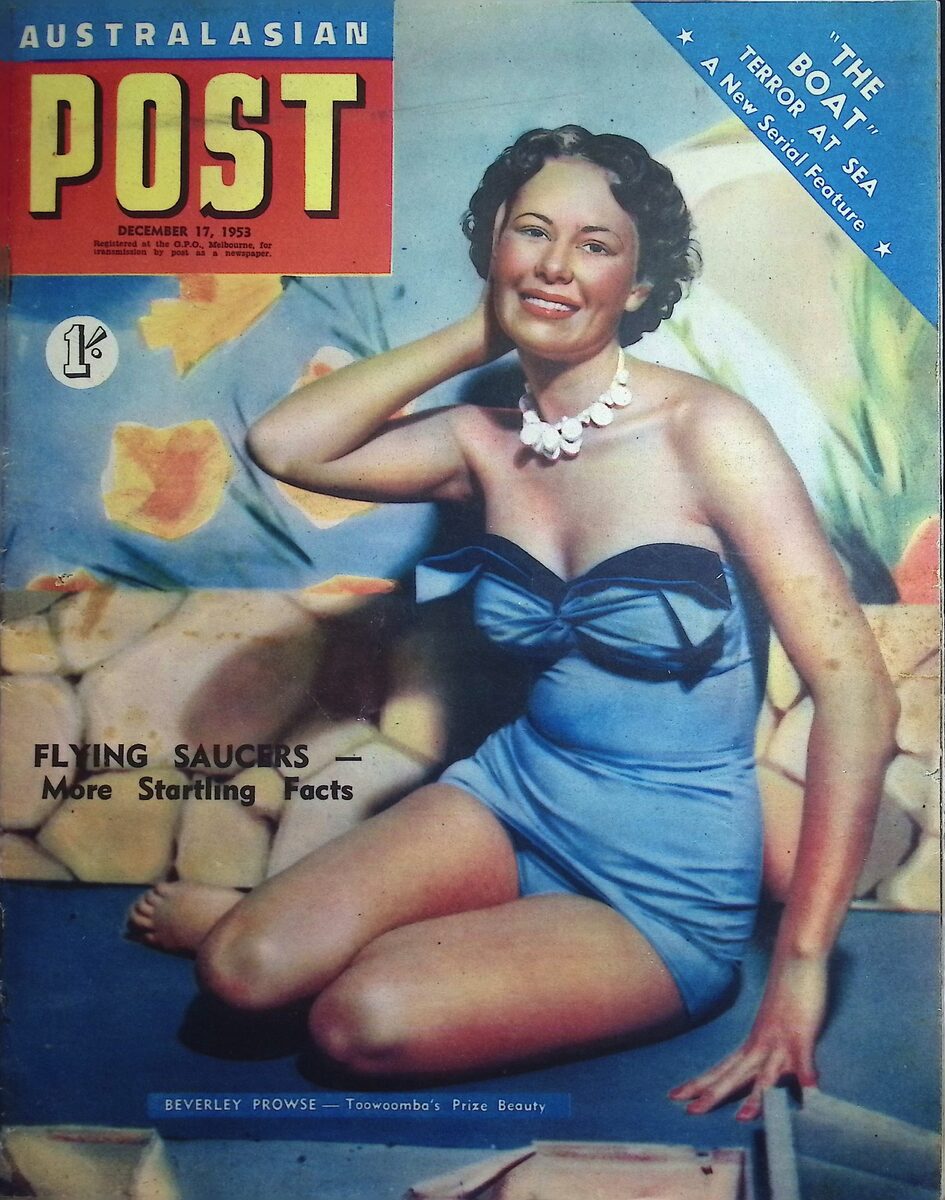
The Publication
The Australasian Post was a weekly illustrated magazine published in Melbourne from 1946 to 2002. A mass-market general interest title sold at newsagents across Australia and New Zealand, it mixed human-interest stories, celebrity features, sport, and serialised non-fiction with full-colour covers and period advertising. By the early 1950s it had a wide national readership and was one of the country’s best-known weeklies.
The December 17, 1953 issue, priced at one shilling, carried Part Five of a multi-part serialisation of George Adamski’s Flying Saucers Have Landed, published under the running title “The Venusian Speaks.” It sat alongside the cover story on Beverley Prowse (“Toowoomba’s Prize Beauty”), a new serial called The Boat, and a spread of the kind of advertisements, sherry, pens, asthma remedies, radio programmes, that defined Australian print media of the era.
Adamski and Flying Saucers Have Landed
George Adamski was a Polish-born American who ran a small café near the Palomar Observatory in California. In 1953, he and Irish author Desmond Leslie co-published Flying Saucers Have Landed through the London firm Werner Laurie. The book became an international bestseller and established the “contactee” genre, first-person accounts of friendly meetings with extraterrestrial beings, that would define one strand of UFO culture for decades.
Adamski’s central claim was that on November 20, 1952, he had driven into the California desert near Desert Center with six companions and encountered a being he described as a visitor from Venus. He said the being communicated through gestures and telepathy, warning of the dangers of nuclear weapons. The encounter formed the climax of the book and the core of the Australasian Post serialisation.
“The Venusian Speaks”, Part Five
The serialisation ran across several pages of the issue, beginning on page 12 and continuing through pages 32 to 35. It carried the dramatic header “The Venusian Speaks” and a subheading describing Adamski driving to a remote Californian mountain spot with six witnesses in hope of contacting a flying saucer.
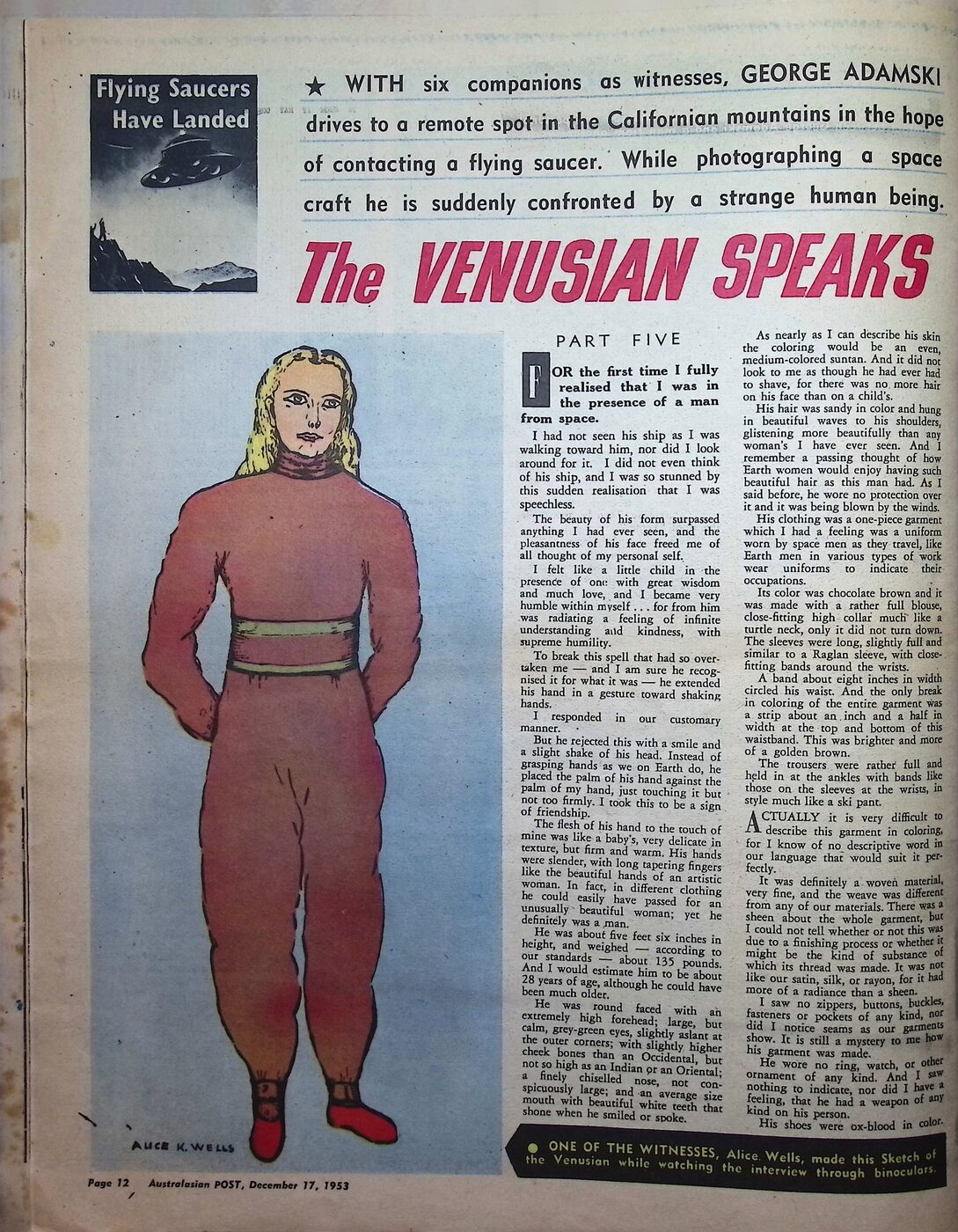
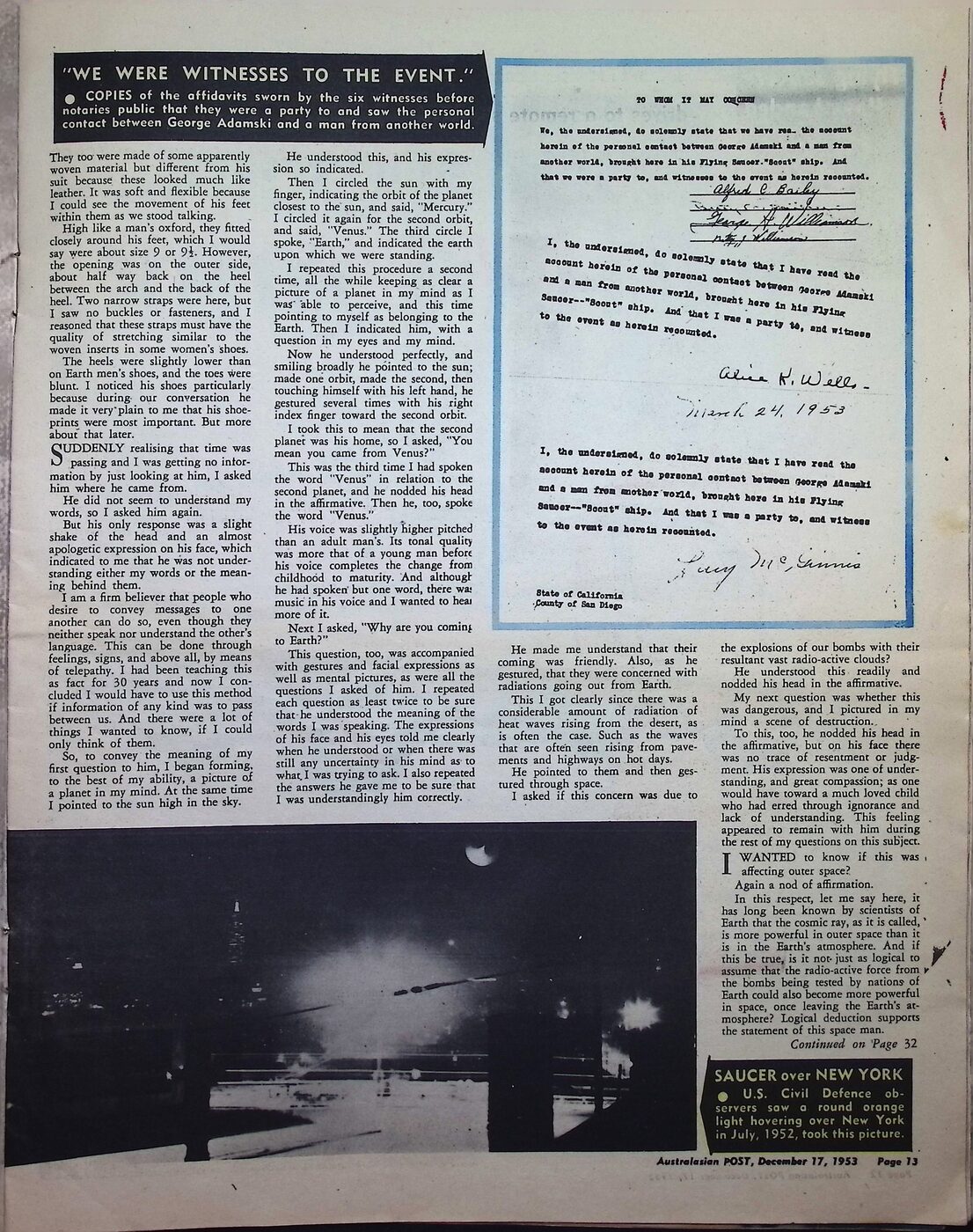
The most striking visual element is a full-colour illustration by Alice K. Wells, one of Adamski’s six companions and the owner of the Palomar Gardens café. It depicts a figure in a chocolate-brown or reddish jumpsuit with shoulder-length hair, standing against a desert landscape. This illustration became one of the most widely reproduced images of the early contactee era. The facing page carries a photograph captioned “Saucer over New York”, attributed to a U.S. Civil Defense sergeant who reportedly photographed a round object hovering over the city in July 1952.
The Witness Affidavits
Page 13 of the issue reproduces what the magazine presented as sworn affidavits from Adamski’s six companions, under the header “We Were Witnesses to the Event.” The witnesses included Alice K. Wells, George Hunt Williamson, Alfred C. Bailey, Betty Bailey, Lucy McGinnis, and Karl L. Hunrath (listed as signatories in the original text). Each affirmed seeing Adamski walk toward a figure in the desert and observing what they described as a craft in the vicinity.
These affidavits were central to Adamski’s credibility strategy. Rather than offering physical evidence, the book relied on the collective testimony of named, photographed witnesses willing to swear statements. The Australasian Post reproduced the affidavit text and signatures as a key part of the serialisation.
The Continuation Pages
The serialisation continued across several further pages, weaving between columns of period advertising. The later sections carried headers including “Flying Saucers Have Landed” and “Hovering in front of me was a Scout Ship”, describing Adamski’s account of seeing the craft itself. A companion piece titled “have landed many times before” extended the narrative across the issue’s back pages, sandwiched between ads for the Hotel Oxford, a tyre removal product, and the Club Celebrity dance venue.
The layout is characteristic of Australian magazine publishing of the period: serialised non-fiction broken into short columns, running around large display advertisements, with small editorial cartoons and illustrations filling the gaps. For a reader picking up the issue at a newsstand in Melbourne or Sydney, the flying saucer story was one item among many, nestled between a horoscope column and a radio programme listing.
Context: The Contactee Moment
By late 1953, George Adamski was arguably the most famous UFO figure in the world. Flying Saucers Have Landed had been published in London that September and was already selling strongly in the United States, Britain, and the Commonwealth. The Australasian Post serialisation placed his account directly in front of a mainstream Australian audience at the height of its cultural impact.
Adamski’s claims were controversial from the start. Other UFO researchers, including those at the civilian organisations emerging in the same period, were often deeply sceptical, viewing the contactee movement as damaging to serious investigation.
See also: Encyclopædia Britannica Confidential Report (1953) • Flying Saucer Review Issue #8 (1953) • AFSRS Newsletter (1968)
About the Source
Title: Australasian Post
Date: December 17, 1953
Publisher: Sun News-Pictorial, Melbourne, Australia
Price: 1/- (one shilling)
Feature: “The Venusian Speaks”, Part Five of the Flying Saucers Have Landed serialisation by George Adamski
Pages: 12-13, 32-35
Cover: Beverley Prowse, “Toowoomba’s Prize Beauty”
Archive: NHI Held Archive
The Australasian Post (1946-2002) was a general-interest weekly published in Melbourne. The serialisation of Flying Saucers Have Landed ran across multiple issues in late 1953, coinciding with the book’s international release by Werner Laurie (London).