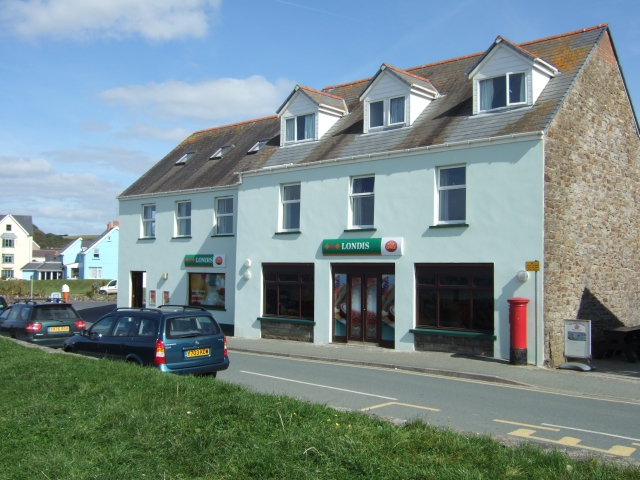
Image: David Smith / Wikimedia Commons · CC BY-SA 2.0
The Broad Haven Triangle
A coastal strip of Pembrokeshire less than ten miles across became the site of the most densely witnessed UFO wave in British history. Over nine months, from February through October 1977, dozens of independent witnesses reported structured craft and humanoid entities across an area centred on the village of Broad Haven. The wave was documented in real time by local journalist Hugh Turnbull, investigated by the Dyfed-Powys Police, and later systematically researched by Randall Jones Pugh, whose 1979 book "The Dyfed Enigma" remains the principal documentary record of the wave. The MOD opened a file. It produced no public conclusions.
The children came back a second time still claiming the object was there. That changed my assessment.Headmaster Ralph Llewellyn, on why he ran the drawing exercise, 1977
The Children's Drawings
4 February 1977: the methodological centrepiece of the case.
Fourteen pupils at Broad Haven Primary School came in from lunch break in a state of agitation. They said a silver, cigar-shaped craft had landed or was hovering in the field adjacent to the playground. A single figure in a silver suit was near the craft. Headmaster Ralph Llewellyn was sceptical. He initially dismissed them and sent them out to look again. They came back saying it was still there.
Llewellyn then did something for which he deserves recognition: he removed each child individually, gave them paper, and asked them to draw what they had seen without discussing it with the others. The drawings show a consistent oval or cigar shape with a dome and protruding leg or fin. The children had not coordinated their accounts. Llewellyn had not orchestrated the drawings to match. This process is the reason the Broad Haven case has methodological weight. It mirrors, seventeen years before the fact, the independent-witness drawing protocol that would make the 1994 Ariel School encounter in Zimbabwe equally compelling.
The Broad Haven drawing protocol and the Ariel School drawing protocol are the two strongest examples of independent-witness visual documentation in UFO case history. Both involved school settings, children separated before giving accounts, and consistent drawings of craft and entities. The archive holds both as exhibition-level cases.
The Haven Fort Hotel
Rosa Granville: the third data point in the cluster.
Rosa Granville owned and operated the Haven Fort Hotel at Little Haven, approximately one mile from the school. In March 1977, she reported seeing a large dome-shaped object land in a field beside her hotel late at night. Two tall humanoid figures in silver suits emerged and moved around the craft before it departed. She described the figures as between seven and eight feet tall. Granville was a civilian adult witness with no prior interest in UFOs. Her report came independently of the school incident and is geographically distinct from the Ripperston Farm events, making her account a key third location in the cluster.
Ripperston Farm
The Coombs family and the most sustained sequence of incidents in the wave.
Ripperston Farm sat near Stack Rocks, a coastal promontory approximately five miles from Broad Haven used by the MOD as a firing range. From March through October 1977, Billie and Pauline Coombs reported a sustained series of incidents. Cattle were disturbed nightly. Their car engine cut out repeatedly on the same stretch of road near Stack Rocks. A large figure was seen standing at the farmhouse window at night by multiple family members on separate occasions. The figure was described as silver-suited, over seven feet tall. Electrical equipment in the farmhouse malfunctioned repeatedly.
Pauline Coombs gave her account to both Randall Jones Pugh and later to Clive Harold, whose book "The Uninvited" focuses on the family. Her testimony is notable for its detail and for corroboration from other family members who witnessed some incidents independently.
The density of independent accounts from unconnected witnesses across a small geographic area over nine months was, in his assessment, without equivalent in the British record.Randall Jones Pugh, "The Dyfed Enigma," 1979
The Investigation
A local vet, a police force, and the MOD.
Randall Jones Pugh was a veterinary surgeon in Pembrokeshire and a BUFORA (British UFO Research Association) investigator. He began systematic fieldwork in mid-1977, interviewing witnesses separately, collecting drawings, and correlating incident dates. His methodology, separating witnesses before interviews and cross-checking accounts, mirrored what Llewellyn had done independently with the children. He was later joined by researcher F.W. Holiday. Together they published "The Dyfed Enigma" in 1979, documenting over 50 independent incidents.
Hugh Turnbull, reporter for the Western Telegraph in Haverfordwest, covered the wave as it unfolded. His reporting gave the story regional credibility and fed into national press coverage. Eight newspaper clippings from February and March 1977 survive in the archive, from the Western Mail and North Wales Weekly News, with three further from 1978.
The Dyfed-Powys Police submitted incident reports to the MOD. Released under Freedom of Information decades later, the MOD files confirm receipt of the police reports. They note the incidents were not explained. No evidence of active investigation beyond initial receipt has been found.
Eleven Welsh newspaper clippings from 1977 to 1978 are preserved in the archive's Wales clipping collection, viewable at the Welsh Newspaper Clipping Viewer. Newsletter coverage spans MUFON (1987, 2012), APRO Bulletin (1983), and Afrinews (book reviews for all three Broad Haven books). The UK government records are covered in the UK Reading Room, which includes the DEFE-24 collection covering 1967 to 1997. See also UK sightings and the Rendlesham Forest exhibition.
Investigation Timeline
Nine months of incidents across a ten-mile stretch of Pembrokeshire coast.
The Stack Rocks Military Range
The case's most cited and most resistant explanatory framework.
Approximately five miles from Ripperston Farm, on the Pembrokeshire coast, sat the Stack Rocks firing range operated by the Ministry of Defence. The proximity of the range to the wave's incident cluster has been the single most-cited sceptical framework for the case. Military exercises produce aerial activity, blast effects, and electromagnetic interference. Cattle disturbances can be attributed to artillery fire. Car electrical failures can be attributed to range communications equipment.
The sceptical framework has held up only partially. The MOD released the Stack Rocks range schedule for 1977 under Freedom of Information in the 2000s. The wave's most intense incident periods, including the Coombs family's October cluster and the school sighting of 4 February, did not coincide with active range exercises. The range was largely dormant through the worst of the wave period. The military activity explanation can account for some incidents in the broader Pembrokeshire reporting record but does not account for the specific dates and locations that Pugh and Holiday documented in "The Dyfed Enigma."
The other widely cited sceptical framework, hypnotic suggestion or peer pressure among the schoolchildren, was the framework that Ralph Llewellyn's separated-drawing methodology specifically defeated. The children produced their drawings before any teacher had had a chance to direct them and before they had had a chance to discuss their experience with one another. The drawings agreed in detail that could not have been produced by group suggestion alone.
Seventeen years after Broad Haven, in September 1994, 62 children at the Ariel School in Ruwa, Zimbabwe, reported witnessing a craft and small entities in the field beside their playground. The investigating researcher, Cynthia Hind, applied a methodology nearly identical to Llewellyn's: separating the children before they drew, asking each for an independent account, cross-checking the drawings for consistency. Hind had reviewed "The Welsh Triangle" in Afrinews and was aware of the Broad Haven methodology. The Ariel and Broad Haven cases together form the strongest pair of independent-witness school-setting UFO records in the literature.
Video & Documentary
Selected video coverage from the NHI Archive YouTube channel.
Fourteen Drawings: The Broad Haven School Sighting
Ripperston Farm: The Coombs Family
The Dyfed Enigma in Context
Key People
The witnesses, investigators, and authors who documented the wave.
Newsletter Coverage
How the civilian research community in Britain and abroad covered the Broad Haven school encounters.
The Broad Haven exhibition has no case-side photographs yet. Worth filing under src/images/cases/broad-haven/:
- Broad Haven Primary School children's drawings (the 14 February 1977 sketches by the schoolchildren)
- Broad Haven beach and Stack Rocks reference photograph
- Randall Jones Pugh portrait (BUFORA investigator who took the children's statements)
- Ralph Noyes portrait (former MOD official who wrote A Secret Property)
- Front page of the Western Telegraph local newspaper coverage