Marie Curie
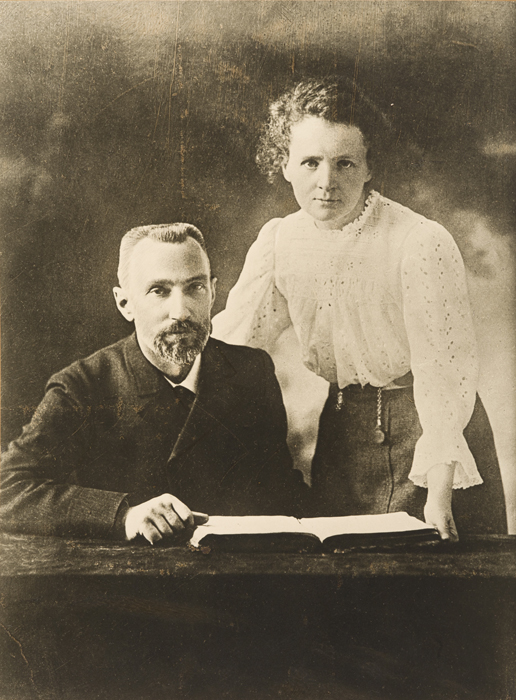
Marie Skłodowska Curie won the Physics Nobel in 1903 with Pierre and Becquerel, and the Chemistry Nobel in 1911 on her own. She was the first woman to hold a Sorbonne chair and the first person of either sex to win Nobels in two different sciences. The Paladino sittings at Richet's house in spring 1905 had both Curies in the room, along with Henri Bergson, Pierre Janet and Édouard Branly. Pierre died in the street the next April. Marie kept the chair, kept the research, founded the Paris Radium Institute in 1914, and ran the petites Curies (the mobile X-ray ambulances) at the Western Front through the First World War. Aplastic anaemia from the radium killed her at the Sancellemoz Sanatorium in the Haute-Savoie in July 1934. Her laboratory notebooks are still radioactive and stored in lead-lined boxes at the Bibliothèque Nationale de France. Her ashes were transferred to the Panthéon in April 1995, the first woman interred there in her own right.
A Life
Maria Salomea Skłodowska was born on 7 November 1867 at 16 Freta Street in the old town of Warsaw, then under the Russian partition of the third Polish division of 1795. She was the youngest of the five children of Władysław Skłodowski, a Warsaw mathematics and physics teacher who lost his teaching post under the Russification policies of the 1860s, and Bronisława Boguska, a teacher who died of tuberculosis when Marie was ten. The Skłodowski household was Polish-patriotic and intensely educated; Marie took the gold medal from the Warsaw Russian gymnasium at sixteen in June 1883 but was barred from Polish university education on grounds of sex.
She spent the next eight years in Warsaw as a governess, supporting her sister Bronisława's medical studies in Paris under the substantial Skłodowski sister-pact: Marie would fund Bronisława through Paris, then Bronisława would in turn fund Marie. She arrived in Paris in November 1891 at twenty-four with eight years of self-teaching in physics and chemistry behind her, and enrolled at the Sorbonne the same month. She took the licence ès sciences mathématiques in 1893 (first in her class) and the licence ès sciences physiques in 1894 (second in her class).
She met Pierre Curie in spring 1894 through Józef Wierusz-Kowalski. They married at the Sceaux town hall on 26 July 1895 with no rings, no religious service, and no wedding gown. The marriage produced two daughters: Irène, born 12 September 1897, and Ève, born 6 December 1904. Irène would share the 1935 Nobel Chemistry with her husband Frédéric Joliot for artificial radioactivity; Ève would write the 1937 biography of her mother and would be the only Curie of the immediate family not to win a Nobel.
The radioactivity research opened with Becquerel's March 1896 observation of uranium-salt emissions. Marie took the question for her doctoral thesis from late 1897, choosing it on her assessment that the territory was unworked. She established by April 1898, working in the EPCI courtyard shed with the piezoelectric quartz balance her brother-in-law Jacques Curie had built, that the activity of pitchblende exceeded what its uranium content alone could account for and that the excess implied an undiscovered radioactive element. Pierre joined the work full-time from spring 1898. They announced polonium in July 1898 (named for Marie's occupied Polish homeland) and radium in December 1898. The Sorbonne awarded Marie her physics doctorate in June 1903 for the radium isolation work, the first PhD in physics from a French university to a woman.
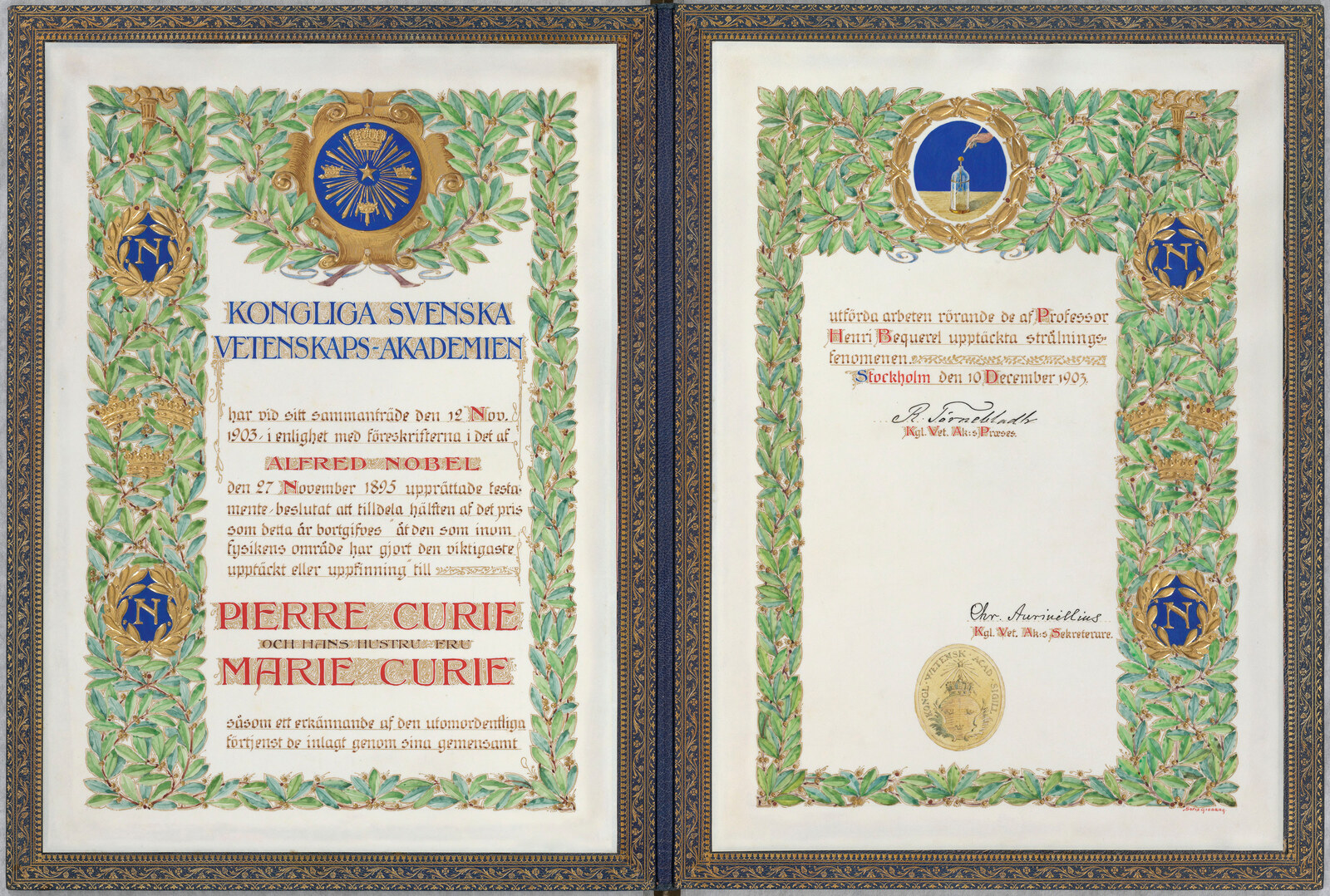
The 1903 Nobel was the joint award with Becquerel. The 1906 death of Pierre on the rue Dauphine left Marie a widow at thirty-eight with two daughters (Irène was eight, Ève was sixteen months old). The Sorbonne offered her Pierre's chair within weeks of his death; she accepted on 13 May 1906 and gave the inaugural lecture on 5 November 1906 (it picked up at the exact sentence Pierre had stopped at in his last lecture). She held the chair for the next twenty-eight years until her death.
The 1911 Nobel Prize in Chemistry was awarded to Marie alone "in recognition of her services to the advancement of chemistry by the discovery of the elements radium and polonium, by the isolation of radium and the study of the nature and compounds of this remarkable element." The award was made in the same month that the French press was running the Paul Langevin affair: Langevin, the physicist who had been a graduate student of Pierre Curie and was a married father of four, was alleged to have been in an extramarital relationship with Marie. The Swedish Nobel Committee debated whether to ask her to decline. She wrote in response: "The prize has been awarded for the discovery of radium and polonium. I believe there is no connection between my scientific work and the facts of private life." She travelled to Stockholm to receive the medal on 10 December 1911.
The Pasteur Institute founded the Radium Institute (the Institut du Radium) in 1914 with Marie as the first director. She held the directorship through to her death. The First World War interrupted the laboratory work; Marie organised approximately twenty mobile X-ray ambulances (the "petites Curies") that she equipped, drove herself, and ran at the front lines from October 1914 onwards, training approximately 150 nurses in X-ray operation across the 1914 to 1918 period. She delivered the substantive 1923 Pierre Curie biography of her husband. The 1930s saw her health decline from the cumulative radium exposure she had carried since 1898. She died of aplastic anaemia at the Sancellemoz Sanatorium in the French Alps on 4 July 1934, age sixty-six. Her ashes were transferred to the Panthéon in Paris on 20 April 1995 alongside Pierre's. She is the only woman interred there under her own name (rather than as the wife of an entombed husband). The laboratory notebooks she worked in across the 1898 to 1934 period remain radioactive at levels requiring lead shielding and are stored at the Bibliothèque Nationale de France in lead-lined boxes. Readers wishing to examine them sign a waiver.
Nothing in life is to be feared, it is only to be understood. Now is the time to understand more, so that we may fear less.Marie Curie, attributed in conversation, c. 1903
The 1905 Paris Paladino Sittings
The Paris sittings of spring 1905 brought Marie alongside Pierre into the Continental psychical-research investigation community. The series was organised by Charles Richet at his Paris house with Eusapia Paladino brought from Naples for the season. The attendance ran across Charles Richet, the Curies, Henri Bergson, Pierre Janet, Édouard Branly (the wireless-receiver pioneer who had been Pierre's EPCI colleague), and Camille Flammarion.
Marie's documented contribution to the Paris series runs through Pierre's correspondence with Georges Gouy (Marie did not write her own published account of the sittings) and through Charles Richet's Thirty Years of Psychical Research of 1923. The April 1906 Pierre Curie letter to Gouy that records "these phenomena really exist" was written about the joint experience Marie had shared with him. She did not return to the Paladino investigation after Pierre's death; her psychical-research engagement was the spring 1905 series with Pierre and was not resumed.
The Curies' attendance at the Paris 1905 Paladino sittings is documented in the Eusapia Paladino biography and the Pierre Curie biography. The Paris series is the closing major Continental Paladino investigation before the 1908-10 American sittings that ended her working career.
Photograph
Significance to the Archive
Marie Curie matters to this archive as the working scientific figure of the highest international standing who participated in the documented Paris 1905 Paladino sittings alongside her husband Pierre Curie and Charles Richet. Her presence at the sittings places the Nobel-winning physicist-chemist within the documented Continental psychical-research investigation community of the period, alongside the English SPR figures Myers and Lodge who had investigated Paladino at Île Roubaud in 1894 and at Cambridge in 1895.
The Curie name carries the scientific authority of two Nobel Prizes and the founding of radioactivity as a research field. Her attendance at the Paladino sittings is the documented engagement of a working scientific figure of the highest standing with the late-Victorian psychical-research investigation tradition the archive's pre-1947 reference layer documents.