Pierre Curie
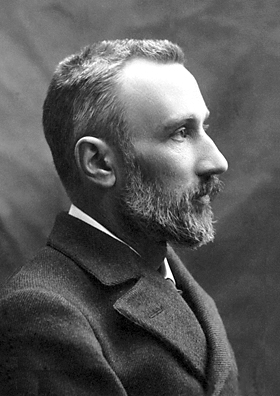
Pierre Curie discovered piezoelectricity with his brother Jacques in 1880. The 1903 Nobel Prize in Physics with Marie Curie and Henri Becquerel followed the radioactivity work. What is less remembered is that he spent the last eighteen months of his life taking the psychical-research question seriously. Eusapia Paladino sat at Charles Richet's Paris house in spring 1905 with both Curies among the investigators. Pierre wrote to Georges Gouy on 24 July 1905 that the phenomena were real and he wanted to do more sittings under stricter conditions. On 19 April 1906 a horse-drawn wagon ran him over in the rue Dauphine and killed him instantly, age forty-six. His Sorbonne chair was two years old.
A Life
Pierre Curie was born on 15 May 1859 at 16 rue Cuvier in the fifth arrondissement of Paris, the younger of the two sons of Eugène Curie, a Paris physician of Alsatian Protestant extraction who had served as a military surgeon in the 1848 Revolution and the 1871 Commune, and Sophie-Claire Depouilly. The household was strongly Republican and broadly anti-clerical in the Third Republic style. He was educated at home by his father and his elder brother Jacques rather than at a Paris lycée, and by sixteen had the equivalent baccalaureate. He took the Sorbonne licence ès sciences in 1877 at eighteen and stayed on at the Sorbonne as a laboratory assistant in the physics department under Paul Desains.
The piezoelectricity discovery of 1880 was the first working result. Pierre and Jacques Curie, working together in the Sorbonne mineralogy laboratory across 1879 and 1880, established that certain crystals (quartz, tourmaline, topaz, Rochelle salt) produce an electric polarisation when mechanically compressed along certain crystallographic axes. The Curie brothers published the first paper in the Comptes Rendus of the Académie des Sciences on 2 August 1880 and the second in March 1881 establishing the inverse effect (mechanical deformation under applied electric field). The piezoelectric quartz balance Pierre Curie built in 1881 became the principal laboratory instrument used a decade later by Marie Curie in measuring the radioactive currents of pitchblende.
Pierre Curie was appointed head of laboratory at the École Municipale de Physique et de Chimie Industrielles de la Ville de Paris (the EPCI, founded 1882) in October 1882 and held the post for the next twenty-two years through to 1904. The EPCI laboratory was the working laboratory of his entire career until his 1904 Sorbonne appointment. His Paris doctoral thesis of 1895 on the magnetic properties of bodies at various temperatures established what is now called the Curie temperature: the temperature above which a ferromagnetic material loses its permanent magnetisation.
He met Marie Skłodowska, then a twenty-six-year-old Polish-born physics student at the Sorbonne, in spring 1894 through the Polish physicist Józef Wierusz-Kowalski. They married at the Sceaux town hall on 26 July 1895 in a civil ceremony, with no rings, no religious service, and no wedding gown (Marie wore a dark blue working dress she could subsequently wear in the laboratory). The marriage produced two daughters: Irène Joliot-Curie, born 12 September 1897, who would share the 1935 Nobel Chemistry with her husband Frédéric Joliot for artificial radioactivity; and Ève Curie, born 6 December 1904, who would write the 1937 biography of her mother and would be the only Curie of the immediate family not to win a Nobel.
The discovery of radioactivity opened with Henri Becquerel's accidental observation on 1 March 1896 that uranium salts left on photographic plates in a dark drawer had exposed the plates without sunlight activation. Marie took up the question for her doctoral thesis from late 1897, joined by Pierre from February 1898 when the work began to outrun her own time. Across April to December 1898 they isolated two new elements from pitchblende residues supplied free of charge by the Austrian government from the Saint Joachimsthal uranium mines: polonium, announced in July 1898 and named for Marie's occupied Polish homeland; and radium, announced in December 1898. The pitchblende processing was carried out in an unheated wooden shed adjoining the EPCI courtyard. Marie's January 1903 Sorbonne doctoral defence on the radium isolation produced the first PhD awarded by a French university to a woman in physics.
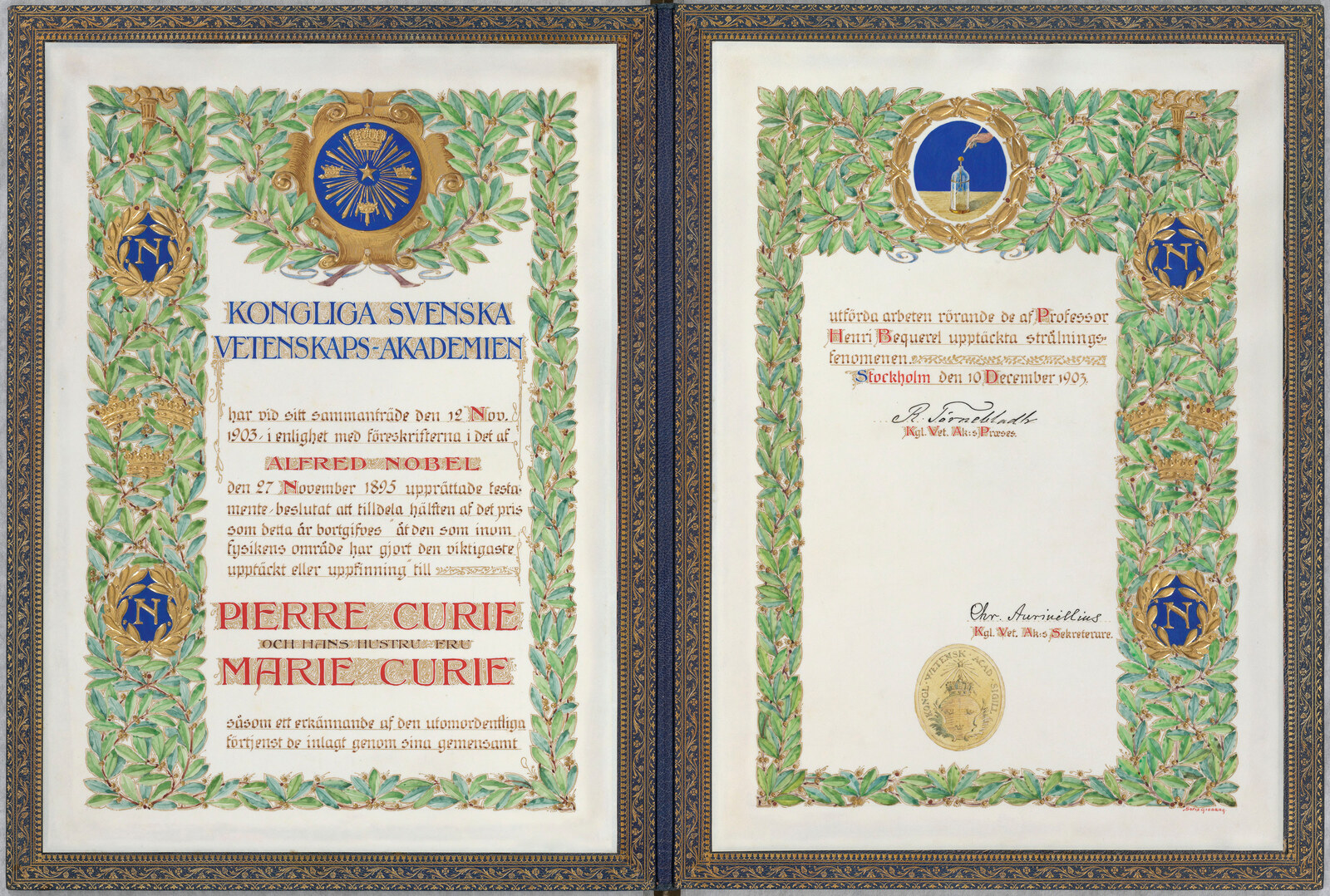
The 1903 Nobel Prize in Physics was awarded jointly to Henri Becquerel "for his discovery of spontaneous radioactivity" and to Pierre and Marie Curie "for their joint researches on the radiation phenomena discovered by Professor Henri Becquerel." Pierre received the Nobel medal at Stockholm on 6 June 1905 (the Curies declined to travel for the December 1903 ceremony, citing teaching duties and Marie's recovery from a difficult pregnancy with Ève). The Sorbonne appointed Pierre to a newly-created chair of physics in October 1904 and Marie to be his laboratory chief, the first paid post for a woman at the Sorbonne.
The 1905 Paladino sittings at Charles Richet's Paris house brought Pierre Curie into the late-Victorian psychical-research community in the closing eighteen months of his life. The sittings ran in spring 1905 with Pierre and Marie Curie, Richet (the future Nobel laureate in Physiology), the philosopher Henri Bergson, the psychologist Pierre Janet, the physicist Édouard Branly (the wireless-receiver pioneer), and other Paris scientific figures attending across the season. Pierre wrote his impressions in the letter of 24 July 1905 to his friend Georges Gouy of the Lyon physics laboratory. He died nine months later in a Paris street accident: on 19 April 1906 he stepped into the rue Dauphine, slipped on the rain-wet cobbles, and was killed instantly when his head was crushed under the wheel of a horse-drawn wagon. He was forty-six.
The result is that these phenomena really exist, and it is no longer possible for me to doubt them. It is improbable, it is unbelievable, but it is so.Pierre Curie, letter to Georges Gouy, 24 July 1905, on the spring 1905 Eusapia Paladino sittings at Charles Richet's Paris house
The 1905 Paladino Sittings
The Paris sittings of spring 1905 were the third major Continental investigation of the Italian materialisation medium Eusapia Paladino after the 1892 Milan Commission and the 1894 Île Roubaud sittings with Charles Richet, F. W. H. Myers, and Oliver Lodge. The Paris series was organised by Charles Richet at his own Paris house with Paladino brought from Naples for the run. The substantial attendance included the Curies, Richet, Henri Bergson, Pierre Janet, Édouard Branly, and the astronomer Camille Flammarion.
Pierre Curie attended approximately a dozen sittings across the season. His correspondence with Georges Gouy, the Lyon physicist who had been his Sorbonne contemporary and remained one of his closest scientific friends, carries the working record of his impressions. The 14 April 1906 letter, written five days before his death, set out the position he had reached: "We made a few more sessions with the medium Eusapia Palladino last winter. The result is that these phenomena really exist, and it is no longer possible for me to doubt them. It is improbable, it is unbelievable, but it is so." The earlier 24 July 1905 letter, written at the close of the spring season, had been more guarded; the April 1906 letter is the position he held at the time of his death.
The Paris sittings were not formally published by Richet in the SPR Proceedings in the form the earlier Île Roubaud and Cambridge sittings had been. Richet's 1923 Thirty Years of Psychical Research reproduces the working notes alongside the Curie correspondence as the published record. The Paris investigation is the last major Continental Paladino series before the 1908 Naples sittings with Hereward Carrington and the 1909-10 New York Columbia investigation that closed the case on the American side.
The Paris 1905 Paladino sittings are documented in the Eusapia Paladino biography. The Curies' attendance places Pierre and Marie in the documented late-Victorian psychical-research community alongside F. W. H. Myers, Oliver Lodge, and Richard Hodgson. The 1905 Paris series is the closing major Continental Paladino investigation before the 1908-10 sittings that ended Paladino's working career on the American side.
Photograph
Significance to the Archive
Pierre Curie matters to this archive for two specific reasons. First, the 24 July 1905 and 14 April 1906 letters to Georges Gouy on the Paladino sittings are the documented late-life Curie position on the late-Victorian psychical-research investigation he had taken seriously in the closing eighteen months of his life. The Curie name carries the scientific authority of the 1903 Nobel Prize, the discoveries of polonium and radium, and the founding of radioactivity as a field; the 1906 letter is the documented position a major working physicist of the period had reached on the Paladino case.
Second, the Paris 1905 sittings place Pierre and Marie Curie alongside Myers, Lodge, Hodgson, Richet, Bergson, Janet, and Flammarion in the late-Victorian and Edwardian psychical-research investigation community the archive's pre-1947 reference layer documents. The Paris series is one of the documented Continental counterparts to the English SPR investigation tradition that ran through the Cambridge Commission, the Île Roubaud sittings, and the eighteen-year Hodgson-Piper investigation at Boston.